Amvuttra
Italy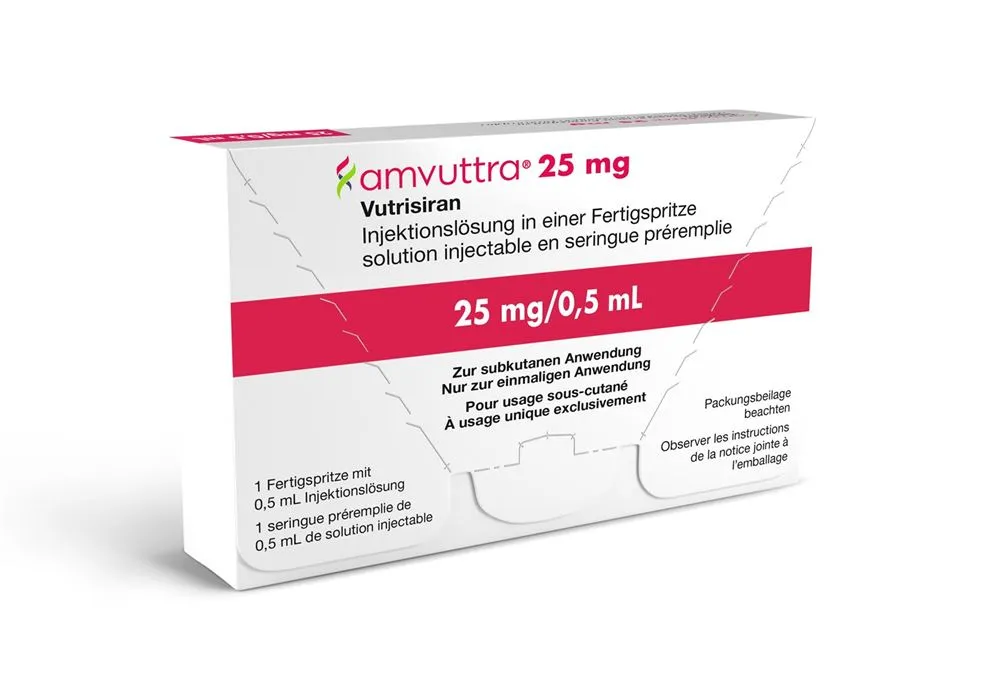
Table of Contents
Patient Information Leaflet
Amvuttra 25 mg solution for injection in pre-filled syringe
vutrisiran
This medicinal product is subject to additional monitoring. This will allow for rapid identification of new safety information. You can help by reporting any side effects you experience while taking this medicine. See the end of section 4 for information on how to report side effects.
Please read this leaflet carefully before using this medicine as it contains important information for you.
- Keep this leaflet. You may need to read it again.
- If you have any questions, ask your doctor, pharmacist, or nurse.
- This medicine has been prescribed for you only. Do not give it to others, even if they have the same symptoms as you, because it may be harmful.
- If you experience any side effects, including those not listed in this leaflet, contact your doctor, pharmacist, or nurse. See section 4.
Contents of this leaflet
- What Amvuttra is and what it is used for
- What you need to know before using Amvuttra
- How to use Amvuttra
- Possible side effects
- How to store Amvuttra
- Contents of the pack and other information
1. What Amvuttra is and what it is used for
The active substance in Amvuttra is vutrisiran.
What Amvuttra is used for
Amvuttra is a medicine used to treat a disease called "ATTR amyloidosis", a condition that can be inherited from one generation to the next and may also be caused by aging. ATTR amyloidosis is caused by problems with a protein present in the body, known as "transthyretin" (TTR). This protein is mainly produced in the liver and transports vitamin A and other substances throughout the body.
In people affected by this disease, small fibers of the TTR protein clump together forming deposits known as "amyloid". Amyloid can accumulate around or within nerves, in the heart, and in other parts of the body, interfering with their normal function. This leads to the symptoms characteristic of the disease.
How Amvuttra works
Amvuttra works by reducing the amount of TTR protein produced by the liver, thereby decreasing the amount of TTR protein in the blood available to form amyloid. This may help reduce the effects of this disease.
Amvuttr is used only in adults.
2. What you should know before using Amvuttra
Do not use Amvuttra
- if you have previously had a serious allergic reaction to vutrisiran or to any of the other ingredients of this medicine (listed in section 6).
If you are unsure, consult your doctor, pharmacist, or nurse before using this medicine.
Warnings and precautions
Low levels of vitamin A in the blood and vitamin supplements
Amvuttra reduces the amount of vitamin A in the blood.
Your doctor will instruct you to take a daily vitamin A supplement. Follow the dose of vitamin A recommended by your doctor.
Signs of vitamin A deficiency may include: vision problems, especially at night, dry eyes, blurred or hazy vision.
- If you notice changes in vision or other eye problems while using Amvuttra, consult your doctor. If necessary, your doctor may refer you to an ophthalmologist for an examination.
Both excessively high and low levels of vitamin A can harm fetal development. Therefore, women of childbearing age must exclude pregnancy before starting treatment with Amvuttra and must use effective contraceptive methods (see section “Pregnancy, breastfeeding and contraception” below).
- Vitamin A levels may remain low for more than 12 months after the last dose of Amvuttra.
- Inform your doctor if you are planning a pregnancy. Your doctor will instruct you to stop taking Amvuttra and vitamin A supplementation. Your doctor will also ensure that your vitamin A levels have returned to normal before attempting conception.
- Inform your doctor if you become pregnant unexpectedly. Your doctor will instruct you to stop taking Amvuttra. During the first 3 months of pregnancy, your doctor may advise you to stop vitamin A supplementation. During the last 6 months of pregnancy, your doctor may advise you to resume vitamin A supplementation if your vitamin A levels have not yet returned to normal, due to an increased risk of vitamin A deficiency in the last 3 months of pregnancy.
Children and adolescents
Amvuttra is not recommended for children and adolescents under 18 years of age.
Other medicines and Amvuttra
Inform your doctor, pharmacist, or nurse if you are taking, have recently taken, or might take any other medicines.
Pregnancy, breastfeeding and contraception
If you are pregnant, think you may be pregnant, are planning to become pregnant, or are breastfeeding, consult your doctor or pharmacist before taking this medicine.
Pregnancy
You must not take Amvuttra if you are pregnant.
Women of childbearing potential
Amvuttra will reduce vitamin A levels in the blood, and vitamin A is important for normal fetal development (see above “Warnings and precautions”).
- If you are a woman of childbearing potential, you must use an effective method of contraception during treatment with Amvuttra.
- Discuss appropriate contraceptive methods with your doctor or nurse.
- Pregnancy must be excluded before starting treatment with Amvuttra.
- Inform your doctor if you are planning a pregnancy or if you become pregnant unexpectedly. Your doctor will instruct you to stop taking Amvuttra.
Breastfeeding
It is not known whether vutrisiran is excreted in human milk. Your doctor will weigh the potential benefits of treatment for you against the risks to the newborn infant.
Driving and using machines
It is unlikely that Amvuttra will affect your ability to drive or operate machinery. Your doctor will advise you whether your condition allows you to drive and use machinery safely.
Amvuttra contains sodium
This medicine contains less than 1 mmol (23 mg) of sodium per mL, i.e., essentially ‘sodium-free’.
3. How to use Amvuttra
Amvuttra may be self-administered or administered by a caregiver or healthcare professional.
Your doctor or healthcare professional will show you and/or your caregiver how to prepare and inject a dose of Amvuttra before you administer it yourself.
For instructions on how to use Amvuttra, read the “Instructions for use” at the end of this leaflet.
What dose of Amvuttra to use
The recommended dose is 25 mg once every 3 months.
Where the injection is given
Amvuttra is given by injection under the skin (“subcutaneous injection”) in the abdominal area (stomach), upper arm (if someone else administers the injection), or thigh.
How long to use Amvuttra
Your doctor will tell you how long you should use Amvuttra. Do not stop treatment with Amvuttra unless instructed by your doctor.
If you use more Amvuttra than you should
In the unlikely event that you use too much (an overdose), contact your doctor or pharmacist, even if you do not have any symptoms. Your doctor will monitor you for the possible development of adverse effects.
If you forget to use Amvuttra
If a dose is missed, administer Amvuttra as soon as possible. Then resume dosing every 3 months, starting from the date of the most recently administered dose.
If you have any doubts about how to use this medicine, consult your doctor, pharmacist, or nurse.
4. Possible side effects
Like all medicines, this medicine can cause side effects, although not everyone gets them.
Inform your doctor, pharmacist or nurse if you notice any of the following side effects:
Common: may affect up to 1 in 10 people
- redness, pain, itching, bruising or warmth at the site of injection
- blood tests showing increased liver enzymes called alkaline phosphatase and alanine aminotransferase
Reporting of side effects
If you experience any side effect, including those not listed in this leaflet, talk to your doctor, pharmacist or nurse. You can also report side effects directly through the national reporting system listed in Annex V. By reporting side effects, you can help provide more information on the safety of this medicine.
5. How to store Amvuttra
Keep this medicine out of the sight and reach of children.
Do not use this medicine after the expiry date stated on the label, on the tray lid, and on the carton after "Exp.". The expiry date refers to the last day of that month.
Do not store above 30°C.
Do not freeze.
Do not dispose of any medicine via wastewater or household waste. Ask your pharmacist how to dispose of medicines you no longer use. This will help protect the environment.
6. Package contents and other information
What Amvuttra contains
- The active substance is vutrisiran. Each pre-filled syringe contains sodium vutrisiran equivalent to 25 mg of vutrisiran in 0.5 mL of solution.
- The other components are: disodium hydrogen phosphate dihydrate, disodium phosphate dihydrate, sodium chloride, and water for injections. Sodium hydroxide and phosphoric acid may be used to adjust the pH (see “Amvuttra contains sodium” in section 2).
Description of the appearance of Amvuttra and contents of the pack
This medicine is a clear, colourless to yellow injectable solution. Each
pack contains one single-dose pre-filled syringe.
Marketing Authorisation Holder and Manufacturer
Alnylam Netherlands B.V.
Antonio Vivaldistraat 150
1083 HP Amsterdam
The Netherlands
For further information about this medicine, contact the local representative of the Marketing Authorisation Holder:
België/Belgique/Belgien Luxembourg/Luxemburg
Alnylam Netherlands B.V. Alnylam Netherlands B.V.
Tél/Tel: 0800 81 443 (+32 234 208 71) Tél/Tel: 80085235 (+352 203 014 48)
[email protected] [email protected]
България Lietuva
Genesis Pharma Bulgaria EOOD Medison Pharma Lithuania UAB
Teл.: +359 2 969 3227 Tel: +370 37 213824
[email protected] [email protected]
Česká republika Magyarország
Medison Pharma s.r.o. Medison Pharma Hungary Kft
Tel: +420 221 343 336 Tel.: +36 1 293 0955
mailto: [email protected] [email protected]
Danmark Malta
Alnylam Sweden AB Genesis Pharma (Cyprus) Ltd
Tlf.: 433 105 15 (+45 787 453 01) Tel: +357 22765715
[email protected] [email protected]
Deutschland Nederland
Alnylam Germany GmbH Alnylam Netherlands B.V.
Tel: 0800 2569526 (+49 89 20190112) Tel: 0800 282 0025 (+31 20 369 7861)
[email protected] [email protected]
Eesti Norge
Medison Pharma Estonia OÜ Alnylam Sweden AB
Tel: +372 679 5085 Tlf: 800 544 00 (+472 1405 657)
[email protected] [email protected]
Ελλάδα Österreich
ΓΕΝΕΣΙΣ ΦΑΡΜΑ Α.Ε Alnylam Austria GmbH
Τηλ: +30 210 87 71 500 Tel: 0800 070 339 (+43 720 778 072)
[email protected] [email protected]
España Polska
Alnylam Pharmaceuticals Spain SL Medison Pharma Sp. z o.o.
Tel: 900810212 (+34 910603753) Tel.: +48 22 152 49 42
[email protected] [email protected]
France Portugal
Alnylam France SAS Alnylam Portugal
Tél: 0805 542 656 (+33 187650921) Tel: 707201512 (+351 21 269 8539)
[email protected] [email protected]
Hrvatska România
Genesis Pharma Adriatic d.o.o Genesis Biopharma Romania SRL
Tel: +385 1 5530 011 Tel: +40 21 403 4074
[email protected] [email protected]
Ireland Slovenija
Alnylam Netherlands B.V. Genesis Biopharma SL d.o.o
Tel: 1800 924260 (+353 818 882213) Tel: +386 1 292 70 90
[email protected] [email protected]
Ísland Slovenská republika
Alnylam Netherlands B.V. Medison Pharma s.r.o.
Sími: +31 20 369 7861 Tel: +421 2 201 109 65
[email protected] [email protected]
Italia Suomi/Finland
Alnylam Italy S.r.l. Alnylam Sweden AB
Tel: 800 90 25 37 (+39 02 89 73 22 91) Puh/Tel: 0800 417 452 (+358 942 727 020)
[email protected] [email protected]
Κύπρος Sverige
Genesis Pharma (Cyprus) Ltd Alnylam Sweden AB
Τηλ: +357 22765715 Tel: 020109162 (+46 842002641)
[email protected] [email protected]
Latvija
Medison Pharma Latvia SIA
Tel: +371 67 717 847
[email protected]
Other sources of information
More detailed information about this medicine is available on the website of the European Medicines Agency, https://www.ema.europa.eu .
PATIENT INSTRUCTIONS FOR USE
Amvuttra 25 mg solution for injection in pre-filled syringe
vutrisiran
Single-dose pre-filled syringe with needle protection device
Read these instructions before using the pre-filled syringe.
Information about the pre-filled syringe
The pre-filled syringe (referred to as “syringe”) is for single use only and must be discarded after use.
Route and method of administration
Each pack contains one single-use syringe of Amvuttra. Each Amvuttra syringe contains 25 mg
of vutrisiran to be injected under the skin (subcutaneous injection) once every 3 months.
Your doctor or healthcare provider will show you and/or your caregiver how to prepare
and inject a dose of Amvuttra before you self-administer the injection. If needed, contact your healthcare provider or doctor for further instructions and assistance.
Keep these instructions until the syringe is used up.
How to store Amvuttra
Do not store above 30°C.
Do not freeze.
Keep this medicine out of the sight and reach of children.
Important warnings
Do not use if the packaging is damaged or shows signs of tampering.
Do not use the syringe if it has fallen on a hard surface.
Do not touch the plunger until it is time to administer the injection.
Do not remove the needle cap until the time of injection.
Never recap the syringe.
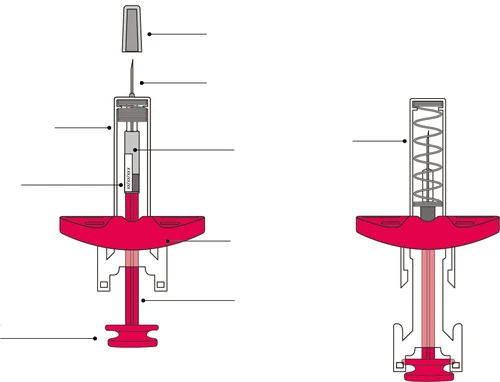
Appearance of the syringe before and after use:
Before use After use
Step 1: Gather materials
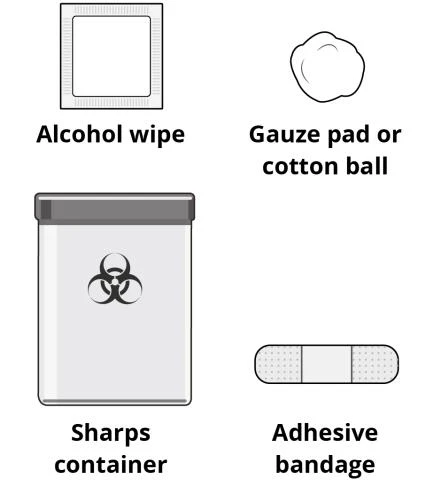
Gather the following supplies (not provided) and
place them on a clean, flat surface:
- Alcohol wipe
- Gauze or cotton ball
- Adhesive bandage
- Sharps disposal container
Step 2: Prepare the syringe
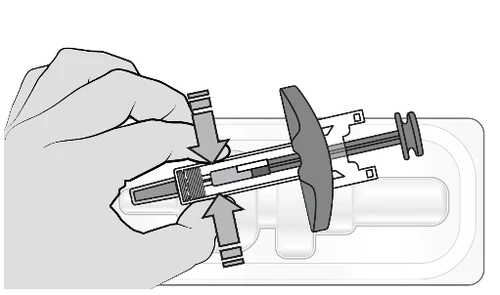
If stored in the refrigerator, allow the
syringe to reach room temperature for
at least 30 minutes before use.
Do not heat the syringe in any other way,
for example, with a microwave, warm
water, or near other heat sources.
Remove the syringe from its packaging by
holding the barrel of the syringe.
Do not touch the plunger until it is time
to administer the injection.
Do not use the syringe if it has fallen on a
hard surface.
Do not remove the needle cap until the
time of injection.
Step 3: Inspect the syringe
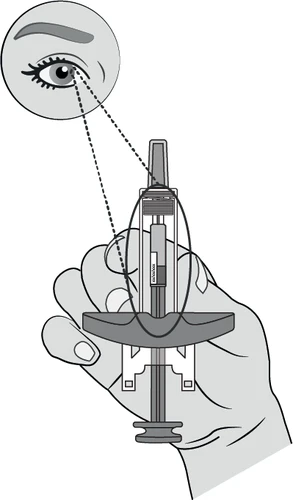
Check the following:
✓ The syringe must not show any damage,
such as cracks or leaks.
✓ The needle cap must be intact and
attached to the syringe.
✓ The medicinal solution inside the
syringe must be clear, colourless to
yellow.
✓ The label on the syringe must state
“Amvuttra 25 mg”.
✓ The expiry date on the syringe label.
It is normal to see air bubbles inside
the syringe.
Do not use the syringe if any problems are observed during inspection of the syringe or the medicinal solution.
Do not use after the expiry date.
Do not use if the solution contains particles or appears cloudy or discoloured.
Contact your healthcare provider if you observe any problems.
Step 4: Choose the injection site
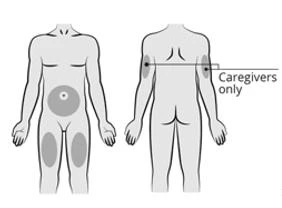
Choose an injection site from the following
areas:
- Abdomen, except for the area within 5 cm around the navel.
- Front of the thighs.
- If the injection is administered by someone else, the upper back of the arm may also be used.
Do not inject into areas of skin that are tender,
red, swollen, bruised, or hardened, or within 5 cm of the navel.
Step 5: Prepare for injection
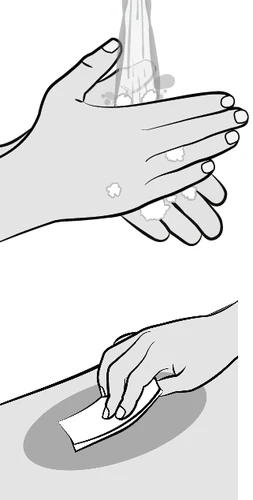
Wash your hands with soap and water and dry them
thoroughly with a clean towel.
Clean the chosen injection site with an
alcohol wipe.
Allow the skin to air dry before administering the injection. Avoid touching or blowing on the injection site after cleaning.
Step 6: Remove the needle cap
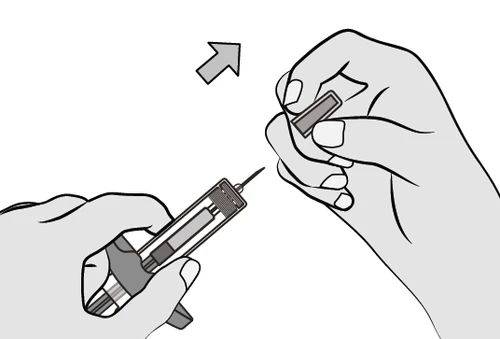
Hold the syringe barrel with one hand.
With the other hand, pull off the needle cap and discard it immediately.
It is normal to see a drop of liquid at the tip of the needle.
Do not touch the needle or allow it to come into contact with any surface.
Do not recap the syringe.
Do not pull the plunger.
Do not use the syringe if it has fallen on a hard surface.
Step 7: Insert the needle
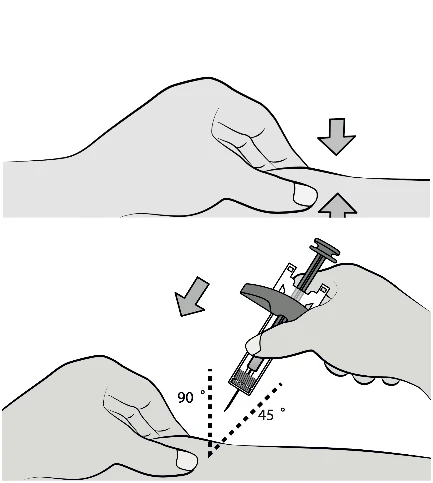
With your free hand, gently pinch the cleaned skin around the injection site to create a skin fold for the injection.
Insert the needle fully into the pinched skin at an angle of 45–90 degrees.
Step 8: Inject the medicine
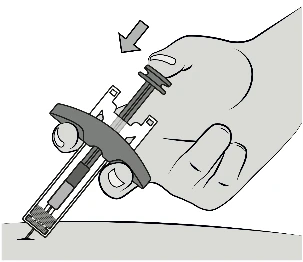
Using the thumb pad, press the plunger while holding the finger flange.
Press the plunger completely to the end of its travel to inject all of the medicinal solution.
The plunger must be pressed
completely to deliver the full dose.
Step 9: Release the plunger
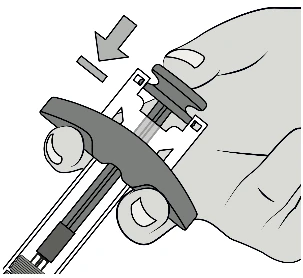
Release the plunger to allow the needle safety device to cover the needle.
Remove the syringe from the skin.
Do not block the movement of the plunger.
Do not pull down the needle safety device. The safety device automatically covers the needle.
Step 10: Check the injection site
A small amount of blood or liquid may be present at the injection site.
If so, apply pressure to the injection site with a gauze or cotton ball until any bleeding stops.
Avoid rubbing the injection site.
Step 11: Dispose of the syringe
Immediately dispose of the used syringe in a
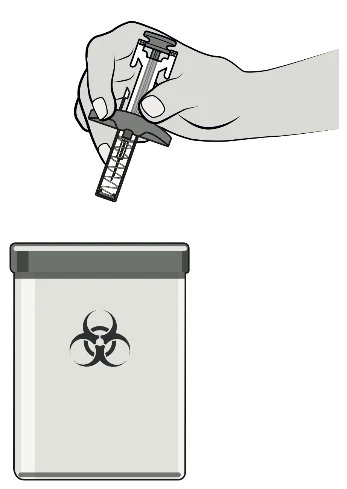
sharps disposal container.
Use only a
sharps disposal container to dispose of syringes.