Amoxicillin and clavulanic acid Sandoz A/S
Italy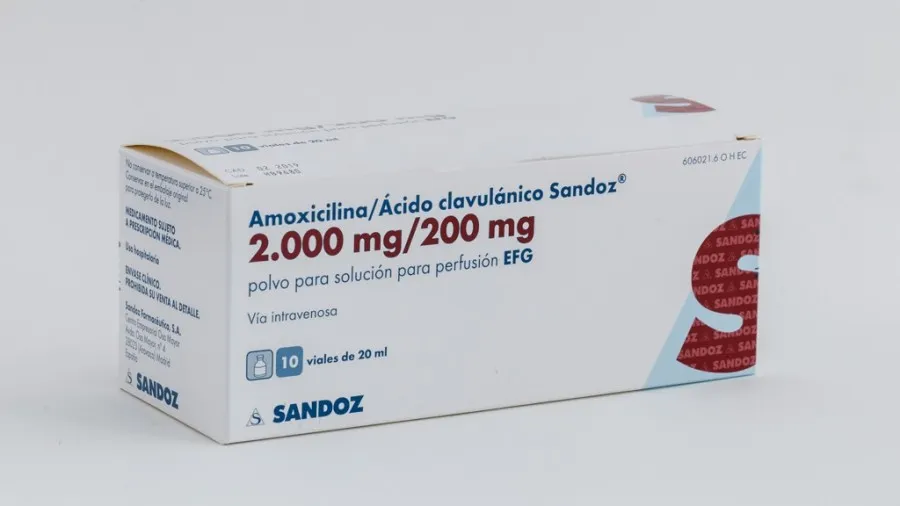
Table of Contents
- Package leaflet: Information for the patient
- Amoxicillin and Clavulanic Acid Sandoz A/S
- 1. What Amoxicillina e Acido Clavulanico Sandoz A/S is and what it is used for
- 2. What you need to know before receiving Amoxicillin and Clavulanic Acid Sandoz A/S
- 3. How Amoxicillina e Acido Clavulanico Sandoz A/S will be given to you
- 4. Possible side effects
- 5. How to store Amoxicillin and Clavulanic Acid Sandoz A/S
- 6. Package Contents and Other Information
Package leaflet: Information for the patient
Amoxicillin and Clavulanic Acid Sandoz A/S
1000 mg/200 mg powder for solution for injection/infusion
2000 mg/200 mg powder for solution for infusion
Generic medicine
Please read all of this leaflet carefully before taking this medicine because it contains
important information for you.
- Keep this leaflet. You may need to read it again.
- If you have any questions, ask your doctor, pharmacist, or nurse.
- This medicine has been prescribed for you only. Do not give it to other people, even if they have the same symptoms as you, because it may be harmful.
- If you experience any side effects, including those not listed in this leaflet, talk to your doctor, pharmacist, or nurse. See section 4.
Contents of this leaflet
- What Amoxicillin and Clavulanic Acid Sandoz A/S is and what it is used for
- What you need to know before taking Amoxicillin and Clavulanic Acid Sandoz A/S
- How you will be given Amoxicillin and Clavulanic Acid Sandoz A/S
- Possible side effects
- How to store Amoxicillin and Clavulanic Acid Sandoz A/S
- Contents of the pack and other information
1. What Amoxicillina e Acido Clavulanico Sandoz A/S is and what it is used for
Amoxicillina e Acido Clavulanico Sandoz A/S is an antibiotic that works by killing bacteria that cause infections. It contains two different active ingredients called amoxicillin and clavulanic acid. Amoxicillin belongs to a group of medicines known as "penicillins", whose activity can sometimes be blocked (rendered inactive). The other active ingredient (clavulanic acid) prevents this from happening.
Amoxicillina e Acido Clavulanico Sandoz A/S is used in adults and children to treat the following infections:
- severe ear, nose and throat infections
- respiratory tract infections
- urinary tract infections
- skin and soft tissue infections, including dental infections
- bone and joint infections
- abdominal infections
- female genital tract infections
FI Amoxicillina e A. Clavulanico Sandoz A_S
1/13
Amoxicillina e Acido Clavulanico Sandoz A/S is used in adults and children to prevent infections associated with major surgical procedures.
2. What you need to know before receiving Amoxicillin and Clavulanic Acid Sandoz A/S
Do not take Amoxicillin and Clavulanic Acid Sandoz A/S:
- if you are allergic to amoxicillin, clavulanic acid, penicillin, or to any of the other ingredients of this medicine (listed in section 6);
- if you have ever had a severe allergic reaction to any other antibiotic. This may include a skin rash or swelling of the face or throat;
- if you have ever had liver problems or jaundice (yellowing of the skin) when taking an antibiotic.
Do not take Amoxicillin and Clavulanic Acid Sandoz A/S if any of the conditions described above apply to you.
If you are unsure, contact your doctor, pharmacist, or nurse before taking Amoxicillin and Clavulanic Acid Sandoz A/S.
Warnings and precautions
Talk to your doctor, pharmacist, or nurse before taking Amoxicillin and Clavulanic Acid Sandoz A/S if:
- you have infectious mononucleosis;
- you are being treated for liver or kidney problems;
- you do not urinate regularly.
If you are unsure whether any of the conditions listed above apply to you, consult your doctor, pharmacist, or nurse before taking Amoxicillin and Clavulanic Acid Sandoz A/S.
In some cases, your doctor may perform tests to identify the type of bacteria causing your infection.
Based on the results, they may prescribe a different dose of Amoxicillin and Clavulanic Acid Sandoz A/S or a different medicine.
Conditions you should be aware of
Amoxicillin and Clavulanic Acid Sandoz A/S may worsen certain pre-existing conditions or cause serious side effects. These include allergic reactions, seizures, and inflammation of the large intestine. You should pay attention to certain symptoms while taking Amoxicillin and Clavulanic Acid Sandoz A/S in order to reduce any risk.
See "Conditions you should be aware of" in section 4.
Blood and urine tests
If you are due to have blood tests (such as checks for red blood cells or liver function tests) or urine tests (for glucose), inform your doctor or nurse that you are taking Amoxicillin and Clavulanic Acid Sandoz A/S. This is because Amoxicillin and Clavulanic Acid Sandoz A/S may affect the results of these tests.
FI Amoxicillin and A. Clavulanic Acid Sandoz A_S
2/13
Other medicines and Amoxicillin and Clavulanic Acid Sandoz A/S
Tell your doctor, pharmacist, or nurse if you are taking, have recently taken, or might take any other medicines. This includes medicines you can buy without a prescription and herbal products.
If you are taking allopurinol (used for gout) together with Amoxicillin and Clavulanic Acid Sandoz A/S, you may be more likely to develop a skin allergic reaction.
If you are taking probenecid (used for gout), concomitant use with Amoxicillin and Clavulanic Acid Sandoz A/S may reduce the excretion of amoxicillin and is not recommended.
If you are taking medicines that help prevent blood clots (such as warfarin) together with Amoxicillin and Clavulanic Acid Sandoz A/S, additional blood tests may be needed.
If you are taking methotrexate (a medicine used to treat cancer, rheumatic diseases, and severe psoriasis), penicillins may reduce the excretion of methotrexate, potentially increasing the risk of side effects.
Amoxicillin and Clavulanic Acid Sandoz A/S may affect the action of mycophenolate mofetil (a medicine used to prevent rejection of transplanted organs).
Pregnancy and breastfeeding
If you are pregnant, think you might be pregnant, planning to become pregnant, or breastfeeding, consult your doctor, pharmacist, or nurse before taking this medicine.
Driving and using machines
Amoxicillin and Clavulanic Acid Sandoz A/S may cause side effects that could affect your ability to drive. Do not drive or operate machinery unless you feel well.
Amoxicillin and Clavulanic Acid Sandoz A/S 1000 mg/200 mg powder for injectable solution/infusion
Amoxicillin and Clavulanic Acid Sandoz A/S 1000 mg/200 mg contains approximately 62.9 mg (2.7 mmol) of sodium. This corresponds to 3.145% of the maximum daily recommended sodium intake for an adult.
Amoxicillin and Clavulanic Acid Sandoz A/S 1000 mg/200 mg contains approximately 39.3 mg (1.0 mmol) of potassium. This should be taken into consideration in patients with kidney problems or those on a low-potassium diet.
Amoxicillin and Clavulanic Acid Sandoz A/S 2000 mg/200 mg powder for infusion solution
Amoxicillin and Clavulanic Acid Sandoz A/S 2000 mg/200 mg contains approximately 125.9 mg (5.5 mmol) of sodium. This corresponds to 6.295% of the maximum daily recommended sodium intake for an adult.
FI Amoxicillin and A. Clavulanic Acid Sandoz A_S
3/13
Amoxicillin and Clavulanic Acid Sandoz A/S 2000 mg/200 mg contains approximately 39.3 mg (1.0 mmol) of potassium. This should be taken into consideration in patients with kidney problems or those on a low-potassium diet.
3. How Amoxicillina e Acido Clavulanico Sandoz A/S will be given to you
Never take this medicine on your own initiative. This medicine will be administered to you by a qualified person such as a doctor or nurse.
The recommended doses are:
Amoxicillina e Acido Clavulanico Sandoz A/S 1000 mg/200 mg powder for injectable solution/infusion
Adults and children weighing equal to or more than 40 kg
| Standard dose | 1000 mg/200 mg every 8 hours |
| To prevent infection during and after surgery | 1000 mg/200 mg before surgery, administered when anesthesia is being given. The dose may vary depending on the type of surgery. Your doctor may repeat the dose if the surgery lasts longer than 1 hour |
Children weighing less than 40 kg
- All doses are calculated based on the child's body weight expressed in kilograms.
| Children aged 3 months and above | 25 mg/5 mg per kg of body weight every 8 hours |
| Children under 3 months of age or weighing less than 4 kg | 25 mg/5 mg per kg of body weight every 12 hours |
Amoxicillin and Clavulanic Acid Sandoz A/S 2000 mg/200 mg powder for solution for infusion
Adults and children weighing equal to or more than 40 kg
Standard dose 1000 mg/100 mg every 8 - 12 hours.
1000 mg/100 mg every 8 hours or 2000 mg/200 mg
every 12 hours.
Higher dose
For very severe infections, the dose may be
increased up to 2000 mg/200 mg every 8 hours.
1000 mg/100 mg to 2000 mg/200 mg before
To prevent infection during and after surgery
surgery when receiving
anaesthesia.
FI Amoxicillin and Clavulanic Acid Sandoz A_S
4/13
The dose may vary depending on the type of
surgery you are undergoing. Your doctor may
repeat the dose if the surgery lasts longer than
1 hour.
Children weighing less than 40 kg
- All doses are calculated based on the child's body weight expressed in kilograms.
50 mg/5 mg per kg of body weight every
Children aged 3 months and older
8 hours
Children younger than 3 months or weighing less 50 mg/5 mg per kg of body weight every
than 4 kg 12 hours
Patients with kidney or liver problems
- If you have kidney problems, you may be given a different dose. Your doctor may choose a different dosage or a different medicine.
- If you have liver problems, your doctor will monitor you closely and may require more frequent tests to check liver function.
How Amoxicillin and Clavulanic Acid Sandoz A/S will be administered to you
- Amoxicillin and Clavulanic Acid Sandoz A/S will be administered to you by intravenous injection or intravenous infusion.
- Make sure you drink an adequate amount of fluids while receiving Amoxicillin and Clavulanic Acid Sandoz A/S.
- Amoxicillin and Clavulanic Acid Sandoz A/S will not be administered for more than 2 weeks without the doctor reviewing your treatment.
If you are given more Amoxicillin and Clavulanic Acid Sandoz A/S than prescribed
It is very unlikely that you will be given an excessive amount of Amoxicillin and Clavulanic Acid
Sandoz A/S, but if you think this has happened, inform your doctor, pharmacist, or nurse immediately.
Symptoms may include gastrointestinal disturbances (feeling sick, being sick, or diarrhoea) or seizures.
If you have any doubts about the use of this medicine, consult your doctor, pharmacist, or
nurse.
4. Possible side effects
Like all medicines, this medicine can cause side effects, although not everyone experiences them.
The following side effects may occur with the use of this medicine.
Conditions you should pay attention to
Allergic reactions:
- skin rash;
- inflammation of blood vessels ( vasculitis ), which may appear as raised red or purple spots on the skin, but may also affect other parts of the body;
- fever, joint pain, swelling of the glands in the neck, armpits, or groin;
- swelling, sometimes of the face or mouth ( angioedema ), causing difficulty in breathing;
- collapse;
- chest pain during allergic reactions, which may be a symptom of allergy-triggered heart attack (Kounis syndrome).
Contact your doctor immediately if you experience any of these symptoms.
Stop taking Amoxicillin and Clavulanic Acid Sandoz A/S.
Inflammation of the large intestine
Inflammation of the large intestine, causing watery diarrhoea, usually with blood and mucus, stomach pain and/or fever.
Acute inflammation of the pancreas (acute pancreatitis)
If you have severe and persistent stomach pain, this could be a sign of acute pancreatitis.
Drug-induced enterocolitis syndrome (DIES)
DIES has been reported mainly in children taking amoxicillin/clavulanate. It is a type of allergic reaction with prolonged vomiting (1-4 hours after intake) as the main symptom. Additional symptoms may include abdominal pain, lethargy, diarrhoea, and low blood pressure.
If you experience these symptoms, contact your doctor as soon as possible for advice.
Common side effects (may affect up to 1 in 10 people)
- thrush ( candida – a fungal infection of the vagina, mouth, or skin folds)
- diarrhoea
Uncommon side effects (may affect up to 1 in 100 people)
- rash, itching
- raised itchy rash ( urticaria )
- feeling sick ( nausea ), especially when taking high doses
- vomiting
- indigestion
- dizziness
- headache
Uncommon side effects that may be detected in blood tests:
- increase in certain substances ( enzymes ) produced by the liver
Rare side effects (may affect up to 1 in 1,000 people)
-
rash, which may appear as blister-like spots resembling small targets (a dark central spot surrounded by a paler area, with a dark ring around the edge – erythema multiforme ).
If you notice any of these symptoms, contact your doctor immediately. -
swelling and redness along a vein, with more pronounced pain when touched.
Rare side effects that may be detected in blood tests:
- low number of cells involved in blood clotting
- low white blood cell count
Other side effects
Other side effects have occurred in a very small number of people, but their exact frequency is unknown.
- Allergic reactions (see above)
- Inflammation of the large intestine (see above)
- Crystals in the urine causing acute kidney damage
- Rash with blisters arranged in a ring with central crusts or resembling a string of pearls (linear IgA disease)
- Inflammation of the membranes surrounding the brain and spinal cord ( aseptic meningitis )
- Severe skin reactions:
- widespread rash with blisters and peeling of the skin, especially around the mouth, nose, eyes, and genitals ( Stevens-Johnson syndrome ), and a more severe form causing extensive skin detachment (more than 30% of body surface – toxic epidermal necrolysis );
- widespread red rash with small pustules ( exfoliative bullous dermatitis );
- a red rash with crusts, swellings under the skin, and blisters ( pustular exanthema );
- flu-like symptoms with rash, fever, swollen glands, and abnormal blood test results (including increased white blood cell count (eosinophilia) and elevated liver enzymes) (Drug Reaction with Eosinophilia and Systemic Symptoms (DRESS));
- red rash commonly seen on both sides of the buttocks, upper inner thighs, armpits, and neck (Symmetrical Drug-Related Intertriginous and Flexural Exanthema (SDRIFE)).
If you experience any of these symptoms, contact your doctor immediately.
- inflammation of the liver ( hepatitis )
- jaundice, caused by increased levels of bilirubin (a substance produced in the liver) in the blood, which may make the skin and whites of the eyes appear yellow
- inflammation of the kidney tubules
- blood takes longer to clot
- seizures (in people taking high doses of Amoxicillin and Clavulanic Acid Sandoz A/S or who have kidney problems)
Side effects that may be detected in blood or urine tests:
- severe reduction in white blood cell count
- low red blood cell count ( haemolytic anaemia )
- crystals in the urine
Reporting of side effects
If you experience any side effect , including those not listed in this leaflet, please contact your doctor, pharmacist, or nurse. You can also report side effects directly via the national reporting system at the website:
www.aifa.gov.it/content/segnalazioni-reazioni-avverse.
By reporting side effects, you can help provide more information on the safety of this medicine.
5. How to store Amoxicillin and Clavulanic Acid Sandoz A/S
Keep this medicine out of the sight and reach of children.
Do not use this medicine after the expiry date stated on the label and outer packaging.
The expiry date refers to the last day of that month.
Do not store above 25 °C.
Keep the container in the outer packaging.
Reconstituted solution:
Amoxicillin and Clavulanic Acid Sandoz A/S 1000 mg/200 mg powder for injectable/infusion solution
Chemical and physical in-use stability has been demonstrated for the reconstituted injectable solution for 15 minutes when stored at 25 °C, and for the reconstituted infusion solution for 60 minutes when stored at 25 °C.
Amoxicillin and Clavulanic Acid Sandoz A/S 2000 mg/200 mg powder for infusion solution
Chemical and physical in-use stability has been demonstrated for the reconstituted infusion solution for 60 minutes when stored at 25 °C.
From a microbiological point of view, unless the reconstitution method excludes the risk of microbial contamination, the injectable and infusion solutions should be used immediately. If not used immediately, the times and conditions of in-use storage are the responsibility of the user.
Do not dispose of any medicine via wastewater or household waste.
Ask your pharmacist how to dispose of medicines no longer required. This will help protect the environment.
6. Package Contents and Other Information
What Amoxicillin and Clavulanic Acid Sandoz A/S Contains
FI Amoxicillin and A. Clavulanic Sandoz A_S
8/13
Amoxicillin and Clavulanic Acid Sandoz A/S 1000 mg/200 mg powder for solution for injection/infusion
- The active substances are amoxicillin (as sodium salt) and clavulanic acid (as potassium salt). Each vial contains 1000 mg of amoxicillin (as sodium salt) and 200 mg of clavulanic acid (as potassium salt).
Amoxicillin and Clavulanic Acid Sandoz A/S 2000 mg/200 mg powder for solution for infusion
- The active substances are amoxicillin (as sodium salt) and clavulanic acid (as potassium salt). Each vial contains 2000 mg of amoxicillin (as sodium salt) and 200 mg of clavulanic acid (as potassium salt).
There are no other components. However, see section 2 for further important information regarding sodium and potassium in Amoxicillin and Clavulanic Acid Sandoz A/S.
Description of the Appearance of Amoxicillin and Clavulanic Acid Sandoz A/S and Contents of the
Pack
Amoxicillin and Clavulanic Acid Sandoz A/S 1000 mg/200 mg powder for solution for injection/infusion
Vial:
20 ml colourless glass vial of type II with halogenated butyl rubber stopper and aluminium flip-off cap.
Pack sizes: 1, 5, 10, 20, 30, 50 and 100 vials.
Bottle:
50 ml colourless glass bottle of type II with halogenated butyl rubber stopper and aluminium flip-off cap.
Pack sizes: 1, 5 and 10 bottles.
Amoxicillin and Clavulanic Acid Sandoz A/S 2000 mg/200 mg powder for solution for infusion
Vial:
20 ml colourless glass vial of type II with halogenated butyl rubber stopper and aluminium flip-off cap.
Pack sizes: 1, 5, 10, 20, 30, 50 and 100 vials.
Bottle:
100 ml colourless glass bottle of type II with halogenated butyl rubber stopper and aluminium flip-off cap.
Pack sizes: 1, 5 and 10 bottles.
Not all pack sizes may be marketed.
FI Amoxicillin and A. Clavulanic Sandoz A_S
9/13
Marketing Authorization Holder
Sandoz A/S
Edvard Thomsens Vej 14
2300 Copenhagen S, Denmark
Legal Representative in Italy:
Sandoz S.p.A.
Viale Luigi Sturzo, 43
20154, Milan, Italy
Manufacturer
Sandoz GmbH
Biochemiestraße 10
6250 Kundl
Austria
This medicinal product is authorized in the Member States of the European Economic Area and in the United Kingdom (Northern Ireland) under the following names:
Netherlands AMOXICILLIN/CLAVULANIC ACID SANDOZ 1000/200 I.V., powder for
solution for injection
AMOXICILLIN/CLAVULANIC ACID SANDOZ 2000/200 I.V., powder for
solution for intravenous infusion
AMOXICILLIN/CLAVULANIC ACID SANDOZ 500/100 I.V., powder for solution
for injection/infusion 500 mg + 100 mg
AMOXICILLIN/CLAVULANIC ACID SANDOZ 500/50 I.V., powder for solution
for injection/infusion
Austria Curam intravenös 1000 mg/200 mg - Powder for the preparation of an injection/infusion solution
Curam intravenös 2000 mg/200 mg - Powder for the preparation of an infusion solution
Curam intravenös 500 mg/100 mg - Powder for the preparation of an injection/infusion solution
Curam intravenös 500 mg/50 mg - Powder for the preparation of an injection/infusion solution
Belgium Amoxiclav Sandoz 1000 mg/200 mg powder for solution for injection/infusion
Amoxiclav Sandoz 2000 mg/200 mg powder for solution for infusion
Amoxiclav Sandoz 500 mg/50 mg powder for solution for injection/infusion
Italy Amoxicillin and Clavulanic Acid Sandoz A/S
Luxembourg Amoxiclav Sandoz 1000 mg/200 mg powder for solution for injection/perfusion
Amoxiclav Sandoz 2000 mg/200 mg powder for solution for perfusion
Amoxiclav Sandoz 500 mg/50 mg powder for injectable solution or for perfusion
United Kingdom Co-amoxiclav 1000/200 mg Powder for Solution for Injection/Infusion
Co-Amoxiclav 500/100 mg Powder for Solution for Injection/Infusion
Germany AmoxClav HEXAL i.v. 1000/200 mg
FI Amoxicillin and A. Clavulanic Sandoz A_S
10/13
AmoxClav HEXAL i.v. 2000/200 mg
AmoxClav HEXAL i.v. 500/100 mg
Estonia Amoxicillin/Clavulanic acid Sandoz
The following information is intended exclusively for physicians or healthcare professionals:
Amoxicillin and Clavulanic Acid Sandoz A/S
1000 mg/200 mg powder for solution for injection/infusion
Amoxicillin and Clavulanic Acid Sandoz A/S
2000 mg/200 mg powder for solution for infusion
This is an extract from the Summary of Product Characteristics (SmPC) supporting the
administration of Amoxicillin and Clavulanic Acid Sandoz A/S. When determining the appropriateness of use in a specific patient, the prescribing physician must be familiar with the full SmPC.
ADMINISTRATION
Amoxicillin and Clavulanic Acid Sandoz A/S 1000 mg/200 mg may be administered either by slow intravenous injection over 3–4 minutes directly into the vein, or via drip infusion or infusion lasting 30 to 40 minutes. Amoxicillin and Clavulanic Acid Sandoz A/S is not suitable for intramuscular administration.
Amoxicillin and Clavulanic Acid Sandoz A/S 2000 mg/200 mg must be administered by intravenous infusion lasting 30 to 40 minutes. Amoxicillin and Clavulanic Acid Sandoz A/S is not suitable for intramuscular administration.
INCOMPATIBILITIES WITH DILUENTS AND OTHER MEDICINAL PRODUCTS
Amoxicillin and Clavulanic Acid Sandoz A/S 1000 mg/200 mg powder for solution for injection/infusion must not be mixed with amino acid solutions, lipid emulsions, blood, or glucose-containing solutions.
Amoxicillin and Clavulanic Acid Sandoz A/S 1000 mg/200 mg powder for solution for injection/infusion is less stable in infusions containing dextran or bicarbonate.
Therefore, the reconstituted solution must not be added directly to such infusions but may be injected into the drip tube over a period of three to four minutes.
Due to inactivation of aminoglycosides by amoxicillin, in vitro mixing must be avoided.
FI Amoxicillin and A. Clavulanic Sandoz A_S
11/13
Amoxicillin and Clavulanic Acid Sandoz A/S 2000 mg/200 mg powder for solution for infusion must not be mixed with amino acid solutions, lipid emulsions, blood, or glucose-containing solutions.
Amoxicillin and Clavulanic Acid Sandoz A/S 2000 mg/200 mg powder for solution for infusion is less stable in infusions containing dextran or bicarbonate.
Therefore, the reconstituted solution must not be added directly to such infusions but may be injected into the drip tube over a period of three to four minutes.
Due to inactivation of aminoglycosides by amoxicillin, in vitro mixing must be avoided.
INSTRUCTIONS FOR USE AND HANDLING
Reconstitution must be performed under aseptic conditions. Prior to administration, the solution must be visually inspected for particulate matter. The solution should only be used if clear and free from particles. Unused solution must be discarded.
From a microbiological standpoint, unless the reconstitution method excludes the risk of microbial contamination, injectable and infusion solutions should be used immediately. If not used immediately, storage times and conditions during use are the responsibility of the user.
For single use only.
Amoxicillin and Clavulanic Acid Sandoz A/S 1000 mg/200 mg
Preparation of intravenous injections:
Vials of 1000 mg/200 mg are diluted with 20 ml of water for injections
| Vial size | Water for injections | Volume after reconstitution* | Concentration after reconstitution* |
| 1000 mg/200 mg | 20 ml | 20.25 ml | 49.4/9.9 mg/ml |
*Data are based on laboratory studies
Preparation of intravenous infusions:
Vials of 1000 mg/200 mg are diluted with 20 ml of water for injections or the following fluids:
physiological saline, sodium lactate 167 mmol/l, Ringer's solution, Hartmann's solution.
Reconstitution of the ready-to-use solution for infusion must be performed in two steps to allow preparation of the required volume for the infusion solution:
The vial containing 1000 mg/200 mg is first reconstituted with one of the compatible intravenous fluids in its vial. This solution should then be transferred into a suitable infusion bag containing the same compatible fluid used for reconstitution, with a volume of 50 ml up to 100 ml.
Controlled and validated aseptic conditions must be maintained.
Vials of 1000 mg/200 mg are diluted with 50 ml of water for injections or the following fluids:
physiological saline, sodium lactate 167 mmol/l, Ringer's solution, Hartmann's solution.
FI Amoxicillin and Clavulanic Acid Sandoz A/S
12/13
If the medicinal product is dissolved in water for injections as specified, this solution may be mixed with the following diluents: water for injections, physiological saline, sodium lactate 167 mmol/l, Ringer's solution, Hartmann's solution.
Amoxicillin and Clavulanic Acid Sandoz A/S 2000mg/200mg
Preparation of intravenous infusions
Vial of Water for injections Volume after Concentration after
reconstitution* reconstitution*
2000/200 mg 20 ml 21.6 ml 92.6/9.3 mg/ml
2000 mg/200 mg 100 ml 100.9 ml 19.8/2.0 mg/ml
*Data are based on laboratory studies
Vials of 2000 mg/200 mg are diluted with 20 ml of water for injections or the following fluids:
physiological saline, sodium lactate 167 mmol/l, Ringer's solution, Hartmann's solution.
Reconstitution of the ready-to-use solution for infusion must be performed in two steps to allow preparation of the required volume for the infusion solution:
The vial containing 2000 mg/200 mg is first reconstituted with one of the compatible intravenous fluids in its vial. This solution should then be transferred into a suitable infusion bag containing the same compatible fluid used for reconstitution, with a volume of 100 ml.
Controlled and validated aseptic conditions must be maintained.
Vials of 2000 mg/200 mg are diluted with 100 ml of water for injections or the following fluids:
physiological saline, sodium lactate 167 mmol/l, Ringer's solution, Hartmann's solution.
If the medicinal product is dissolved in water for injections as specified, this solution may be mixed with the following diluents: water for injections, physiological saline, sodium lactate 167 mmol/l, Ringer's solution, Hartmann's solution.
The intravenous infusion solution must be administered completely within 60 minutes after preparation.
After dissolution in water for injections, a transient pink color may occur; the solution will rapidly become clear again. The reconstituted solution is clear, pale yellow, and free of particles.
FI Amoxicillin and Clavulanic Acid Sandoz A/S
13/13