Amiped
ItalyTable of Contents
Package leaflet: Information for the user
Amiped, infusion solution
For use in children (0-11 years)
amino acids
Please read all of this leaflet carefully before using this medicine because it contains important information for you.
- Keep this leaflet. You may need to read it again.
- If you have any questions, ask your doctor or nurse.
- This medicine has been prescribed only for your child. Do not give it to others, even if their symptoms are the same as your child’s, because it could be harmful.
- If your child experiences any side effect, including those not listed in this leaflet, talk to your doctor or nurse. See section 4.
Contents of this leaflet
- What Amiped is and what it is used for
- What you need to know before your child is given Amiped
- How to use Amiped
- Possible side effects
- How to store Amiped
- Contents of the pack and other information
1. What Amiped is and what it is used for
Amiped is a solution administered to your child through a small tube with a cannula inserted into a vein (intravenous infusion).
The solution contains amino acids which are essential for growth or recovery of the body.
The solution is suitable to meet the specific requirements of full-term and preterm neonates, infants, toddlers, and children.
They will receive this medicine if they are unable to eat food normally and also cannot be fed through a tube inserted into the stomach. They may also receive other nutrients in combination with Amiped, such as glucose solutions or lipid emulsions.
2. What you should know before your child takes Amiped
Do not use Amiped if your child:
- is allergic to any of the active substances or to any of the other components of this medicine (listed in section 6).
- has a congenital disorder of protein and amino acid metabolism.
- has severe, potentially life-threatening circulatory disorders (shock).
- has insufficient oxygen supply (hypoxia).
- has an accumulation of acids in the blood (acidosis).
- suffers from a severe liver disease (severe hepatic insufficiency).
- suffers from severe kidney failure (severe renal insufficiency) not adequately treated with artificial kidney or similar therapies.
- has heart failure with marked impairment of blood circulation (decompensated heart failure).
- has fluid accumulation in the lungs (acute pulmonary edema).
- has disturbances in the balance of salts (electrolytes) or fluids in the body.
Warnings and precautions
When used in preterm neonates and infants up to 2 years of age, the solution (in bags and administration sets) must be protected from light exposure until administration is complete. Exposure to light of parenteral nutrition solutions containing Amiped, particularly after addition of trace elements and/or vitamins, may generate peroxides and other degradation products, which can be minimized by protecting the solution from light.
Talk to your doctor or nurse before using Amiped if your child:
- has impaired metabolism of proteins and amino acids due to any condition other than those listed above (see section “Do not use Amiped if your child...”).
- has impaired liver or kidney function.
- has impaired heart function.
- has an abnormally high concentration of substances in the blood serum (elevated serum osmolarity).
If your child has disturbances in fluid or electrolyte balance, this condition must be corrected before administering this medicine. Examples include concurrent deficiency of water and salts (hypotonic dehydration), or low levels of sodium (hyponatremia) or potassium (hypokalemia).
Before and during the period when children receive this solution, the doctor will monitor levels of electrolytes and glucose in the blood, fluid balance, and acid-base balance. Blood protein levels, as well as kidney and liver function, will also be monitored. For this purpose, blood samples will be taken and urine samples collected for analysis.
Amino acid-based solutions constitute only one component of parenteral nutrition. Typically, children receive Amiped as part of intravenous nutrition that also includes non-protein energy sources (carbohydrate solutions, lipid emulsions), essential fatty acids, electrolytes, vitamins, fluids, and trace elements.
Other medicines and Amiped
Inform your doctor or nurse if your child is taking, has recently taken, or might take any other medicines.
Pregnancy and breastfeeding
Amiped is intended for use only in infants, toddlers, and children.
Driving and using machines
Not applicable, since Amiped is intended for use only in infants, toddlers, and children.
3. How to use Amiped
Amiped is administered by healthcare professionals.
The doctor will carefully adjust the dosage of this medicine according to the child's age, stage of development, and actual type of illness.
The amounts to be administered are as follows:
First day of life: ≥ 15 mL per kg of body weight per day
From day 2 onwards: 25–35 mL per kg of body weight per day
Term neonates (0–27 days): 15–30 mL per kg of body weight per day
Infants and toddlers (from 1 month up to 3 years): 10–25 mL per kg of body weight per day
Children (from 3 up to 12 years): 10–20 mL per kg of body weight per day
Higher amounts (up to 30 mL per kg of body weight per day) may be administered to critically ill children.
Patients with renal or hepatic impairment
In the presence of liver or kidney disease, dosages will be adjusted according to the individual needs of the child.
Duration of use
This medicine may be administered for as long as your child requires parenteral nutrition.
Method of administration
This medicine will be administered to your child through a small tube inserted into a vein (intravenous infusion).
When used in preterm neonates and infants up to 2 years of age, the solution (in bags and administration sets) must be protected from exposure to light until administration is completed (see section 2).
If your child receives more Amiped than they should
It is unlikely that this will occur, as the doctor will determine the daily doses for your child. However, if your child receives an overdose or if the solution is administered too rapidly, your child may experience feelings of malaise, episodes of vomiting, chills, or headache.
Additionally, your child may develop excessive levels of acidic substances (metabolic acidosis) or ammonia (hyperammonaemia) in the blood, and in such cases, may lose amino acids in the urine.
Your child may also suffer from excessive fluid in the body (overhydration), disturbances in the body's salt balance (electrolyte imbalance), and fluid in the lungs (pulmonary oedema). In these cases, the infusion will be stopped and restarted later at a slower rate.
If you have any doubts about the use of this medicine, consult your doctor or nurse.
4. Possible side effects
Like all medicines, this medicine can cause side effects, although not everyone gets them.
These side effects are not specifically associated with Amiped, but may occur with any type of intravenous nutrition, especially during the initial phases of therapy.
The following side effects can be serious. If your child experiences any of the following side effects,
contact your doctor immediately; the doctor will stop administering this medicine to your child:
Not known (frequency cannot be estimated from the available data)
- Allergic reactions
Other side effects
Uncommon (may affect up to 1 in 100 people):
- Vomiting, malaise
Reporting of side effects
If your child experiences any side effect, including those not listed in this leaflet, talk to your doctor or nurse.
You can also report side effects directly via
https://www.aifa.gov.it/content/segnalazioni-reazioni-avverse.
By reporting side effects, you can help provide more information on the safety of this medicine.
5. How to store Amiped
Keep this medicine out of sight and reach of children.
When used in preterm neonates and infants up to 2 years of age, the solution (in bags and administration sets) must be protected from light exposure until administration is complete (see section 2).
Do not use this medicine after the expiry date stated on the vial and on the outer carton. The expiry date refers to the last day of that month.
This medicine does not require any special storage conditions.
Do not freeze.
After infusion, do not store any remaining solution for later use.
6. Contents of the pack and other information
What Amiped contains
The active substances are amino acids.
This medicine contains:
| Amino acids | per 1mL | per 100mL | per 250mL |
| Isoleucine | 5.10 mg | 0.51 g | 1.28 g |
| Leucine | 7.60 mg | 0.76 g | 1.90 g |
| Lysine monohydrate (equivalent to lysine) | 9.88 mg (8.80 mg) | 0.99 g (0.88 g) | 2.47 g (2.20 g) |
| Methionine | 2.00 mg | 0.20 g | 0.50 g |
| Phenylalanine | 3.10 mg | 0.31 g | 0.78 g |
| Threonine | 5.10 mg | 0.51 g | 1.28 g |
| Tryptophan | 4.00 mg | 0.40 g | 1.00 g |
| Valine | 6.10 mg | 0.61 g | 1.53 g |
| Arginine | 9.10 mg | 0.91 g | 2.28 g |
| Histidine | 4.60 mg | 0.46 g | 1.15 g |
| Alanine | 15.90 mg | 1.59 g | 3.98 g |
| Glycine | 2.00 mg | 0.20 g | 0.50 g |
| Aspartic acid | 6.60 mg | 0.66 g | 1.65 g |
| Glutamic acid | 9.30 mg | 0.93 g | 2.33 g |
| Proline | 6.10 mg | 0.61 g | 1.53 g |
| Serine | 2.00 mg | 0.20 g | 0.50 g |
| N-acetyl tyrosine (equivalent to tyrosine) | 1.30 mg (1.06 mg) | 0.13 g (0.11 g) | 0.33 g (0.27 g) |
| Acetylcysteine | 0.700 mg | 0.070 g | 0.175 g |
| (equivalent to cysteine) | (0.520 mg) | (0.052 g) | (0.13 g) |
| Taurine | 0.300 mg | 0.030 g | 0.075 g |
| per 1mL | per 100mL | per 250mL | |
| Total amino acids | 0.1 g | 10 g | 25 g |
| Total nitrogen | 0.0152 g | 1.52 g | 3.8 g |
| Energy (kJ/L [kcal/L]) | 1700 (406) |
| Theoretical osmolarity [mOsm/L] | 790 |
| Acidity (titration to pH 7.4) [mmol NaOH/L] | 23 |
| pH | approximately 6.1 |
The other components are citric acid monohydrate (for pH adjustment) and water for injections.
Description of the appearance of Amiped and contents of the pack
Amiped is a clear, colourless or pale yellow solution.
It is supplied in single-chamber plastic bags made of a transparent multilayer film (polypropylene, styrene ethylene butylene styrene (SEBS) and copolyester-ether). The innermost layer in contact with the solution is composed of polypropylene. The bags contain 100 mL or 250 mL.
The bag is enclosed in a protective overwrap. An oxygen absorber and an oxygen indicator are placed between the bag and the overwrap; the oxygen indicator consists of a thermoformed blister containing sodium resorufin, an oxygen-sensitive dye; the oxygen absorber sachet is made of inert material and contains active iron powder, electrolytic materials and activated carbon (Figure A).
Different pack sizes are packed in boxes of 12 bags.
Packs: 12 x 100 mL and 12 x 250 mL.
Not all pack sizes may be marketed.
Marketing Authorisation Holder and Manufacturer
B. Braun Melsungen AG
Carl-Braun-Straße 1
34212 Melsungen,
Germany
Postal address:
34209 Melsungen, Germany
Tel.: +49/5661/71-0
Fax: +49/5661/71-4567
This medicinal product is authorised in the European Economic Area and in the United Kingdom (Northern Ireland) under the following names:
Austria, Germany: Aminoplasmal Paed 10% Infusionslösung
Denmark, Italy, Norway, Czech Republic, Slovak Republic: Amiped
Luxembourg, Poland: Aminoplasmal Paed 10%
Portugal: Aminoplasmal Paed
Spain: Aminoplasmal Paed 10% solución para perfusión
United Kingdom (Northern Ireland): Aminoplasmal Paediatric 10% Solution for Infusion
The following information is intended for healthcare professionals only:
Dosage
Paediatric population
The dosages for these age groups as indicated below represent average guideline values.
The exact dosage must be individually adjusted according to age, stage of development and underlying disease.
Administration should be initiated below the target infusion rate and may be increased up to the target rate within the first hour.
Parenteral amino acid intake considered suitable for most paediatric patients:
Daily dose for preterm neonates:
First day of life
≥ 1.5 g of amino acids/kg body weight ≙ ≥ 15 mL/kg body weight
From day 2 onwards
2.5–3.5 g of amino acids/kg body weight ≙ 25–35 mL/kg body weight
Daily dose for term neonates (0–27 days):
1.5–3.0 g/kg body weight ≙ 15–30 mL/kg body weight
Daily dose for infants and toddlers (from 1 month to less than 3 years):
2.5 g/kg body weight ≙ 25 mL/kg body weight
Daily dose for children (from 3 to less than 12 years):
1.0–2.0 g/kg body weight ≙ 10–20 mL/kg body weight
Method of administration
For intravenous use.
For central venous infusion only.
When used in preterm neonates and infants up to 2 years of age, the solution (in both the bags and administration sets) must be protected from exposure to light until administration is complete.
Special warnings and precautions for use
Exposure to light of intravenous solutions for parenteral nutrition, particularly after addition of trace elements and/or vitamins, may have adverse effects on clinical outcomes in neonates due to the formation of peroxides and other degradation products. When used in preterm neonates and infants up to 2 years of age, Amiped must be protected from exposure to light until administration is complete.
Special precautions for disposal and handling
Containers are for single use only. After use, dispose of the overwrap, oxygen indicator, oxygen absorber, container and any unused contents.
Before opening the overwrap, check the colour of the oxygen indicator (see Figure A). Do not use if the oxygen indicator has turned pink. Use only if the oxygen indicator is yellow.
The product must not be used if the solution is not clear and colourless or pale yellow, practically free from visible particles, or if the bag or its closure is damaged.
When used in preterm neonates and infants up to 2 years of age, parenteral nutrition solutions containing Amiped must be protected from exposure to light until administration is complete. Exposure of such solutions to ambient light, particularly after addition of trace elements and/or vitamins, generates peroxides and other degradation products, which can be reduced by protection from light.
Use a sterile administration set for infusion of Amiped.
If, as part of a complete parenteral nutrition regimen, other nutrients such as carbohydrates, lipids, vitamins and trace elements need to be added to this medicinal product, mixing must be performed under strictly aseptic conditions. Mix thoroughly after addition of any additive. Pay particular attention to compatibility.
- Glucose: stability has been demonstrated up to a total of 150 g/L glucose in the mixture.
- Electrolytes: without lipid content: stability has been demonstrated up to a total of 200 mmol/L sodium + potassium (sum), 5 mmol/L magnesium and 20 mmol/L calcium in the mixture; with lipid content: stability has been demonstrated up to a total of 200 mmol/L sodium + potassium (sum), 5 mmol/L magnesium and 10 mmol/L calcium in the mixture.
- Lipids: stability has been demonstrated up to a total of 25 g/L lipid emulsion in the mixture.
- Trace elements and vitamins: stability has been demonstrated with commercially available multi-trace element and multivitamin products (e.g. Peditrace, Vitalipid Infant, Soluvit N) up to the standard dosage recommended by the respective micronutrient manufacturers.
Shelf-life after mixing the medicinal product with additives
From a microbiological standpoint, mixtures should be administered immediately after preparation. If immediate administration is not possible, storage times and conditions prior to use are the responsibility of the user and should normally not exceed 24 hours at 2 °C–8 °C, unless mixing has been carried out under controlled and validated aseptic conditions.
For complete information on this medicinal product, consult the Summary of Product Characteristics.
Amiped: Handling
Figure A: Bag and overpack
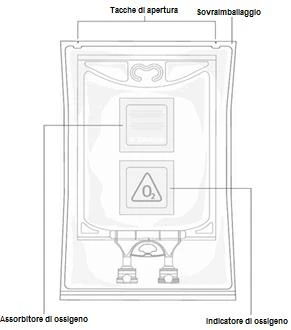
Figure B: Bag
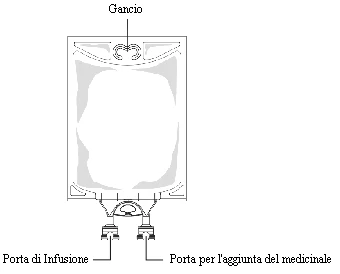
Bag hook
Infusion port Medication addition port
To open:
Remove the bag from its protective overwrap by grasping it at the notches for opening at the top and remove the container holding the solution (Figure 1). Dispose of the overwrap, oxygen indicator and oxygen absorber.
Check for leaks. If the bag
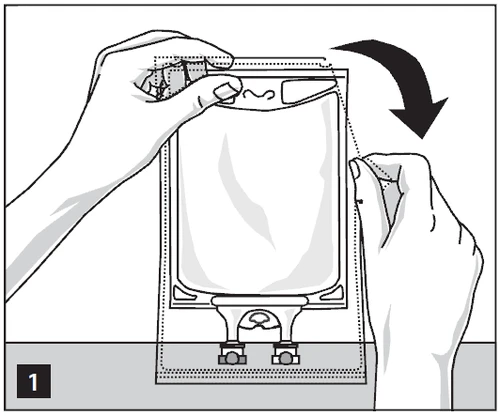
is leaking, dispose of the product as sterility may be compromised.
To add medications:
Addition of additives must be performed using strictly aseptic techniques.
Compatible medicinal products may be added through the medication port (transparent colour).
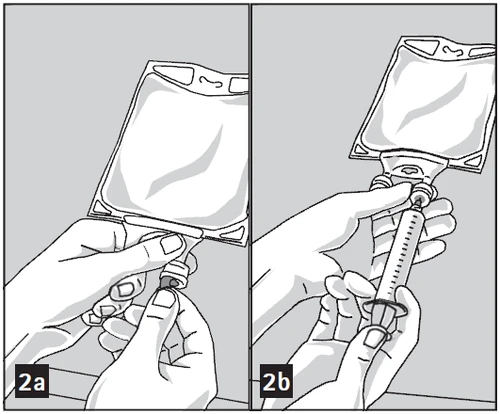
- Prepare the medication addition port (transparent colour) by removing the aluminium foil (Figure 2a). Note: the area beneath the foil on the medication port is sterile.
- Pierce the resealable medication addition port and inject the additive(s) (Figure 2b).
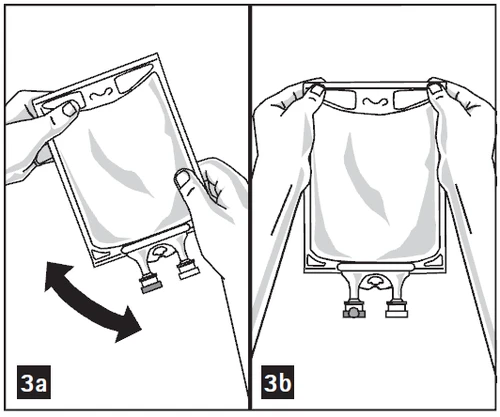
- Mix the solution and medicinal product thoroughly (Figure 3a).
- The medication addition port may be cleaned with a swab soaked in a disinfectant (e.g. isopropanol) before making a new puncture.
- Visually inspect the mixture for the presence of particles (Figure 3b).
Preparation for administration:
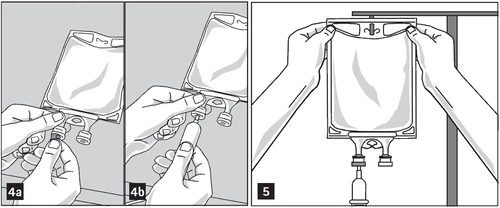
- Remove the aluminium foil from the infusion port (green colour) at the bottom of the container (Figure 4a) and attach the infusion set (Figure 4b): use an infusion set without an air inlet or close the air inlet if present. Follow the instructions for use of the infusion set. Note: the area beneath the foil on the infusion port is sterile.
- Hang the bag on an IV pole (Figure 5).
Additional information:
The container is free from PVC, DEHP and latex.