Amikan
Italy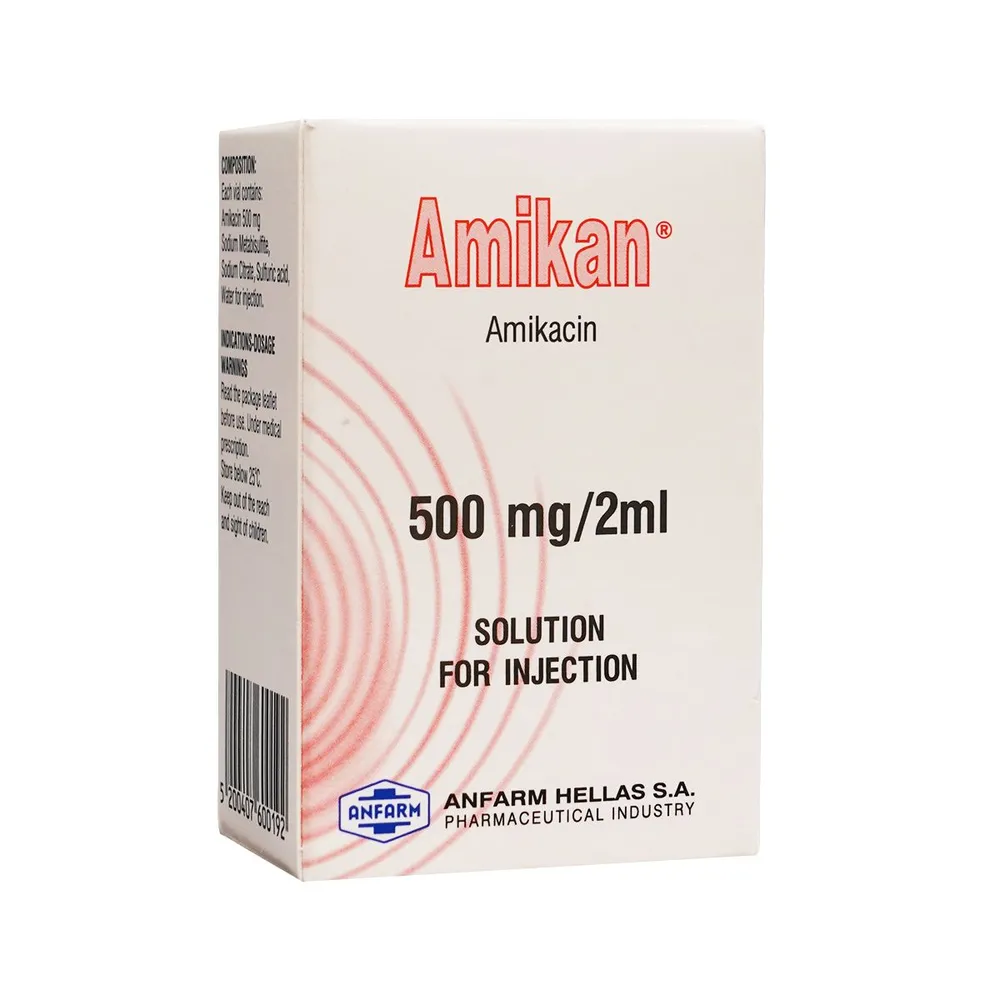
Table of Contents
- Package leaflet: Information for the patient
- Amikan 1 g/4 ml injection solution, 500 mg/2 ml injection solution
- 1. What Amikan is and what it is used for
- 2. What you need to know before taking Amikan
- 3. How to take Amikan
- 4. Possible side effects
- 5. How to store Amikan
- 6. Package contents and other information
Package leaflet: Information for the patient
Amikan 1 g/4 ml injection solution, 500 mg/2 ml injection solution
Amikacin
Generic medicine
Please read this leaflet carefully before taking this medicine, as it contains important information for you.
- Keep this leaflet. You may need to read it again.
- If you have any questions, ask your doctor or pharmacist.
- This medicine has been prescribed for you only. Do not give it to others, even if their symptoms are the same as yours, as it could be harmful.
- If you experience any side effect, including those not listed in this leaflet, contact your doctor or pharmacist. See section 4.
Contents of this leaflet:
- What Amikan is and what it is used for
- What you need to know before taking Amikan
- How to take Amikan
- Possible side effects
- How to store Amikan
- Contents of the pack and other information
1. What Amikan is and what it is used for
Amikan contains the active substance amikacin.
Amikacin belongs to a group of medicines called antibiotics used to treat serious infections
caused by bacteria that can be killed (sensitive) by amikacin. Specifically,
amikacin belongs to a group of substances called aminoglycosides and is indicated for the treatment of
the following conditions:
- for short-term treatment of serious infections caused by the following bacterial strains: Pseudomonas, E. coli, Proteus indolo + and indolo -, Providencia, Klebsiella-Serratia, and Acinetobacter;
- for the treatment of serious infections caused by Proteus rettgeri, Providencia stuartii, Serratia marcescens, and Pseudomonas aeruginosa strains that have proven resistant to therapy with other antibiotics such as gentamicin and tobramycin. Amikan has proven effective:
- in the treatment of bacteraemia (presence of bacteria in the blood), septicaemia (systemic illness due to persistent presence of bacteria in the blood), and blood infections in newborns (neonatal sepsis);
- in the treatment of serious respiratory tract infections, bone and joint infections, central nervous system (CNS) infections (including meningitis), intra-abdominal infections (including peritonitis), burn infections, and postoperative infections (after surgery);
- in the treatment of serious, complicated, and recurrent urinary tract infections;
- as initial therapy in confirmed or suspected staphylococcal infections (caused by the bacterial strain Staphylococcus), when the patient is allergic to other antibiotics, or when a mixed infection is present, i.e., caused simultaneously by staphylococci and the above-mentioned bacteria;
- in the treatment of blood infections in newborns (neonatal sepsis), when other antibiotics cannot be used. In such cases, concomitant therapy with a penicillin-type antibiotic may also be indicated. Amikacin is not indicated for the treatment of initial episodes of urinary tract infections when a less toxic antibiotic can be used.
2. What you need to know before taking Amikan
Do not take Amikan
- If you are allergic (hypersensitive) to amikacin, to other similar substances (aminoglycosides), or to any of the other ingredients of this medicine (listed in section 6).
Warnings and precautions
Talk to your doctor or pharmacist before taking Amikan:
- If you have kidney or hearing problems. Injectable amikacin may cause further damage to the kidneys and hearing; therefore, your doctor will check the function of your hearing and kidneys before deciding whether to start treatment.
- If you are allergic to other antibiotics in the same class (glycosides).
- If you are being treated with other antibiotics in the same class (glycosides). Amikacin is potentially toxic to the ears and kidneys.
- If you are pregnant or breastfeeding (see "Pregnancy and breastfeeding").
- If you or your family members have a genetic disorder causing mitochondrial mutation or hearing loss induced by antibiotics, you should inform your doctor or pharmacist before taking an aminoglycoside, as certain mitochondrial mutations associated with this product may increase the risk of hearing loss. Your doctor may recommend genetic testing before administering Amikan.
While using Amikan, always keep in mind that:
- Amikacin, like all antibiotics in the same class (aminoglycosides), is potentially toxic to the ear, kidneys, and nervous system. Therefore, your doctor will continuously monitor the function of these organs and advise you to avoid concomitant administration with other drugs that have similar toxicity (see "Other medicines and Amikan").
- The risk of kidney toxicity is reduced if Amikan is administered at the recommended doses to well-hydrated patients with normal kidney function.
- If symptoms of kidney problems occur, your doctor will closely monitor you and may advise:
- regular monitoring of kidney function;
- increasing fluid intake to prevent dehydration, in case of symptoms of kidney irritation;
- reducing the administered dose, if there is clear evidence of impaired kidney function;
- discontinuing treatment if high levels of nitrogen in the blood (azotemia) occur or if there is a progressive decrease in urine output.
- In patients with kidney problems (renal insufficiency), if Amikan is administered for more than five days, your doctor will perform a hearing test both before starting and during treatment.
- If you experience ringing in the ears (tinnitus), hearing loss, or reduced perception of high-frequency sounds, stop taking the medicine and inform your doctor immediately.
- When amikacin is indicated in combination with other antibiotics, these agents should not be mixed in the same syringes or infusion bottles.
- Before starting treatment with Amikan, your doctor will perform a test to determine which antibiotics the specific bacterial strain causing your infection is sensitive to (antibiogram). However, amikacin may still be used as initial therapy when test results are not yet available but amikacin-sensitive bacteria are suspected. Nevertheless, the decision to continue treatment with this antibiotic should be based on test results, severity of infection, patient response, and all relevant warnings.
- The safety of amikacin use during pregnancy has not been established; therefore, in pregnant women and very young infants, the product should be administered only if clearly necessary and under direct medical supervision (see "Pregnancy and breastfeeding").
- It is not known whether amikacin is excreted in breast milk. As a general rule, breastfeeding should be avoided in women receiving medications that may pass into milk (see "Pregnancy and breastfeeding").
- Amikan contains sodium metabisulfite, a substance that may cause allergic reactions, including potentially life-threatening anaphylactic reactions or less severe allergic symptoms, and may trigger severe asthma attacks, especially in sensitive individuals and particularly in asthmatics.
- Irreversible deafness, kidney impairment, and death due to neuromuscular blockade have been reported following topical use of aminoglycoside medicines such as Amikan during surgical procedures.
- As with other antibiotics, use of amikacin may lead to overgrowth of antibiotic-resistant bacteria. In such cases, treatment should be discontinued and you should consult your doctor for appropriate alternative therapy.
- Following injection of amikacin into the eye, retinal infarction has been reported, sometimes resulting in permanent vision loss.
Special attention is required regarding:
The harmful effects of amikacin on the ear and auditory nerve:
- may be increased in patients with impaired kidney function and/or in otherwise healthy patients receiving amikacin or similar drugs for more than 5–7 days;
- may manifest as dizziness, numbness, skin tingling, muscle twitching, and convulsions.
The harmful effects of amikacin on the neuromuscular system:
- may be increased in patients with neuromuscular disorders such as myasthenia gravis or Parkinson’s disease;
- may manifest as impaired nerve impulse transmission and muscle contraction (neuromuscular blockade) and respiratory paralysis (respiratory paralysis).
The harmful effects of amikacin on the kidneys:
- may be increased in patients with impaired kidney function, those receiving high doses or prolonged treatment with amikacin, elderly patients, and dehydrated patients. Your doctor will perform blood tests to assess kidney function before starting treatment and daily during therapy.
Children and adolescents
Amikacin should be used with caution in premature infants and newborns due to their incomplete kidney development, which may prolong drug concentrations in the blood.
The potential for ototoxicity (hearing damage) of amikacin in children is not well known.
Until more data become available, this antibiotic should be used in pediatric patients only when sensitivity tests indicate that other aminoglycosides cannot be used, and when the child can be closely monitored for signs of toxicity.
Other medicines and Amikan
Inform your doctor or pharmacist if you are taking, have recently taken, or might take any other medicines.
In particular, avoid taking Amikan and contact your doctor if you are taking:
- medicines that cause damage to the nervous system, hearing, or kidneys, such as bacitracin, cisplatin, amphotericin B, cyclosporine, tacrolimus, kanamycin, gentamicin, tobramycin, neomycin, streptomycin, cephaloridine, paromomycin, viomycin, polymyxin B, colistin, vancomycin, or other aminoglycoside antibiotics. Avoid concomitant or sequential administration of these drugs, as their toxic effects may add up to those of amikacin.
- cephalosporins. Concomitant use with aminoglycosides may increase the risk of kidney damage.
- potent diuretic medicines (diuretics) such as ethacrynic acid, furosemide, or mannitol, since some diuretics themselves may cause hearing damage and, when administered intravenously, may increase the toxicity of amikacin.
Inform your doctor if you are taking:
- bisphosphonates (used to treat bone diseases). Concomitant use with Amikan increases the risk of low blood calcium levels.
- platinum-containing compounds (used in cancer therapy). The risk of kidney toxicity and possible hearing toxicity increases with concomitant administration.
- anesthetics or neuromuscular blocking agents such as succinylcholine, decamethonium, atracurium, rocuronium, or vecuronium, or in patients undergoing massive blood transfusions with citrate-treated blood to prevent clotting. With these drugs, use of Amikan increases the risk of respiratory paralysis.
- penicillins (antibiotics). Concurrent use of amikacin with penicillins, even when administered via separate routes, may reduce the effectiveness of Amikan.
- indomethacin (anti-inflammatory medicine). Concurrent use may increase amikacin blood levels in newborns.
- thiamine (vitamin B1). Amikacin, when administered concurrently, causes loss of thiamine efficacy due to the presence of sodium bisulfite, a component of Amikan.
Pregnancy, breastfeeding, and fertility
If you are pregnant, think you may be pregnant, planning to become pregnant, or are breastfeeding, consult your doctor or pharmacist before taking this medicine.
Pregnancy
You should take Amikan only on the direct advice of your doctor, who will assess whether the potential benefits outweigh the possible risks to you and your baby.
Breastfeeding
It is not known whether Amikan is excreted in breast milk. In such cases, breastfeeding should be discontinued or treatment stopped.
Fertility
Reproduction toxicity studies in mice and rats showed no effects on fertility or fetal toxicity.
Driving and using machines
No studies have been conducted on the effects of Amikan on the ability to drive or operate machinery. However, this ability may be impaired if certain adverse effects listed in section 4 occur.
Amikan contains sodium
Amikan contains sodium metabisulfite, which may rarely cause severe hypersensitivity reactions and bronchospasm.
AMIKAN 500 mg/2 ml contains 16.56 mg of sodium (a main component of table salt) per vial. This corresponds to 0.8% of the maximum daily dietary intake recommended for an adult.
AMIKAN 1000 mg/4 ml contains 33.39 mg of sodium (a main component of table salt) per vial. This corresponds to 1.7% of the maximum daily dietary intake recommended for an adult.
You should take Amikan only on the direct advice of your doctor.
3. How to take Amikan
Take this medicine exactly as directed by your doctor or pharmacist. If you have
any doubts, consult your doctor or pharmacist.
In case of intramuscular administration, the recommended dose is:
Adults and children: 15 mg/kg/day, divided into 2–3 doses (every 8–12 hours).
Neonates and premature infants: initial loading dose: 10 mg/kg; followed by 7.5 mg/kg every 12 hours.
At the recommended dosage, less severe infections caused by microorganisms sensitive to Amikacin should
respond within 24–48 hours.
Duration of treatment: 7–10 days.
If there is no clinical improvement within 3–5 days, consider alternative therapy based on microbiological
test results.
High-risk infections and/or those caused by Pseudomonas:
the initial dose in adults may be increased to 500 mg every 8 hours, but the daily dose must never exceed
1.5 g/day nor the treatment last longer than 10 days. The maximum total dose is 15 g.
Uncomplicated urinary tract infections (excluding those caused by Pseudomonas):
7.5 mg/kg/day as a single daily dose.
Impaired renal function:
the daily dose should be reduced and/or the intervals between doses increased to avoid drug accumulation.
A recommended method for determining doses in patients with suspected or confirmed reduced renal function
is to multiply the serum creatinine concentration by 9: the result represents the interval in hours between
doses.
Amikan must be administered alone.
In case of intravenous infusion, the recommended dose is:
Adults:
the volume of fluid (100–200 ml for the 500 mg vial and 200 ml for the 1 g vial) should be administered over
a period of 30 to 60 minutes.
Therefore, the vial must be diluted in suitable solvents such as physiological saline solution, 5% glucose
solution, or lactated Ringer's solution.
Children:
the volume of fluid to be used will depend strictly on the amount of antibiotic the child needs to receive;
the infusion should be given over 30–60 minutes; in younger children, the infusion should last 1–2 hours.
Compatible diluents for infusion include: normal saline solution, 5% dextrose, lactated Ringer's solution.
Amikacin must not be mixed with other infusion substances, but must be administered alone, according to
the established dosing schedule.
If you take more Amikan than you should
Administration of high doses of amikacin may cause kidney damage, optic nerve damage, or block muscle
function (paralysis). In such cases, treatment with amikacin must be stopped immediately and you should
contact your doctor or go to the nearest hospital.
Calcium salts may be used to counteract the paralyzing effect. If necessary, urinary excretion (diuresis) will
be increased to remove amikacin from the body. Additional measures may include dialysis or, in neonates,
blood exchange; however, specialist consultation must be obtained before implementing such measures.
If you forget to take Amikan
Do not take a double dose to make up for a missed dose.
If you stop taking Amikan
Do not stop taking this medicine without first consulting your doctor. The duration of treatment is 7–10 days.
It is important that you complete the full course of treatment even if you start to feel better after a few days.
If you stop taking this medicine too early, the infection may not be completely cured, and symptoms may
return or worsen. You may also develop antibiotic resistance.
If you have any doubts about how to use this medicine, consult your doctor or pharmacist.
4. Possible side effects
Like all medicines, this medicine can cause side effects, although not everybody will experience them.
As stated in the previous sections, the main side effects that may occur during treatment with amikacin are toxicity affecting the auditory nerve and the kidneys.
These toxicities occur more frequently in patients with impaired renal function, in patients receiving other medicines toxic to the auditory system and kidneys, and in patients treated for long periods and/or with doses higher than those recommended (see “Warnings and precautions”).
If you experience any of the following serious side effects, stop taking Amikan immediately and contact your doctor without delay or go to the nearest hospital.
- Severe, sudden-onset allergic reaction (anaphylactic shock)
- Deafness
- Respiratory paralysis
- Severe kidney problems and presence of cells in the urine
The frequency of these reactions is not known, i.e. cannot be estimated from the available data.
Other side effects that may occur with Amikan
Uncommon side effects: may affect up to 1 in 100 patients:
Emergence of new infections superimposed on existing ones, or colonization by antibiotic-resistant bacteria and/or yeasts
- Nausea, vomiting
- Skin rash
Rare side effects: may affect up to 1 in 1,000 patients:
- Pathological reduction in blood haemoglobin levels (anaemia), increased number of eosinophils (a type of white blood cell)
- Decreased magnesium levels in the blood
- Tremor, paraesthesia (tingling), headache, balance disorders
- Blindness, retinal infarction (eye stroke)
- Tinnitus (ringing in the ears), hearing impairment
- Low blood pressure
- Itching, urticaria (hives)
- Joint inflammation, muscle contractions
- Reduced urinary output (oliguria), increased serum creatinine levels, presence of albumin (a blood protein) in urine, increased blood nitrogen levels (azotemia), red blood cells in urine, white blood cells in urine
- Fever
Side effects with unknown frequency (frequency cannot be estimated from the available data):
- Allergic reactions
- Breathing difficulty (apnoea), narrowing of the bronchial lumen (bronchospasm)
See “Warnings and precautions”. Amikacin is not formulated for intraocular (intravitreal) use. Blindness and retinal infarction have been reported following intravitreal administration (injection into the eye) of amikacin.
Reporting of side effects
If you experience any side effect, including those not listed in this leaflet, talk to your doctor or pharmacist. You can also report side effects directly via the national reporting system at the following website: https://www.aifa.gov.it/content/segnalazioni-reazioni-avverse . Reporting side effects can help provide more information on the safety of this medicine.
5. How to store Amikan
Keep this medicine out of the sight and reach of children.
Do not use this medicine after the expiry date which is stated on the label after "Exp.". The expiry date refers to the last day of that month. The expiry date applies to the product in its original packaging, properly stored.
This medicine does not require any special storage conditions.
Do not dispose of any medicine via wastewater or household waste. Ask your pharmacist how to dispose of medicines you no longer use. This will help protect the environment.
6. Package contents and other information
What Amikan contains
The active substance is amikacin.
Each vial of Amikan 1 g/4 ml injectable solution contains 1335 mg of amikacin sulfate, equivalent to
1000 mg of amikacin.
Each vial of Amikan 500 mg/2 ml injectable solution contains 667.50 mg of amikacin sulfate, equivalent to
500 mg of amikacin.
The other components are sodium citrate, sodium metabisulfite, and water for injectable preparations.
Description of the appearance of Amikan and package contents
Amikan is an injectable solution suitable for both intramuscular and intravenous administration.
The solution is contained in glass vials.
Amikan 1 g/4 ml is available in a carton containing 1 glass vial of 4 ml.
Amikan 500 mg/2 ml is available in a carton containing 1 glass vial of 2 ml.
Marketing Authorization Holder and Manufacturer
MARKETING AUTHORIZATION HOLDER
So.Se.PHARM S.r.l.
Via dei Castelli Romani, 22
00071 Pomezia (RM)
Italy
MANUFACTURER
ESSETI Farmaceutici
Via Campobello 15
00071 Pomezia (RM)
Italy