Ambrotus
Italy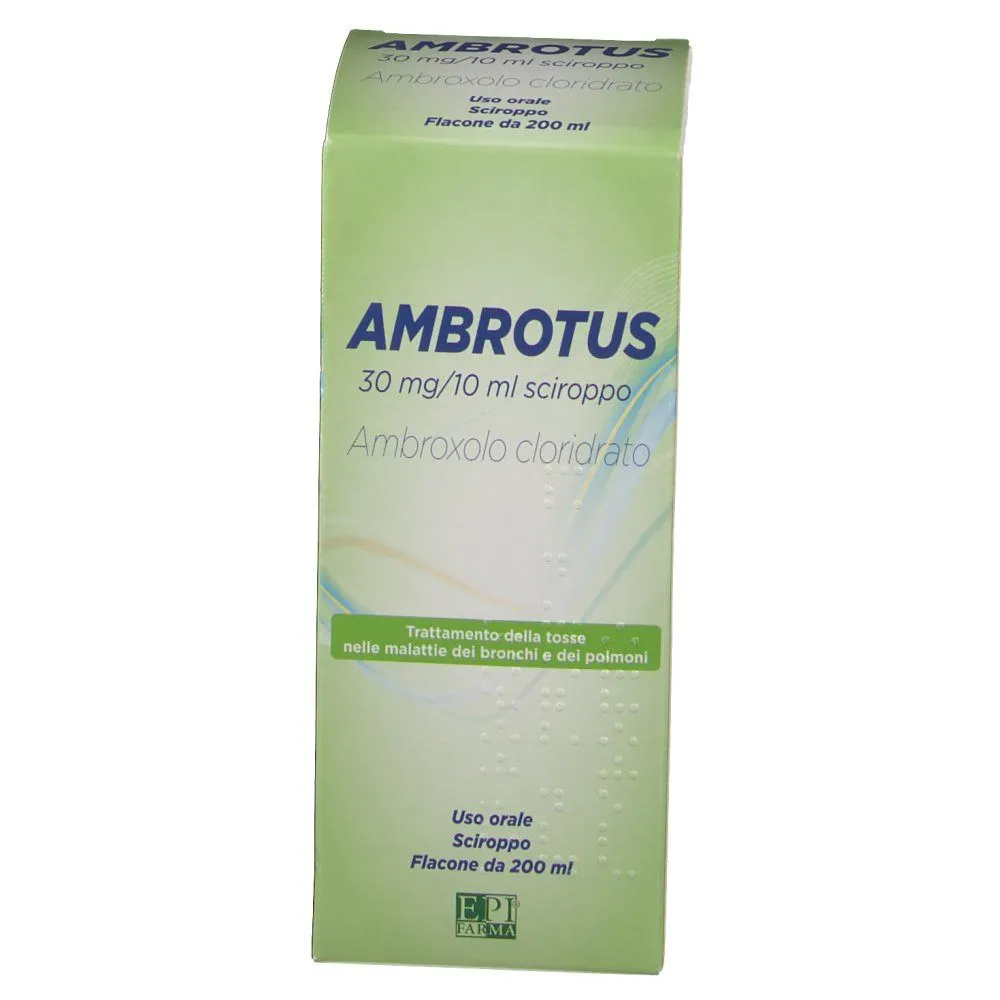
Table of Contents
- Package leaflet: Information for the patient
- AMBROTUS 15mg/2ml nebulising solution
- 1. What AMBROTUS is and what it is used for
- 2. What you should know before using AMBROTUS
- 3. How to use AMBROTUS
- 4. Possible side effects
- 5. How to store AMBROTUS
- 6. Package contents and other information
- Package leaflet: information for the patient
- AMBROTUS 30 mg/10 ml syrup bottle 200 ml, 30 mg/10 ml syrup single-dose containers 10 ml
- 1. What AMBROTUS is and what it is used for
- 2. What you need to know before taking AMBROTUS
- 3. How to take AMBROTUS
- 4. Possible side effects
- 5. How to store AMBROTUS
- 6. Package contents and other information
Package leaflet: Information for the patient
AMBROTUS 15mg/2ml nebulising solution
Ambroxol hydrochloride
Please read all of this leaflet carefully before using this medicine because it contains important information for you.
Use this medicine exactly as described in this leaflet or as your doctor or pharmacist has told you to do.
- Keep this leaflet. You may need to read it again.
- If you need more information or advice, consult your pharmacist.
- If you experience any side effects, including those not listed in this leaflet, contact your doctor or pharmacist. See section 4.
- Contact your doctor if you do not notice any improvement or if your symptoms worsen after a short period of treatment.
Contents of this leaflet:
- What AMBROTUS is and what it is used for
- What you need to know before using AMBROTUS
- How to use AMBROTUS
- Possible side effects
- How to store AMBROTUS
- Contents of the pack and other information
1. What AMBROTUS is and what it is used for
Ambrotus contains ambroxol, an active substance that works by dissolving mucus and facilitating its elimination.
AMBROTUS is used in adults and children for the treatment of secretions in acute and chronic diseases of the bronchi and lungs (i.e. in case of cough and difficulty in expelling mucus from the bronchi due to increased or thickened mucus).
2. What you should know before using AMBROTUS
Do not use AMBROTUS
- if you are allergic to ambroxol or to any of the other ingredients of this medicine (listed in section 6);
- if you have severe liver or kidney problems (severe hepatic and/or renal impairment).
Warnings and precautions
Talk to your doctor or pharmacist before using AMBROTUS.
Use this medicine with caution and inform your doctor:
- if you have or have had stomach and/or intestinal lesions (peptic ulcer).
Severe skin reactions have been reported with ambroxol administration. If you develop a skin rash (including lesions of mucous membranes such as mouth, throat, nose, eyes, genitals), stop using AMBROTUS and contact your doctor immediately.
These reactions could be symptoms of serious skin diseases characterized by skin peeling and severe skin toxicity (Stevens-Johnson Syndrome and Toxic Epidermal Necrolysis).
Additionally, during the initial phase of Stevens-Johnson Syndrome or Toxic Epidermal Necrolysis (TEN), you may experience non-specific symptoms resembling those of influenza, such as fever, chills, runny nose (rhinitis), cough, and sore throat. Due to these misleading symptoms, symptomatic treatment with cough and cold remedies might be restarted.
Other medicines and AMBROTUS
Inform your doctor or pharmacist if you are taking, have recently taken, or might take any other medicines.
In particular, following administration of ambroxol, increased concentrations of antibiotics (amoxicillin, cefuroxime, erythromycin) have been observed in bronchopulmonary secretions and saliva.
Pregnancy, breastfeeding and fertility
If you are pregnant, think you may be pregnant, planning a pregnancy, or breastfeeding, consult your doctor or pharmacist before using this medicine.
Pregnancy
- If you are in the first 3 months of pregnancy, the use of Ambrotus is not recommended.
- Use AMBROTUS from the 4th to the 9th month of pregnancy only on medical advice.
Breastfeeding
- If you are breastfeeding, the use of AMBROTUS is not recommended.
Fertility
- AMBROTUS has no effect on fertility.
Driving and using machines
Ambrotus does not affect the ability to drive vehicles or operate machinery.
3. How to use AMBROTUS
Use this medicine exactly as stated in this leaflet or as instructed by your doctor or pharmacist. If you have any doubts, consult your doctor or pharmacist.
The recommended dose is:
Adults and children over 5 years of age: 2–3 vials per day.
Children under 5 years of age: 1–2 vials per day.
Warning: Do not exceed the recommended doses without medical advice.
Ambrotus nebulizing solution can be administered using various inhalation devices.
Your doctor will advise whether this medicine should be diluted with physiological solution (saline solution). If dilution is required, equal parts should be used (the same amount of medicine and physiological solution).
Do not mix Ambrotus nebulizing solution with other solutions if the resulting mixture has a pH greater than 6.3 (e.g. when using Emser salts), as an increase in pH may cause clouding of the solution.
Since inhalation itself may provoke coughing, breathe normally during the inhalation.
It is recommended to warm the solution to body temperature by holding the vial in your hands before use.
If you suffer from asthma, use your usual bronchospasmolytic (medication used for the treatment of asthma) before inhalation.
Consult your doctor if symptoms recur, if you have noticed any recent changes in their pattern, or if symptoms worsen or do not improve.
If you use more AMBROTUS than you should
In case of accidental ingestion/overdose of Ambrotus, contact your doctor immediately or go to the nearest hospital.
If you forget to use AMBROTUS
Do not use a double dose to make up for the missed dose.
If you stop using AMBROTUS
If you have any questions about the use of this medicine, consult your doctor or pharmacist.
4. Possible side effects
Like all medicines, this medicine can cause side effects, although not everybody will experience them.
The following side effects may occur with the use of Ambrotus:
Common (may affect up to 1 in 10 people)
- nausea, taste disturbances (dysgeusia), numbness of the mouth and tongue (oral hypoaesthesia), and numbness of the throat (pharyngeal hypoaesthesia);
Uncommon (may affect up to 1 in 100 people)
- vomiting, diarrhoea, abdominal pain, difficulty in digestion (dyspepsia), dry mouth;
Rare (may affect up to 1 in 1,000 people)
- hypersensitivity reactions, skin rash (rash), appearance of red spots on the skin accompanied by itching (urticaria), dryness of the throat, difficulty in passing urine (dysuria), fatigue.
Not known (frequency cannot be estimated from the available data)
- anaphylactic reactions, including anaphylactic shock, angioedema (rapid swelling of the skin, subcutaneous tissues, mucosa, and submucosal tissues), and pruritus;
- severe cutaneous adverse reactions (including erythema multiforme, Stevens-Johnson syndrome / toxic epidermal necrolysis, and acute generalized exanthematous pustulosis);
- heartburn (pyrosis).
These side effects are usually temporary. If they occur, consult your doctor or pharmacist.
Reporting of side effects
If you experience any side effects, including those not listed in this leaflet, please contact your doctor or pharmacist. You may also report side effects directly via the national reporting system at www.aifa.gov.it/content/segnalazioni-reazioni-avverse.
By reporting side effects, you can help provide more information on the safety of this medicine.
5. How to store AMBROTUS
Keep this medicine out of sight and reach of children.
Do not use this medicine after the expiry date stated on the packaging after "Exp".
The expiry date refers to the last day of that month.
This medicine does not require any special storage conditions.
Do not dispose of medicines via wastewater or household waste. Ask your pharmacist how to
dispose of medicines you no longer use. This will help protect the environment.
6. Package contents and other information
What AMBROTUS contains
One vial contains:
- The active substance is ambroxol hydrochloride. 2 ml of nebulising solution contain 15 mg of ambroxol hydrochloride.
- The other components are: monosodium phosphate monohydrate, disodium phosphate dihydrate, water for injections.
Description of the appearance of AMBROTUS and contents of the pack
Ambrotus is a solution for nebulisation. It is available in packs containing
10 vials of 2 ml each.
Marketing Authorisation Holder
Epifarma S.r.l. - Via San Rocco, 6 – 85033 Episcopia (PZ)
Manufacturer
Esseti Farmaceutici S.r.l. - Via Campobello, 15 - 00071 Pomezia – Rome
Package leaflet: information for the patient
AMBROTUS 30 mg/10 ml syrup bottle 200 ml, 30 mg/10 ml syrup single-dose containers 10 ml
Ambroxol hydrochloride
Please read all of this leaflet carefully before taking this medicine because it contains important information for you.
Always take this medicine exactly as described in this leaflet or as your doctor or pharmacist has instructed you.
- Keep this leaflet. You may need to read it again.
- If you need more advice or information, consult your pharmacist.
- If you experience any side effects, including those not listed in this leaflet, talk to your doctor or pharmacist. See section 4.
- Consult your doctor if you do not notice any improvement or if your symptoms worsen after 2 weeks of treatment.
Contents of this leaflet:
- What AMBROTUS is and what it is used for
- What you need to know before taking AMBROTUS
- How to take AMBROTUS
- Possible side effects
- How to store AMBROTUS
- Contents of the pack and other information
1. What AMBROTUS is and what it is used for
Ambrotus contains ambroxol, an active substance that works by liquefying mucus and facilitating its elimination.
AMBROTUS is used in adults and children over 2 years of age for the treatment of secretions in acute and chronic diseases of the bronchi and lungs (i.e. in the presence of cough and difficulty in expelling mucus from the bronchi due to increased amount or thickness).
2. What you need to know before taking AMBROTUS
Do not take AMBROTUS
- if you are allergic to ambroxol or to any of the other ingredients of this medicine (listed in section 6);
- if you have severe liver or kidney problems;
- if the person taking this medicine is a child under 2 years of age (See section “Children”).
Warnings and precautions
Talk to your doctor or pharmacist before taking AMBROTUS.
Take this medicine with caution and inform your doctor:
- if you have or have had stomach and/or intestinal lesions (peptic ulcer).
Serious skin reactions have been reported with ambroxol administration. If you develop a skin rash (including lesions of mucous membranes such as mouth, throat, nose, eyes, genitals), stop taking AMBROTUS and contact your doctor immediately.
These reactions may be symptoms of severe skin disorders characterized by skin peeling and severe skin toxic reaction (Stevens-Johnson syndrome and Toxic Epidermal Necrolysis).
Additionally, during the initial phase of Stevens-Johnson syndrome or Toxic Epidermal Necrolysis (TEN), you may experience non-specific symptoms resembling those of influenza, such as fever, chills, runny nose (rhinitis), cough, and sore throat. Due to these misleading symptoms, symptomatic treatment with cough and cold therapy might be restarted.
Children
Do not give this medicine to children under 2 years of age. Mucolytics may cause bronchial obstruction in children under 2 years of age. Indeed, the ability to drain bronchial mucus is limited in this age group due to the physiological characteristics of the respiratory tract.
Other medicines and AMBROTUS
Inform your doctor or pharmacist if you are taking, have recently taken, or might take any other medicines.
In particular, after administration of ambroxol, concentrations of antibiotics (amoxicillin, cefuroxime, erythromycin) in bronchopulmonary secretions and saliva are increased.
Mucosolvan with food and drink
You may take Ambrotus either on an empty or full stomach.
Pregnancy, breastfeeding and fertility
If you are pregnant, think you may be pregnant or are planning to become pregnant, or if you are breastfeeding, ask your doctor or pharmacist for advice before taking this medicine.
Pregnancy
- If you are in the first 3 months of pregnancy, the use of AMBROTUS is not recommended.
- Take Ambrotus from the 4th to the 9th month of pregnancy only on medical advice.
Breastfeeding
- If you are breastfeeding, the use of AMBROTUS is not recommended.
Fertility
- Ambrotus has no effect on fertility.
Driving and using machines
Ambrotus does not affect the ability to drive vehicles or operate machinery.
AMBROTUS contains sorbitol, benzoic acid and propylene glycol
This medicine contains 350 mg of sorbitol per ml. Sorbitol is a source of fructose. If your doctor has told you that you (or the child) are intolerant to certain sugars, or if you have been diagnosed with hereditary fructose intolerance, a rare genetic disorder in which patients cannot metabolize fructose, speak with your doctor before you (or the child) take this medicine.
It may cause gastrointestinal disturbances and has a mild laxative effect.
This medicine contains 2 mg of benzoic acid per ml.
This medicine contains 30 mg of propylene glycol per ml.
3. How to take AMBROTUS
Take this medicine exactly as stated in this leaflet or as instructed by your doctor or pharmacist. If you have any doubts, consult your doctor or pharmacist.
The recommended dose is:
Adults: 10 ml three times daily.
Children over 5 years of age: 5 ml three times daily.
Children from 2 to 5 years of age: 2.5 ml three times daily.
Warning: Do not exceed the recommended doses without medical advice.
Consult your doctor if symptoms recur repeatedly, if you have noticed any recent changes in their characteristics, or if symptoms worsen or do not improve.
If you take more AMBROTUS than you should
In case of accidental ingestion or overdose of Ambrotus, contact your doctor immediately or go to the nearest hospital.
If you forget to take AMBROTUS
Do not take a double dose to make up for the forgotten dose.
If you stop taking Ambrotus
If you have any doubts about how to use this medicine, consult your doctor or pharmacist.
4. Possible side effects
Like all medicines, this medicine can cause side effects, although not everybody gets them.
The following side effects may occur with the use of Ambrotus:
Common (may affect up to 1 in 10 people)
- nausea, altered taste (dysgeusia), numbness of the mouth and tongue (oral hypoaesthesia), numbness of the throat (pharyngeal hypoaesthesia);
Uncommon (may affect up to 1 in 100 people)
- vomiting, diarrhoea and abdominal pain, difficulty in digestion (dyspepsia), dry mouth;
Rare (may affect up to 1 in 1000 people)
- hypersensitivity reactions, skin rash, appearance of red spots on the skin accompanied by itching (urticaria), dryness of the throat, difficulty in passing urine (dysuria), fatigue;
Not known (frequency cannot be estimated from the available data)
- anaphylactic reactions, including anaphylactic shock, angioedema (rapid swelling of the skin, subcutaneous tissues, mucosa and submucosal tissues), and itching;
- serious cutaneous adverse reactions (including erythema multiforme, Stevens-Johnson syndrome / toxic epidermal necrolysis, and acute generalised exanthematous pustulosis);
- bronchial obstruction;
- heartburn (pyrosis).
These side effects are usually temporary. If they occur, consult your doctor or pharmacist.
Reporting of side effects
If you experience any side effect, including those not listed in this leaflet, tell your doctor or pharmacist. You can also report side effects directly via the national reporting system at www.aifa.gov.it/content/segnalazioni-reazioni-avverse.
By reporting side effects, you can help provide more information on the safety of this medicine.
5. How to store AMBROTUS
Keep this medicine out of the sight and reach of children.
Do not use this medicine after the expiry date stated on the packaging after "Exp".
The expiry date refers to the last day of that month.
This medicine does not require any special storage conditions.
Do not dispose of any medicine via wastewater or household waste. Ask your pharmacist how to
dispose of medicines you no longer use. This will help protect the environment.
6. Package contents and other information
What AMBROTUS 30mg/10ml syrup 200 ml bottle contains
- The active substance is ambroxol hydrochloride. 100 ml of syrup contain 300 mg of ambroxol hydrochloride.
- The other components are: hydroxyethylcellulose, sorbitol 70%, glycerol, benzoic acid, sour cherry flavour, propylene glycol, tartaric acid, purified water.
What AMBROTUS 30mg/10ml syrup single-dose containers 10 ml contain
- The active substance is ambroxol hydrochloride. Each single-dose container contains 30 mg of ambroxol hydrochloride.
- The other components are: hydroxyethylcellulose, sorbitol 70%, glycerol, benzoic acid, sour cherry flavour, propylene glycol, tartaric acid, purified water.
Description of the appearance of AMBROTUS and contents of the pack
Ambrotus is a syrup. It is available in a pack containing one 200 ml bottle and an oral dosing syringe, and in a pack containing 20 single-dose containers of 10 ml each.
Marketing Authorization Holder
EPIFARMA S.r.l. - Via San Rocco, 6 – 85033 Episcopia (PZ)
Manufacturer
AMBROTUS 30 mg/10 ml syrup 200 ml bottle:
Special Product Line S.p.A. - Via Fratta Rotonda Vado Largo, 1 - 03012 - Anagni (FR)
AMBROTUS 30 mg/10 ml syrup single-dose containers 10 ml:
Esseti Farmaceutici S.r.l. - Via Campobello, 15 - 00071 Pomezia – Roma