Ambisome liposomal
Italy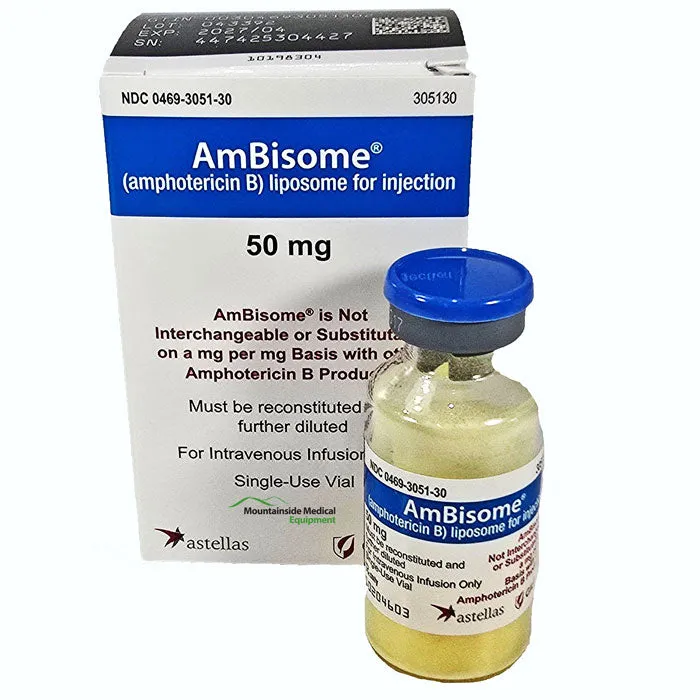
Table of Contents
- Package leaflet: Information for the patient
- AmBisome liposomal 50 mg powder for dispersion for infusion
- 1. What AmBisome is and what it is used for
- 2. What you should know before using AmBisome
- 3. How to use AmBisome
- 4. Possible side effects
- 5. How to store AmBisome
- 6. Package contents and other information
Package leaflet: Information for the patient
AmBisome liposomal 50 mg powder for dispersion for infusion
Please read this leaflet carefully before using this medicine because it contains important information for you.
- Keep this leaflet. You may need to read it again.
- If you have any questions, ask your doctor, pharmacist, or nurse.
- This medicine has been prescribed for you only. Do not give it to other people, even if their symptoms are the same as yours, as it may be harmful.
- If you experience any side effect, including those not listed in this leaflet, tell your doctor or pharmacist. See section 4.
Contents of this leaflet:
- What AmBisome is and what it is used for
- What you need to know before using AmBisome
- How to use AmBisome
- Possible side effects
- How to store AmBisome
- Contents of the pack and other information
1. What AmBisome is and what it is used for
AmBisome contains the active substance Amphotericin B, which is administered by infusion for the
treatment of:
- presumed fungal infections in patients with febrile neutropenia (a condition of low levels of neutrophils, a type of white blood cells, associated with fever)
- serious systemic and/or deep fungal infections such as: candidiasis, aspergillosis, mucormycosis, chronic mycetoma, and HIV-associated cryptococcal meningitis.
AmBisome may also be effective in the following fungal infections:
- North American blastomycosis
- coccidioidomycosis
- histoplasmosis, mucormycosis caused by species of the genera Mucor, Rhizopus, Absidia, Entomophtora, and Basidiobolus
- sporotrichosis caused by Sporothrix schenckii.
Your doctor should not administer this medicine to you if you have a common subclinical form of fungal infection that shows only positive skin or serological tests.
2. What you should know before using AmBisome
Do not use AmBisome:
- if you are allergic to the active substance or to any of the other ingredients of this medicine (listed in section 6).
- if you are allergic to peanuts or soya.
Warnings and precautions
Talk to your doctor or pharmacist before receiving AmBisome.
Kidney-related adverse reactions have been reported, and caution should be exercised during prolonged therapy.
- If you are taking other medicines that may cause kidney damage, see section Other medicines and AmBisome. AmBisome can cause kidney damage. Your doctor or nurse will take blood samples to measure creatinine (a chemical in the blood that reflects kidney function) and levels of electrolytes (particularly potassium and magnesium) before and during treatment with AmBisome, as both may become abnormal if kidney function is impaired. This is especially important if you have previously had kidney damage or if you are taking other medicines that may affect how your kidneys work. Blood samples will also be examined to detect any liver changes and to assess your body’s ability to produce new blood cells and platelets. If blood tests show a change in kidney function or other significant changes, your doctor may prescribe a lower dose of AmBisome or stop treatment.
- If blood tests show that your potassium levels are low, your doctor may prescribe a potassium supplement to be taken during treatment with AmBisome.
- If blood tests show that your potassium levels are high, you may experience irregular heartbeat, sometimes severe.
Allergic reactions such as anaphylaxis and anaphylactoid or other types of reactions have been reported following AmBisome infusion.
If a severe anaphylactic/anaphylactoid reaction occurs, the infusion must be immediately stopped and the medicine must not be administered again.
Cases of acute pulmonary toxicity have been reported in patients who received amphotericin B during or shortly after leukocyte transfusions. In such cases, the infusions should be administered separately, spaced as far apart in time as possible, and your lung function should be monitored.
If you are diabetic, your doctor should be aware that each vial of AmBisome contains approximately 900 mg of sucrose.
Other medicines and AmBisome
Tell your doctor or pharmacist if you are taking, have recently taken, or might take any other medicines.
Concomitant administration of amphotericin B with other nephrotoxic agents (harmful to the kidneys) (e.g. cyclosporine, aminoglycosides, and pentamidine) may increase, in some patients, the risk of kidney toxicity caused by the drug. However, in patients who have received cyclosporine and/or aminoglycosides concomitantly, AmBisome has been associated with significantly lower nephrotoxicity compared to conventional amphotericin B.
If your doctor administers AmBisome together with any other nephrotoxic medicine, regular monitoring of kidney function is recommended.
Concomitant use with corticosteroids, ACTH (adrenocorticotropic hormone), and diuretics may worsen AmBisome-induced hypokalaemia (potassium deficiency).
Hypokalaemia caused by AmBisome may enhance the toxicity of digitalis (medicines that support heart function).
AmBisome-induced hypokalaemia may accentuate the curare-mimetic effect (curare-like action) of skeletal muscle relaxants (e.g. tubocurarine).
Concomitant use with flucytosine (an antifungal medicine) may increase the toxicity of AmBisome.
Concomitant use with antineoplastic agents (cancer medicines) may cause kidney toxicity, bronchospasm (contraction of airway muscles), and hypotension (low blood pressure); the use of such combinations requires careful assessment of the risk/benefit ratio by the doctor.
The use of amphotericin B during or shortly after leukocyte transfusions may cause pulmonary toxicity.
Pregnancy and breastfeeding
If you are pregnant, suspect you may be pregnant, planning a pregnancy, or breastfeeding, your doctor must decide whether the potential benefits outweigh the potential risks for both you and the baby.
Driving and using machines
Some of the side effects of AmBisome described in section 4 may affect your ability to drive or use machinery.
AmBisome contains
AmBisome liposomal 50 mg powder for infusion concentrate contains approximately 900 mg of sucrose per vial. This should be taken into account if you have diabetes.
Ambisome, at the maximum daily dose of 5 mg/kg, contains 49 mg of sodium, equivalent to 2.5% of the maximum daily intake recommended by the WHO, which corresponds to 2 g of sodium for an adult.
3. How to use AmBisome
Your doctor will decide the most appropriate dosage for you.
AmBisome must be administered by intravenous infusion over a period of 30–60 minutes. For doses exceeding 5 mg/kg/day, intravenous infusion over a period of 2 hours is recommended.
Adult patients
Empirical treatment of febrile neutropenia
The recommended daily dose is 3 mg/kg.
Treatment of systemic and/or deep mycoses
The recommended dose is 3.0 mg/kg per day.
Treatment of mucormycosis
Higher doses may be required for mucormycosis: the recommended daily dose is 5–10 mg/kg body weight. The duration of therapy will be determined by your doctor on an individual basis.
Treatment of HIV-associated cryptococcal meningitis
Treatment consists of a single dose of AmBisome 10 mg/kg body weight on the first day of treatment, as an induction phase of therapy, which will then continue according to the recommendations of the most up-to-date Guidelines.
Patients with renal impairment
In patients with pre-existing renal impairment, AmBisome has been administered at initial doses ranging from 1 to 3 mg/kg/day, without the need for dose adjustment or change in frequency of administration. Regular monitoring of renal function is recommended. There are no data on the use of AmBisome at doses exceeding 3 mg/kg per day in patients with pre-existing renal failure.
Patients with hepatic impairment
There are no data on potential dose adjustments in patients with hepatic impairment.
Paediatric population
In children, AmBisome is administered at doses similar to those used in adults, based on body weight.
Elderly
No dose adjustment or change in frequency of administration is required.
4. Possible side effects
Like all medicines, this medicine can cause side effects, although not everybody gets them.
Very common (may affect more than 1 in 10 people)
- nausea
- vomiting
- cold symptoms
- fever
- hypokalaemia (reduced potassium levels in the blood)
Common (may affect up to 1 in 10 people) - tachycardia (rapid heartbeat)
- vasodilation
- flushing
- hypotension (low blood pressure)
- dyspnoea (breathing difficulty)
- diarrhoea
- abdominal pain
- abnormal liver function test
- rash
- back pain
- chest pain
- headache
- elevated potassium levels in the blood
- hypomagnesaemia (reduced magnesium levels in the blood)
- hypocalcaemia (reduced calcium levels in the blood)
- hyperglycaemia (increased blood glucose)
- hyponatraemia (reduced sodium levels in the blood)
- hyperbilirubinaemia (high bilirubin in the blood)
- increased alkaline phosphatase
- increased creatinine
- increased blood urea
Uncommon (may affect up to 1 in 100 people) - bronchospasm (contraction of airway muscles)
- anaphylactoid reaction (allergic reaction)
- seizures
- thrombocytopenia (low platelet count)
Not known (frequency cannot be estimated from the available data) - cardiac arrest
- arrhythmia (changes in heart rhythm)
- angioedema (severe allergic reaction with swelling of the face, neck, tongue, lips)
- rhabdomyolysis (severe muscle damage) associated with hypokalaemia (reduced potassium levels in the blood)
- musculoskeletal pain
- renal function abnormalities
- renal failure
- anaemia
- anaphylactic reactions
- hypersensitivity
Laboratory findings
- a false increase in serum phosphate levels may occur when samples from patients treated with AmBisome are analysed using the PHOSm test.
Reporting of side effects
If you experience any side effect, including those not listed in this leaflet, talk to your doctor, pharmacist, or nurse. You can also report side effects directly via the national reporting system at: https://www.aifa.gov.it/content/segnalazioni-reazioni-avverse
By reporting side effects, you can help provide more information on the safety of this medicine.
5. How to store AmBisome
Keep this medicine out of the sight and reach of children.
Store the sealed vials of lyophilized powder at a temperature not exceeding 25°C.
Do not use this medicine after the expiry date stated on the carton after "Exp.:". The expiry date refers to the last day of that month.
Do not dispose of any medicine via wastewater or household waste. Ask your pharmacist how to dispose of medicines you no longer use. This will help protect the environment.
6. Package contents and other information
What AmBisome contains
- The active substance is liposomal amphotericin B, equivalent to 50 mg of amphotericin B.
- The other components are:
- sucrose
- hydrogenated soybean lecithin
- distearoyl lecithin
- cholesterol
- alpha tocopherol
- sodium succinate hexahydrate (sodium salt)
Description of the appearance of AmBisome and contents of the pack
Powder for dispersion for infusion in a pack containing 10 vials and 10 individual filters of
5 microns.
Marketing Authorisation Holder and Manufacturer
Holder:
Gilead Sciences S.r.l.
Via Melchiorre Gioia, 26
20124 Milan
Italy
Tel. +39 02 439201
Manufacturer:
Gilead Sciences Ireland UC
IDA Business & Technology Park
Carrigtohill, Co Cork
Ireland
<------------------------------------------------------------------------------------------------------------------------>
The following information is intended for healthcare professionals only:
READ THE ENTIRE PARAGRAPH CAREFULLY BEFORE PROCEEDING WITH
RECONSTITUTION
AmBisome is NOT interchangeable with other amphotericin-containing medicinal products.
AmBisome must be reconstituted using sterile water for injections (without bacteriostatic agents) and diluted exclusively in glucose infusion solution (5%, 10%, or 20%).
The use of solutions other than those recommended, or the presence of bacteriostatic agents (e.g. benzyl alcohol) in the solution, may cause precipitation of AmBisome.
AmBisome is NOT compatible with saline solutions and must not be reconstituted or diluted with saline solutions, nor administered via an intravenous catheter previously used for saline solution, unless it is first flushed with glucose infusion solution (5%, 10%, or 20%).
If this is not possible, AmBisome must be administered through a separate catheter.
DO NOT mix AmBisome with other drugs or electrolytes.
Aseptic technique must be strictly maintained throughout all procedures, as no preservative or bacteriostatic agent is present in AmBisome or in the materials specified for reconstitution and dilution.
AmBisome vials containing 50 mg of amphotericin B should be prepared as follows:
If more than one vial needs to be reconstituted, complete the entire reconstitution and dispersion process of one vial before adding sterile water to the next vial.
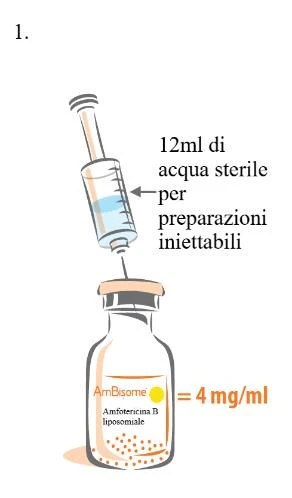
- Add 12 ml of sterile water for injections to each AmBisome vial to obtain a preparation containing 4 mg/ml of amphotericin B.
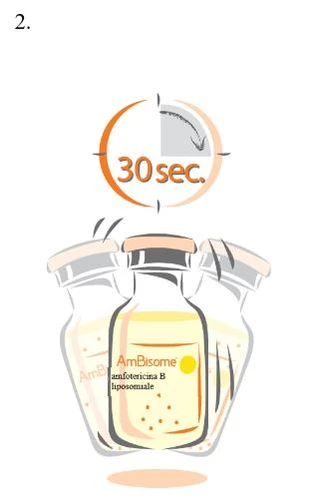
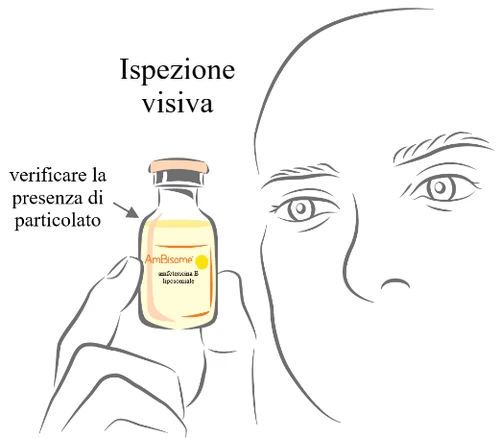
- IMMEDIATELY after adding water, VIGOROUSLY SHAKE THE VIAL for 30 seconds to completely dissolve AmBisome. After reconstitution, the concentrate appears as a semi-transparent yellow dispersion. Visually inspect the vial for particulate matter and continue shaking until complete dispersion is achieved. Do not use if precipitation of foreign material is observed.
- Calculate the required volume of reconstituted AmBisome (4 mg/ml) for further dilution (see table below).
- The infusion solution is obtained by diluting reconstituted AmBisome with glucose infusion solution (5%, 10%, or 20%) at a ratio of one (1) to nineteen (19) parts by volume, to achieve a final concentration within the recommended range of 2.0 mg/ml to 0.2 mg/ml of amphotericin as AmBisome (see table below).
- Withdraw the calculated volume of reconstituted AmBisome into a sterile syringe. Using the supplied 5-micron filter, transfer the AmBisome preparation into a sterile container with the appropriate amount of glucose infusion solution (5%, 10%, or 20%).
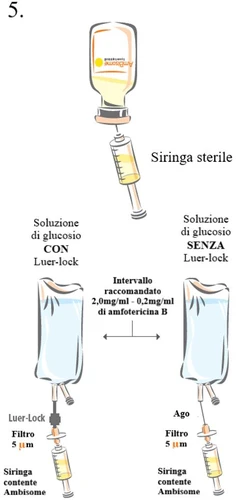
An in-line filter may be used for intravenous infusion of AmBisome. However, the average pore size of the filter must not be less than 1.0 micron.
Example of preparation of AmBisome infusion dispersion at a dose of 3 mg/kg in 5% glucose infusion solution.
| Weight (kg) | Number of vials | Amount of AmBisome (mg) to be withdrawn for further dilution | Volume of reconstituted AmBisome (ml) | To obtain a concentration of 0.2 mg/ml (1:20 dilution) | To obtain a concentration of 2.0 mg/ml (1:2 dilution) | ||
| Volume of 5% glucose required (ml) | Total volume (ml; AmBisome plus 5% glucose) | Volume of 5% glucose required (ml) | Total volume (ml; AmBisome plus 5% glucose) | ||||
| 10 | 1 | 30 | 7.5 | 142.5 | 150 | 7.5 | 15 |
| 25 | 2 | 75 | 18.75 | 356.25 | 375 | 18.75 | 37.5 |
| 40 | 3 | 120 | 30 | 570 | 600 | 30 | 60 |
| 55 | 4 | 165 | 41.25 | 783.75 | 825 | 41.25 | 82.5 |
| 70 | 5 | 210 | 52.5 | 997.5 | 1050 | 52.5 | 105 |
| 85 | 6 | 255 | 63.75 | 1211.25 | 1275 | 63.75 | 127.5 |
Each vial of AmBisome liposomal 50 mg is reconstituted with 12 ml of water for injections to provide a concentration of 4 mg/ml of amphotericin B.
Any unused medicinal product and waste materials derived from this medicinal product must be disposed of in accordance with local regulations.