Alphanate
Italy
Table of Contents
- PACKAGE LEAFLET: INFORMATION FOR THE USER
- Alphanate 250 IU + 300 IU / 5 ml Powder and solvent for solution for infusion, 500 IU + 600 IU / 5 ml Powder and solvent for solution for infusion, 1000 IU + 1200 IU / 10 ml Powder and solvent for solution for infusion, 1500 IU + 1800 IU / 10 ml Powder and solvent for solution for infusion, 2000 IU + 2400 IU / 10 ml Powder and solvent for solution for infusion
- 1. WHAT ALPHANATE IS AND WHAT IT IS USED FOR
- 2. WHAT YOU SHOULD KNOW BEFORE USING ALPHANATE
- 3. HOW TO USE ALPHANATE
- 4. POSSIBLE ADVERSE REACTIONS
- 5. HOW TO STORE ALPHANATE
- 6. PACKAGING CONTENTS AND OTHER INFORMATION
PACKAGE LEAFLET: INFORMATION FOR THE USER
Alphanate 250 IU + 300 IU / 5 ml Powder and solvent for solution for infusion, 500 IU + 600 IU / 5 ml Powder and solvent for solution for infusion, 1000 IU + 1200 IU / 10 ml Powder and solvent for solution for infusion, 1500 IU + 1800 IU / 10 ml Powder and solvent for solution for infusion, 2000 IU + 2400 IU / 10 ml Powder and solvent for solution for infusion
Human coagulation Factor VIII and human von Willebrand Factor complex.
Please read this leaflet carefully before using this medicine because it contains important information for you.
- Keep this leaflet. You may need to read it again.
- If you have any questions, ask your doctor, pharmacist, or nurse.
- This medicine has been prescribed for you only. Do not give it to other people, even if their symptoms are the same as yours, as it may be harmful.
- If you experience any adverse reaction, including those not listed in this leaflet, contact your doctor, pharmacist, or nurse. See section 4.
Contents of this leaflet:
- What Alphanate is and what it is used for
- What you need to know before using Alphanate
- How to use Alphanate
- Possible side effects
- How to store Alphanate
- Contents of the pack and other information
1. WHAT ALPHANATE IS AND WHAT IT IS USED FOR
Alphanate is a lyophilized powder for solution for infusion, nominally containing 250 IU, 500 IU, 1000 IU, 1500 IU, or 2000 IU of human coagulation factor VIII and 300 IU, 600 IU, 1200 IU, 1800 IU, or 2400 IU of human von Willebrand factor (VWF) per vial.
After reconstitution with 5 ml (for the 250 IU and 500 IU presentations) or 10 ml (for the 1000 IU, 1500 IU, and 2000 IU presentations) of water for injections, the product contains approximately:
Alphanate 250 IU + 300 UI / 5 ml: Contains 50 IU of FVIII/ml and 60 IU of VWF/ml
Alphanate 500 IU + 600 UI / 5 ml: Contains 100 IU of FVIII/ml and 120 IU of VWF/ml
Alphanate 1000 IU + 1200 UI / 10 ml: Contains 100 IU of FVIII/ml and 120 IU of VWF/ml
Alphanate 1500 IU + 1800 UI / 10 ml: Contains 150 IU of FVIII/ml and 180 IU of VWF/ml
Alphanate 2000 IU + 2400 UI / 10 ml: Contains 200 IU of FVIII/ml and 240 IU of VWF/ml
Alphanate belongs to the group of medicines known as coagulation factors.
Alphanate is used for:
- Treatment and prophylaxis of bleeding episodes in patients with haemophilia A (congenital factor VIII deficiency). Alphanate may be used in the treatment of acquired factor VIII deficiency.
- Treatment of haemophilia A patients with factor VIII inhibitors (antibodies).
- Prophylaxis and treatment of bleeding or surgical bleeding in von Willebrand disease (VWD) when treatment with desmopressin (DDAVP) alone is ineffective or contraindicated.
2. WHAT YOU SHOULD KNOW BEFORE USING ALPHANATE
Do not use Alphanate
- If you are allergic to human coagulation factor VIII or human von Willebrand factor or to any of the other ingredients of this medicine (listed in section 6).
If you would like more information, ask your doctor.
Warnings and precautions
Talk to your doctor, pharmacist, or nurse before using Alphanate.
- Rarely, an anaphylactic reaction (a severe and sudden allergic reaction) may occur, presenting symptoms such as hives, generalized urticaria, chest tightness, wheezing, hypotension (low blood pressure), dizziness, lightheadedness, nausea, or vertigo upon standing. If these symptoms occur, you must stop using the product immediately and contact your doctor. In case of shock, standard shock management guidelines must be followed.
- Your doctor should perform tests to ensure that the dose of Alphanate you are receiving is sufficient to achieve and maintain an appropriate factor VIII level, thereby controlling any bleeding.
- The development of inhibitors (antibodies) is a known complication that may occur during treatment with all factor VIII medicines. Inhibitors, especially at high levels, may prevent the treatment from working properly, and you or your child will be closely monitored for the development of such inhibitors. If Alphanate does not control bleeding in you or your child, inform your doctor immediately.
- During treatment for von Willebrand disease, there is a risk of developing blood clots (thrombotic events), especially if clinical risk factors are known. Therefore, your doctor should perform tests to identify any signs of clotting and prescribe treatment if necessary.
- Patients with von Willebrand disease, particularly type 3, may develop neutralizing antibodies against von Willebrand factor (inhibitors). Your doctor should perform additional blood tests to check whether inhibitors are present in the blood.
Viral safety
When medicines are manufactured from human blood or plasma, specific measures are taken to prevent transmission of infections to patients. These measures include:
- Careful selection of blood and plasma donors to ensure that potentially infected donors are excluded.
- Testing of each individual donation and plasma pool (a mixture of multiple donations) to detect the presence of viruses/infections.
- Inclusion of certain steps in the processing of blood or plasma capable of inactivating or removing viruses. Despite these measures, when administering medicines prepared from human blood or plasma, the possibility of transmitting infectious agents cannot be completely ruled out. This also applies to emerging or unknown viruses or other types of infectious agents.
The measures taken are considered effective against enveloped viruses such as human immunodeficiency virus (HIV), hepatitis B virus (HBV), and hepatitis C virus (HCV). The measures may have limited effectiveness against non-enveloped viruses such as hepatitis A virus (HAV) and parvovirus B19. Parvovirus B19 infection may be severe in pregnant women (fetal infection) and in immunocompromised individuals (those with a weakened immune system) or those with certain types of anemia (e.g., sickle cell anemia or hemolytic anemia).
Your doctor may recommend vaccination against hepatitis A and B if you receive repeated or regular infusions of factor VIII and von Willebrand factor derived from human plasma.
It is recommended to record, for each administration of Alphanate, the product name and batch number to ensure traceability of the batches used.
See also section 4.
Other medicines and Alphanate
Inform your doctor or pharmacist if you are taking, have recently taken, or might take any other medicines.
No interactions of Alphanate with other medicines are known.
Pregnancy and breastfeeding
If you are pregnant, suspect you may be pregnant, planning to become pregnant, or are breastfeeding, consult your doctor or pharmacist before taking this medicine.
Reproduction studies in animals have not been conducted with the FVIII/VWF complex.
Due to the rarity of hemophilia A in women, data on the use of FVIII/VWF during pregnancy and breastfeeding are not available.
Therefore, the FVIII/VWF complex should be used during pregnancy and breastfeeding only if clearly indicated.
Consult your doctor or pharmacist before taking any medicine.
Driving and use of machines
Alphanate has no effect or a negligible effect on the ability to drive and use machinery.
Sodium content
Alphanate 250, 500, 1000, and 1500 IU contains less than 1 mmol (23 mg) of sodium per vial (4.6 mg/ml in the 250 and 500 IU presentations and 2.3 mg/ml in the 1000 and 1500 IU presentations), i.e., it is essentially “sodium-free”. Alphanate 2000 IU contains 34.5 mg of sodium (a main component of table salt) per vial (3.4 mg/ml). This corresponds to 1.72% of the maximum recommended daily dietary intake for an adult. However, depending on your body weight and dosage, you may receive more than one vial.
This should be taken into account for patients on a sodium-restricted diet.
3. HOW TO USE ALPHANATE
Use this medicine exactly as your doctor has told you. If you have any doubts, consult your doctor.
The dose of Alphanate you need depends on several factors, such as your body weight, clinical condition, type and severity of bleeding. Your doctor will calculate the dose, frequency and intervals of administration of Alphanate required to achieve the necessary blood level of factor VIII or von Willebrand factor.
The product must be administered by intravenous infusion (into a vein). The infusion rate should be 3 ml/min and must never exceed 10 ml/min, to avoid adverse effects.
Your doctor will decide how long your treatment with Alphanate should last.
You will receive full training before using Alphanate outside the hospital setting.
Refer to the training documentation or, for further information, contact your local hemophilia center.
Instructions for Use
Follow these instructions unless your doctor has given you different advice.
The reconstituted product must be used immediately. Any remaining solution must never be reused or stored in the refrigerator.
Only use the infusion sets provided in the package: treatment inefficacy may occur due to adsorption of the FVIII/VWF complex onto the inner surfaces of certain infusion devices.
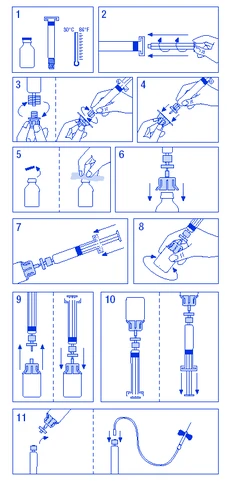
Preparation of the solution:
- Warm the vial and syringe, not exceeding 30°C.
- Insert the plunger into the syringe containing the solvent.
- Remove the filter from its packaging. Remove the cap from the syringe connector and attach the syringe to the filter.
- Remove the vial adapter from its packaging and connect it to the filter on the syringe.
- Remove the plastic protective cap from the vial and disinfect the stopper with the swabs provided.
- Pierce the vial stopper with the needle of the adapter.
- Transfer all the solvent from the syringe into the vial.
- Gently rotate the vial without shaking until the product is completely dissolved. Since this is a parenteral solution, do not use the product if it is not completely dissolved or if particles are visible.
- Quickly disconnect the syringe with filter from the vial with adapter to break the vacuum. Proceed immediately to step 10.
- With the vial held upright, draw the solution into the syringe.
- Prepare the injection site, disconnect the syringe, and inject the product using the butterfly needle set provided. The infusion rate must be 3 ml/min intravenously and must never exceed 10 ml/min, to avoid vasomotor reactions.
Do not reuse the administration set.
It is important to use the infusion set provided with the medicine. If other medical infusion systems are used, their compatibility with the pre-filled syringe must be verified. Adapters should be used when necessary to ensure proper product administration.
Reconstituted products must be visually inspected for particles and discoloration before administration. The solution should be clear or slightly opalescent. Do not use cloudy solutions or those containing deposits.
Use in children and adolescents
Clinical study data are insufficient to recommend the use of Alphanate in children under 6 years of age.
Further information on dosing and duration of therapy is provided at the end of this leaflet in the section intended for doctors or healthcare professionals.
If you use more Alphanate than you should
There are no known cases of overdose with Alphanate. However, if you have taken more Alphanate than you should, inform your doctor or pharmacist immediately or go to the nearest hospital.
If you forget to use Alphanate
- Proceed immediately with the next scheduled dose and continue at regular intervals as instructed by your doctor.
- Do not use a double dose to make up for a missed dose.
4. POSSIBLE ADVERSE REACTIONS
Like all medicines, this medicine can cause adverse reactions, although not everyone experiences them.
- In patients treated with products containing factor VIII and von Willebrand factor, hypersensitivity or allergic reactions have rarely been observed, which may include rapid swelling of the skin and mucous membranes (angioedema), burning sensation and acute pain at the infusion site, chills, flushing, generalized widespread skin rash (generalized urticaria), headache (cephalaea), wheals, drop in blood pressure (hypotension) which may cause dizziness upon standing, drowsiness (lethargy), nausea, restlessness, rapid heartbeat (tachycardia), chest tightness (thoracic constriction) or feeling unwell, tingling (paresthesia), vomiting, and wheezing. Such adverse reactions may in some cases progress to acute allergic reactions (acute anaphylaxis), including shock.
- Fever has rarely been observed.
In previously untreated children with factor VIII-based medicines, the development of inhibitory antibodies (see section 2) may be very common (more than 1 in 10 patients); however, in patients who have previously received factor VIII treatment (more than 150 days of treatment), the risk is uncommon (less than 1 in 100). If this occurs, the medicine may no longer work properly and you or your child may experience persistent bleeding. If this happens, you must contact your doctor immediately.
Patients with von Willebrand disease, especially type 3, may develop neutralizing antibodies against von Willebrand factor (inhibitors). If such inhibitors occur, an inadequate clinical response will be the sign. The development of inhibitors may also manifest with anaphylactic reactions (acute allergic reactions). Therefore, if you experience an anaphylactic reaction, you will also be evaluated for the presence of inhibitors.
In all these cases, it is recommended to contact a specialized haemophilia treatment centre.
In patients with von Willebrand disease, thrombotic events (clot formation) may occur, especially if known clinical or laboratory risk factors are present.
Reporting of adverse reactions
If you experience any adverse reaction, including those not listed in this leaflet, please contact your doctor, pharmacist, or nurse. You may also report adverse reactions directly via the national reporting system at the following address:
http://www.agenziafarmaco.gov.it/content/come-segnalare-una-sospetta-reazione-avversa .
By reporting adverse reactions, you can help provide more information on the safety of this medicine.
5. HOW TO STORE ALPHANATE
Keep this medicine out of the sight and reach of children.
Do not store above 30 °C. Keep the vial in the outer packaging to protect the medicine from light.
Do not freeze.
Do not use this medicine after the expiry date stated on the label and outer packaging after "Exp".
Reconstituted Alphanate must be used immediately.
The reconstituted product should be inspected visually for particulate matter and discoloration prior to administration. The solution should be clear or slightly opalescent. Do not use solutions that are cloudy or contain deposits.
Do not dispose of any medicine via wastewater or household waste. Ask your pharmacist how to dispose of medicines no longer in use. This will help protect the environment.
6. PACKAGING CONTENTS AND OTHER INFORMATION
What Alphanate contains
- The active substances are human coagulation factor VIII complexed with human von Willebrand factor.
- The other components are histidine, human albumin, arginine, hydrochloric acid, and sodium hydroxide.
- The pre-filled solvent syringe contains water for injections.
Description of the appearance of Alphanate and contents of the pack
Alphanate is supplied as a vial containing a hygroscopic powder or friable solid, white or light yellow in colour, and a pre-filled syringe with water for injections (solvent).
Pack sizes:
Alphanate 250 IU + 300 IU / 5 ml AIC No. 033077088
Alphanate 500 IU + 600 IU / 5 ml AIC No. 033077090
Alphanate 1000 IU + 1200 IU / 10 ml AIC No. 033077102
Alphanate 1500 IU + 1800 IU / 10 ml AIC No. 033077114
Alphanate 2000 IU + 2400 IU / 10 ml AIC No. 033077126
Pack contents: 1 vial of lyophilized powder, 1 pre-filled solvent syringe, and accessories (one vial adapter, one filter, two disinfectant swabs, and one infusion set).
Not all pack sizes may be marketed.
Marketing Authorization Holder and Manufacturer
Marketing Authorization Holder:
Grifols Italia S.p.A.
Viale Enrico Forlanini, 23
20134 Milan - ITALY
Manufacturer:
Instituto Grifols, S.A.
Can Guasc, 2 - Parets del Vallès
08150 Barcelona - SPAIN
The following information is intended exclusively for physicians or healthcare professionals:
Factor VIII deficiency
The doses and duration of replacement therapy depend on the severity of the factor VIII deficiency, the location and extent of bleeding, and the patient's clinical condition.
The number of factor VIII units administered is expressed in International Units (IU), referenced to the current WHO standards for factor VIII products. Factor VIII activity in plasma is expressed either as a percentage (relative to normal human plasma) or in International Units (relative to the International Standard for plasma factor VIII).
One International Unit (IU) of factor VIII activity corresponds to the amount of factor VIII contained in 1 ml of normal human plasma.
On-demand treatment
The required dose of factor VIII is calculated based on the empirical observation that 1 International Unit (IU) of factor VIII per kg of body weight increases plasma factor VIII activity by 1.5 to 2% of normal (1.5–2 IU/dL).
The necessary dose can be determined using the following formula:
Units required = Body weight × Desired increase in factor VIII × 0.5
(IU) (kg) (% or IU/dL)
The amount to be administered and the frequency of administration should always aim to achieve clinical efficacy in each individual case.
In the case of the following bleeding events, factor VIII activity during the relevant period must not fall below the indicated plasma activity level (in % of normal or IU/dL).
The following table may be used to guide dosing during bleeding episodes and surgery:
| Bleeding severity | Required factor VIII levels (% or IU/dL) | Frequency of administration (hours) | Duration of therapy (days) | |------------------------|---------------------------------------------|----------------------------------------|-------------------------------| | Bleeding | | | | | Recent hemarthrosis, intramuscular bleeding, or oral cavity bleeding | 20–40 | Repeat every 12–24 hours | At least 1 day, until pain resolves or healing is evident | | More extensive hemarthrosis, intramuscular bleeding, or hematoma | 30–60 | Repeat infusion every 12–24 hours | 3–4 days or more, until pain and acute disability resolve | | Life-threatening bleeding | 60–100 | Repeat infusion every 8–24 hours | Until the risk is resolved | | Surgery | | | | | Minor (including dental extractions) | 30–60 | Every 24 hours | At least 1 day, until wound healing | | Major (pre- and post-operative) | 80–100 | Repeat infusion every 8–24 hours | Until adequate wound healing is achieved, followed by at least 7 additional days of therapy to maintain factor VIII activity between 30% and 60% (30–60 IU/dL) |
Prophylaxis
For long-term prophylaxis of bleeding in patients with severe haemophilia A, the usual dose range is 20–40 IU of factor VIII per kg of body weight, administered every 2–3 days.
In some cases, especially in younger patients, it may be necessary to shorten the interval between doses or administer higher doses.
During treatment, it is recommended to monitor factor VIII levels carefully in order to adjust the dose and frequency of repeated infusions. In particular, during major surgical procedures, close monitoring of replacement therapy using coagulation tests (plasma factor VIII activity) is essential. Individual patients may show variable responses to factor VIII, achieving different in vivo recovery levels and displaying different half-lives.
Von Willebrand disease
Generally, 1 IU/kg of VWF:RCo increases circulating VWF:RCo levels by 0.02 IU/mL (2%).
Target levels should be VWF:RCo > 0.6 IU/mL (60%) and FVIII:C > 0.4 IU/mL (40%).
To achieve haemostasis, administration of 40–80 IU/kg of von Willebrand factor (VWF:RCo) and 20–40 IU/kg of FVIII:C is generally recommended.
An initial dose of 80 IU/kg of von Willebrand factor may be required, especially in patients with type 3 von Willebrand disease, where maintaining adequate levels may require higher doses compared to other types of von Willebrand disease.
Appropriate doses should then be administered every 12–24 hours. The dose and duration of treatment depend on the patient's clinical condition, type and severity of bleeding, and levels of VWF:RCo and FVIII:C.
When using von Willebrand factor preparations containing FVIII, the physician should be aware that prolonged treatment may lead to excessive increases in FVIII:C levels. After 24–48 hours of treatment, to avoid excessive elevation of FVIII:C, consideration should be given to reducing the dose and/or increasing the interval between doses, or using a VWF product with a low FVIII content.
Paediatric population
Since dosing is adjusted based on clinical response to the conditions described above, the dosage per kg body weight in children is not considered different from that in adults.
There are insufficient data from clinical studies to recommend the use of Alphanate in children under 6 years of age.
Alphanate is to be administered intravenously.
Alphanate must be administered at a rate not exceeding 10 ml/minute.