Algo pirina
Italy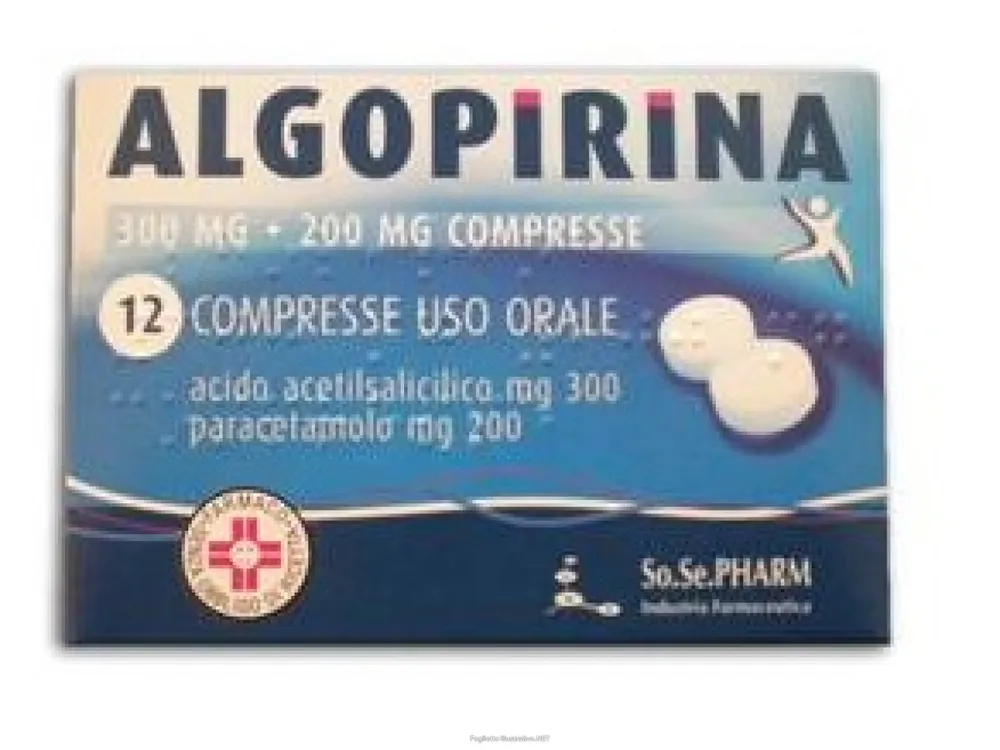
Table of Contents
Package leaflet: Information for the patient
ALGOPIRINA 300mg + 200mg tablets
acetylsalicylic acid and paracetamol
Equivalent medicine
Please read this leaflet carefully before taking this medicine because it contains important information for you.
Always take this medicine exactly as described in this leaflet or as your doctor or pharmacist has instructed you to do.
- Keep this leaflet. You may need to read it again.
- If you have any questions, ask your pharmacist.
- If you experience any side effects, including those not listed in this leaflet, tell your doctor or pharmacist. See section 4.
- Consult your doctor if you do not notice any improvement or if your symptoms worsen after 5-7 days.
Contents of this leaflet
- What Algopirina is and what it is used for
- What you need to know before taking Algopirina
- How to take Algopirina
- Possible side effects
- How to store Algopirina
- Contents of the pack and other information
1. What ALGOPIRINA is and what it is used for
Algopirina contains the active substances acetylsalicylic acid and paracetamol.
Acetylsalicylic acid and paracetamol belong to a group of medicines called analgesics and antipyretics.
Both provide rapid antipyretic and pain-relieving (analgesic) effects, along with anti-inflammatory action.
Algopirina is indicated for the treatment of influenza-like and cold symptoms; for the symptomatic relief of headache, nerve inflammation (neuralgia), toothache, menstrual pain, and joint pain.
Consult your doctor if you do not feel better or if you feel worse after 5-7 consecutive days of treatment.
Take Algopirina with food.
2. What you should know before taking Algopirina
Do not take Algopirina
- If you are allergic to the active substances, to related substances, or to any of the other ingredients of this medicine listed in section 6.
- If you have previously suffered from gastrointestinal bleeding (haemorrhage) or tears due to prior treatments, or have experienced frequent gastrointestinal bleeding/tears (ulcer) (two or more distinct episodes of proven ulceration or bleeding).
- If you have a confirmed tendency to develop bleeding, stomach disorders (e.g.: gastroduodenal ulcer), asthma, reduced kidney function; abnormally low levels of phosphate in the blood (hypophosphataemia).
- If you suffer from severe heart failure.
- If you have a condition known as glucose-6-phosphate dehydrogenase enzyme deficiency (an enzyme whose absence, genetically determined, leads to a disease characterized by reduced survival of red blood cells), or if you suffer from a condition called haemolytic anaemia (a pathological state in which there is low concentration of haemoglobin in the blood).
- If you suffer from severe liver problems.
- During the third trimester of pregnancy at doses exceeding 100 mg/day.
Warnings and precautions
Talk to your doctor or pharmacist before taking Algopirina
- If you are already taking any other non-steroidal anti-inflammatory drug (NSAID);
- If you are an elderly patient and/or have previously suffered from gastrointestinal bleeding, especially if complicated by tears (see "Do not take Algopirina"), if you are using acetylsalicylic acid or other medicines that may cause gastrointestinal damage. The risk of gastrointestinal bleeding or perforation is higher with high doses of NSAIDs. Your doctor will therefore advise starting treatment with the lowest available dose and possibly using protective medicines for the stomach lining (misoprostol or proton pump inhibitors) simultaneously (see below and "Other medicines and Algopirina"). For these patients with a history of gastrointestinal damage, and especially for the elderly, it is recommended to keep your doctor constantly informed about any unusual gastrointestinal symptoms, particularly during the initial phases of treatment.
- If you are taking oral corticosteroid medicines, or drugs to reduce blood clot formation (anticoagulants) such as warfarin, or antidepressants (selective serotonin reuptake inhibitors) or agents that reduce platelet aggregation in the blood (antiplatelets) such as acetylsalicylic acid. Caution is advised before using Algopirina because these medicines may increase the risk of developing stomach or intestinal bleeding/tears (see "Other medicines and Algopirina").
- If you suffer from gastrointestinal diseases such as ulcerative colitis or Crohn's disease. Your doctor will advise on the most appropriate therapy, as concomitant use of non-steroidal anti-inflammatory drugs (NSAIDs) may worsen these conditions (see section 4).
- If you have a condition known as glucose-6-phosphate dehydrogenase enzyme deficiency, gastric or intestinal disorders, impaired renal function, or if you are pregnant.
- If you suffer from high blood pressure and/or impaired heart function. Concomitant use of NSAIDs may cause fluid retention and swelling due to accumulation of fluid in interstitial spaces (oedema).
- In case of viral infections such as influenza or chickenpox. Consult your doctor before administering the product to children.
- In children under 12 years of age. The product should only be administered under medical prescription.
- If you suffer from kidney or liver problems.
- If you are already taking a medicine containing the same active ingredient, paracetamol; indeed, if paracetamol is taken in high doses, serious adverse reactions may occur. Your doctor will advise whether or not you can take other medicines while taking Algopirina (see "Other medicines and Algopirina").
While using Algopirina, always keep in mind that:
- Adverse effects can be minimized by using the lowest effective dose for the shortest duration necessary to control symptoms.
- Elderly patients have a higher probability of developing adverse effects from NSAIDs, especially gastrointestinal bleeding and perforation, which can be fatal (see section 3).
- At any time, with or without warning symptoms or previous history of serious gastrointestinal events, during treatment with all NSAIDs, gastrointestinal bleeding, injury, and perforation have been reported, which may be life-threatening. If such events occur, stop treatment immediately and contact your doctor or go to the nearest hospital.
- You must not use Algopirina for prolonged treatments.
- You should consult your doctor if, after a continuous treatment period of 5–7 days, you do not experience noticeable improvement in your condition.
- High or prolonged doses of the product may cause severe liver disease and serious alterations in the kidney and blood.
- In case of viral infections such as influenza or varicella, if prolonged vomiting or profound drowsiness occurs during treatment, discontinue treatment and contact your doctor.
- Use before surgery may interfere with attempts to control bleeding (haemostasis) during an operation.
- In case of an allergic reaction, discontinue use of Algopirina.
- Very rarely, severe skin reactions have been reported, some of which were fatal, such as widespread skin irritation with skin peeling (exfoliative dermatitis), severe skin reaction with skin peeling and swelling, blisters on skin, mouth, eyes, genitals (Stevens-Johnson Syndrome), and severe widespread skin rash with fever (toxic epidermal necrolysis) (see section 4). During the early stages of therapy, patients appear to be at higher risk: the reaction usually occurs within the first month of treatment. Discontinue treatment at the first sign of skin rash, skin lesion, or any other sign of allergy and contact your doctor.
During treatment with Algopirina, inform your doctor immediately:
If you suffer from serious illnesses, including severe renal impairment or sepsis (when bacteria and their toxins circulate in the blood causing organ damage), malnutrition, chronic alcoholism, or if you are also taking flucloxacillin (an antibiotic). In patients in these conditions, a serious condition called metabolic acidosis (an abnormality in blood and fluids) has been reported when paracetamol is used regularly for a prolonged period or when paracetamol is taken in combination with flucloxacillin. Symptoms of metabolic acidosis may include: severe breathing difficulties with rapid, deep breathing, drowsiness, nausea, and vomiting.
Children
In children under 12 years of age, the product should only be administered under medical prescription.
Other medicines and Algopirina
Inform your doctor or pharmacist if you are taking, have recently taken, or might take any other medicine.
Inform your doctor or pharmacist before taking Algopirina if you are taking:
- Corticosteroid medicines. Concomitant use with Algopirina increases the risk of gastrointestinal injury or bleeding (see "Warnings and precautions");
- Anticoagulant medicines. NSAIDs may enhance the effects of anticoagulants such as warfarin (see "Warnings and precautions");
- Antiplatelet agents and antidepressant medicines (selective serotonin reuptake inhibitors (SSRIs)). When administered together with Algopirina, they increase the risk of gastrointestinal bleeding (see "Warnings and precautions");
- Other anti-inflammatory medicines;
- Uricosuric medicines (used in the treatment of gout), sulphonylureas (used in diabetes therapy), hypoglycaemics (which lower blood sugar levels). Algopirina interferes with these medicines;
- Medicines with systemic alkalizing action (which raise blood pH). These medicines accelerate the elimination of salicylate medicines (e.g. acetylsalicylic acid) and thus reduce their effectiveness;
- Probenecid (used in the treatment of gout and elevated blood uric acid levels, hyperuricaemia) or acetazolamide (used to lower blood pressure). These medicines facilitate the accumulation of salicylates in the blood.
- Diuretic medicines (which promote diuresis) and antihypertensives (which lower blood pressure), particularly antihypertensives belonging to the class of ACE inhibitors or angiotensin II antagonists. NSAIDs may reduce their effect. In some patients with impaired renal function (for example, dehydrated patients or elderly patients with compromised kidney function), co-administration of Algopirina with an ACE inhibitor or an angiotensin II antagonist may lead to further deterioration of kidney function. In such cases, it is advisable to drink plenty of fluids and consult your doctor, who may consider monitoring your kidney function during concomitant therapy;
- Medicines that may facilitate the activation of certain liver enzymes (hepatic mono-oxygenases) or in case of exposure to substances that may have such an effect (e.g. rifampicin, cimetidine, antiepileptics such as glutethimide, phenobarbital, carbamazepine);
- Metamizole (a substance used to reduce pain and fever) may reduce the effect of acetylsalicylic acid on platelet aggregation (blood cells that clump together to form a blood clot) when taken simultaneously. Therefore, this combination should be used with caution in patients taking low-dose aspirin for cardioprotection;
- Flucloxacillin (an antibiotic), due to a serious risk of blood and fluid abnormalities (called high anion gap metabolic acidosis) that require urgent treatment (see section 2).
Do not take Algopirina if you are due to undergo tests to determine blood uric acid levels (uricaemia) (using the phosphotungstic acid method), or tests to determine blood sugar levels (using the glucose-oxidase-peroxidase method). Indeed, administration of paracetamol may interfere with these tests.
Pregnancy, breastfeeding and fertility
If you are pregnant, suspect you may be pregnant, are planning a pregnancy, or are breastfeeding, ask your doctor or pharmacist for advice before taking this medicine.
Do not use Algopirina during the last three months of pregnancy to avoid delays in delivery, unless specifically prescribed by your doctor.
The acetylsalicylic acid contained in Algopirina may adversely affect pregnancy and/or embryonic/fetal development.
During the first and second trimesters of pregnancy, acetylsalicylic acid should not be administered unless strictly necessary.
If you are planning a pregnancy or during the first and second trimesters of pregnancy, the dose and duration of treatment should be kept as low as possible.
During the third trimester of pregnancy, all medicines acting via the same mechanism as acetylsalicylic acid (prostaglandin synthesis inhibitors) may expose the fetus to:
- Increased risk of heart and lung malformations (premature closure of the ductus arteriosus and pulmonary hypertension);
- Kidney dysfunction that may progress to renal failure with reduced amniotic fluid (oligo-hydramnios); and the mother and newborn, at the end of pregnancy, to:
- Possible prolongation of bleeding time, and antiplatelet effects that may occur even with very low doses;
- Inhibition of uterine contractions, resulting in delayed or prolonged labour. Therefore, during the third trimester of pregnancy, do not take acetylsalicylic acid at doses exceeding 100 mg per day.
Driving and using machines
Algopirina does not affect the ability to drive or use machinery.
3. How to take Algopirina
Take this medicine exactly as directed by your doctor or pharmacist. If you have
any doubts, consult your doctor or pharmacist.
The recommended dose is 1 tablet, three to four times a day.
This medicine should be taken with food.
Do not exceed the recommended doses. Elderly patients should adhere to the minimum dose indicated above.
Use in children
The use of Algopirina in children under 12 years of age is not recommended unless specifically prescribed
by a doctor.
If you take more Algopirina than you should
In case of accidental overdose of Algopirina, contact your doctor immediately or go to the nearest hospital.
The ingestion of excessive amounts of paracetamol (one of the two active substances in Algopirina) may
cause liver cell death, leading to general and irreversible liver damage.
If you forget to take Algopirina
If you forget to take Algopirina, do not take a double dose to make up for the missed dose.
If you stop taking Algopirina
Consult your doctor or pharmacist before stopping treatment.
If you have any doubts about the use of this medicine, consult your doctor or pharmacist.
4. Possible side effects
Like all medicines, this medicine can cause side effects, although not everybody will get them.
If you experience any of the following serious side effects, stop treatment with Algopirina and
contact your doctor immediately:
- peptic ulcers, gastrointestinal perforation or bleeding, sometimes fatal, particularly in the elderly (see "Warnings and precautions");
- allergic reactions such as severe and sudden swelling of the skin or mucous membranes, for example swelling of the hands, feet and ankles, swelling around the eyes, face, lips, tongue and/or throat (angioedema), severe allergic reaction with sudden onset (anaphylactic shock). Gastrointestinal side effects are the most commonly reported with the use of Algopirina.
Other side effects that may occur with Algopirina include:
- nausea, vomiting, diarrhoea, flatulence, constipation, indigestion, abdominal pain, passage of black stools (melena), loss of blood from the stomach through vomiting (haematemesis), inflammation with lesions in the oral cavity, worsening of gastrointestinal disorders such as colitis and Crohn's disease (see "Warnings and precautions");
- gastritis (less frequently);
- gastrointestinal disorders, dizziness, allergic skin rashes;
- reduction in the number of all blood cells (thrombocytopenia, leucopenia, anaemia, agranulocytosis), severe liver problems (liver function abnormalities and hepatitis), severe kidney problems (acute renal failure, interstitial nephritis, haematuria, anuria).
Due to the presence of acetylsalicylic acid, the following may occur:
- ear disorders (such as tinnitus, etc.), episodes of bleeding (epistaxis, gingival bleeding, etc.), delay in childbirth (see "Pregnancy and breastfeeding"), and reduction in the number of platelets in the blood.
Due to the presence of paracetamol, the following may occur:
- severe skin reactions, some of which are fatal, such as severe skin inflammation (erythema multiforme), widespread and severe skin irritation with skin peeling (exfoliative dermatitis), severe skin reaction with skin peeling and swelling, blisters on the skin, mouth, eyes, genitals (Stevens-Johnson syndrome), and severe and extensive skin rash with fever (toxic epidermal necrolysis).
- Frequency not known (cannot be estimated from available data): severe condition that may make the blood more acidic (called metabolic acidosis), in patients with a serious illness using paracetamol (see section 2).
Reporting of side effects
If you experience any side effect, including those not listed in this leaflet, talk to your doctor or pharmacist.
You can also report side effects directly via the national reporting system at https://www.aifa.gov.it/content/segnalazioni-reazioni-avverse.
By reporting side effects, you can help provide more information on the safety of this medicine.
5. How to store Algopirina
Keep this medicine out of the sight and reach of children.
Do not use this medicine after the expiry date stated on the carton after "Exp.". The expiry date refers to the
last day of that month. The expiry date applies to the product in its original packaging, correctly stored.
Store in the original packaging to protect the product from heat.
Do not dispose of medicines via wastewater or household waste. Ask your pharmacist how to dispose of
medicines you no longer use. This will help protect the environment.
6. Package contents and other information
What Algopirina contains
The active substances are acetylsalicylic acid and paracetamol.
One tablet of Algopirina contains 300 mg of acetylsalicylic acid and 200 mg of paracetamol.
The other components are: calcium hydrogen phosphate dihydrate and magnesium stearate.
Description of the appearance of Algopirina and package contents
Algopirina 300 mg + 200 mg tablets is available in a carton containing a blister strip of 12 tablets.
To remove the tablet, apply light pressure on the bulging part of the blister, thereby breaking the aluminum foil.
Marketing Authorization Holder and Manufacturer
Marketing Authorization Holder
So.Se.PHARM S.r.l.
Via dei Castelli Romani, 22
00071 Pomezia (Rome)
Italy
Manufacturer
Special Product’s Line S.p.A.
Via Fratta Rotonda Vado Largo, 1
03012 Anagni (FR)
Italy