Alfatex
Italy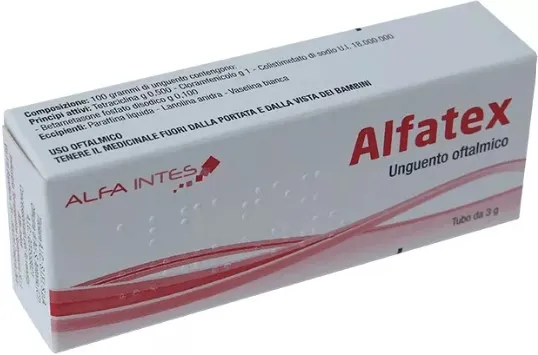
Table of Contents
Package leaflet: Information for the user
Alfatex
ophthalmic ointment
Betamethasone disodium phosphate / Chloramphenicol / Sodium colistimethate / Tetracycline
Please read this leaflet carefully before using this medicine because it contains important information for you.
- Keep this leaflet, as you may need to read it again.
- If you have any questions, consult your doctor or pharmacist.
- This medicine has been prescribed for you only. Do not give it to others, even if their symptoms are the same as yours, as it could be harmful.
- If any adverse reaction occurs, including those not listed in this leaflet, consult your doctor or pharmacist. See section 4.
Contents of this leaflet
- What Alfatex is and what it is used for
- What you need to know before using Alfatex
- How to use Alfatex
- Possible side effects
- How to store Alfatex
- Contents of the pack and other information
1. What Alfatex is and what it is used for
Alfatex is a pharmaceutical combination of:
- disodium betamethasone phosphate, which belongs to the class of corticosteroids and has an anti-inflammatory effect,
- chloramphenicol, sodium colistimethate, and tetracycline, which act against bacteria that can cause eye infections.
Alfatex is used in the treatment of eye inflammations (allergic, vernal, phlyctenular and infectious conjunctivitis, blepharitis, blepharoconjunctivitis, keratitis, keratoendothelitis, keratoconjunctivitis, scleritis and episcleritis, uveitis), post-surgical and post-traumatic ocular inflammations, and injuries caused by thermal and chemical agents.
Consult your doctor if, at the end of the prescribed treatment, you do not notice any improvement or if you notice a worsening of your condition.
2. What you need to know before using Alfatex
Do not use Alfatex
- if you are allergic to betamethasone, chloramphenicol, colistimethate, tetracycline, or any of the other ingredients of this medicine (listed in section 6).
- if you have:
- increased pressure inside the eye (endocular hypertension);
- inflammation of the cornea (the transparent membrane covering the colored part of the eye) caused by Herpes simplex or other viral infections involving the cornea and in the acute ulcerative phase (unless you are simultaneously using specific antiviral medications for herpes virus);
- viral infection of the transparent membrane covering the white part of the eye and the inner eyelids (conjunctivitis with ulcerative keratitis, even in the early stage);
- eye infection caused by mycobacteria (tuberculosis of the eye);
- fungal infection of the eye (fungal keratitis);
- eye inflammation with pus formation (acute purulent ophthalmia), infection of the transparent membrane covering the white part of the eye and the inner eyelids with pus formation (purulent conjunctivitis);
- inflammation of the eyelid margin with pus formation (purulent blepharitis);
- stye (hordeolum).
Topical corticosteroids should not be used in corneal lesions or abrasions, as they delay healing of damaged tissues and may promote the onset and spread of possible infections.
Warnings and precautions
Talk to your doctor or pharmacist before using Alfatex.
Some patients may develop sensitization (allergic reaction). If symptoms such as localized itching or redness of the skin occur, stop treatment and consult your doctor to begin appropriate therapy.
The use of corticosteroids in patients with bacterial, viral, or fungal conjunctivitis may mask signs of infection progression.
Prolonged use of topical antibiotics may lead to overgrowth of microorganisms not sensitive to these antibiotics. You may become more susceptible to eye infections caused by bacteria, viruses, fungi, or parasites.
Contact your doctor if your symptoms worsen or recur.
If you use this medicine for a long time and in excessive doses, toxic effects may occur.
Rare cases of bone marrow failure (the bone marrow stops producing new blood cells) have been reported following prolonged use of topical chloramphenicol. For this reason, Alfatex should be used strictly according to the doctor's instructions.
Long-term application of corticosteroids to the eyes may cause increased intraocular pressure (ocular hypertension), vision problems, and clouding of the lens inside the eye, known as the crystalline lens (cataract). If you use Alfatex for a prolonged period, you should have regular eye pressure checks.
Consult your doctor before using this medicine if you have conditions causing thinning of the transparent membrane covering the colored part of the eye (corneal thinning).
Contact your doctor if blurred vision or other visual disturbances occur.
Children
In early infancy, this product should be administered only when strictly necessary and under direct medical supervision.
Alfatex must not be used in children under three years of age.
Other medicines and Alfatex
Tell your doctor or pharmacist if you are taking, have recently taken, or might take any other medicines.
No pharmacological interactions have so far been reported with the use of Alfatex.
Pregnancy and breastfeeding
If you are pregnant, think you may be pregnant, planning a pregnancy, or breastfeeding, ask your doctor or pharmacist for advice before using this medicine.
Pregnancy
Alfatex should be used during pregnancy only if strictly necessary. Consult your doctor, who will decide whether you should use Alfatex while pregnant.
Driving and using machines
Application of the eye ointment may cause temporary blurring of vision. If this occurs, do not drive or operate machinery until your vision is clear again.
3. How to use Alfatex
Use this medicine exactly as directed by your doctor. If you have any doubts, consult your doctor or pharmacist.
The recommended dose is 3–4 applications per day.
Apply a small amount of Alfatex ophthalmic ointment as directed by your doctor.
Use the medicine for the length of time prescribed by your doctor.
If you use more Alfatex than you should
Cases of overdose with Alfatex have never been reported.
If you use more ointment than you should, it is unlikely to cause you any problems.
Apply the next dose as usual.
If you forget to use Alfatex
Do not use a double dose to make up for the missed dose.
If you stop using Alfatex
If you have any questions about using this medicine, consult your doctor or pharmacist.
4. Possible side effects
Like all medicines, this medicine can cause side effects, although not everyone experiences them.
Application of Alfatex may cause a mild and temporary burning or stinging sensation. If this occurs, treatment should be discontinued and appropriate therapy initiated.
Prolonged use may lead to posterior subcapsular cataract (clouding of the lens inside the eye, known as the crystalline lens) and increased intraocular pressure.
Side effects with unknown frequency (frequency cannot be estimated from the available data): blurred vision.
Reporting of side effects
If you experience any side effect, including those not listed in this leaflet, talk to your doctor or pharmacist. You may also report side effects directly through the national reporting system at the following address: https://www.aifa.gov.it/content/segnalazioni-reazioni-avverse . By reporting side effects, you can help provide more information on the safety of this medicine.
5. How to store Alfatex
Keep this medicine out of the sight and reach of children.
Do not use this medicine after the expiry date stated on the packaging after
Exp.
The expiry date refers to the last day of that month.
Store below 25°C.
Do not dispose of any medicine via wastewater or household waste. Ask your pharmacist
how to dispose of medicines no longer in use. This will help protect the environment.
6. Package contents and other information
What Alfatex contains
- The active substances are betametasone disodium phosphate, chloramphenicol, sodium colistimethate and tetracycline; 100 g of ointment contain 0.1 g of betametasone disodium phosphate, 1 g of chloramphenicol, 18,000,000 I.U. of sodium colistimethate and 0.5 g of tetracycline.
- The other components are: liquid paraffin, anhydrous lanolin, white vaseline.
Description of the appearance of Alfatex and contents of the pack
Alfatex ophthalmic ointment is a semi-solid mass of light yellow colour
contained in an aluminium tube with a net content of 3 g of ointment.
Marketing Authorization Holder:
Alfa Intes Industria Terapeutica Splendore S.r.l.
via Fratelli Bandiera, 26 - 80026 Casoria (NA)
Manufacturer:
SIFI S.p.A. - Via Ercole Patti, 36 – 95025 Aci Sant’Antonio (CT)