Albumin Grifols
Italy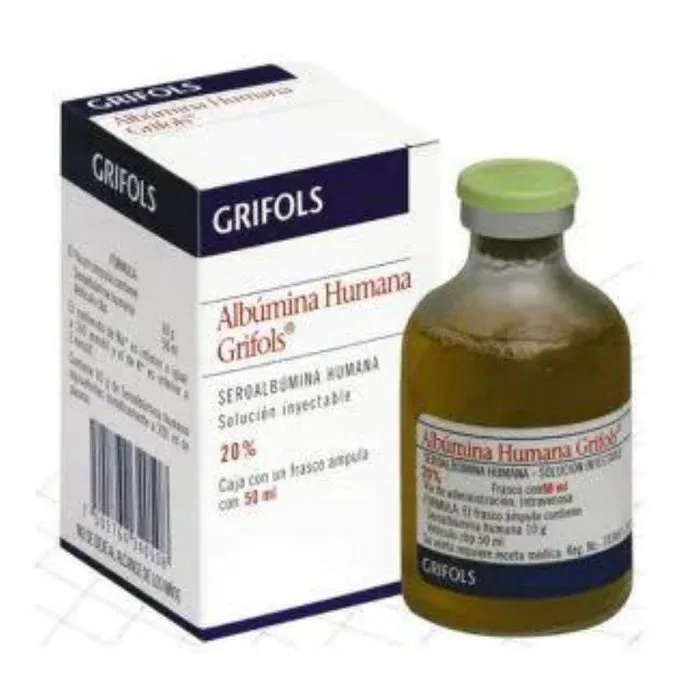
Table of Contents
- Package leaflet: Information for the user
- Albumina Grifols 50 g/l, 200 g/l, 250 g/l infusion solution
- 1. What Albumin Grifols is and what it is used for
- 2. What you should know before using Albumina Grifols
- 3. How to use Albumina Grifols
- 4. Possible side effects
- 5. How to store Albumina Grifols
- 6. Package Contents and Other Information
Package leaflet: Information for the user
Albumina Grifols 50 g/l, 200 g/l, 250 g/l infusion solution
Human albumin from human plasma
Please read all of this leaflet carefully before you start using this medicine because it contains important information for you.
- Keep this leaflet. You may need to read it again.
- If you have any questions, ask your doctor, pharmacist, or nurse.
- This medicine has been prescribed for you only. Do not give it to other people, even if they have the same symptoms as you, because it may be harmful.
- If you experience any side effects, including those not listed in this leaflet, tell your doctor, pharmacist, or nurse. See section 4.
Contents of this leaflet:
- What Albumina Grifols is and what it is used for
- What you need to know before using Albumina Grifols
- How to use Albumina Grifols
- Possible side effects
- How to store Albumina Grifols
- Contents of the pack and other information
1. What Albumin Grifols is and what it is used for
Albumin Grifols is a solution for intravenous infusion containing proteins extracted from human plasma, which is the liquid portion of blood. In this product, more than 95% of the human plasma proteins consist of albumin, at a concentration of 5, 20 or 25%, expressed as weight/volume.
Albumin Grifols belongs to a group of medicines known as blood substitutes.
Albumin Grifols is used to restore and maintain circulating blood volume in patients who have lost blood and/or body fluids for any reason, and in whom the use of a colloid (plasma substitute) is appropriate.
The physician may decide to use albumin instead of an artificial colloid based on the individual patient's clinical condition and official recommendations.
If you have any doubts about the use of Albumin Grifols, consult your doctor, pharmacist, or nurse.
2. What you should know before using Albumina Grifols
Do not use Albumina Grifols
If you are allergic (hypersensitive) to human albumin or to any of the other ingredients of this
medicinal product (listed in section 6).
Warnings and precautions
Talk to your doctor, pharmacist, or nurse before using Albumina Grifols.
- If you experience or have previously experienced symptoms of an allergic reaction (hypersensitivity) to human albumin, such as difficulty breathing or feeling weak, inform your doctor or nurse immediately. Suspected allergic or anaphylactic reactions (symptoms of which may include swelling of the face, lips, and throat, shortness of breath, feeling faint, respiratory failure, itching, or redness) require immediate discontinuation of the infusion. In case of shock, standard medical treatments for shock must be initiated.
- If you suffer from any of the following conditions, inform your doctor:
- Decompensated heart failure (reduced cardiac performance)
- Arterial hypertension (high blood pressure)
- Esophageal varices (enlarged veins in the esophagus)
- Pulmonary edema (fluid accumulation in the lungs)
- Hemorrhagic diathesis (tendency to bleed)
- Severe anemia (deficiency of red blood cells or hemoglobin, the substance that carries oxygen in the blood)
- Pre-renal and post-renal anuria (absence of urine production)
These conditions may contraindicate the use of Albumina Grifols in your treatment, or may require your doctor to adjust the dose or infusion rate to prevent complications.
If the dose and infusion rate are not adjusted according to your circulatory status, you may experience symptoms indicating an increase in blood volume (hypervolemia). If you notice any of the following symptoms, inform your doctor immediately, as the infusion must be stopped without delay: headache, dyspnea (difficulty breathing), jugular vein distension (swelling of the veins running down the neck), increased blood pressure, elevated venous pressure, pulmonary edema.
For athletes: using this medicinal product without a therapeutic need constitutes doping and may result in a positive anti-doping test.
Viral safety
When medicinal products are prepared from human blood or plasma, specific measures are implemented to prevent transmission of infections to patients. These measures include:
- careful selection of blood and plasma donors to ensure potentially infected donors are excluded,
- testing of each donation and plasma pool for the presence of viruses/infections,
- inclusion of manufacturing steps capable of inactivating or removing viruses during blood and plasma processing.
Despite these measures, the possibility of transmitting infectious agents cannot be completely ruled out when administering medicinal products derived from human blood or plasma. This also applies to emerging or unknown viruses or other infectious agents.
No cases of viral transmission have been reported with albumin manufactured by well-established processes meeting European Pharmacopoeia standards.
It is strongly recommended that each time you receive a dose of Albumina Grifols, both the product name and batch number are recorded, in order to maintain traceability between the patient and the batch used.
Other medicines and Albumina Grifols
Inform your doctor, pharmacist, or nurse if you are taking, have recently taken, or might take any other medicines.
No specific interactions between albumin and other medicinal products are known.
Incompatibilities: Albumina Grifols must not be mixed with other medicinal products (except for the diluents recommended in the section "The following information is intended exclusively for physicians or healthcare professionals"), nor with whole blood or red blood cell concentrates.
Pregnancy, breastfeeding, and fertility
Pregnancy
If you are pregnant, suspect you may be pregnant, are planning to become pregnant, or are breastfeeding, consult your doctor or pharmacist or nurse before using this medicinal product.
The safety of using Albumina Grifols during pregnancy has not been established in controlled clinical studies. However, clinical experience with albumin suggests that no harmful effects on pregnancy, the fetus, or the newborn are expected.
In general, particular caution should be exercised when performing plasma volume replacement in a pregnant patient.
Breastfeeding
It is not known whether Albumina Grifols is excreted in human milk. Excretion of human albumin in milk has not been studied in animals. The decision whether to continue or discontinue breastfeeding or to continue or discontinue treatment with Albumina Grifols should be made taking into account the benefits of breastfeeding for the child and the benefits of treatment with Albumina Grifols for the woman.
Fertility
No animal reproduction studies have been conducted with Albumina Grifols. Therefore, there are no data indicating a potential reduction in fertility with Albumina Grifols. However, albumin is a normal constituent of human blood.
Driving and using machines
No effects on the ability to drive or operate machinery have been observed.
Albumina Grifols contains Sodium
Patients on a sodium-restricted diet should be aware that Albumina Grifols 50 g/l contains 333.5 mg (14.5 mmol) of sodium per 100 ml vial, 833.8 mg (36.3 mmol) of sodium per 250 ml vial, and 1667.5 mg (72.5 mmol) of sodium per 500 ml vial; and that Albumina Grifols 200 g/l and Albumina Grifols 250 g/l contain 166.8 mg (7.3 mmol) of sodium per 50 ml vial and 333.5 mg (14.5 mmol) of sodium per 100 ml vial.
Albumina Grifols 50 g/l, 200 g/l, and 250 g/l contain very low amounts of potassium and can therefore be considered “potassium-free”.
3. How to use Albumina Grifols
Albumina Grifols is a product intended for hospital use. It will be administered to you as an intravenous infusion by healthcare professionals and must not be self-administered.
Your doctor will decide the amount of product to be administered, the infusion rate, frequency, and duration of treatment with Albumina Grifols. These parameters will be determined based on your clinical condition.
Paediatric population
The safety and efficacy of Albumina Grifols in children have not been established in controlled clinical studies, and its use in the paediatric population is based solely on established medical practice. However, clinical experience with albumin suggests that no harmful effects on children are expected.
If you use more Albumina Grifols than you should
If you have been given more Albumina Grifols than prescribed, contact your doctor, pharmacist, or nurse immediately.
If you forget to use Albumina Grifols
Contact your doctor, pharmacist, or nurse immediately and follow their instructions.
Do not take a double dose to make up for the missed dose.
If you stop using Albumina Grifols
If you have any doubts about using this medicine, consult your doctor, pharmacist, or nurse.
4. Possible side effects
Like all medicines, this medicine can cause side effects, although not everybody gets them.
If you experience any of the following side effects, contact your doctor immediately or go to the nearest hospital:
- Severe reactions such as anaphylactic shock (symptoms of which may include swelling of the face, lips and throat, shortness of breath, feeling faint, respiratory failure, itching or redness). In such cases, the infusion must be stopped and appropriate treatment initiated. These reactions may occur very rarely.
Other side effects:
- Skin redness
- Skin rashes
- Fever
- Nausea
- Chills
- Hypotension (low blood pressure)
- Tremor
- Dyspnea (difficulty breathing)
These mild reactions may occur rarely and usually resolve quickly by slowing down or interrupting the infusion rate.
For information on viral safety, see section 2.
Additional side effects in children and adolescents
There are no specific data available to assess the possible occurrence of different adverse reactions in this population.
Reporting of side effects
If you experience any side effect, including those not listed in this leaflet, please inform your doctor, pharmacist or nurse. You can also report side effects directly via
http://www.agenziafarmaco.gov.it/it/responsabili. By reporting side effects, you can help provide more information on the safety of this medicine.
5. How to store Albumina Grifols
Keep this medicine out of the sight and reach of children.
Do not use this medicine after the expiry date stated on the label and the carton after "Exp.". The expiry date refers to the last day of that month.
Store below 30 °C. Do not freeze.
Keep the vial in the outer packaging to protect it from light.
The solution should be clear or slightly opalescent. Do not use this medicine if you notice that the solution is cloudy or contains deposits. The presence of cloudiness or deposits may indicate that the protein is not stable or that the solution has been contaminated.
Once the container has been opened, the contents should be used immediately.
Do not dispose of any medicine via wastewater or household waste. Ask your pharmacist how to dispose of medicines no longer required. This will help protect the environment.
6. Package Contents and Other Information
What Albumin Grifols Contains
- The active substance is human albumin. One litre of Albumin Grifols, depending on concentration, contains 50, 200 or 250 g of human plasma proteins, consisting of at least 95% human albumin.
- The other components are sodium chloride, sodium caprylate, sodium N-acetyltryptophanate, and water for injections.
For further information on excipients, see also section 2.
Description of the Appearance of Albumin Grifols and Contents of the Pack
Albumin Grifols is an infusion solution. It is a clear, slightly viscous liquid, almost colourless, yellow, amber, or green in appearance.
Albumin Grifols 50 g/l; 100 ml vial
Albumin Grifols 50 g/l; 250 ml vial
Albumin Grifols 50 g/l; 500 ml vial
Albumin Grifols 200 g/l; 50 ml vial
Albumin Grifols 200 g/l; 100 ml vial
Albumin Grifols 250 g/l; 50 ml vial
Albumin Grifols 250 g/l; 100 ml vial
Marketing Authorization Holder and Manufacturer
Instituto Grifols, S.A.
Can Guasc, 2 - Parets del Vallès
08150 Barcelona - SPAIN
More detailed information on this medicinal product is available on the website of the Italian Medicines Agency (AIFA): http://www.agenziafarmaco.it
The following information is intended exclusively for physicians or healthcare professionals:
- Albumin Grifols must be administered intravenously, either directly or diluted with an isotonic solution (e.g. 5% glucose or 0.9% sodium chloride). Mixing with electrolyte solutions should be performed under aseptic conditions.
- Do not dilute albumin solutions with water for injections, as this may cause haemolysis in the patient.
- Do not mix human albumin with other medicinal products, whole blood, or red blood cell concentrates.
- The solution should be transparent or slightly opalescent. Do not use solutions that are cloudy or contain deposits, as this may indicate protein instability or contamination.
- If large volumes are to be administered, the product should be warmed to room or body temperature before use.
- Once the vial is opened, the contents should be infused immediately.
- Infusion must be carried out intravenously using a sterile, pyrogen-free, single-use infusion set. Before inserting the infusion set into the vial stopper, disinfect the stopper with an antiseptic solution. Once the vial is opened, the contents must be infused immediately.
- Albumin should be used with caution in conditions where hypervolaemia and its consequences or haemodilution may pose a particular risk to the patient.
- The concentration of the albumin preparation, the dose, and the infusion rate must be adjusted according to the individual patient's needs. The required dose depends on the patient's body weight, the severity of trauma or illness, and ongoing losses of body fluids and proteins. The necessary dose should be determined based on the measurement of circulating volume rather than plasma albumin levels.
- During plasmapheresis, the infusion rate should be adjusted according to the removal rate. Hypervolaemia may occur if the dose and infusion rate are not adapted to the patient's haemodynamic status. At the first clinical signs of cardiovascular overload (headache, dyspnoea, jugular vein distension), increased arterial or venous blood pressure, or pulmonary oedema, stop the infusion immediately.
- When administering concentrated albumin, particular attention should be paid to ensuring adequate hydration of the patient. Patients must be closely monitored to avoid circulatory overload and overhydration.
- When administering albumin, the patient's fluid and electrolyte status must be monitored, and electrolyte balance should be restored or maintained.
- If relatively large volumes need to be replaced, coagulation parameters and haematocrit should be monitored. Adequate replacement of other blood components (coagulation factors, electrolytes, platelets, and erythrocytes) must be ensured.
- Unused solutions must be disposed of in accordance with local regulations.