Alaxa
Italy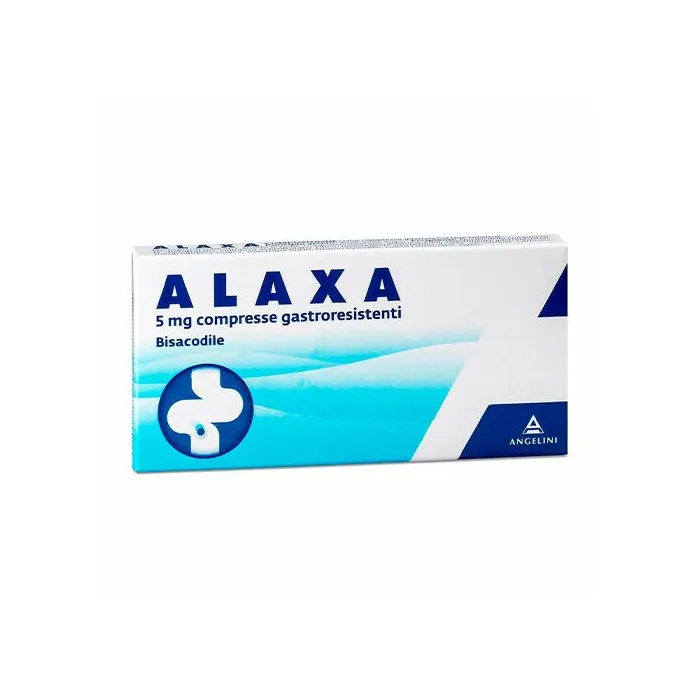
Table of Contents
Package leaflet: Information for the patient
ALAXA 5 mg gastro-resistant tablets
Bisacodyl
Please read this leaflet carefully before taking this medicine because it contains
important information for you.
Always take this medicine exactly as described in this leaflet or as your
doctor or pharmacist has instructed you.
- Keep this leaflet. You may need to read it again.
- If you need more information or advice, consult your pharmacist.
- If you experience any side effects, including those not listed in this leaflet, consult your doctor or pharmacist. See section 4.
- Consult your doctor if you do not notice any improvement or if you experience worsening of symptoms after a short period of treatment.
Contents of this leaflet:
- What ALAXA is and what it is used for
- What you need to know before taking ALAXA
- How to take ALAXA
- Possible side effects
- How to store ALAXA
- Contents of the pack and other information
1. What ALAXA is and what it is used for
ALAXA is a laxative whose active substance is bisacodyl, used to facilitate the evacuation of faeces. The laxative effect is achieved thanks to bisacodyl's ability to soften faeces and increase the speed of intestinal transit.
This medicine is indicated for the short-term treatment of occasional constipation.
Consult your doctor if you do not feel better or if you feel worse after a short period of treatment.
2. What you need to know before taking ALAXA
Do not take ALAXA if:
- you are allergic to the active substance or to similar substances (for example, sodium picosulfate) or to any of the other ingredients of this medicine (listed in section 6);
- you have sudden abdominal pain or any abdominal pain of unknown cause (for example, appendicitis);
- you have nausea or vomiting;
- you have stomach or intestinal inflammation (gastroenteritis);
- you have an intestinal obstruction or narrowing (stenosis);
- you have rectal bleeding of unknown cause;
- you are in a severe state of dehydration, which manifests as dry and sticky mouth, thirst, low urine output, absence or reduced tears, and dry skin;
- you are pregnant or breastfeeding (see "Pregnancy and breastfeeding").
Do not use ALAXA in children under 3 years of age.
Warnings and precautions
Talk to your doctor before using ALAXA:
- for use of the medicine in children aged between 3 and 12 years;
- if your constipation is chronic or you have repeated episodes of constipation;
- if the need for a laxative arises from a sudden change in previous bowel habits (frequency and characteristics of bowel movements) lasting more than two weeks;
- if you have rectal bleeding;
- if you have heart disease or suffer from high blood pressure (hypertension);
- if you have diabetes;
- if you are elderly or in poor general health.
If using the laxative does not produce results after a short period of treatment, consult your doctor.
You should know that laxative abuse (i.e. frequent or prolonged use, or use in excessive doses) may cause persistent diarrhea, resulting in loss of water, mineral salts (especially potassium), and other essential nutrients. In severe cases, decreased potassium levels may lead to heart or muscle disorders, particularly if you are also being treated with certain heart medications (cardiac glycosides), drugs that increase urine production (diuretics), or drugs used to treat inflammation (corticosteroids).
Avoid frequent or prolonged use of this medicine, as it may lead to tolerance and dependence (i.e. the need to progressively increase the dose and inability to do without the medicine), intestinal inflammation (atonic colitis), chronic constipation, and loss of normal intestinal function (intestinal atony).
Other medicines and ALAXA
Inform your doctor or pharmacist if you are taking, have recently taken, or might take any other medicines, and especially if you are taking:
- certain heart medications (cardiac glycosides);
- medications that increase urine production (diuretics);
- medications used to treat inflammation (corticosteroids).
Medicines used to reduce stomach acidity (antacids) may alter the effect of ALAXA; wait at least one hour before taking the laxative. Avoid taking laxatives and other medicines at the same time, as laxatives stimulate intestinal movements and may reduce the absorption of orally taken medicines; wait at least two hours after taking any medicine before taking ALAXA.
ALAXA with food
Avoid taking ALAXA at the same time as milk and dairy products, as these substances may alter the effect of the medicine. Wait at least one hour before taking ALAXA.
Pregnancy and breastfeeding
If you are pregnant, think you may be pregnant, are planning to become pregnant, or are breastfeeding, ask your doctor or pharmacist for advice before taking this medicine.
Use this medicine only when necessary and under direct medical supervision.
Driving and using machines
This medicine does not impair the ability to drive or operate machinery. However, caution should be exercised by individuals performing activities requiring alertness.
ALAXA contains lactose, sucrose, and sodium:
Lactose: if your doctor has diagnosed you with an intolerance to certain sugars, contact him/her before taking this medicine.
Sucrose: if your doctor has diagnosed you with an intolerance to certain sugars, contact him/her before taking this medicine.
Sodium: this medicine contains less than 1 mmol (23 mg) of sodium per dose, i.e. essentially "sodium-free".
3. How to take ALAXA
Take this medicine exactly as stated in this leaflet or as directed by your doctor or pharmacist. If you have any doubts, consult your doctor or pharmacist.
Laxatives should be used as infrequently as possible and for no longer than 7 days; use for longer periods requires a doctor's prescription.
The correct dose is the lowest dose sufficient to produce an easy evacuation of soft stools. It is advisable to initially use the lowest recommended doses.
The recommended dose in adults and children over 12 years of age is 2 tablets per day. In particularly resistant cases, this dose may be increased to 3 tablets per day.
Use in children aged between 3 and 12 years
1-2 tablets per day (0.3 mg per kg of body weight).
Use ALAXA only after consulting your doctor.
Method of administration
Take ALAXA by mouth (oral administration). Swallow the tablets whole with a full glass of water, preferably after the evening meal, as the laxative effect occurs after 10–12 hours. If you take ALAXA on an empty stomach, the laxative effect may occur within 5 hours.
If you take more ALAXA than you should
Excessive doses may cause abdominal pain and diarrhoea with fluid loss. This fluid loss should be replaced by drinking water or other fluids. You may also experience muscle weakness and weight loss.
In case of accidental ingestion or overdose of ALAXA, inform your doctor immediately or go to the nearest hospital, as appropriate measures may be necessary (e.g. gastric lavage).
4. Possible side effects
Like all medicines, this medicine may cause side effects, although not everybody gets them.
Side effects with ALAXA usually affect the stomach and intestine (gastrointestinal). In particular, the medicine may cause abdominal pain (such as cramps, either isolated or spreading throughout the abdomen).
Reporting of side effects
If you experience any side effect, including those not listed in this leaflet, talk to your doctor or pharmacist. You can also report side effects directly via the national reporting system at
https://www.aifa.gov.it/content/segnalazioni-reazioni-avverse . By reporting side effects, you can help provide more information on the safety of this medicine.
5. How to store ALAXA
Keep this medicine out of the sight and reach of children.
Store below 25°C.
Keep in the original packaging to protect the medicine from moisture.
Do not use this medicine after the expiry date stated on the packaging. The expiry date refers to the last day of that month.
Do not dispose of any medicine via wastewater or household waste. Ask your pharmacist how to dispose of medicines no longer in use. This will help protect the environment.
6. Package contents and other information
What ALAXA contains
The active substance is: bisacodyl.
Each ALAXA tablet contains 5 mg of bisacodyl.
The other components are: lactose monohydrate, maize starch, magnesium stearate, gelatin,
diethyl phthalate, cellulose acetate phthalate, talc, acacia, sucrose, sodium carboxymethylcellulose,
macrogol 6000, titanium dioxide, calcium carbonate.
Description of the appearance of ALAXA and contents of the pack
ALAXA is available in a pack containing 20 coated tablets.
Marketing Authorization Holder
Aziende Chimiche Riunite Angelini Francesco – A.C.R.A.F. S.p.A., Viale Amelia 70 - 00181
Rome, Italy
Manufacturer
A.C.R.A.F. S.p.A., Via Vecchia del Pinocchio - 60131 Ancona
Delpharm L’Aigle, Zone Industrielle n°1 Route de Crulai, L’AIGLE, 61300 - France
Health Education Notes
In most cases, a balanced diet rich in water and fibre (bran, vegetables and fruit) can provide a long-term solution to constipation.
Many people believe they are constipated if they do not have a bowel movement every day. This is a mistaken belief, as going less frequently is perfectly normal for many individuals.
Constipation is instead defined as a reduction in bowel movements compared to one's usual pattern, associated with the passage of hard stools. Before using laxatives, it is advisable to correct dietary habits by increasing daily intake of dietary fibre and water.
If the condition is persistent (chronic constipation) or recurrent, you should consult your doctor.