Aislar
Italy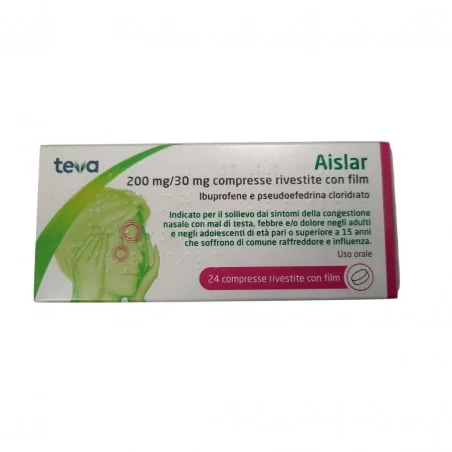
Table of Contents
Package leaflet: Information for the user
Aislar 200 mg/30 mg film-coated tablets
ibuprofen and pseudoephedrine hydrochloride
Please read this leaflet carefully before taking this medicine because it contains important
information for you.
Always take this medicine exactly as described in this leaflet or as your doctor or
pharmacist has instructed you.
- Keep this leaflet . You may need to read it again.
- If you need more information or advice, consult your pharmacist.
- If you experience any side effects, including those not listed in this leaflet, consult your doctor or pharmacist. See section 4.
- Consult your doctor if you do not notice improvement or if your symptoms worsen after 3 days (in adolescents) or 5 days (in adults).
Contents of this leaflet
- What Aislar is and what it is used for
- What you need to know before taking Aislar
- How to take Aislar
- Possible side effects
- How to store Aislar
- Contents of the pack and other information
This medicine is called Aislar 200 mg/30 mg film-coated tablets, but in this leaflet it will be referred to as Aislar.
1. What Aislar is and what it is used for
Aislar contains the active ingredients ibuprofen, a non-steroidal anti-inflammatory drug (NSAID), and
pseudoephedrine, a nasal decongestant.
- Ibuprofen reduces pain, swelling, and elevated temperature.
- Pseudoephedrine acts on blood vessels inside the nose to relieve nasal congestion.
Aislar is indicated for the relief of symptoms of nasal congestion accompanied by headache, fever and/or pain associated with cold and flu.
Aislar is indicated for adults and adolescents over 15 years of age.
Use this combination product only if you have a blocked nose together with pain or fever. Do not use this
product if you have only one of these symptoms.
Consult your doctor if you do not notice any improvement or if your symptoms worsen after 3 days (for adolescents) or 5 days (for adults).
2. What you need to know before taking Aislar
DO NOT take Aislar:
- if you are allergic to ibuprofen, pseudoephedrine, or any of the other ingredients of this medicine (listed in section 6);
- if you are under 15 years of age;
- if you are pregnant or breastfeeding;
- if in the past you developed an allergic reaction (such as wheezing, worsening of asthma, runny or itchy nose, facial swelling, or hives) while taking acetylsalicylic acid or other painkillers, antipyretics, or non-steroidal anti-inflammatory drugs (NSAIDs);
- if you have or have previously had stomach ulcers;
- if in the past you experienced gastrointestinal perforation or bleeding related to NSAID use;
- if you suffer from severe liver failure;
- if you suffer from severe acute (sudden) or chronic (long-term) kidney disease or renal failure;
- if you suffer from severe heart failure;
- if you have serious heart or circulatory problems (heart disease, high blood pressure, angina, rapid heartbeat), hyperthyroidism, diabetes, or pheochromocytoma (a tumour of the adrenal gland);
- if you have previously had a heart attack (myocardial infarction);
- if you have very high blood pressure (severe hypertension) or uncontrolled hypertension due to medication;
- if you have had a stroke or are at risk of stroke;
- if in the past you experienced seizures;
- if you suffer from blood disorders of unknown origin;
- if you have glaucoma (increased intraocular pressure);
- if you have difficulty urinating due to prostate problems;
- if you suffer from systemic lupus erythematosus (SLE), a disease affecting the immune system that causes, for example, joint pain and skin changes;
- if you are taking:
- acetylsalicylic acid (more than 75 mg per day) or other non-steroidal anti-inflammatory drugs (NSAIDs) or analgesics;
- other nasal decongestants such as phenylpropanolamine, phenylephrine, ephedrine, or methylphenidate;
- non-selective monoamine oxidase inhibitors (known as MAOIs) used to treat Parkinson’s disease or depression, or if you have taken MAOIs within the last 2 weeks.
Warnings and precautions
Talk to your doctor or pharmacist before taking Aislar:
- if you suffer from asthma (risk of asthma attack);
- if your doctor has told you that you have a blood clotting disorder;
- if you are taking medicines to thin the blood, e.g. warfarin, low-dose acetylsalicylic acid;
- if you are taking medicines that may increase the risk of stomach ulcers or bleeding, e.g. steroids, antidepressants belonging to the class of selective serotonin reuptake inhibitors (SSRIs) (e.g. fluoxetine, paroxetine), or NSAIDs including acetylsalicylic acid;
- if you suffer from psychosis or diabetes;
- if in the past you have had gastrointestinal disease (such as ulcerative colitis or Crohn’s disease);
- if you have kidney or liver problems;
- if you are taking migraine medications;
- if you have an infection; see the section titled “Infections” below.
Cases of reversible posterior encephalopathy syndrome (PRES) and reversible cerebral vasoconstriction syndrome (RCVS) have been reported following the use of medicines containing pseudoephedrine.
PRES and RCVS are rare conditions that may lead to reduced blood flow to the brain. Stop using Aislar immediately and seek immediate medical help if you develop symptoms that could be signs of PRES or RCVS (see section 4 “Possible side effects” for symptoms).
With ibuprofen, signs of allergic reaction to this medicine have been reported, including breathing difficulties, facial and neck swelling (angioedema), and chest pain. Stop taking Aislar immediately and contact your doctor or emergency services immediately if you notice any of these signs.
Use with caution in case of hyperexcitability. If hallucinations, restlessness, or sleep disturbances occur during treatment, use of the medicine should be discontinued.
Anti-inflammatory/painkillers such as Aislar may be associated with a slight increase in the risk of heart attack (“myocardial infarction”) or stroke, especially when used at high doses. Any risk is more likely with high doses and prolonged treatment. Do not exceed the recommended dose or duration of treatment.
With Aislar, sudden abdominal pain or rectal bleeding due to inflammation of the colon (ischaemic colitis) may occur. If you develop these gastrointestinal symptoms, stop treatment with Aislar and contact your doctor or seek immediate medical help. See section 4.
With Aislar, reduced blood flow to the optic nerve may occur. If sudden vision loss occurs, stop treatment with Aislar and contact your doctor or seek immediate medical help. See section 4.
Skin reactions
Severe skin reactions have been reported in association with treatment with Aislar. Stop treatment with Aislar and consult a doctor immediately if you develop a skin rash, mucosal lesions, blisters, or other signs of allergy, as these may be early signs of a very serious skin reaction. See section 4.
If you develop a generalized feverish erythema associated with pustules, stop taking this medicine and contact your doctor or seek medical help immediately. See section 4.
Infections
Aislar may mask signs of infection such as fever and pain. Therefore, Aislar may delay the start of appropriate treatment for infection, which could lead to an increased risk of complications. This has been observed with bacterial pneumonia and bacterial skin infections associated with chickenpox. If you take this medicine during an infection and infection symptoms persist or worsen, consult a doctor immediately.
Talk to your doctor or pharmacist before taking Aislar:
- if you have heart problems, including heart failure and angina (chest pain), have had a heart attack, have undergone bypass surgery, have had peripheral artery disease (poor circulation in the legs or feet due to narrowed or blocked arteries), or have previously had any type of stroke (including “mini-stroke” or transient ischaemic attack [“TIA”]);
- if you have high blood pressure, diabetes, or high cholesterol, have a family history of heart disease or stroke, or are a smoker.
Avoid alcohol consumption during treatment.
In dehydrated adolescents, there is a risk of kidney problems.
Contact a doctor if symptoms persist or worsen.
For those engaged in sports
Using the medicine without therapeutic need constitutes doping and may result in a positive anti-doping test.
Children and adolescents
Aislar must not be given to children under 15 years of age.
Other medicines and Aislar
Inform your doctor or pharmacist if you are taking, have recently taken, or might take any other medicines, including those without a prescription.
Aislar must not be used if you are taking:
- acetylsalicylic acid (more than 75 mg per day);
- other non-steroidal anti-inflammatory drugs (NSAIDs);
- other painkillers or antipyretics;
- monoamine oxidase inhibitors (MAOIs; used to treat Parkinson’s disease or depression) or if you have taken MAOIs within the last 2 weeks;
- other vasoconstrictors used as nasal decongestants (e.g. phenylpropanolamine, phenylephrine, and ephedrine administered orally or nasally).
Aislar may affect or be affected by other medicines. For example:
- anticoagulants (i.e. medicines that thin the blood/prevent clotting, e.g. acetylsalicylic acid, warfarin, ticlopidine);
- medicines that lower high blood pressure (ACE inhibitors such as captopril, beta-blockers such as atenolol-containing medicines, angiotensin II receptor antagonists such as losartan);
- medicines that may increase the risk of stomach ulcers or bleeding, e.g. steroids, antidepressants belonging to the SSRI class (e.g. fluoxetine, paroxetine) or NSAIDs including acetylsalicylic acid, and selective cyclooxygenase-2 (COX-2) inhibitors;
- medicines for irregular heartbeat, heart failure, or fluid retention (e.g. cardiac glycosides), as Aislar may reduce their effectiveness or increase the risk of heart rhythm abnormalities, high blood pressure, or impaired kidney function;
- cyclosporine (immunosuppressants) due to the possible increased risk of impaired kidney function;
- medicines for depression (lithium, tricyclic antidepressants) may increase the risk of side effects;
- concomitant use of phenytoin may increase serum levels of these medicines. Correct use (for a maximum of 5 days) does not require monitoring of phenytoin serum levels;
- other decongestants or appetite suppressants, migraine medicines, oxytocin, as they may increase the risk of side effects;
- probenecid or sulfinpyrazone may delay the excretion of ibuprofen;
- sulfonylureas (antidiabetics): although no interactions with ibuprofen have been reported so far, monitoring of blood glucose levels is recommended as a precaution when taken concomitantly;
- medicines to increase urine production (diuretics);
- high-dose methotrexate (over 20 mg per week), as the effect of methotrexate may be enhanced;
- quinolone antibiotics due to increased risk of seizures;
- cyclosporine, tacrolimus, and trimethoprim;
- zidovudine (for treatment of HIV);
- injectable heparin and/or preparations containing Ginkgo biloba due to increased risk of bleeding;
- mifepristone: NSAIDs must not be administered for 8–12 days after mifepristone administration as they may reduce its effect.
There are also other medicines that may affect or be affected by treatment with Aislar.
Therefore, always ask your doctor or pharmacist for advice before using Aislar with other medicines, including those without a prescription.
Due to the administration of pseudoephedrine, an acute hypertensive response may occur during the perioperative period. Therefore, stop treatment with Aislar several days before surgery and inform the anaesthetist.
Aislar with food and drinks
Take the tablets with water, preferably with food.
Pregnancy, breastfeeding and fertility
If you are pregnant, suspect you may be pregnant, planning a pregnancy, or breastfeeding, consult your doctor or pharmacist before taking this medicine.
Pregnancy
Aislar must not be taken during pregnancy. The active ingredients, ibuprofen and pseudoephedrine, may cause serious problems for the foetus.
NSAIDs may cause kidney and heart problems in the foetus. They may affect the bleeding tendency of both mother and baby and delay or prolong labour more than expected. From the 20th week of pregnancy, NSAIDs may cause kidney problems in the foetus, reducing the levels of amniotic fluid surrounding the baby (oligohydramnios) or causing narrowing of a blood vessel (ductus arteriosus) in the baby’s heart.
Breastfeeding
Aislar must not be taken if you are breastfeeding. It has been shown that the active ingredients, ibuprofen and pseudoephedrine, are present in infants breastfed by women who have taken them.
Fertility
Aislar contains ibuprofen, which belongs to a group of medicines (NSAIDs) that may impair fertility in women. This effect is reversible upon discontinuation of the medicine.
Driving and using machines
Aislar has no known effects on the ability to drive or use machines. In rare cases, dizziness or hallucinations may occur, which should be taken into account.
Aislar contains sodium
This medicine contains less than 1 mmol (23 mg) of sodium per tablet, i.e. essentially “sodium-free”.
3. How to take Aislar
Take Aislar exactly as described in this leaflet or as instructed by your doctor or
pharmacist. If you have any doubts, consult your doctor or pharmacist.
Aislar is for oral use only.
The lowest effective dose for the shortest duration necessary to relieve symptoms should be used. In case of
infection, consult a doctor immediately if symptoms (such as fever and pain) persist or worsen (see
section 2).
Recommended dose:
Adults and adolescents aged 15 years and older: 1 tablet every 4–6 hours, as needed. For
more severe symptoms, 2 tablets every 6–8 hours, as needed.
Do not exceed the maximum daily dose of 6 tablets.
Swallow the tablets with water, preferably with food. Do not break or crush the tablets.
Use in children and adolescents
Do not give to children under 15 years of age.
Duration of treatment
This medicine is intended for short-term use only. Use the lowest effective dose for the shortest time
necessary to relieve symptoms.
In adults, do not exceed 5 days of treatment.
In adolescents (15–18 years), do not exceed 3 days of treatment.
If symptoms persist or worsen, consult your doctor.
If you take more Aislar than you should
If you have taken more Aislar than you should, or if children have accidentally ingested this medicine,
always contact a doctor or the nearest hospital for advice regarding potential risks and necessary actions.
Symptoms of overdose may include nausea, stomach ache, vomiting (even with traces of blood),
diarrhea, dry mouth, headache, tinnitus, confusion, blurred vision, and eye tremor. At high doses, drowsiness,
excitation, disorientation, chest pain, palpitations, loss of consciousness, seizures (mainly in children),
weakness, dizziness, blood in the urine, low blood potassium levels, feeling cold, and breathing difficulties may occur.
Additionally, prolongation of prothrombin time (INR) may occur. Severe kidney and liver damage may also occur.
In asthmatic patients, worsening of asthma may occur.
Furthermore, insomnia, fever, sweating, anxiety, restlessness, and tremor may occur.
If you forget to take Aislar
Do not take a double dose to make up for the missed dose.
If you have any doubts about using this product, consult your pharmacist or doctor.
4. Possible side effects
Like all medicines, this medicine can cause side effects, although not everybody gets them.
Stop treatment with Aislar immediately and contact your doctor urgently if:
- you experience any of the following symptoms, which may be signs of a severe allergic reaction:
- difficulty breathing or swallowing;
- swelling of the face, lips, tongue or throat;
- severe skin itching with hives;
- serious skin reactions with blisters under the skin;
- rapid heartbeat with low blood pressure;
- you experience signs of gastrointestinal bleeding such as
- bright red stools (bowel movements), black tarry stools, vomiting blood or dark particles resembling coffee grounds;
- you develop symptoms that could indicate posterior reversible encephalopathy syndrome (PRES) or reversible cerebral vasoconstriction syndrome (RCVS). These include:
- sudden, severe headache;
- nausea;
- vomiting;
- confusion;
- seizures;
- changes in vision.
Other possible side effects include:
Uncommon (may affect up to 1 in 100 people):
- headache, dizziness, difficulty sleeping, restlessness, irritability or fatigue;
- heart attack, seizures, aseptic meningitis;
- visual disturbances;
- dry mouth, thirst;
- abdominal discomfort, indigestion, nausea, vomiting, diarrhoea, reduced appetite;
Rare (may affect up to 1 in 1,000 people):
- tinnitus (ringing in the ears);
- nervousness, tremor, anxiety, restlessness, hallucinations, insomnia;
- worsening of asthma;
- stomach pain, flatulence, constipation;
- swelling, high blood pressure, palpitations, rapid heartbeat, heart attack, shortness of breath;
- irregular heart rhythm, chest pain;
- kidney tissue damage, elevated levels of uric acid in the blood;
- skin rashes, hives, itching, redness, excessive sweating.
Very rare (may affect up to 1 in 10,000 people):
- infectious inflammation, meningitis symptoms (headache, fever, neck stiffness);
- blood disorders (anaemia, leucopenia, thrombocytopenia, pancytopenia, agranulocytosis). Early signs include fever, sore throat, superficial mouth ulcers, flu-like symptoms, severe fatigue, nosebleeds and unexplained bruising;
- severe allergic reactions;
- psychotic reactions, depression;
- kidney failure or other kidney disorders;
- liver disorders;
- stomach ulcer, sometimes with bleeding or perforation (blood in vomit or stools), gastritis, mouth ulcers, worsening of colitis and Crohn’s disease, intestinal stenosis (narrowing);
- oesophagitis (heartburn); pancreatitis;
- severe skin reactions including exfoliative dermatitis, Stevens-Johnson syndrome, erythema multiforme and toxic epidermal necrolysis;
- alopecia;
- serious skin infections, complications affecting soft tissues during chickenpox infection;
- reduced levels of haemoglobin in the blood.
Frequency not known (cannot be estimated from the available data):
- serious conditions affecting cerebral blood vessels known as posterior reversible encephalopathy syndrome (PRES) and reversible cerebral vasoconstriction syndrome (RCVS);
- drug reaction with eosinophilia and systemic symptoms (DRESS): a severe skin reaction may occur. Symptoms of DRESS include skin rash, fever, swollen lymph nodes and increased levels of eosinophils (a type of white blood cell);
- widespread red, scaly rash accompanied by fever at the start of treatment, with bumps under the skin and blisters mainly located in skin folds, trunk and upper limbs (acute generalized exanthematous pustulosis, AGEP). Discontinue treatment with Aislar if you develop these symptoms and consult a doctor immediately. See also section 2; inflammation of the colon due to inadequate blood supply (ischaemic colitis);
- skin becomes sensitive to light;
- hallucinations, abnormal behaviour;
- muscle weakness;
- difficulty urinating in men with prostate enlargement;
- reduced blood flow to the optic nerve (ischaemic optic neuropathy);
- chest pain, which may be a sign of a potentially serious allergic reaction called Kounis syndrome.
Reporting of side effects
If you experience any side effect, including those not listed in this leaflet, talk to your doctor or pharmacist.
You can also report side effects directly via the national reporting system at: https://www.aifa.gov.it/content/segnalazioni-reazioni-avverse.
By reporting side effects, you can help provide more information on the safety of this medicine.
5. How to store Aislar
Keep this medicine out of the sight and reach of children.
This medicine does not require any special storage conditions.
Do not use Aislar after the expiry date stated on the blister pack/box after “Exp.”. The expiry date refers to the last day of that month.
Do not dispose of medicines via wastewater or household waste. Ask your pharmacist how to dispose of medicines you no longer use. This will help protect the environment.
6. Package contents and other information
What Aislar contains
- The active substances are ibuprofen (200 mg per tablet) and pseudoephedrine hydrochloride (30 mg per tablet, equivalent to 24.6 mg of pseudoephedrine base).
The other components are microcrystalline cellulose, pregelatinized starch (maize), povidone K-30, anhydrous colloidal silica, stearic acid, sodium croscarmellose, sodium lauryl sulfate, polyvinyl alcohol (partially hydrolysed), talc (E553b), macrogol 3350, pearly pigment based on MICA (a mixture of potassium aluminium silicate [E555]-[mica] and titanium dioxide [E171]), polysorbate 80 (E433), hypromellose, titanium dioxide (E171), macrogol 400, yellow iron oxide (E172), red iron oxide (E172), black iron oxide (E172). (See the end of section 2 for further information on sodium).
Description of the appearance of Aislar and contents of the pack
Aislar tablets are film-coated, oval-shaped, yellow tablets (dimensions: approximately 15.6 mm x 7.7 mm).
The tablets are available in blisters of 12, 20 or 24 tablets.
Not all pack sizes may be marketed.
Marketing Authorisation Holder and Manufacturer
Marketing Authorisation Holder
TEVA B.V., Swensweg 5, 2031 GA Haarlem, The Netherlands
Manufacturers
Teva Operations Poland Sp. z.o.o., ul. Mogilska 80, 31-546 Krakow, Poland
Merckle GmbH, Ludwig-Merckle-Strasse 3, 89143 Blaubeuren, Germany
Teva Czech Industries s.r.o., Ostravska 29, c.p. 305, 74770 Opava-Komarov, Czech Republic
This medicinal product is authorised in the European Economic Area countries under the following names:
Italy: Aislar
Poland: Infex Zatoki
Romania: Tedolfen 200 mg/30 mg film-coated tablets