Agiolax
Italy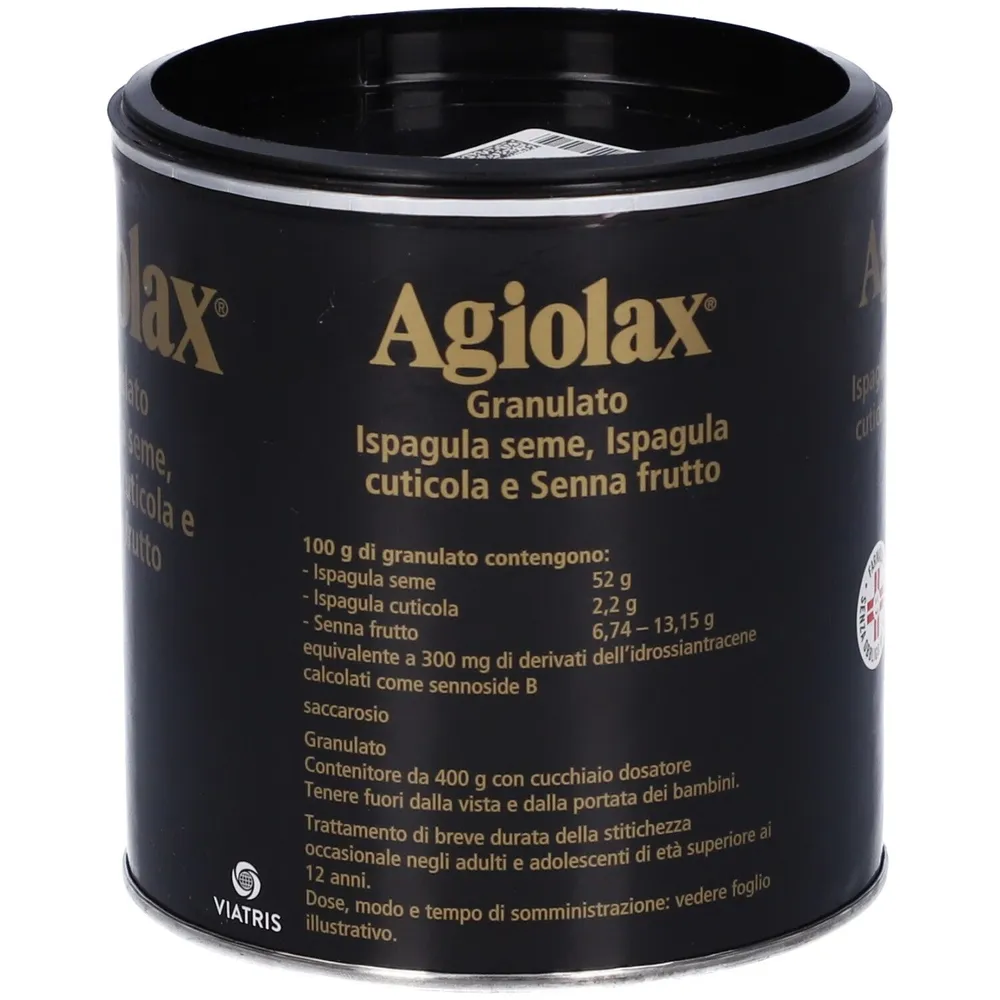
Table of Contents
Package leaflet: Information for the user
AGIOLAX granules
Plantago ovata seed, Plantago ovata husk and Senna fruit
Please read all of this leaflet carefully before you start taking this medicine because it contains important information for you.
Always use this medicine exactly as described in this leaflet or as your doctor or pharmacist has told you to do.
- Keep this leaflet. You may need to read it again.
- If you need more information or advice, consult your pharmacist.
- If you experience any side effects, including any not listed in this leaflet, talk to your doctor or pharmacist. See section 4.
- Consult your doctor if you do not notice any improvement or if your symptoms worsen after 7 days.
Contents of this leaflet:
- What AGIOLAX is and what it is used for
- What you need to know before taking AGIOLAX
- How to take AGIOLAX
- Possible side effects
- How to store AGIOLAX
- Contents of the pack and other information
1. What AGIOLAX is and what it is used for
This medicinal product contains Ispaghula seed, Ispaghula husk and Senna fruit, and belongs to a group of medicines called laxatives. Agiolax is used for the short-term treatment of occasional constipation in adults and adolescents over 12 years of age.
Consult a doctor if you do not feel better or if you feel worse after 7 days.
2. What you need to know before using AGIOLAX
Do NOT use AGIOLAX
- if you are allergic to Ispaghula seed, Ispaghula husk, or Senna fruit, or to any of the other ingredients of this medicine (listed in section 6)
- if for more than 2 weeks you have experienced intestinal irregularity characterized by excessive straining during defecation, hard stools that are difficult to pass and/or of reduced volume, bowel movements less than three times a week, or loose and/or liquid stools
- if you suffer from abdominal pain, even of unknown origin
- if you experience episodes of nausea or vomiting
- if you have intestinal obstruction
- if you have stenosis (narrowing) of the esophagus (the food passage from the throat to the stomach) or of any part of the gastrointestinal tract (stomach and intestine)
- if you have unexplained rectal bleeding
- if you are unable to defecate even after using laxatives
- if you suffer from severe dehydration (excessive loss of body water)
- if you suffer from dysphagia (difficulty swallowing), hiatal hernia (protrusion of a portion of the stomach moving upward), or conditions that increase the risk of regurgitation (e.g. if you are bedridden)
- if you suffer from loss of normal bowel function (colonic atony), excessive bowel distension (megacolon), or have a hard, bulky mass of stool in the intestine due to constipation (fecaloma)
- if you are pregnant or breastfeeding (see section Pregnancy, breastfeeding and fertility)
- if you suffer from inflammatory bowel diseases (Crohn's disease, ulcerative colitis, or appendicitis)
- if the person to be treated is under 12 years of age
Warnings and precautions
Talk to your doctor or pharmacist before using Agiolax.
Health education notes
First of all, it should be noted that in most cases, a balanced diet rich in water and fiber (bran, vegetables, and fruit) can provide a lasting solution to constipation.
Many people believe they are constipated if they do not have a bowel movement every day. This is a mistaken belief, as such a pattern is completely normal for many individuals.
Consider instead that constipation occurs when bowel movements are less frequent than your usual pattern and are associated with the passage of hard stools.
If episodes of constipation recur frequently, you should consult your doctor.
Abuse of laxatives (frequent or prolonged use, or excessive doses) may cause persistent diarrhea, resulting in loss of water, mineral salts (especially potassium), and other essential nutrients.
In severe cases, dehydration (excessive loss of body water) or hypokalemia (low potassium levels in the blood) may occur, which can lead to heart or muscle problems, especially if you are simultaneously taking certain medications (see Other medicines and AGIOLAX).
Laxative abuse may lead to dependence (and thus a possible need to progressively increase the dose), chronic constipation, and intestinal atony (loss of normal intestinal function).
During treatment with Agiolax, it is necessary to drink plenty of fluids (6–8 glasses of water per day) to prevent intestinal obstruction.
Agiolax should only be used when therapeutic effects cannot be achieved by modifying the diet or by using bulk-forming laxatives.
Inform your doctor if you are taking thyroid medications.
After oral intake or skin contact, Agiolax may cause hypersensitivity reactions (allergies); see “Possible side effects”.
Abdominal pain, spasms, and diarrhea may occur, especially if you already have irritable bowel syndrome (altered intestinal motility); see “Possible side effects”.
Some symptoms may also occur following an overdose; in such cases, the dose should be reduced (see “If you take more AGIOLAX than you should”).
Other medicines and AGIOLAX
Inform your doctor or pharmacist if you are taking, have recently taken, or might take any other medicine.
Avoid taking laxatives together with other medicines: if you need to take another medicine, wait at least 2 hours before taking the laxative.
Consult your doctor before using this medicine:
- if you are taking opioids (medicines that reduce pain)
- if you are taking cortisone (medicines for inflammation)
- if you are taking diuretics (medicines that lower blood pressure)
- if you are taking cardiac glycosides (medicines used to treat heart problems)
- if you are taking antiarrhythmics (medicines that regulate heart rhythm)
- if you are taking vitamin B12. Also, consult your doctor if you are undergoing treatment with:
- anticoagulants (medicines that delay blood clotting)
- lithium (a medicine used to treat manic-depressive psychosis)
- carbamazepine (used to control epilepsy, a disease characterized by loss of consciousness and violent involuntary muscle contractions)
- antidiabetic agents (medicines used to treat diabetes, a disease characterized by high blood sugar levels)
Pregnancy, breastfeeding and fertility
If you suspect you are pregnant or are planning a pregnancy, consult your doctor or pharmacist before using this medicine.
The use of Agiolax during pregnancy and breastfeeding is contraindicated (see “Do NOT use AGIOLAX”).
No studies have been conducted on fertility.
Driving and using machines
Agiolax does not affect the ability to drive vehicles or operate machinery.
AGIOLAX contains sucrose
If your doctor has diagnosed you with an intolerance to certain sugars, contact him before taking this medicine.
3. How to use AGIOLAX
Use this medicine exactly as stated in this leaflet or as directed by your doctor or pharmacist. If you have any doubts, consult your doctor or pharmacist.
Dosage
The correct dose is the lowest dose that is sufficient to produce easy passage of soft stools.
It is recommended to initially use the lowest recommended doses.
If necessary, the dose may then be increased. Do not exceed the maximum recommended dose.
Adults and adolescents over 12 years
The recommended dose is:
| 5 g or 10 g of granules (equivalent to 1 - 2 measuring spoons) once daily. |
- 1-2 sachets of 5 g once daily. Do not exceed the recommended maximum daily dose. Children Agiolax is contraindicated in children under 12 years of age (see "Do not use AGIOLAX"). A single dose of 5 g of granules contains:
- 2.6 g of Plantago ovata seed
- 0.11 g of Plantago ovata husk
- 0.34 - 0.66 g of Senna fruit
Method of administration
The granules must not be chewed or dissolved, but placed on the tongue and swallowed while standing upright, together with a full glass of water. Agiolax must always be taken with liquids. Without sufficient liquid, the product may swell and block the pharynx or oesophagus, creating a risk of choking (see "Warnings and precautions"). It may be taken independently of meals. It is preferable to take it in the evening, one hour before going to bed. Use the dosing spoon provided in the package.
Duration of treatment
Laxatives should be used as infrequently as possible and must not be used for more than 7 days. If no improvement is observed after 3 days, or if abdominal pain or intestinal irregularity (characterized by hard-to-pass stools or poorly formed or liquid stools) occurs, consult your doctor. Prolonged use must be established by a doctor after adequate clinical evaluation.
If you take more AGIOLAX than you should
If you take an excessive dose of Agiolax, you may experience abdominal spasms (sudden, involuntary contractions of the intestine), abdominal pain, flatulence (passing intestinal gas through the anus), intestinal obstruction, and severe diarrhoea.
In such a case, stop treatment and drink fluids to replace fluid and electrolyte losses (salts present in the blood).
Prolonged use of high doses of Agiolax may cause toxic hepatitis (liver damage).
If you forget to take AGIOLAX
Do not take a double dose to make up for a forgotten dose.
If you have any doubts about using this medicine, consult your doctor or pharmacist.
4. Possible side effects
Like all medicines, this medicine can cause side effects, although not everybody gets them.
If you experience any of the following symptoms, STOP using Agiolax immediately and contact your
doctor or go to the nearest hospital, where you will be given appropriate and specific treatment:
- Hypersensitivity reactions (allergic reactions)
- Anaphylactic reactions (severe allergic reactions)
- Skin rash and itching. Abdominal colic (painful contractions of visceral muscles) may also occur. These are more frequent in cases of severe constipation or irritable bowel syndrome (a condition involving altered intestinal motility).
The following side effects may also occur:
Rare (may affect up to 1 in 1,000 people):
- Flatulence (passing intestinal gas through the anus)
- Abdominal distension (bloating)
- Chromaturia (abnormal urine coloration), due to the presence of senna components
Very rare (may affect up to 1 in 10,000 people):
- Oesophageal obstruction (blockage of the oesophagus, the food passage from the throat to the stomach)
Not known (frequency cannot be estimated from the available data):
- Nausea
- Vomiting
- Diarrhoea
- Albuminuria [loss of albumin (a protein) in the urine], due to prolonged use
- Haematuria (blood in the urine), due to prolonged use
In addition, colon melanosis (pigmentation of the intestinal mucosa) has been reported, which resolves after discontinuation of the medicine.
Reporting of side effects
If you experience any side effect, including those not listed in this leaflet, talk to your doctor or pharmacist. You can also report side effects directly via the national reporting system at
https://www.aifa.gov.it/content/segnalazioni-reazioni-avverse
By reporting side effects, you can help provide more information on the safety of this medicine.
5. How to store AGIOLAX
Keep this medicine out of the sight and reach of children.
Do not use this medicine after the expiry date which is stated on the packaging after "Exp." The
expiry date refers to the last day of that month.
Container of 100 g, 250 g, 400 g:
Store below 25°C.
Packets:
Store below 30°C.
Keep in the outer packaging to protect the medicine from moisture.
Do not dispose of medicines via wastewater or household waste. Ask your pharmacist how to
dispose of medicines no longer in use. This will help protect the environment.
6. Package contents and other information
What AGIOLAX contains
- The active substances are Ispaghula seed, Ispaghula husk and Senna fruit. The other components are: talc, arabic gum, cumin flavour, sage flavour, mint flavour, liquid paraffin, solid paraffin, E 172, sucrose (see section 2 “AGIOLAX contains sucrose”).
Description of the appearance of AGIOLAX and package contents
Granules in:
- 1 paper/Al container with screw cap and PP cap insert, 100 g and 250 g, with a graduated PP dosing spoon of 7 ml
- 1 paper/Al container with peelable membrane and snap-on PP lid, 400 g, with a graduated PP dosing spoon of 7 ml
- 6 paper/Al/PE sachets of 5 g. Not all pack sizes may be marketed.
Marketing Authorisation Holder
Cooper Consumer Health B.V.
Verrijn Stuartweg 60 – 1112 AX Diemen
(The Netherlands)
Manufacturer
For containers of 100 g, 250 g and 400 g:
Madaus GmbH – Luetticher Strasse, 5 – Troisdorf - Germany.
For 5 g sachets:
Lamp San Prospero SpA - Via della Pace, 25/A - 41030 San Prospero (MO) - Italy