Adreview
Italy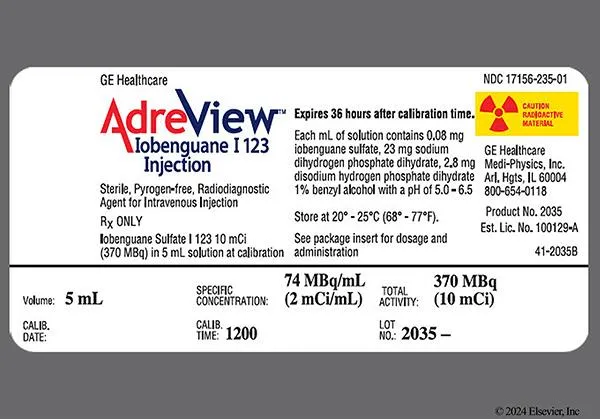
Table of Contents
- PACKAGE LEAFLET: INFORMATION FOR THE PATIENT
- AdreView 74 MBq/ml solution for injection
- 1. What AdreView is and what it is used for
- 2. What you should know before AdreView is administered to you
- 3. How AdreView is used
- 4. Possible side effects
- 5. How AdreView is stored
- 6. Package contents and other information
PACKAGE LEAFLET: INFORMATION FOR THE PATIENT
AdreView 74 MBq/ml solution for injection
Iobenguane ( I)
Please read this leaflet carefully before using this medicine because it contains important information for you.
- Keep this leaflet. You may need to read it again.
- If you would like more information, please speak to the nuclear medicine specialist supervising the procedure.
- If you experience any side effects, contact the nuclear medicine physician. This also applies to any possible side effects not listed in this leaflet.
Contents of this leaflet:
- What AdreView is and what it is used for
- What you need to know before being administered AdreView
- How AdreView is used
- Possible side effects
- How AdreView is stored
- Contents of the pack and other information
1. What AdreView is and what it is used for
This medicinal product is a radiopharmaceutical used solely for diagnostic purposes.
It is used only to help identify possible presence of diseases.
AdreView is a 'radiopharmaceutical' medicinal product. It is administered before a scan and helps a special device to visualise the inside of a part of your body.
- It contains an active substance called 'iobenguane'.
- Once injected, it can be seen from outside your body by the imaging device used for the diagnostic examination.
- The diagnostic scan may help your doctor detect certain types of tumours of the adrenal glands or thyroid, and assess how a tumour responds to treatment.
- This medicinal product is also used in some patients prior to a diagnostic examination to evaluate heart function. The use of AdreView involves exposure to small amounts of radiation. Your doctor or nuclear medicine physician must evaluate that the clinical benefit you will obtain from the diagnostic procedure with the radiopharmaceutical outweighs the risk related to radiation exposure. Your doctor or nurse will inform you which part of your body will be examined.
2. What you should know before AdreView is administered to you
AdreView must not be used:
- If you are allergic (hypersensitive) to the active substance or to any of the excipients of this medicine (listed in section 6). Do not take AdreView if any of the above apply to you. If in doubt, speak to your doctor or nurse.
AdreView must not be administered to premature infants and newborns. (See section
"Important information about some ingredients of AdreView").
Warnings and precautions
Inform the nuclear medicine doctor before AdreView is administered to you if:
- you have kidney problems
- you are pregnant or think you may be pregnant
Before administration of AdreView you must:
Drink plenty of fluids before undergoing the examination, so that you urinate as frequently as possible during the first few hours after the examination.
Children and adolescents
Inform the nuclear medicine doctor if you are under 18 years of age.
Other medicines and AdreView
Inform the nuclear medicine doctor if you are taking, have recently taken, or might take any other medicines, including over-the-counter medicines and herbal remedies.
This is because some medicines may interfere with AdreView.
Before undergoing the examination, inform your nuclear medicine doctor if you are taking any of the following types of medicines. This is because these medicines may interfere with the results of your examination:
- Calcium channel blockers, such as: diltiazem, nifedipine or verapamil.
- Antidepressants, such as amitriptyline or imipramine.
- "Sympathomimetic agents" (used as decongestants for cough or cold remedies), such as phenylephrine, ephedrine, pseudoephedrine or phenylpropanolamine.
- Reserpine (used to treat mental disorders or high blood pressure).
- Labetalol (used to treat high blood pressure).
- Phenothiazines (used to treat mental disorders).
- Cocaine. If you are unsure whether any of the above apply to you, inform your nuclear medicine doctor before taking AdreView.
Pregnancy and breastfeeding
Inform the nuclear medicine doctor before administration of AdreView if you are pregnant or suspect you may be pregnant, if you have missed your menstrual period, or if you are breastfeeding. In case of doubt, it is important to consult the nuclear medicine doctor supervising the procedure.
If you are pregnant
Your doctor will administer this medicine only if they consider that the expected benefit outweighs the risk.
AdreView contains benzyl alcohol, which can cross the placenta. Therefore, potential toxicity in premature infants should be considered if AdreView is administered shortly before or during delivery, even if by caesarean section.
If you are breastfeeding
Do not breastfeed if you have been administered AdreView.
This is because small amounts of radioactivity may pass into breast milk.
If you are breastfeeding, your nuclear medicine doctor should wait until the end of breastfeeding before using AdreView.
If waiting is not possible, your nuclear medicine doctor will ask you:
- to stop breastfeeding for 3 days, and
- to use infant formula for your baby, and
- to express (remove) breast milk and discard it. Your doctor will inform you when you can resume breastfeeding.
Driving and using machines
Ask your doctor whether you may drive vehicles or use machinery after AdreView has been administered to you.
Important information about some excipients of AdreView
- AdreView contains benzyl alcohol. Benzyl alcohol may cause toxic reactions and allergic reactions in newborns and children up to 3 years of age. 0.18 mmol (4.23 mg) of sodium per ml. This medicine contains less than 1 mmol (23 mg) of sodium per dose, therefore essentially sodium-free.
Important information about AdreView
When AdreView is used, you are exposed to radioactivity.
- Your doctor will always assess the potential risks and benefits before administering the medicine to you. Ask your doctor if you have any questions.
3. How AdreView is used
There are strict regulations governing the use, handling, and disposal of radiopharmaceuticals.
AdreView will only be used in a hospital setting.
This product will be handled and administered by specially trained and qualified personnel.
The staff will ensure that the product is used safely and will inform you about the actions taken.
- Your doctor will instruct you to take another medicine at least one hour before AdreView is administered. This medication is intended to block the accumulation of radioactivity in the thyroid gland. The nuclear medicine physician supervising the procedure will determine the amount of AdreView to be used in your case. The minimum necessary dose required to obtain the desired information will be used. The usual administered amount in an adult ranges between 80 and 400 MBq. The megabecquerel (MBq) is the unit of measurement for radioactivity.
Use in children and adolescents
The amount to be administered to a child or adolescent depends on body weight.
Administration of AdreView and performance of the procedure:
The usual dose is:
- A single injection given over several minutes. Usually, the examination will be performed either on the same day or the day after the drug injection, and administration may be repeated.
Duration of the procedure
Your nuclear medicine physician will inform you about the duration of the procedure.
If you have been given more AdreView than you should have:
Cases of overdose are unlikely due to the nature of the radioactive isotope and the amount of Iobenguane present.
However, in the event of an overdose, you will receive appropriate treatment.
If you have any questions about the use of AdreView, please consult the nuclear medicine physician supervising the procedure.
4. Possible side effects
Like all medicines, AdreView can cause side effects, although not everybody gets them.
Allergic reactions
If you experience an allergic reaction while you are in hospital or a clinic undergoing the investigation, inform your doctor or nurse immediately.
Symptoms may include:
- skin rash, itching, or hot flushes
- swelling of the face
- difficulty breathing. In more severe cases, reactions may include:
- fainting (loss of consciousness), feeling dizzy or lightheaded
- nausea (feeling unwell)
- cold chills.
If any of the side effects listed above occur after you have left the hospital or clinic, go immediately to the nearest hospital emergency department.
Other side effects include
If AdreView is injected too quickly, the following may occur:
- fast or irregular heartbeat
- difficulty breathing
- feeling unusually hot
- stomach cramps
- high blood pressure. Symptoms of this side effect may include headache and changes in vision (visual disturbances).
With AdreView, you will receive a small amount of ionising radiation, which carries a low risk of developing cancer or hereditary abnormalities.
Your doctor has determined that the clinical benefit you will receive from the radiopharmaceutical procedure outweighs the risk associated with radiation exposure.
If you experience any of the side effects listed above, if any of the side effects worsen, or if you notice any side effects not listed in this leaflet, inform your doctor or the nuclear medicine physician supervising the procedure.
Reporting of side effects
If you experience any side effect, including those not listed in this leaflet, speak to your nuclear medicine doctor. Side effects can also be reported directly via the national reporting system at www.agenziafarmaco.gov.it/it/responsabili. Reporting of side effects helps provide more information on the safety of this medicine.
5. How AdreView is stored
Do not store this medicine. This medicine is stored under the responsibility of a specialist in suitable premises, in accordance with current regulations regarding radioactive materials.
AdreView must not be used after the expiry date stated on the packaging.
The following information is intended exclusively for the specialist.
It can be used up to 36 hours from the calibration time stated on the label.
After opening, store in a refrigerator (2°C – 8°C) and use within 8 hours.
The medicine must be stored at a temperature not exceeding 25°C. Do not freeze.
Protect from light.
Store in the original lead container or in an equivalent container.
Keep AdreView out of the sight and reach of children.
The product label includes the correct storage conditions and the expiry date of the batch.
Hospital staff must ensure that the product is correctly stored and disposed of, and that it is not used after the expiry date stated on the label.
6. Package contents and other information
What AdreView contains
- The active substance is iobenguane (I). Each ml of AdreView contains 74 MBq of iobenguane at the date and time of calibration.
- The other components are benzyl alcohol, 3-iodobenzylguanidine, monosodium phosphate dihydrate, disodium phosphate dihydrate, and water for injections.
Description of the appearance of AdreView and package contents
AdreView is supplied in a single multidose glass vial containing a variable volume of injectable solution between 0.5 mL and 10 mL.
Marketing Authorization Holder
GE Healthcare S.r.L.
Via Galeno 36,
20126 Milano
Italy
Manufacturer
GE Healthcare B.V.
Den Dolech 2
5612 AZ Eindhoven
The Netherlands
This leaflet was last approved in MM/YYYY.
The following information is intended exclusively for the physician or healthcare professional:
The full RCP (Summary of Product Characteristics) for AdreView is provided as a separate document inside the package, intended to provide medical personnel with additional scientific information and practical guidance on the administration and use of the radiopharmaceutical.
Please refer to the RCP (the RCP must be included in the package).