Adrenaline Monico
Italy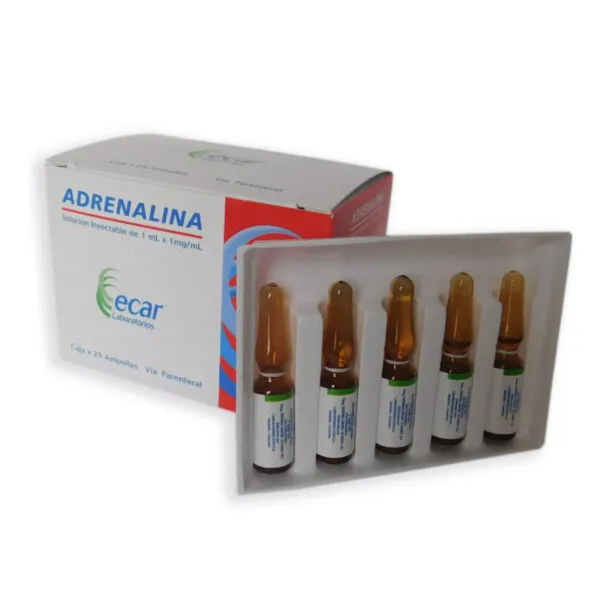
Table of Contents
- Package leaflet: Information for the user
- monico adrenaline
- 1. What Adrenalina Monico is and what it is used for
- 2. What you need to know before using adrenaline monico
- 3. How to use Adrenalina Monico
- 4. Possible side effects
- 5. How to store adrenaline monico
- 6. Contents of the pack and other information
Package leaflet: Information for the user
monico adrenaline
0.5 mg/ml injection solution
1 mg/ml injection solution
adrenaline
Generic medicine
Please read all of this leaflet carefully before you start using this medicine because it contains important information for you.
- Keep this leaflet. You may need to read it again.
- If you have any questions, ask your doctor or pharmacist.
- This medicine has been prescribed for you only. Do not give it to other people, even if their symptoms are the same as yours, as it may be harmful.
- If you experience any side effects, including those not listed in this leaflet, please tell your doctor or pharmacist. See section 4.
Contents of this leaflet:
- What adrenaline monico is and what it is used for
- What you need to know before using adrenaline monico
- How to use adrenaline monico
- Possible side effects
- How to store adrenaline monico
- Contents of the pack and other information
1. What Adrenalina Monico is and what it is used for
Adrenalina Monico contains the active substance adrenaline, which belongs to a group of medicines called adrenergic and dopaminergic agents.
Adrenalina Monico can be used in emergency situations to treat anaphylactic shock, a sudden, potentially life-threatening allergic reaction, and angioedema, characterized by swelling of the face, lips, tongue, and breathing difficulties, caused by insect stings or bites, foods, medicines, or other substances.
2. What you need to know before using adrenaline monico
Do not use adrenaline monico
- if you are allergic to adrenaline or to any of the other ingredients of this medicine (listed in section 6);
- if you have collapse due to severe circulatory problems (shock);
- if you have heart diseases such as enlarged heart (cardiac hypertrophy) or irregular heartbeat (arrhythmias);
- if you have brain damage (organic cerebral damage);
- if you have circulatory problems affecting blood flow to the brain (cerebral arteriosclerosis);
- if you have high eye pressure (closed-angle glaucoma).
Adrenaline must not be administered during general anaesthesia with chloroform,
trichloroethylene or cyclopropane, and must be used with caution with other halogenated anaesthetics (e.g.
halothane).
Adrenaline must not be injected into certain areas such as fingers or tongue during local
anaesthesia, as it may cause tissue damage and tissue death (necrosis) due to reduced blood supply to these areas.
Adrenaline must not be used during the second stage of labour (see section “Pregnancy and breastfeeding”).
Warnings and precautions
Talk to your doctor or pharmacist before being administered adrenaline monico.
This medicine should be administered with great care in the following cases:
- if you are elderly;
- if you have diabetes;
- if you have heart or circulatory problems;
- if you are allergic to certain substances similar to adrenaline called sympathomimetic amines;
- if you have hypercalcaemia (increased calcium concentration in the blood);
- if you have hypokalaemia (decreased potassium concentration in the blood);
- if you have prostate disorders.
Injection into the gluteal region should be avoided, as it may cause tissue damage and tissue death.
Prolonged use of this medicine may cause a change in blood pH (metabolic acidosis).
For people engaged in sports, the use of this medicine without genuine therapeutic need constitutes doping and may lead to a positive result in anti-doping tests.
Other medicines and adrenaline monico
Tell your doctor or pharmacist if you are taking, have recently taken, or might take any other medicines.
Adrenaline must not be administered together with the following medicines:
- other substances similar to adrenaline (sympathomimetic agents), as they may increase the activity and toxicity of adrenaline;
- alpha- and beta-blocking medicines used to lower blood pressure, such as propranolol, phentolamine, and medicines used for migraine (dihydroergotoxine), as they may reduce the effect of adrenaline;
- medicines used during anaesthesia such as cyclopropane and halothane, and medicines used to treat irregular heartbeat (cardiac glycosides), especially at high doses, as they may cause disturbances in heart rhythm (arrhythmias, tachycardia, fibrillation);
- medicines for depression such as tricyclic antidepressants (e.g. imipramine), certain antihistamines used for allergies (e.g. diphenhydramine, tripelennamine and desloratadine), and thyroid hormones, as they may enhance the effects of adrenaline;
- insulin and other medicines used to lower blood sugar levels, as the dose of these medicines may need to be increased;
- clonidine, a medicine used for high blood pressure, doxapram, a medicine used for respiratory difficulties, and oxytocin, used during childbirth, as they may cause an increase in blood pressure (hypertension);
- dopexamine, a medicine used to improve heart function, and entacapone, a medicine used for Parkinson’s disease, as they may increase the action of adrenaline;
- medicines used for mental disorders (antipsychotics), as they may reduce the effects of the medicine;
- medicines used to treat headache (ergotamine and methysergide), as their use together with adrenaline may increase the risk of poisoning due to the active ingredient in these medicines (ergotism).
Adrenaline must not be used to treat circulatory collapse or low blood pressure caused by phenothiazines (antipsychotic medicines), as it may cause a further drop in blood pressure.
Pregnancy and breastfeeding
If you are pregnant, think you may be pregnant, are planning a pregnancy, or are breastfeeding, ask your doctor or pharmacist for advice before this medicine is administered to you.
Adrenaline must not be administered during childbirth, as it inhibits uterine contractions and may delay the second stage of labour.
This medicine must not be administered during pregnancy unless absolutely necessary, as it may cause problems for the foetus.
Avoid breastfeeding if you are administered this medicine, as adrenaline passes into breast milk.
Driving and using machines
There are no data available to determine the effect of this medicine on the ability to drive vehicles and use machinery.
adrenalina monico contains sodium and sodium metabisulphite
This medicine contains less than 1 mmol (less than 23 mg) of sodium per dose, i.e. it is practically 'sodium-free'.
This medicine contains sodium metabisulphite, which may rarely cause severe hypersensitivity reactions and bronchospasm.
3. How to use Adrenalina Monico
Use this medicine exactly as directed by your doctor or pharmacist. If you have any doubts, consult your doctor or pharmacist.
Adrenalina Monico must not be injected into the buttock (see section “Warnings and precautions”).
The recommended dose is 0.5–1 mg administered intramuscularly, repeated every 10 minutes until improvement is achieved. During treatment, blood pressure and heart rate must be closely monitored.
In more severe cases, intravenous administration (intravenous infusion) of 0.5 mg may be required, at an infusion rate of 100 micrograms per minute, after appropriate dilution to 1:10,000 (e.g., 1:10 ml dilution in the case of a syringe).
Use in children (under 12 years of age) and underweight adolescents
- Up to 6 months: the recommended dose is 50 micrograms for intramuscular administration.
- From 6 months to 6 years: the recommended dose is 120 micrograms for intramuscular administration in healthy-weight children and 60 micrograms in underweight children.
- From 6 to 12 years and underweight adolescents: the recommended dose is 250 micrograms for intramuscular administration. The same dosage applies to underweight adolescents.
In severe cases, intravenous administration (intravenous infusion) may be necessary at a dose of 10 micrograms per kg of body weight, after appropriate dilution to 1:10,000 (e.g., 1:10 ml dilution in the case of a syringe).
Adrenalina Monico is incompatible with oxidizing agents and alkalis (sodium bicarbonate, halogens, permanganates, chromates, nitrates, nitrites, and salts of metals that are easily reducible such as iron, copper, and zinc). Adrenaline may be added to physiological saline solution, but it is incompatible with 5% sodium chloride; its stability in 5% glucose decreases when the pH of the solution exceeds 5.5.
If you use more Adrenalina Monico than you should
In case of overdose or accidental injection of adrenaline, contact your doctor immediately or go to the nearest hospital.
Symptoms of overdose may include: severe increase in blood pressure that may lead to bleeding in the blood vessels of the brain (cerebrovascular hemorrhage) or other areas, movement difficulties (hemiplegia)—especially in the elderly—changes in heart rhythm (bradycardia, tachycardia, arrhythmia), kidney function problems, alteration of blood pH (metabolic acidosis), and fluid accumulation in the lungs (pulmonary edema).
Treatment involves administration of medicines that counteract the effects of adrenaline.
If you think you have taken an excessive dose of Adrenalina Monico, go immediately to the Emergency Department of the nearest hospital.
4. Possible side effects
Like all medicines, this medicine may cause side effects, although not everybody gets them.
The following side effects may occur:
Not known (frequency cannot be estimated from the available data)
- heart problems, such as changes in heart rate (arrhythmias, palpitations, tachycardia);
- stiffness, tremor, agitation, weakness, psychomotor agitation;
- headache, dizziness, lightheadedness, excitability;
- nervousness, insomnia, disorientation, memory loss, panic, hallucinations;
- psychiatric problems and tendencies to harm oneself or others (suicidal or homicidal tendencies);
- nausea, vomiting;
- excessive sweating and pallor;
- breathing difficulties or absence of breathing (apnea);
- hyperglycaemia (high blood sugar levels);
- hypokalaemia (low blood potassium levels);
- metabolic acidosis (increased acidity of the blood).
Following the instructions provided in the leaflet reduces the risk of side effects.
Reporting of side effects
If you experience any side effect, including those not listed in this leaflet, talk to your doctor or pharmacist.
You can also report side effects directly via the national reporting system at
https://www.aifa.gov.it/content/segnalazioni-reazioni-avverse. By reporting side effects, you can help provide more information on the safety of this medicine.
5. How to store adrenaline monico
Keep this medicine out of the sight and reach of children.
Do not use this medicine after the expiry date stated on the carton after "Exp.".
The expiry date refers to the last day of that month.
Store in the original packaging, protected from light and at a temperature below 15°C. Do not freeze.
The solution should be clear, colourless or slightly yellow and free from visible particles.
Discard solutions that are pink in colour. The vial is intended for single, uninterrupted administration; any remaining solution must not be used.
Do not dispose of medicines via wastewater or household waste. Ask your pharmacist how to dispose of medicines no longer required. This will help protect the environment.
6. Contents of the pack and other information
What adrenalina monico contains
adrenalina monico 0.5 mg/ml solution for injection
- The active substance is adrenaline. Each vial contains 0.5 mg of adrenaline.
- The other components are: sodium chloride, sodium metabisulphite, hydrochloric acid, water for injections.
adrenalina monico 1 mg/ml solution for injection
- The active substance is adrenaline. Each vial contains 1 mg of adrenaline.
- The other components are: sodium chloride, sodium metabisulphite, hydrochloric acid, water for injections.
Description of the appearance of adrenalina monico and contents of the pack
Pack containing 5 or 10 glass vials of 1 ml solution for injection.
Marketing Authorisation Holder and Manufacturer
Monico spa
Via Ponte di Pietra 7, 30173 Venezia Mestre - Italy