Adenoscan
Italy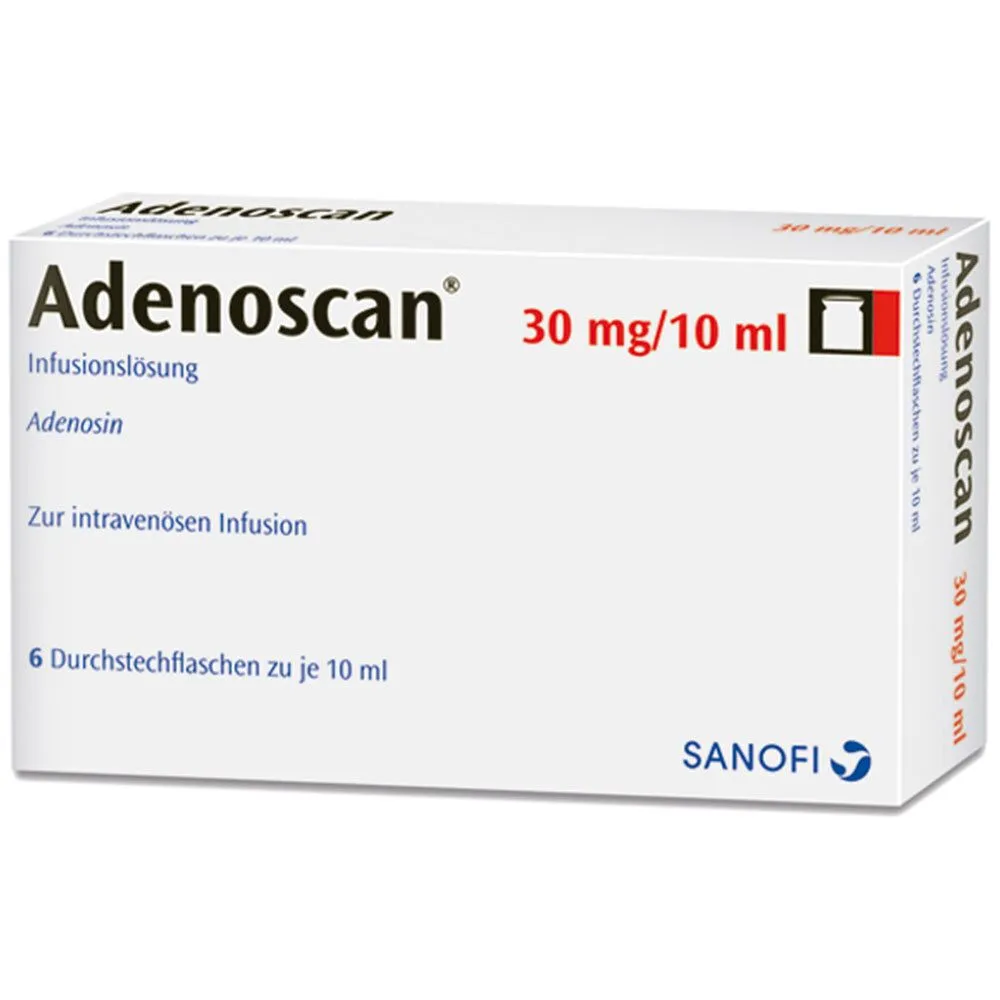
Table of Contents
PACKAGE LEAFLET: INFORMATION FOR THE USER
ADENOSCAN 30 mg/10 ml solution for infusion
adenosine
Read this leaflet carefully before you are given this medicine.
- Keep this leaflet. You may need to read it again.
- If you have any questions, ask your doctor or nurse.
- If any of the side effects worsen, or if you notice any side effects not listed in this leaflet, inform your doctor or nurse.
Contents of this leaflet:
- What Adenoscan is and what it is used for
- Before you are given Adenoscan
- How Adenoscan is given
- Possible side effects
- How to store Adenoscan
- Further information
1. WHAT ADENOSCAN IS AND WHAT IT IS USED FOR
Adenoscan contains a medicine called adenosine. This medicine belongs to a group of medicines known as "coronary vasodilators".
This medicine is for diagnostic use only.
Adenoscan is used prior to a test called "myocardial perfusion imaging" to examine the heart. During this test, a medicine called a "radiopharmaceutical" is administered to you.
Adenoscan works by dilating the blood vessels of the heart, allowing blood to flow more freely. This enables the "radiopharmaceutical" to enter the heart. Your doctor can then observe the heart and assess its condition. This procedure is used if you are unable to perform physical exercise or if an exercise stress test is not possible.
2. BEFORE YOU ARE GIVEN ADENOSCAN
Do not take Adenoscan and inform your doctor if:
× you are allergic (hypersensitive) to adenosine or any of the excipients in Adenoscan
(listed in section 6).
Signs of an allergic reaction include: rash, difficulty swallowing or breathing, swelling of the lips, face, throat or tongue
× you have very low blood pressure (severe hypotension)
× you have uncontrolled unstable angina not managed by medical therapy
× you have asthma or any other severe respiratory disorder
× you are taking a medicine called dipyridamole, used to thin the blood
× you have a type of heart failure where the heart does not pump out enough blood
× you have a heart rhythm disorder and do not have a pacemaker implanted (second- or third-degree AV block, sick sinus syndrome)
× you have been diagnosed with "long QT syndrome". This is a rare heart condition that may cause increased heart rate and fainting
Do not take this medicine if any of the above apply to you. If you have any doubts, consult your doctor or nurse before being given Adenoscan.
Take special care with Adenoscan
Before treatment with Adenoscan, check with your doctor or nurse if:
you have low circulating blood volume (hypovolemia) that has not been adequately stabilized by medical therapy
you have disorders of a part of the central nervous system called the "autonomic nervous system"
you have narrowing of the main arteries in the neck (carotid artery stenosis). This means blood supply to the brain is insufficient (cerebrovascular insufficiency)
you currently have or have previously had seizures or convulsions
you have breathing difficulties (bronchospasm)
you have a heart disorder due to narrowing of the heart valves (valvular stenosis)
you have inflammation of the membrane surrounding the heart (pericarditis) or fluid accumulation around the heart (pericardial effusion)
you have a left-to-right shunt in the heart. This means blood flows directly from the left side of the heart to the right
you have narrowing of the main left artery supplying blood to the heart (main left coronary artery stenosis)
you have recently had a heart attack, severe heart failure, or have undergone a heart transplant within the past year
you have an abnormal heart rhythm. For example, your heartbeat is very fast or irregular (atrial fibrillation or atrial flutter), particularly if you have "abnormal conduction through accessory pathways"
you have minor heart conduction problems (first-degree AV block or bundle branch block). These conditions may be temporarily worsened by taking Adenoscan.
Use of Adenoscan with other medicines
Inform your doctor or nurse if you are taking or have recently taken any other medicines, including those without a prescription, as well as herbal remedies. This is because Adenoscan may alter the way other medicines work. Conversely, some medicines may alter the way Adenoscan works.
In particular, consult your doctor or nurse if you are taking any of the following medicines:
- dipyridamole (a medicine used to thin the blood). Make sure your doctor knows you are taking dipyridamole. Your doctor may ask you to stop taking dipyridamole 24 hours before receiving Adenoscan, or you may be given a much lower dose of Adenoscan
- aminophylline, theophylline, or other xanthines (medicines used for respiratory problems). Your doctor may ask you to stop taking these 24 hours before Adenoscan administration
Use of Adenoscan with food and drinks
Foods and drinks containing xanthines such as tea, coffee, chocolate, and cola beverages should be avoided for at least 12 hours before administration of Adenoscan.
Pregnancy and breastfeeding
Talk to your doctor or nurse before receiving this medicine if:
- you are pregnant, could become pregnant, or think you might be pregnant. The use of Adenoscan is not recommended unless absolutely necessary.
- you are breastfeeding. The use of Adenoscan is not recommended. Ask your doctor or nurse for advice before taking any medicine if you are pregnant or breastfeeding.
If you are under 18 years of age
The use of Adenoscan in children and adolescents has not been sufficiently studied.
Important information about some excipients in Adenoscan
Sodium: Adenoscan contains 35.4 mg of sodium per injection vial (10 ml). You may receive up to 0.99 mg of sodium per kg of body weight. This should be taken into account for patients on a controlled low-sodium diet.
3. HOW ADENOSCAN IS GIVEN
How Adenoscan is given
- Adenoscan is intended for hospital use only.
- It must be administered by a doctor or nurse as an intravenous injection. The injection will be given into a vein and will last for a certain period of time (this procedure is called intravenous infusion).
- Your heart and blood pressure will be closely monitored.
How much Adenoscan is given
If you have any doubts about why you are being given Adenoscan or if you would like more information about the amount of Adenoscan you are receiving, please consult your doctor or nurse.
Adults (including elderly)
- The dose is calculated based on body weight.
- The usual dose is 140 micrograms per kilogram of body weight per minute. This amount is infused over a period of six minutes using an infusion pump (slow intravenous injection).
- The dose of Adenoscan does not need to be adjusted in cases of liver or kidney problems.
If you receive more Adenoscan than you should
It is unlikely that an excessive amount of this medicine will be injected, as it is administered by a doctor or nurse. The doctor will carefully determine the correct amount of Adenoscan to give you.
However, if you are accidentally given more of this medicine than intended, the following effects may occur:
- very low blood pressure (severe hypotension)
- slowing of the heartbeat (bradycardia)
- a heart problem (asystole)
The doctor will closely monitor your heart throughout the entire procedure. Since adenosine remains in the blood for a very short time, any undesirable effects related to the amount of Adenoscan received should rapidly resolve once the infusion is stopped. Occasionally, if you experience adverse effects, you may need to be given an injection of a medicine called aminophylline or theophylline. If you have any questions about the use of this medicine, please consult your doctor or nurse.
4. POSSIBLE ADVERSE REACTIONS
Like all medicines, Adenoscan can cause adverse reactions, although not everyone experiences them. Some of the following adverse reactions may occur while you are being administered Adenoscan.
If any of these adverse reactions worsen, inform your doctor or nurse immediately; they will decide whether you should continue the infusion or not.
Usually, adverse reactions disappear within a few seconds or minutes after stopping the infusion, but you must inform your doctor or nurse if any of these occur.
Very common (affects more than 1 in 10 people)
- Skin flushing accompanied by a sensation of warmth (hot flushes)
- Shortness of breath or need to breathe deeply (dyspnea)
- Headache
- Chest pain or sensation of chest tightness
- Abdominal discomfort
Common (affects less than 1 in 10 people)
- Dizziness or lightheadedness
- Abnormal skin sensations such as numbness, tingling, itching, burning, or chills on the skin (paresthesia)
- Low blood pressure
- Heart problem called atrioventricular block
- Fast or irregular heartbeat (cardiac arrhythmias)
- Dry mouth
- Throat, jaw, or neck discomfort
Uncommon (affects less than 1 in 100 people)
- Metallic taste in the mouth
- Sweating
- Discomfort in the legs, arms, or back
- Feeling of weakness, pain, or general malaise
- Nervousness
- Slowing of the heartbeat (bradycardia)
Rare (affects less than 1 in 1,000 people)
- Breathing difficulties (bronchospasm)
- Nasal congestion
- Drowsiness
- Blurred vision
- Ringing in the ears (tinnitus)
- Sudden urge to urinate
- Unpleasant sensation in the nipple
- Tremors
Very rare (affects less than 1 in 10,000 people)
- Severe respiratory failure or breathing problems
- Redness, pain, or swelling at the injection site
Other adverse reactions (frequency cannot be estimated from the available data)
- Serious heart problems that may be fatal (asystole) or irregular heartbeat
- Seizures (convulsions)
- Fainting
- Breathing stops (respiratory arrest)
- Feeling unwell (nausea) or illness (vomiting)
If any of these adverse reactions worsen, inform your doctor or nurse, who will decide whether to continue the infusion or not. Usually, adverse reactions disappear within a few seconds or minutes after stopping the infusion, but you must inform your doctor or nurse if any of these occur.
If you notice any adverse reaction not listed in this leaflet, inform your doctor or nurse immediately.
5. HOW TO STORE ADENOSCAN
This medicine will be stored by the doctor, nurse, or pharmacist in a safe place
out of the sight and reach of children.
Do not use Adenoscan after the expiry date stated on the outer cardboard box
and on the label. The expiry date refers to the last day of the month.
Do not store in the refrigerator.
The medicine is for single use only and must be used immediately after
opening.
Any unused portion of the vial must be discarded.
Adenoscan must not be used if the doctor or nurse observes particles in the
solution or any discoloration of the medicine before administration. If the product appears visually altered, the vial must be discarded.
Medicines must not be disposed of via wastewater or household waste. This
will help protect the environment.
6. OTHER INFORMATION
What Adenoscan contains
- The active substance is adenosine. Each 10 ml vial of Adenoscan contains 30 mg of adenosine (3 mg per ml).
- The excipients are sodium chloride and sterile water for injectable preparations.
What Adenoscan looks like and contents of the pack
Adenoscan is a clear, sterile, colourless infusion solution.
Each pack contains 6 single-use vials of 30 mg/10 ml.
Marketing Authorisation Holder
sanofi-aventis S.p.A.
Viale L. Bodio, 37/B
20158 Milan, Italy
Manufacturer
Glaxo Wellcome Production
1, rue de l'Abbaye
76960 Notre-Dame de Bondeville
France
Or
Famar Health Care Services Madrid, S.A.U.
Avenida de Leganes, 62
28925 Alcorcon (Madrid)
Spain
This medicinal product is authorised in the European Economic Area (EEA) Member States
under the following names:
Austria Adenoscan Infusionslösung
France Adenoscan 30mg/10mL, solution for infusion
Germany Adenoscan
Italy ADENOSCAN
Portugal Adenoscan
Spain Adenoscan 30mg/10ml solución para perfusión
Netherlands Adenoscan solution for intravenous infusion 30mg/10ml
United Kingdom Adenoscan 30mg/10mL, solution for infusion
This leaflet was last approved on: