Adempas
Italy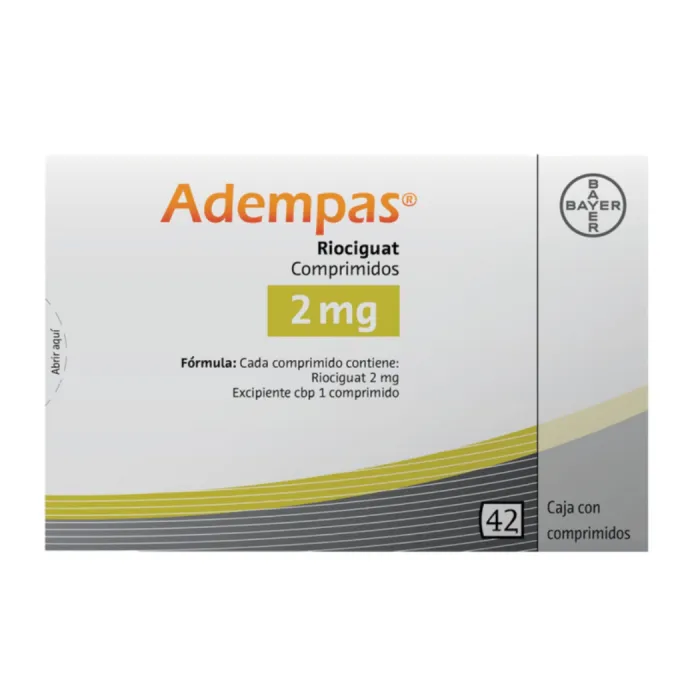
Table of Contents
- Package leaflet: Information for the user
- Adempas 0.5 mg film-coated tablets, 1 mg film-coated tablets, 1.5 mg film-coated tablets, 2 mg film-coated tablets, 2.5 mg film-coated tablets
- 1. What Adempas is and what it is used for
- 2. What you need to know before taking Adempas
- 3. How to take Adempas
- 4. Possible side effects
- 5. How to store Adempas
- 6. Package contents and other information
- Patient Information Leaflet: Information for the user
- Adempas 0.15 mg/mL granules for oral suspension
- 1. What Adempas is and what it is used for
- 2. What you should know before using Adempas
- 3. How to use Adempas
- 4. Possible side effects
- 5. How to store Adempas
- 6. Package contents and other information
- Instructions for use (IFU)
- Adempas 0.15 mg/mL 250 mL bottle containing 10.5 g of Adempas granules
- Adempas.
Package leaflet: Information for the user
Adempas 0.5 mg film-coated tablets, 1 mg film-coated tablets, 1.5 mg film-coated tablets, 2 mg film-coated tablets, 2.5 mg film-coated tablets
riociguat
Please read all of this leaflet carefully before taking this medicine because it contains
important information for you.
- Keep this leaflet. You may need to read it again.
- If you have any questions, ask your doctor or pharmacist.
- This medicine has been prescribed for you only. Do not pass it on to other people, even if they have the same symptoms as yours, because it may be harmful.
- If you experience any side effects, including those not listed in this leaflet, tell your doctor or pharmacist. See section 4.
- This package leaflet has been written assuming that the person reading it is the person taking the medicine. If you are administering this medicine to your child, replace “you” with “your child”.
Contents of this leaflet
- What Adempas is and what it is used for
- What you need to know before taking Adempas
- How to take Adempas
- Possible side effects
- How to store Adempas
- Contents of the pack and other information
1. What Adempas is and what it is used for
Adempas contains the active substance riociguat, a soluble guanylate cyclase (sGC) stimulator.
It is used to treat adults and children aged 6 years and older with certain forms of pulmonary hypertension:
-
Chronic thromboembolic pulmonary hypertension (CTEPH)
Adempas is used to treat adult patients with CTEPH. In patients with CTEPH, the blood vessels in the lungs are blocked or narrowed by blood clots. The medicine can be used in patients with CTEPH who cannot undergo surgery, or in patients in whom pulmonary hypertension persists or recurs after surgery. -
Pulmonary arterial hypertension (PAH)
Adempas is used to treat adults and children aged 6 years and older with pulmonary arterial hypertension. In these patients, the walls of the blood vessels in the lungs are thickened and the vessels are narrowed. In patients with PAH, Adempas may be taken together with certain other medicines (called endothelin receptor antagonists). In adults, the medicine may also be taken alone (monotherapy).
In patients with pulmonary hypertension, the blood vessels that carry blood from the heart to the lungs become narrowed, making it harder for the heart to pump blood to the lungs and causing increased blood pressure in these vessels. Because the heart must work harder than normal, people with pulmonary hypertension experience fatigue, dizziness, and difficulty breathing.
Adempas widens the blood vessels that carry blood from the heart to the lungs, reducing disease symptoms and enabling patients to perform physical activity more easily.
2. What you need to know before taking Adempas
Do not take Adempas if
- you are taking PDE5 inhibitors, such as sildenafil, tadalafil, or vardenafil. These are medicines used to treat high blood pressure in the lung arteries or erectile dysfunction.
- you have severely impaired liver function.
- you are allergic to riociguat or any of the other ingredients of this medicine (listed in section 6).
- you are pregnant.
- you are taking nitrates or nitric oxide donors such as amyl nitrite. These medicines are often used to treat high blood pressure, chest pain, or heart disease. They also include recreational drugs known as "poppers".
- you are taking other medicines similar to Adempas called soluble guanylate cyclase stimulators, such as vericiguat. Ask your doctor if you are unsure.
- you have low blood pressure before starting Adempas for the first time. To begin treatment with Adempas, systolic blood pressure values must be:
- 90 mmHg or higher if you are between 6 and 12 years of age,
- 95 mmHg or higher if you are over 12 and under 18 years of age.
- you have pulmonary hypertension associated with lung scarring of unknown cause, called idiopathic interstitial pneumonia. If any of these conditions apply to you, consult your doctor first and do not take Adempas.
Warnings and precautions
Talk to your doctor or pharmacist before using Adempas if:
- you suffer from pulmonary veno-occlusive disease, a condition causing shortness of breath due to fluid buildup in the lungs. Your doctor will decide whether to prescribe an alternative medicine.
- you have recently had severe bleeding from the lungs or airways.
- you have undergone treatment to stop coughing up blood (bronchial artery embolization).
- you are taking medicines that prevent blood clotting, as this may cause bleeding from the lungs. Your doctor will perform regular blood tests and blood pressure measurements.
- your doctor may decide to monitor your blood pressure if:
- you have symptoms of low blood pressure, such as dizziness, lightheadedness, or fainting, or
- you are taking medicines to lower blood pressure or increase urination, or
- you have heart or circulation problems.
- you are over 65 years of age, as low blood pressure is more likely in this age group.
Tell your doctor if
- you are on dialysis or your kidneys are not functioning properly, as use of this medicine is not recommended.
- your liver is not functioning properly.
While using Adempas, contact your doctor if
- you experience shortness of breath during treatment with this medicine. This may be caused by fluid accumulation in the lungs. If this is due to pulmonary veno-occlusive disease, your doctor may stop treatment with Adempas.
- you start or stop smoking during treatment with this medicine, as this may affect the level of riociguat in your blood.
Children and adolescents
- Chronic thromboembolic pulmonary hypertension (CTEPH)
- Adempas is not recommended for use in patients with CTEPH under 18 years of age.
- Pulmonary arterial hypertension (PAH)
- You have been prescribed Adempas tablets. For PAH patients aged 6 years and older weighing less than 50 kg, Adempas is also available as granules for oral suspension. Patients may switch from tablets to oral suspension during treatment due to changes in body weight. Efficacy and safety have not been established in the following pediatric populations:
- Children under 6 years of age due to safety concerns.
Other medicines and Adempas
Tell your doctor or pharmacist if you are taking, have recently taken, or might take any other medicines, especially:
- Do not take medicines used for
- high blood pressure or heart disease, such as nitrates and amyl nitrite, or other soluble guanylate cyclase stimulators, such as vericiguat. Do not take these medicines together with Adempas.
- high blood pressure in the pulmonary arteries, because you must not take certain medicines such as sildenafil and tadalafil together with Adempas. Other medicines for high blood pressure in the pulmonary arteries, such as bosentan and iloprost, may be used with Adempas, but you must inform your doctor.
- erectile dysfunction, such as sildenafil, tadalafil, vardenafil. Do not take these medicines together with Adempas.
- The following medicines may increase Adempas levels in the blood, increasing the risk of side effects
- fungal infections, such as ketoconazole, posaconazole, itraconazole.
- HIV infection, such as abacavir, atazanavir, cobicistat, darunavir, dolutegravir, efavirenz, elvitegravir, emtricitabine, rilpivirine, ritonavir.
- epilepsy, such as phenytoin, carbamazepine, phenobarbital.
- depression, such as St. John’s wort.
- prevention of organ transplant rejection, such as cyclosporine.
- cancer, such as erlotinib, gefitinib.
- nausea, vomiting, such as granisetron.
- to treat stomach disorders or heartburn, so-called antacids, such as aluminium hydroxide/magnesium hydroxide. Take antacids at least 2 hours before or 1 hour after taking Adempas.
Adempas with food
Adempas can generally be taken with or without food.
However, if you tend to have low blood pressure, take Adempas always with food or always without food.
Pregnancy and breastfeeding
- Contraception: women and adolescent girls of childbearing age must use effective contraception during treatment with Adempas. Talk to your doctor about suitable contraceptive methods to prevent pregnancy. In addition, monthly pregnancy tests are required.
- Pregnancy: do not use Adempas during pregnancy.
- Breastfeeding: breastfeeding is not recommended during treatment with this medicine, as it may be harmful to the infant. Inform your doctor if you are breastfeeding or plan to breastfeed before using this medicine. Your doctor will decide whether you should stop breastfeeding or stop taking Adempas.
Driving and using machines
Adempas has a moderate effect on the ability to ride a bicycle, drive vehicles, or operate machinery. It may cause side effects such as dizziness. You should be aware of possible side effects of this medicine before riding a bicycle, driving, or using machinery (see section 4).
Adempas contains lactose
If your doctor has diagnosed you with an intolerance to certain sugars, contact them before taking this medicine.
Adempas contains sodium
This medicine contains less than 1 mmol (23 mg) of sodium per tablet, i.e., essentially 'sodium-free'.
3. How to take Adempas
Take this medicine exactly as your doctor has told you. If you are unsure, consult your doctor or pharmacist.
Adempas is available as tablets or oral suspension granules.
The tablets are intended for use in adults and pediatric patients weighing at least 50 kg.
The oral suspension granules are intended for pediatric patients weighing less than 50 kg.
Treatment must be initiated only by a doctor experienced in the treatment of high blood pressure in the pulmonary arteries, who will monitor you throughout treatment. During the first weeks of treatment, your doctor will measure your blood pressure at regular intervals.
Adempas is available in different strengths, and with regular blood pressure monitoring at the beginning of treatment, your doctor will ensure you are taking the correct dose.
Starting treatment:
Your doctor will tell you what dose of Adempas to take.
- Treatment usually starts at a low dose.
- Your doctor will gradually increase the dose depending on your response to treatment.
- During the first weeks of treatment, your doctor will measure your blood pressure at least once every two weeks. This is necessary to determine the correct dose of the medicine.
How to take the medicine
Adempas is for oral use. Tablets should be taken 3 times daily, every 6–8 hours.
Crushed tablets:
If you have difficulty swallowing the tablets whole, ask your doctor about alternative ways to take Adempas. The tablet may be crushed and mixed with water or soft food immediately before taking.
How much medicine to take
The recommended starting dose is 1 tablet of 1 mg taken 3 times daily for 2 weeks.
Your doctor will increase the dose every 2 weeks up to a maximum of 2.5 mg 3 times daily (maximum daily dose of 7.5 mg), unless you have very low blood pressure. In that case, your doctor will prescribe the highest dose of Adempas that you tolerate well. The optimal dose will be determined by your doctor. For some patients, lower doses taken 3 times daily may be sufficient.
If you are 65 years of age or older
You may be at higher risk of low blood pressure. Your doctor may adjust your dose.
If you smoke
If you smoke, you are advised to stop before starting treatment, as smoking may reduce the effectiveness of this medicine. Inform your doctor if you start or stop smoking during treatment. Your doctor may need to adjust your dose.
If you take more Adempas than you should
Contact your doctor if you have taken more Adempas than prescribed or if you notice any adverse effects (see section 4). If your blood pressure drops (which may cause dizziness), you may require immediate medical treatment.
If you forget to take Adempas
Do not take a double dose to make up for a missed dose. If you forget a dose, take the next dose at the usual scheduled time.
If you stop taking Adempas
Do not stop taking this medicine without first talking to your doctor. Stopping this medicine may cause your condition to worsen. If you have stopped taking this medicine for 3 days or more, inform your doctor before restarting.
If you are switching from Adempas to sildenafil or tadalafil
To avoid interactions, Adempas and PDE5 inhibitors (sildenafil, tadalafil) must not be taken at the same time.
- When switching to Adempas:
- Do not take Adempas for at least 24 hours after the last dose of sildenafil and at least 48 hours after the last dose of tadalafil.
- When switching from Adempas:
- Stop taking Adempas at least 24 hours before starting sildenafil or tadalafil.
If you have any questions about how to use this medicine, ask your doctor or pharmacist.
4. Possible side effects
Like all medicines, this medicine can cause side effects, although not everybody gets them.
The most serious side effects in adults are:
- coughing up blood (haemoptysis) (common, may affect up to 1 in 10 people),
- acute bleeding from the lungs (pulmonary haemorrhage) which may cause coughing up blood and which can be fatal (uncommon, may affect up to 1 in 100 people). If this occurs, contact your doctor immediately, as you may require urgent medical treatment.
General list of possible side effects (in adult patients)
Very common: may affect more than 1 in 10 people
- dizziness
- headache
- indigestion (dyspepsia)
- diarrhoea
- feeling unwell (nausea)
- vomiting
- swelling of limbs (peripheral oedema)
Common: may affect up to 1 in 10 people
- inflammation of the gastrointestinal tract (gastroenteritis)
- reduced number of red blood cells (anaemia). Symptoms include paleness, weakness, or shortness of breath,
- irregular, strong, or rapid heartbeat (palpitations)
- low blood pressure (hypotension)
- nosebleeds (epistaxis)
- difficulty breathing through the nose (nasal congestion)
- inflammation of the stomach (gastritis)
- heartburn (gastro-oesophageal reflux disease)
- difficulty swallowing (dysphagia)
- stomach, intestinal, or abdominal pain (gastrointestinal and abdominal pain)
- constipation
- bloating (flatulence)
Side effects in children
In general, the side effects observed in children aged 6 to less than 18 years treated with Adempas were similar to those observed in adults. The most frequent side effects in children were:
- low blood pressure (hypotension) ( Very common : may affect more than 1 in 10 people);
- headache ( Common : may affect more than 1 in 10 people).
Reporting of side effects
If you experience any side effect, including those not listed in this leaflet, talk to your doctor or pharmacist. You can also report side effects directly via the national reporting system listed in Annex V. By reporting side effects, you can help provide more information on the safety of this medicine.
5. How to store Adempas
Keep this medicine out of the sight and reach of children.
This medicine does not require any special storage conditions.
Do not use this medicine after the expiry date stated on the blister pack and the outer carton after
"Exp.". The expiry date refers to the last day of that month.
Do not dispose of medicines via wastewater or household waste. Ask your pharmacist how to dispose of medicines you no longer use. This will help protect the environment.
6. Package contents and other information
What Adempas contains
-
The active substance is riociguat.
Adempas 0.5 mg film-coated tablets: Each film-coated tablet contains 0.5 mg of riociguat.
Adempas 1 mg film-coated tablets: Each film-coated tablet contains 1 mg of riociguat.
Adempas 1.5 mg film-coated tablets: Each film-coated tablet contains 1.5 mg of riociguat.
Adempas 2 mg film-coated tablets: Each film-coated tablet contains 2 mg of riociguat.
Adempas 2.5 mg film-coated tablets: Each film-coated tablet contains 2.5 mg of riociguat. -
The other components are:
Tablet core: microcrystalline cellulose, crospovidone (type B), hypromellose 5 cP, monohydrate lactose, magnesium stearate and sodium lauryl sulfate (see end of section 2 for further information on lactose and sodium).
Tablet coating: hydroxypropylcellulose, hypromellose 3 cP, propylene glycol (E 1520) and titanium dioxide (E 171).
Adempas 1 mg and 1.5 mg tablets also contain yellow iron oxide (E 172).
Adempas 2 mg and 2.5 mg tablets also contain yellow iron oxide (E 172) and red iron oxide (E 172).
Description of the appearance of Adempas and contents of the pack
Adempas is a film-coated tablet:
Adempas 0.5 mg film-coated tablets
- White, round, biconvex tablets, 6 mm in diameter, with the Bayer cross engraved on one side and "0.5" and "R" on the other side.
Adempas 1 mg film-coated tablets - Light yellow, round, biconvex tablets, 6 mm in diameter, with the Bayer cross engraved on one side and "1" and "R" on the other side.
Adempas 1.5 mg film-coated tablets - Orange-yellow, round, biconvex tablets, 6 mm in diameter, with the Bayer cross engraved on one side and "1.5" and "R" on the other side.
Adempas 2 mg film-coated tablets - Light orange, round, biconvex tablets, 6 mm in diameter, with the Bayer cross engraved on one side and "2" and "R" on the other side.
Adempas 2.5 mg film-coated tablets - Orange-red, round, biconvex tablets, 6 mm in diameter, with the Bayer cross engraved on one side and "2.5" and "R" on the other side.
The tablets are available in packs of:
- 42 tablets: 2 transparent calendar blisters with 21 tablets each.
- 84 tablets: 4 transparent calendar blisters with 21 tablets each.
- 90 tablets: 5 transparent calendar blisters with 18 tablets each.
- 294 tablets: 14 transparent calendar blisters with 21 tablets each.
Not all pack sizes may be marketed.
Marketing Authorisation Holder
Bayer AG
51368 Leverkusen
Germany
Manufacturer
Bayer AG
Kaiser-Wilhelm-Allee
51368 Leverkusen
Germany
For further information about this medicinal product, please contact the local representative of the Marketing Authorisation Holder.
België / Belgique / Belgien
MSD Belgium
Tél/Tel: 32(0)27766211
[email protected]
Lietuva
UAB Merck Sharp & Dohme
Tel: +370 5 2780 247
[email protected]
България
Мерк Шарп и Доум България ЕООД
Tel: +359 2 819 37 37
[email protected]
Luxembourg / Luxemburg
MSD Belgium
Tel/Tél: +32(0)27766211
[email protected]
Česká republika
Merck Sharp & Dohme s.r.o.
Tel: +420 233 010 111
[email protected]
Magyarország
MSD Pharma Hungary Kft.
Tel.: +36 1 888 5300
[email protected]
Danmark
MSD Danmark ApS
Tlf.: +45 4482 4000
[email protected]
Malta
Merck Sharp & Dohme Cyprus Limited
Tel: 8007 4433 (+356 99917558)
[email protected]
Deutschland
MSD Sharp & Dohme GmbH
Tel: +49 (0) 89 20 300 4500
[email protected]
Nederland
Merck Sharp & Dohme B.V.
Tel: 0800 9999 000 (+31 23 5153153)
[email protected]
Eesti
Merck Sharp & Dohme OÜ
Tel: +372 6144 200
[email protected]
Norge
MSD (Norge) AS
Tlf: +47 32 20 73 00
[email protected]
Ελλάδα
MSD Α.Φ.Ε.Ε
Τηλ: +30 210 98 97 300
[email protected]
Österreich
Merck Sharp & Dohme Ges.m.b.H.
Tel: +43 (0) 1 26 044
[email protected]
España
Merck Sharp & Dohme de España, S.A.
Tel: +34 91 321 06 00
[email protected]
Polska
MSD Polska Sp. z o.o.
Tel: +48 22 549 51 00
[email protected]
France
MSD France
Tél: +33(0) 01 80 46 40 40
[email protected]
Portugal
Merck Sharp & Dohme, Lda
Tel: +351 214465700
[email protected]
Hrvatska
Merck Sharp & Dohme d.o.o.
Tel: +385 1 6611 333
[email protected]
România
Merck Sharp & Dohme Romania S.R.L.
Tel: +40 21 529 29 00
[email protected]
Ireland
Merck Sharp & Dohme Ireland (Human Health) Limited
Tel: +353 (0)1 2998700
[email protected]
Slovenija
Merck Sharp & Dohme, inovativna zdravila d.o.o.
Tel: +386 1 5204201
[email protected]
Ísland
Vistor ehf.
Sími: +354 535 7000
[email protected]
Slovenská republika
Merck Sharp & Dohme, s.r.o.
Tel: +421 2 58282010
Italia
MSD Italia S.r.l.
Tel: 800 23 99 89 (+39 06 361911)
[email protected]
Suomi/Finland
MSD Finland Oy
Puh/Tel: +358 (0)9 804650
[email protected]
Κύπρος
Merck Sharp & Dohme Cyprus Limited
Τηλ.: 800 00 673 (+357 22866700)
[email protected]
Latvija
SIA Merck Sharp & Dohme Latvija
Tel.: +371 67025300
[email protected]
More detailed information on this medicinal product is available on the website of the European Medicines Agency: https://www.ema.europa.eu.
Patient Information Leaflet: Information for the user
Adempas 0.15 mg/mL granules for oral suspension
riociguat
Please read this leaflet carefully before using this medicine because it contains important information for you.
- Keep this leaflet. You may need to read it again.
- If you have any questions, consult your doctor or pharmacist.
- This medicine has been prescribed for you only. Do not give it to other people, even if their symptoms are the same as yours, as it may be harmful.
- If you experience any side effects, including those not listed in this leaflet, consult your doctor or pharmacist. See section 4.
- This patient information leaflet has been written assuming the reader is the person taking the medicine. If you are administering this medicine to your child, replace “you” with “your child”.
Contents of this leaflet
- What Adempas is and what it is used for
- What you need to know before taking Adempas
- How to take Adempas
- Possible side effects
- How to store Adempas
- Contents of the pack and other information
1. What Adempas is and what it is used for
Adempas contains the active substance riociguat, a soluble guanylate cyclase (sGC) stimulator.
Pulmonary arterial hypertension (PAH)
Adempas is used to treat children aged 6 years and older with pulmonary arterial hypertension. In these patients, the walls of the blood vessels in the lungs are thickened, causing the vessels to narrow. Adempas may be taken together with certain other medications (called endothelin receptor antagonists).
In patients with pulmonary hypertension, the blood vessels that carry blood from the heart to the lungs become narrowed, making it harder for the heart to pump blood to the lungs and resulting in increased blood pressure in these vessels. Because the heart must work harder than normal, people with pulmonary hypertension experience fatigue, dizziness, and shortness of breath.
Adempas dilates the blood vessels that carry blood from the heart to the lungs, reducing disease symptoms and enabling patients to perform physical activity more easily.
2. What you should know before using Adempas
Do not use Adempas if
- you are taking PDE5 inhibitors, such as sildenafil, tadalafil, or vardenafil. These are medicines used to treat high blood pressure in the lung arteries or erectile dysfunction.
- you have severely impaired liver function.
- you are allergic to riociguat or any of the other ingredients of this medicine (listed in section 6).
- you are pregnant.
- you are taking nitrates or nitric oxide donors such as amyl nitrite. These medicines are often used to treat high blood pressure, chest pain, or heart diseases. They also include recreational drugs known as "poppers".
- you are taking other medicines similar to Adempas called soluble guanylate cyclase stimulators, such as vericiguat. Ask your doctor if you are unsure.
- you have low blood pressure before starting Adempas for the first time. To begin treatment with Adempas, systolic blood pressure values must be:
- 90 mmHg or higher if you are between 6 and 12 years old,
- 95 mmHg or higher if you are over 12 and under 18 years old.
- you have pulmonary hypertension associated with lung scarring of unknown cause, called idiopathic interstitial pneumonia.
If any of these conditions apply to you, consult your doctor first and do not use Adempas.
Warnings and precautions
Talk to your doctor or pharmacist before using Adempas if:
- you have pulmonary veno-occlusive disease, a condition causing shortness of breath due to fluid accumulation in the lungs. Your doctor will decide whether to prescribe an alternative medicine.
- you have recently had severe bleeding from the lungs or airways.
- you have undergone treatment to stop coughing up blood (bronchial artery embolization).
- you are taking medicines that prevent blood clotting, as this may cause bleeding from the lungs. Your doctor will perform regular blood tests and blood pressure measurements.
- your doctor may decide to monitor your blood pressure if:
- you have symptoms of low blood pressure, such as dizziness, lightheadedness, or fainting,
- you are taking medicines to lower blood pressure or increase urination,
- you have heart or circulation problems,
- you are over 65 years old, as low blood pressure is more likely in this age group.
Tell your doctor if:
- you are on dialysis or your kidneys are not working properly, as use of this medicine is not recommended.
- your liver is not working properly.
While using Adempas, contact your doctor if:
- you experience shortness of breath during treatment with this medicine. This may be caused by fluid accumulation in the lungs. If this is due to pulmonary veno-occlusive disease, your doctor may stop treatment with Adempas.
- you start or stop smoking during treatment with this medicine, as this may affect the level of riociguat in your blood.
Children and adolescents
You have been prescribed Adempas oral suspension granules. For patients with PAH aged 6 years and older who weigh 50 kg or more, Adempas is also available in tablet form. Patients may switch from oral suspension to tablets during therapy due to changes in body weight. The efficacy and safety have not been established in the following pediatric populations:
- Children under 6 years of age due to safety concerns.
Other medicines and Adempas
Tell your doctor or pharmacist if you are taking, have recently taken, or might take any other medicines, especially:
- Do not take medicines used for:
- high blood pressure or heart diseases, such as nitrates and amyl nitrite, or other soluble guanylate cyclase stimulators, such as vericiguat. Do not take these medicines together with Adempas.
- high blood pressure in the pulmonary arteries, because you should not take certain medicines such as sildenafil and tadalafil together with Adempas. Other medicines for high blood pressure in the pulmonary arteries, such as bosentan and iloprost, may be used with Adempas, but you must inform your doctor.
- erectile dysfunction, such as sildenafil, tadalafil, vardenafil. Do not take these medicines together with Adempas.
- The following medicines may increase Adempas levels, increasing the risk of side effects. Medicines used to treat:
- fungal infections, such as ketoconazole, posaconazole, itraconazole.
- HIV infection, such as abacavir, atazanavir, cobicistat, darunavir, dolutegravir, efavirenz, elvitegravir, emtricitabine, rilpivirine, ritonavir.
- epilepsy, such as phenytoin, carbamazepine, phenobarbital.
- depression, such as St. John’s wort (Hypericum perforatum).
- prevention of organ transplant rejection, such as cyclosporine.
- cancer, such as erlotinib, gefitinib.
- nausea, vomiting, such as granisetron.
- stomach diseases or heartburn, called antacids, such as aluminium hydroxide/magnesium hydroxide. Take antacids at least 2 hours before or 1 hour after taking Adempas.
Adempas with food
Adempas can generally be taken with or without food.
However, if you tend to have low blood pressure, take Adempas always with food or always without food.
Pregnancy and breastfeeding
- Contraception: women and adolescent girls of childbearing age must use effective contraception during treatment with Adempas. Talk to your doctor about suitable contraceptive methods to prevent pregnancy. In addition, monthly pregnancy tests are required.
- Pregnancy: do not use Adempas during pregnancy.
- Breastfeeding: breastfeeding is not recommended during treatment with this medicine, as it may be harmful to the infant. Inform your doctor if you are breastfeeding or plan to breastfeed before using this medicine. Your doctor will decide whether to discontinue breastfeeding or stop treatment with Adempas.
Driving and using machines
Adempas may have a moderate effect on the ability to ride a bicycle, drive vehicles, or operate tools and machinery. It may cause side effects such as dizziness. You should be aware of any side effects caused by this medicine before riding a bicycle, driving, or using tools or machinery (see section 4).
Adempas contains sodium benzoate
This medicine contains 1.8 mg of sodium benzoate (E 211) in each mL of oral suspension.
Adempas contains sodium
This medicine contains 0.5 mg of sodium in each mL of oral suspension. This medicine contains less than 1 mmol (23 mg) of sodium per mL of oral suspension, i.e., essentially ‘sodium-free’.
3. How to use Adempas
Use this medicine exactly as prescribed by your doctor. If you have any doubts, consult your doctor or pharmacist.
Adempas is available as tablets or granules for oral suspension.
The tablets are intended for use in adults and children weighing at least 50 kg. The granules for oral suspension are intended for pediatric patients weighing less than 50 kg.
Starting treatment:
Your doctor will tell you the dose of Adempas to take.
- Treatment usually starts with a low dose.
- Your doctor will gradually increase the dose depending on your response to treatment.
- During the first weeks of treatment, your doctor should measure your blood pressure at least once every two weeks. This is necessary to determine the correct dose of the medicine.
Your doctor will calculate and inform you of the amount of oral suspension to take, in millilitres (mL). Do not change the dose on your own initiative. The volume in mL must be measured using one of the two blue syringes provided in the Adempas package. Your doctor or pharmacist will tell you which blue syringe to use (either the 5 mL or the 10 mL syringe).
Before use
- Make sure the correct dose is indicated on the package. If not, ask your doctor or pharmacist to confirm it. Keep the package until the granules for oral suspension are completely used up.
- Carefully follow the “Instructions for Use” included in the package to prepare and administer the Adempas oral suspension, in order to avoid handling problems such as clumping or sedimentation.
- All materials necessary for preparing and taking the oral suspension are supplied with the medicine. Use only still (non-carbonated) water to avoid bubbles.
- To ensure accurate dosing, administer Adempas using only the syringes provided. Do not use other methods to take the suspension, such as a different syringe, a spoon, etc.
How to take the medicine
Adempas is for oral use. Each dose of Adempas must be swallowed. The patient must swallow the entire dose of the medicine. Take Adempas 3 times a day, approximately every 6–8 hours.
How much medicine to use
Initially, your doctor will determine the dose of oral suspension every two weeks. The dose will be adjusted based on body weight and blood pressure. The maximum dose depends on body weight. During treatment, your doctor will decide whether and when to switch between tablets and oral suspension due to changes in body weight.
If you smoke
If you smoke, you are advised to stop before starting treatment, as smoking may reduce the effectiveness of this medicine. Inform your doctor if you start or stop smoking during treatment. Your doctor may need to adjust your dose.
If you use more Adempas than you should
Contact your doctor if you have taken more Adempas than prescribed and notice any adverse effects (see section 4). If your blood pressure drops (which may cause dizziness), immediate medical treatment may be required.
If you forget to take Adempas
Do not take a double dose to make up for a missed dose. If you forget a dose, continue with the next dose as scheduled.
If you stop taking Adempas
Do not stop using this medicine without first talking to your doctor. If you stop taking this medicine, your condition may worsen. If you have not taken the medicine for 3 days or more, inform your doctor before restarting.
If you are switching from Adempas to sildenafil or tadalafil
To avoid interactions, Adempas and PDE5 inhibitors (sildenafil, tadalafil) must not be taken at the same time.
- If switching to Adempas:
- Do not start Adempas earlier than 24 hours after the last dose of sildenafil and at least 48 hours after the last dose of tadalafil.
- If switching from Adempas:
- Stop using Adempas at least 24 hours before starting sildenafil or tadalafil.
If you have any questions about the use of this medicine, consult your doctor or pharmacist.
4. Possible side effects
Like all medicines, this medicine can cause side effects, although not everybody gets them. Some of these side effects can be serious. If they occur, contact your doctor immediately, as you may require urgent medical treatment.
Side effects in paediatric patients
In general, the side effects observed in paediatric patients under 18 years of age treated with Adempas were similar to those observed in adults. The most frequent side effects in paediatric patients were:
- low blood pressure (hypotension) (Very common: may affect more than 1 in 10 people);
- headache (Common: may affect more than 1 in 10 people).
General list of possible side effects (in adult patients)
Very common: may affect more than 1 in 10 people
- dizziness
- headache
- digestive disorders (dyspepsia)
- diarrhoea
- feeling unwell (nausea)
- vomiting
- swelling of the limbs (peripheral oedema)
Common: may affect up to 1 in 10 people
- inflammation of the digestive tract (gastroenteritis)
- decrease in red blood cell levels (anaemia). Symptoms include paleness, weakness or shortness of breath
- irregular, strong or rapid heartbeat (palpitations)
- low blood pressure (hypotension)
- nosebleeds (epistaxis)
- difficulty breathing through the nose (nasal congestion)
- inflammation of the stomach (gastritis)
- heartburn (gastro-oesophageal reflux disease)
- difficulty swallowing (dysphagia)
- stomach, intestinal or abdominal pain (gastrointestinal and abdominal pain)
- constipation
- bloating (abdominal distension)
Reporting of side effects
If you experience any side effects, including those not listed in this leaflet, talk to your doctor or pharmacist. You can also report side effects directly via the national reporting system detailed in Annex V. By reporting side effects, you can help provide more information on the safety of this medicine.
5. How to store Adempas
Keep this medicine out of the sight and reach of children.
Do not use this medicine after the expiry date stated on the vial label after "Exp.". The expiry date refers to the last day of that month.
Do not store above 30 °C.
Do not freeze.
After reconstitution, the suspension is stable for 14 days at room temperature.
Store the prepared suspension in an upright position.
Do not dispose of any medicine via wastewater or household waste. Ask your pharmacist how to dispose of medicines no longer required. This will help protect the environment.
6. Package contents and other information
What Adempas contains
- The active substance is riociguat. After preparation, the oral suspension contains 10.5 g of granulate plus 200 mL of water, resulting in 208 mL of suspension containing 0.15 mg of riociguat per mL.
- The other components are anhydrous citric acid (E 330); strawberry flavour; hypromellose; mannitol (E 421); microcrystalline cellulose and sodium carmellose; sodium benzoate (E 211) (see end of section 2 for further information on sodium benzoate and sodium); sucralose (E 955); xanthan gum (E 415).
Description of the appearance of Adempas and contents of the pack
Adempas is a white to off-white granulate.
Pack contents:
- 1 bottle (amber glass) containing 10.5 g of Adempas granulate, closed with a child-resistant screw cap.
- 1 water syringe of 100 mL (for single use only), used to measure 200 mL of water and add it to the bottle.
- 1 bottle adapter and blue syringes.
- 2 blue 5 mL syringes with blue plungers for oral withdrawal and administration of Adempas (1 is a spare syringe). The scale on the 5 mL blue syringe starts at 1 mL. Graduation marks are in 0.2 mL increments.
- 2 blue 10 mL syringes with blue plungers for oral withdrawal and administration of Adempas (1 is a spare syringe). The scale on the 10 mL blue syringe starts at 2 mL. Graduation marks are in 0.5 mL increments.
Marketing Authorisation Holder
Bayer AG
51368 Leverkusen
Germany
Manufacturer
Bayer AG
Kaiser-Wilhelm-Allee
51368 Leverkusen
Germany
For further information on this medicinal product, please contact the local representative of the Marketing Authorisation Holder.
België / Belgique / Belgien Lietuva
MSD Belgium UAB Merck Sharp & Dohme
Tél/Tel: 32(0)27766211 Tel: + 370 5 2780 247
[email protected] [email protected]
България Luxembourg / Luxemburg
Мерк Шарп и Доум България ЕООД MSD Belgium
Tel.: + 359 2 819 37 37 Tel/Tél: +32(0)27766211
[email protected] [email protected]
Česká republika Magyarország
Merck Sharp & Dohme s.r.o. MSD Pharma Hungary Kft.
Tel: +420 233 010 111 Tel.: + 36 1 888 5300
[email protected] [email protected]
Danmark Malta
MSD Danmark ApS Merck Sharp & Dohme Cyprus Limited
Tlf.: +45 4482 4000 Tel: 8007 4433 (+356 99917558)
[email protected] [email protected]
Deutschland Nederland
MSD Sharp & Dohme GmbH Merck Sharp & Dohme B.V.
Tel: +49 (0) 89 20 300 4500 Tel: 0800 9999 000 (+ 31 23 5153153)
[email protected] [email protected]
Eesti Norge
Merck Sharp & Dohme OÜ MSD (Norge) AS
Tel: + 372 6144 200 Tlf: + 47 32 20 73 00
[email protected] [email protected]
Ελλάδα Österreich
MSD Α.Φ.Ε.Ε Merck Sharp & Dohme Ges.m.b.H.
Τηλ: + 30 210 98 97 300 Tel: +43 (0) 1 26 044
[email protected] [email protected]
España Polska
Merck Sharp & Dohme de España, S.A. MSD Polska Sp. z o.o.
Tel: +34 91 321 06 00 Tel: +48 22 549 51 00
[email protected] [email protected]
France Portugal
MSD France Tél: +33(0) 01 80 46 40 40 Merck Sharp & Dohme, Lda
Tel: + 351 214465700
[email protected]
Hrvatska România
Merck Sharp & Dohme d.o.o. Merck Sharp & Dohme Romania S.R.L.
Tel: + 385 1 6611 333 Tel: + 40 21 529 29 00
[email protected] [email protected]
Ireland Slovenija
Merck Sharp & Dohme Ireland (Human Health) Limited Merck Sharp & Dohme, inovativna zdravila d.o.o.
Tel: +353 (0)1 2998700 Tel: + 386 1 5204201
[email protected] [email protected]
Ísland Slovenská republika
Vistor ehf. Merck Sharp & Dohme, s. r. o.
Sími: + 354 535 7000 Tel: + 421 2 58282010
[email protected]
Italia Suomi/Finland
MSD Italia S.r.l. MSD Finland Oy
Tel: 800 23 99 89 (+39 06 361911) Puh/Tel: + 358 (0)9 804650
[email protected] [email protected]
Κύπρος Sverige
Merck Sharp & Dohme Cyprus Limited Merck Sharp & Dohme (Sweden) AB
Τηλ.: 800 00 673 Tel: + 46 77 5700488
(+357 22866700) [email protected]
[email protected]
Latvija
SIA Merck Sharp & Dohme Latvija
Tel.: + 371 67025300
[email protected]
More detailed information on this medicinal product is available on the website of the European Medicines Agency: https://www.ema.europa.eu.
Instructions for use (IFU)
Adempas 0.15 mg/mL 250 mL bottle containing 10.5 g of Adempas granules
for oral suspension
Active substance: riociguat
Preparation and administration of the oral suspension
(granules/water mixture)
- Adempas suspension is for oral use only. Before starting
- The child's doctor will inform you of the correct dose volume and how often to administer it.
- Always use the volume prescribed by the child's doctor, and record the correct dosage and frequency of administration in the designated space on the outside of the box. Keep the box for the entire duration of use. If this space is blank, ask the child's doctor or pharmacist to provide the relevant information.
- Do not change the dose on your own.
- Read all sections of the Instructions for Use carefully before using Adempas for the first time and before administering each dose.
- Make sure you understand the instructions before starting. If not, consult the doctor or pharmacist.
- Keep the Instructions for Use available so you can refer to them during treatment with Adempas.
- Further information on Adempas is provided in the package leaflet.
Do not remove individual components from the packaging until the
Caution:
instructions indicate to do so.
Do not use Adempas if any part has been opened or is
damaged.
Do not use Adempas after the expiry date stated on
the box.
The box contains small parts. These may obstruct airways and pose a choking risk.
Keep out of reach of infants and young children.
Do not reuse blue syringes for more than one patient, as this may lead to
infections.
Follow these “Instructions for Use” on how to prepare and
use Adempas oral suspension. For any
questions, contact the doctor, pharmacist, or
local representative listed at the end of the package leaflet.
Adempas.
Packaging contents
Each box contains the following components:
1 bottle with child-resistant screw cap containing the
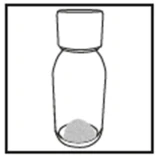
Adempas granules
1 water-filled syringe of 100 mL (single-use only)
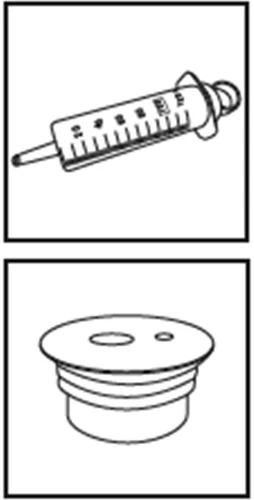
1 packaged bottle adapter
2 packaged blue syringes of 5 mL (1 is a spare syringe)
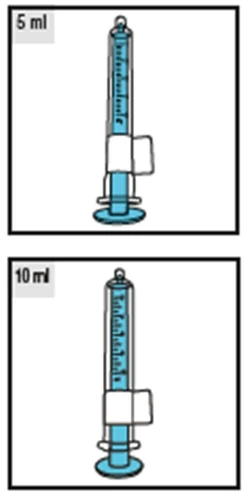
2 packaged blue syringes of 10 mL (1 is a spare syringe)
Use of Adempas • The Adempas suspension is for oral use only.
- Your child's doctor will inform you of the correct dose volume and frequency of administration.
- Always use the volume prescribed by your child's doctor and record the correct dosage and frequency of administration in the designated field on the outside of the box. Keep the box for the entire duration of use. If this field does not contain the required information, ask your child’s/adolescent’s doctor or pharmacist to provide the relevant details.
- Do not change the dose on your own.
- Follow the detailed Instructions for Use provided in the following sections.
- Keep the Instructions for Use available for reference during the use of Adempas.
- Make sure to follow all instructions regarding administration.
Preparation of the oral suspension
The preparation of the suspension must be performed
with each new package.
Before preparing the suspension:
Preparation – Get ready
a. Before starting, you will need the following equipment:
- Two containers (such as a cup or bowl)
- One container filled with drinking water,
- The other container empty.
b. Prepare the following additional materials:
- A container with at least 300 mL of non-carbonated drinking water at room temperature
- A cloth to wipe off excess water.
c. Wash your hands thoroughly with soap and dry them
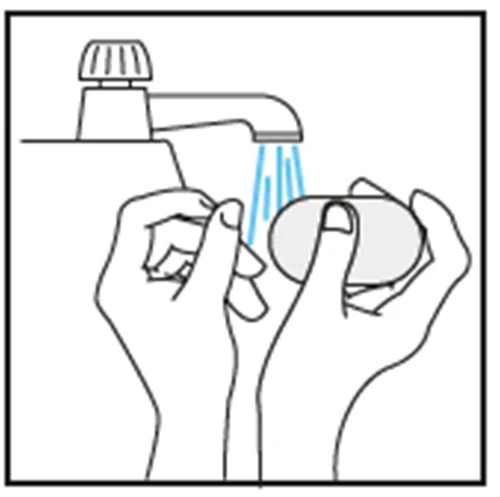
immediately afterwards.
d. Check the expiry date on the box.
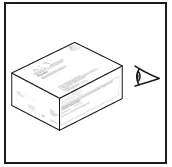
Do not use the medicine if it has expired.
Adding 200 mL of water to the 250 mL bottle containing the granules
Each time a new package is started, use only the materials
supplied in the new package.
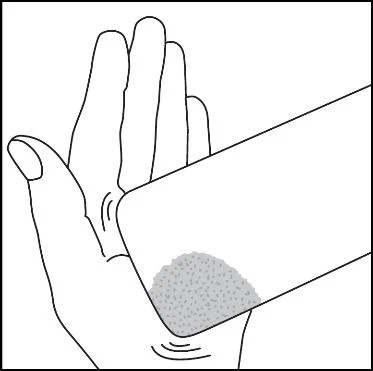
- Gently tap the bottle on your hand until the granules flow freely.
- Be careful as the bottle is made of glass.
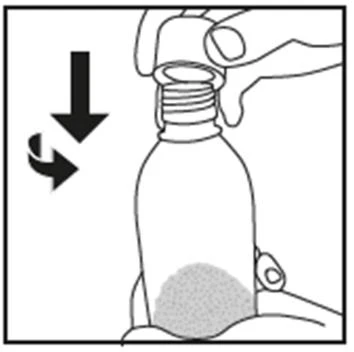
a. Unscrew the child-resistant cap from the bottle (press
downward and turn counterclockwise).
b. Remove the water syringe from its packaging.
c. Submerge the tip of the water syringe into the
container with water.
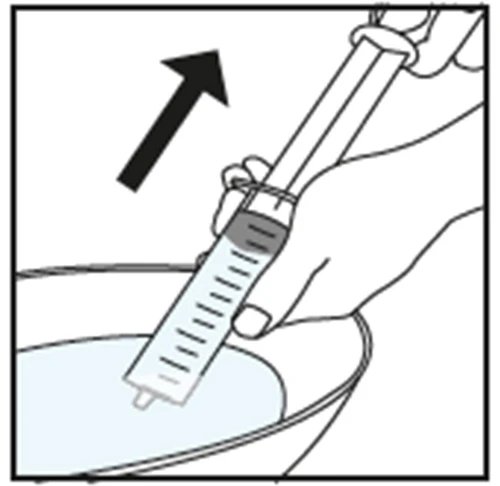
d. Draw up a volume greater than 100 mL.
e. To do this, pull the plunger towards you and ensure that
the tip of the water syringe remains below the water level
at all times. This will prevent air bubbles from entering the syringe.
f. Remove the syringe from the water.
g. Turn the water syringe so that the tip points
upward.
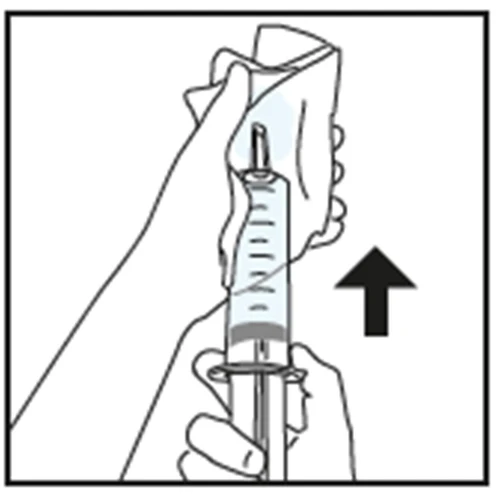
→ Holding the syringe vertically, any air bubbles
will rise to the top.
Tap gently with your fingers to help any remaining air bubbles rise further.
h. Push the plunger rod until the upper ring of the
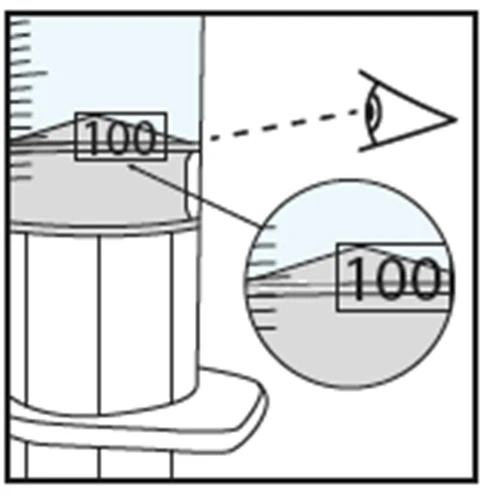
plunger aligns exactly with the 100 mL mark.
→ When pressing the plunger, some water may escape from the tip of the syringe. This water can be wiped off with a cloth.
Warning:
The upper ring of the black plunger must be precisely aligned
with the 100 mL mark to achieve the correct suspension concentration.
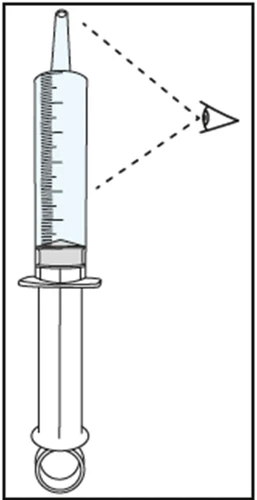
i. Keep holding the water syringe with the tip facing
upward and carefully check the water inside:
- for correct volume,
- for presence of air bubbles. Small air bubbles are not a problem, but large air bubbles must be removed.
j. If the water syringe was not filled correctly or
contains too much air:
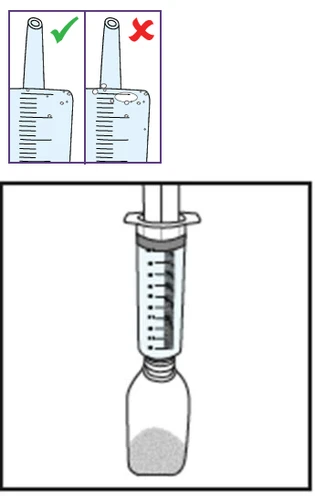
a. Empty the water syringe.
b. Repeat steps c. to i.
k. Place the filled water syringe onto the top edge
of the bottle opening.
l. Hold the bottle firmly.
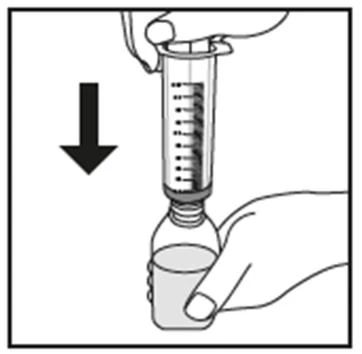
Slowly press the plunger down.
The entire volume of water must be transferred into the bottle.
m. Repeat the reconstitution steps (from “c” to “l”)
one more time.
Warning:
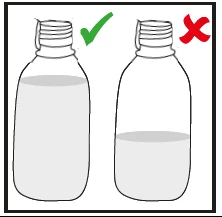
The bottle with granules must be filled with a total of 200 mL of
water (2 x 100 mL).
Inserting the adapter and mixing the oral suspension
a. Remove the bottle adapter from its packaging.
b. Push the adapter completely into the neck of the bottle.
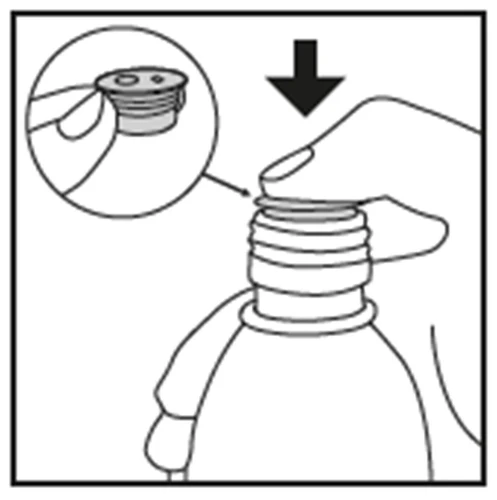
c. Close the bottle securely with the screw cap.


d. Gently shake the bottle for at least 60 seconds.
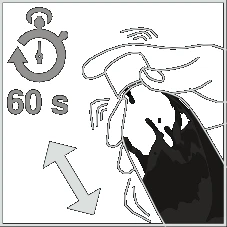
→ The goal is to obtain a well-mixed suspension.
e. Check whether the suspension is well mixed:
- no lumps,
- no sediment.

Warning: For correct dosing, the suspension must not contain
any lumps or sediment. Do not use the medicine if the
suspension contains lumps or sediment.
f. If lumps or sediment are present:
→ Invert the bottle
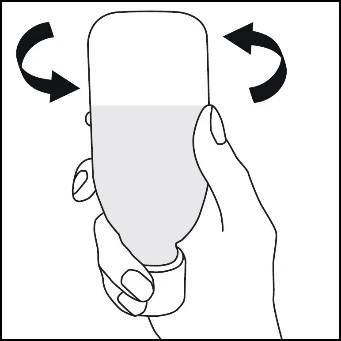
→ Shake in various directions
→ if necessary, wait a moment and shake again until no lumps or sediment remain
Do not add additional water to the bottle.
The suspension is stable for 14 days at
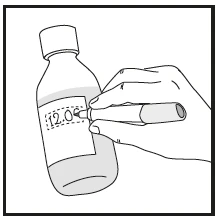
room temperature.
g. Record the expiry date of the freshly prepared suspension on the bottle label.
Expiry date (date of reconstitution + 14 days)
The image shown is for illustrative purposes only.
Setting the prescribed dose with each new blue syringe
Warning: Once set on the blue syringe, the dose cannot be changed.
- Do not remove the removable label until instructed to do so in the Instructions for Use.
- The blue syringe is equipped with a red button to adjust the volume. This button is initially covered by a removable label.
- Pressing the red button sets the syringe volume. This operation can only be performed once.
- Do not press the red button until the Instructions for Use instruct you to do so.
Selection of the blue syringe The package contains blue syringes of different volumes:
suitable ▪ 5 mL blue syringes for doses from 1 mL to 5 mL;
- 10 mL blue syringes for doses exceeding 5 mL.
If the prescribed dose is 11 mL:
Measure 5.5 mL twice using the 10 mL blue syringe.
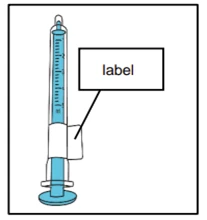
a. Select the appropriate blue syringe based on the dose prescribed
by the child's doctor.
b. Remove the blue syringe from its packaging.
Setting the required dose The blue syringe is equipped with a scale (mL).
on the new blue syringe ▪ The scale on the 5 mL blue syringe starts at 1 mL.
Graduation marks are in 0.2 mL increments.
- The scale on the 10 mL blue syringe starts at 2 mL. Graduation marks are in 0.5 mL increments.
a. Check the dose indicated in the designated field on the outside of the
box.
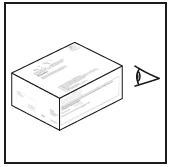
b. If this information is not available:
Ask the doctor to provide it.
c. Hold the blue syringe with the tip pointing upward.
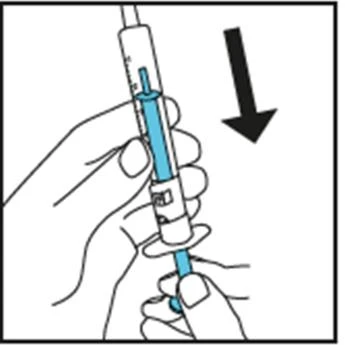
d. Pull the plunger slowly until the upper edge
reaches the mark corresponding to the required volume.
As you move the plunger, you may feel a “click” at each adjustable graduation mark.
Warning: The upper edge of the plunger must be exactly aligned
with the correct mark indicating the required volume.
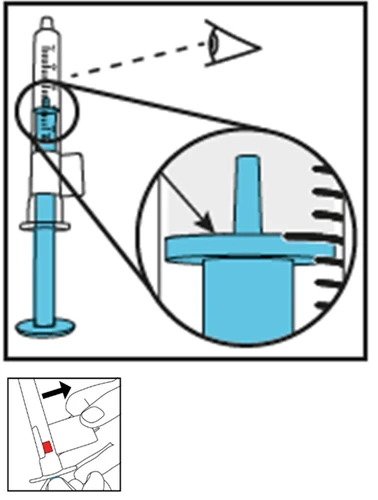
Warning, do not pull the plunger beyond the required volume.
Warning, do not press on the label while pulling the plunger.
e. Remove the removable label from the blue syringe completely. The red button for volume setting is now visible.
f. Check the plunger position again. Ensure that
the upper edge of the plunger is exactly aligned with
the correct mark for the required volume.
g. If the position of the blue plunger does not match the
required volume:
Adjust it accordingly.
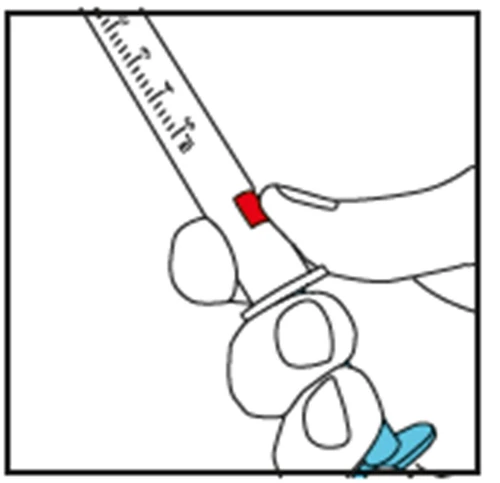
h. If the position of the blue plunger matches the required volume, press the red button to lock the setting.
→ Pressing the red button produces an audible click.
→ The required dose is now set.
Warning: ▪ If you notice that the wrong dose has been selected (the red button has been pressed), use the appropriate spare blue syringe.
- Repeat steps from “a” to “h” with a new blue syringe.
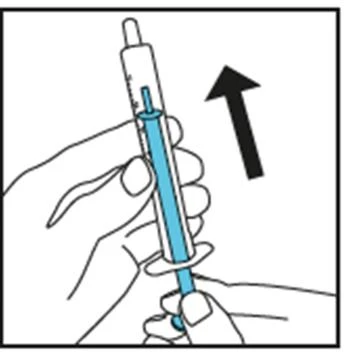
i. Push the plunger fully upward into the blue syringe.
The blue syringe is now ready for use.
Administration of the oral suspension
Follow the steps described below for each administration
Shake the oral suspension
as needed.
Warning: Allow the suspension to reach room temperature if
it has been stored in the refrigerator.
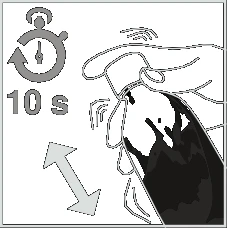
a. Gently shake the bottle for at least 10 seconds before
each administration. The goal is to obtain a
well-mixed suspension.
.
b. Check whether the suspension is well mixed, i.e.:
- no lumps,
- no sediment. c. If lumps or sediment are present: Repeat the previous steps “a” and “b”.

Note • Shaking the bottle may cause foam formation.
- Let the bottle stand until the foam dissipates.
- The wider opening visible on the adapter is used to connect the blue syringe.
- The surface of the bottle adapter must be free of liquid.
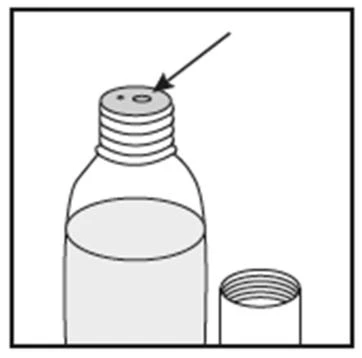
d. Unscrew the bottle cap, but keep the adapter on the top of the bottle.
e. If liquid is present on the adapter: Remove the
liquid with a clean cloth.
Withdrawing the required dose
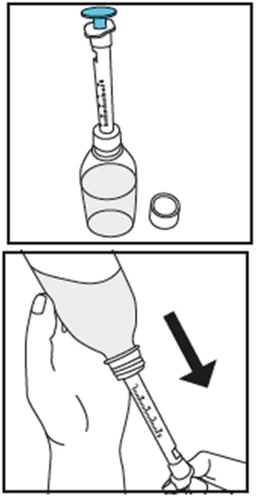
a. Hold the bottle upright. Insert the tip of the blue syringe completely into the large opening of the adapter.
b. Invert the bottle.
c. Pull the blue plunger slowly until it stops
(i.e., until the set dose is reached).
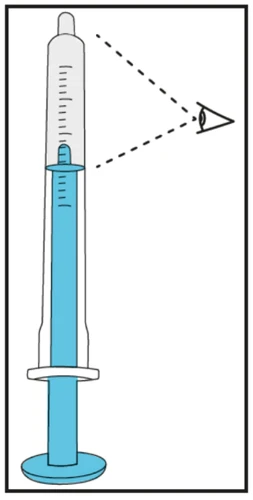
d. Carefully check that no air is present in the
blue syringe.
Small air bubbles are not a problem.
e. If large air bubbles are present:
- Return the suspension to the bottle by pushing the plunger fully into the blue syringe.
- Repeat steps “b” to “e” described above. f. Return the bottle to an upright position. g. Carefully remove the blue syringe from the adapter.
h. Hold the blue syringe vertically and check:
→ that the tip is full,
→ that the correct volume has been drawn,
→ that no large air bubbles are present.
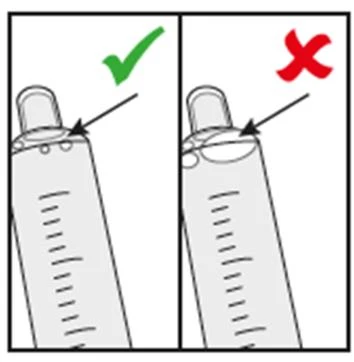
i. If large air bubbles or air are present in the tip:
- Reinsert the tip of the blue syringe completely into the large opening of the adapter.
- Return the suspension to the bottle by pushing the plunger fully into the blue syringe.
- Repeat steps from “b” to “h” until no large air bubbles are visible.
j. Close the bottle with the screw cap.
Administer the suspension immediately after filling the blue syringe.
Administration of the prescribed dose
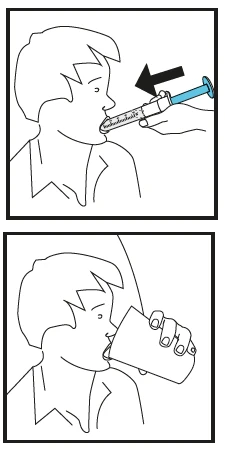
a. Insert the blue syringe into the patient’s mouth.
b. Direct the tip toward the cheek to facilitate natural swallowing.
c. Push the plunger slowly until it stops (the blue syringe is completely empty).
d. Ensure that the patient swallows the entire dose.
e. Then encourage the patient to drink fluids.
Warning: ▪ The patient must swallow the entire dose of the medicine.
Cleaning and storage
The blue syringe must be Follow the steps below to clean the device.
cleaned after each use Three washing cycles are required in total to ensure adequate cleaning.
Cleaning
Warning: ▪ Do not wash the blue syringe in a dishwasher.
- Never boil the blue syringe.
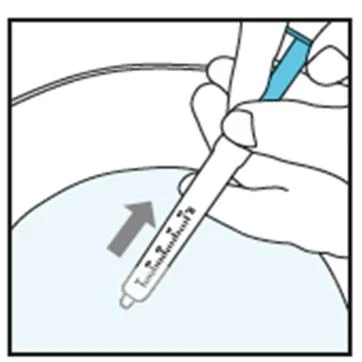
a. Immerse the tip of the blue syringe into the container with water.
b. Draw water into the syringe until the plunger stops.
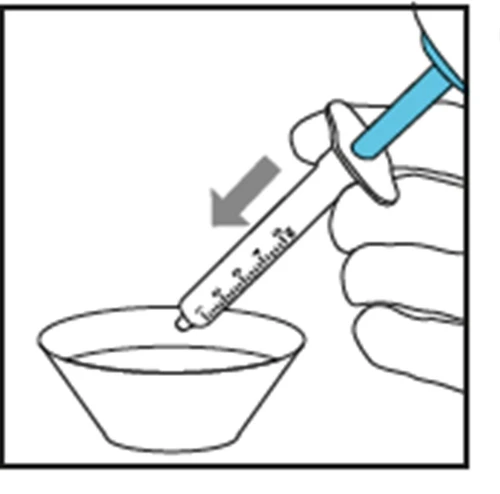
c. Empty the blue syringe into the empty container prepared earlier.
d. Repeat steps “a” to “c” two more times.
e. After cleaning, push the plunger until it stops.
f. Wipe the outer surface of the syringe with a clean cloth.
Storage Store the blue syringe in a clean and dry place until next use.
Keep it away from direct sunlight.
Disposal Unused medicine and waste materials from this medicine,
including syringes and the adapter, must be disposed of in accordance with
local regulations.