Adalat Chrono
Italy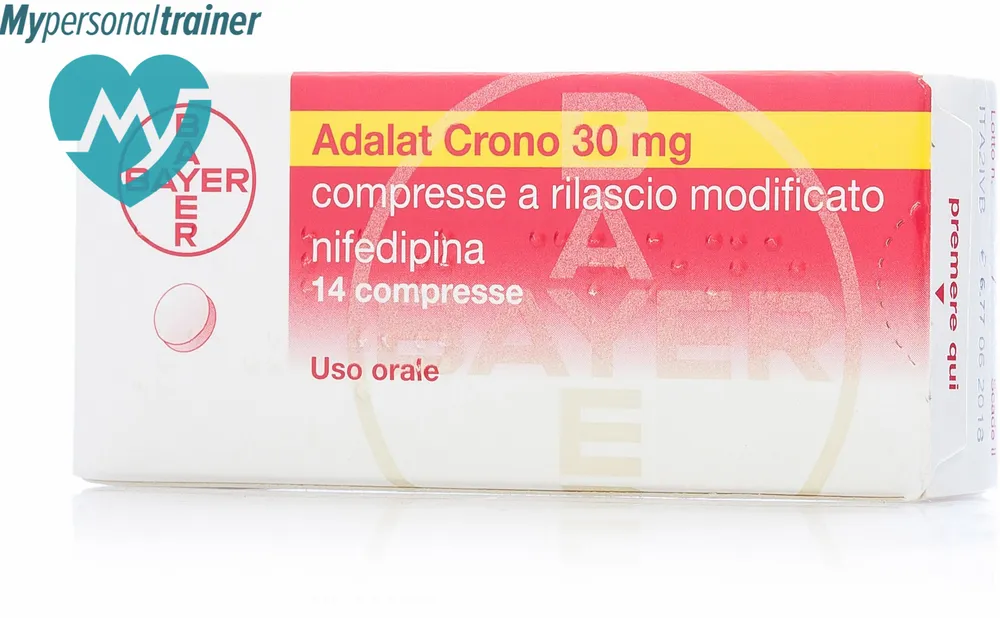
Table of Contents
Patient Information Leaflet
Adalat Crono 30 mg modified release tablets
Nifedipine
Read this leaflet carefully before taking this medicine because it contains important information for you.
- Keep this leaflet. You may need to read it again.
- If you have any questions, ask your doctor or pharmacist.
- This medicine has been prescribed for you only. Do not give it to other people, even if their symptoms are the same as yours, as it may be harmful.
- If you experience any side effect, including those not listed in this leaflet, tell your doctor or pharmacist. See section 4.
Contents of this leaflet:
- What Adalat Crono is and what it is used for
- What you need to know before taking Adalat Crono
- How to take Adalat Crono
- Possible side effects
- How to store Adalat Crono
- Contents of the pack and other information
1. What Adalat Crono is and what it is used for
Adalat Crono contains the active substance nifedipine, which belongs to a class of medicines known as calcium antagonists.
Adalat Crono is used to treat the following conditions:
- exertional angina (angina pectoris), which is characterized by severe chest pain behind the breastbone due to inadequate blood and oxygen supply to the heart (usually occurring during physical exertion). Nifedipine works by dilating the coronary arteries, thereby increasing blood and oxygen supply to the heart tissue. In addition, by acting on peripheral blood vessels, it reduces the heart's oxygen demand.
- high blood pressure (arterial hypertension), as it causes relaxation of blood vessels and increases the excretion of sodium and water. This leads to a reduction in blood pressure, particularly evident in patients with high blood pressure.
2. What you should know before taking Adalat Chrono
Do not take Adalat Chrono
- if you are allergic to nifedipine or to any of the other ingredients of this medicine (listed in section 6);
- if you are or suspect you may be pregnant (up to week 20) or during breastfeeding (see "Pregnancy and breastfeeding");
- if you are in cardiovascular shock (sudden drop in blood pressure);
- if you have a Kock pouch ("pouch diversion" following surgical removal of the colon and rectum);
- if you are taking a medicine containing rifampicin, an antibiotic used to treat certain types of infections. In this case, nifedipine blood levels may become insufficient (see "Other medicines and Adalat Chrono").
Warnings and precautions
Talk to your doctor or pharmacist before taking Adalat Chrono.
Be especially careful with Adalat Chrono if:
- You have very low blood pressure (systolic pressure below 90 mm Hg), suffer from heart failure (weak heart), or have severe aortic stenosis (narrowing of a heart valve);
- You have severe narrowing of the gastrointestinal tract, because, since the tablet consists of a non-absorbable shell, symptoms of intestinal obstruction (bowel obstruction) may occur. Rarely, these shells may form large masses in the stomach called bezoars, which cannot be eliminated through the intestine and sometimes require surgical intervention. In isolated cases, symptoms of obstruction have occurred even in patients who had never experienced gastrointestinal disturbances. If you undergo gastrointestinal X-rays with barium contrast, be aware that Adalat Chrono may produce images that could be misinterpreted as polyps.
- Your liver is not functioning properly. In this case, careful monitoring may be required and, if your condition is severe, a reduction in the dose of Adalat Chrono may be necessary.
- You are pregnant, as available data do not exclude the possibility of adverse effects on the unborn child and newborn. For this reason, Adalat Chrono must not be used during the first 20 weeks of pregnancy (see "Do not take Adalat Chrono" and "Pregnancy and breastfeeding"). After this period, it may be used only after a very careful assessment of potential risks and expected benefits, and when other therapies are unsuitable or ineffective. Your doctor will decide whether Adalat Chrono treatment is appropriate for you. If prescribed Adalat Chrono, you will likely undergo frequent blood pressure checks, especially if you are also receiving intravenous magnesium sulfate, due to the risk of excessive blood pressure drop, which could harm both you and the fetus.
- You are breastfeeding, since nifedipine passes into breast milk. For immediate-release formulations, it is recommended to delay breastfeeding or milk expression by 3 to 4 hours after taking the medicine to reduce infant exposure to nifedipine. As there are no data on possible effects on the newborn, if nifedipine treatment becomes necessary during this period, breastfeeding should be discontinued.
If you are undergoing a laboratory test to measure vanillylmandelic acid levels in urine (a test to diagnose adrenal gland tumors), be aware that, in the presence of nifedipine and depending on the method used, values may be falsely elevated.
Children and adolescents
The use of Adalat Chrono is not recommended in children and adolescents under 18 years of age, as there is limited efficacy and safety data available in this population.
Other medicines and Adalat Chrono
Inform your doctor or pharmacist if you are taking, have recently taken, or might take any other medicine.
Regarding Adalat Chrono, please note:
Nifedipine is metabolized in the body through a specific system of molecules (enzymes). If other medicines that affect or use this same system are taken concomitantly, a decrease or increase in blood concentration—and thus in the effect—of nifedipine or the other medicine may occur. Dose adjustments of nifedipine or the other medicine and/or more frequent blood pressure monitoring may then be necessary.
Medicines that may alter the effect of nifedipine include:
- rifampicin (an antibiotic); never take Adalat Chrono with medicines containing rifampicin (see "Do not take Adalat Chrono").
- certain macrolide antibiotics such as erythromycin;
- certain anti-AIDS medicines such as ritonavir, amprenavir, indinavir, nelfinavir or saquinavir;
- certain antifungal medicines such as ketoconazole, itraconazole or fluconazole;
- fluoxetine, nefazodone (antidepressants);
- quinupristin/dalfopristin (an antibiotic used for specific infections);
- phenytoin, carbamazepine, phenobarbital, valproic acid (anticonvulsants);
- cimetidine, cisapride (medicines used for stomach ulcers).
Nifedipine may alter the effect of the following medicines:
- Nifedipine may enhance the blood pressure-lowering effect of other medicines that reduce blood pressure. In particular, if taken concomitantly with beta-blockers, your doctor must monitor you closely, as it may also worsen the heart's ability to pump blood.
- digoxin, quinidine (heart medicines).
- tacrolimus (a medicine used to prevent transplant rejection).
Medicines containing the following substances do not appear to alter nifedipine blood concentrations and/or their metabolism is not influenced by nifedipine: ajmaline (antiarrhythmic), acetylsalicylic acid at a dose of 100 mg (used for flu symptoms or blood thinning), benazepril, doxazosin, candesartan cilexetil, irbesartan, debrisoquine, talinolol (antihypertensives), omeprazole, pantoprazole, ranitidine (medicines for heartburn), orlistat (weight-loss medicine), rosiglitazone (antidiabetic), triamterene-hydrochlorothiazide (diuretic).
Adalat Chrono with food and drink
Do not drink grapefruit juice during treatment with Adalat Chrono, as it may increase nifedipine blood levels and prolong its effect. If you regularly drink grapefruit juice, this effect may last for more than 3 days after stopping.
Pregnancy and breastfeeding
If you are pregnant, suspect you may be pregnant, plan to become pregnant, or are breastfeeding, consult your doctor or pharmacist before taking this medicine.
Do not take Adalat Chrono if you are in the first 20 weeks of pregnancy or if you are breastfeeding (see "Do not take Adalat Chrono").
Nifedipine should not be used during pregnancy unless the patient's clinical condition requires treatment with nifedipine. Nifedipine use should be reserved for women with severe hypertension who have not responded to standard therapy (see "Warnings and precautions").
Nifedipine is not recommended during breastfeeding because it has been reported to pass into breast milk, and the effects of oral absorption of small amounts of nifedipine by the infant are unknown.
Driving and using machines
Adalat Chrono may cause dizziness or lightheadedness, especially at the beginning of treatment or when taken with alcoholic beverages. If you experience these effects, do not drive or operate machinery.
Adalat Chrono contains sodium
This medicine contains sodium (the main component of table salt) in the following amounts:
9.4 mg per tablet.
With the maximum daily dose of 120 mg, up to 37.6 mg of sodium per day may be ingested.
This corresponds to 1.88% of the maximum daily sodium intake recommended by WHO for an adult.
3. How to take Adalat Crono
Take this medicine exactly as your doctor or pharmacist has told you. If
you have any doubts, consult your doctor or pharmacist.
The recommended dose is one 30 mg coated tablet once daily in the morning.
The safety and efficacy of Adalat Crono in patients under 18 years of age has not been established.
The dose may be gradually increased, at the doctor's discretion, up to a maximum of 60 mg
in arterial hypertension or 120 mg in pectoris angina, taken once daily in the morning.
Adalat Crono is for oral use. Swallow the tablet whole with some liquid. Do not chew or break the
tablets. You may take Adalat Crono with food or on an empty stomach. Remove the tablets from the
blister pack only at the time of administration.
In Adalat Crono tablets, the medicine is contained within a non-absorbable shell that slowly releases
the active substance for absorption. Once this process is complete, the empty tablet shell is excreted
and may be seen in the stool.
Your doctor will determine how long you should continue treatment with Adalat Crono.
Use in elderly patients
If you are elderly, a lower dosage may be required compared to younger patients.
Use in patients with hepatic impairment
If your liver function is impaired, careful monitoring of blood pressure may be necessary and, in severe
cases, a reduction in dosage may be required.
If you take more Adalat Crono than you should
It is important to follow the dose prescribed by your doctor. If you have taken too many tablets by
mistake, do not hesitate: contact your doctor or go to the nearest hospital emergency department.
If you forget to take Adalat Crono
If you forget to take your dose, take it as soon as you remember, on the same day. If you miss a dose for
an entire day, take your next dose as usual the following day. Do not take a double dose to make up
for the missed dose.
If you are unsure what to do, consult your doctor or pharmacist.
If you have any further questions about the use of this medicine, consult your doctor or pharmacist.
4. Possible side effects
Like all medicines, this medicine can cause side effects, although not everyone experiences them.
The following side effects have been observed during clinical trials with nifedipine:
Common side effects (may affect up to 1 in 10 people)
- headache,
- oedema, including peripheral oedema (generalised swelling or swelling in the extremities),
- vasodilatation (dilation of blood vessels),
- constipation,
- malaise (feeling unwell).
Uncommon side effects (may affect up to 1 in 100 people)
- allergic reaction,
- allergic oedema/angioedema (swelling of the skin, face and mucous membranes, including laryngeal oedema, potentially life-threatening),
- anxiety reactions,
- sleep disorders,
- dizziness,
- migraine (unilateral headache),
- vertigo,
- tremor,
- visual disturbances,
- tachycardia (increased heart rate),
- palpitations (awareness of rapid or irregular heartbeat),
- hypotension (low blood pressure),
- syncope (fainting),
- epistaxis (nosebleed),
- nasal congestion (stuffy nose),
- gastrointestinal and abdominal pain,
- nausea,
- dyspepsia (indigestion),
- flatulence (gas in the intestine),
- dry mouth,
- transient increase in liver enzymes,
- erythema (redness of the skin),
- muscle cramps,
- joint swelling,
- polyuria (increased urine volume),
- dysuria (difficulty urinating),
- erectile dysfunction (difficulty achieving or maintaining an erection),
- non-specific pain,
- chills.
Rare side effects (may affect up to 1 in 1,000 people)
- pruritus (itching),
- urticaria (itching and small skin spots),
- rash,
- paraesthesia/dysesthesia (altered sensation, e.g. tingling),
- gingival hyperplasia (enlargement of the gums).
Side effects with unknown frequency (frequency cannot be estimated from the available data)
- agranulocytosis (lack of certain blood cells called granulocytes),
- leucopenia (decrease in the number of white blood cells in the blood),
- anaphylactic/anaphylactoid reaction (severe allergic or allergy-like reaction),
- hyperglycaemia (increased blood sugar levels),
- hypoesthesia (reduced sensation),
- somnolence (drowsiness),
- eye pain,
- chest pain (angina pectoris),
- dyspnoea (breathing difficulty, shortness of breath),
- bezoars (formation of large masses in the stomach),
- dysphagia (difficulty swallowing),
- intestinal obstruction (blockage of intestinal content passage),
- intestinal ulcer,
- vomiting,
- gastroesophageal sphincter insufficiency (regurgitation),
- jaundice (yellowing of the skin and whites of the eyes),
- toxic epidermal necrolysis (serious skin disease),
- photoallergic reaction (skin reaction following exposure to sunlight),
- palpable purpura (a specific type of skin rash),
- arthralgia (joint pain),
- myalgia (muscle pain),
- respiratory difficulty.
Reporting of side effects
If you experience any side effect, including those not listed in this leaflet, please contact your doctor or pharmacist. Side effects can also be reported directly via the national reporting system at https://www.aifa.gov.it/content/segnalazioni-reazioni-avverse. Reporting side effects helps provide more information on the safety of this medicine.
5. How to store Adalat Chrono
Keep this medicine out of the sight and reach of children.
Do not use this medicine after the expiry date which is stated on the blister and outer carton after "Exp". The expiry date refers to the last day of that month.
Store in the original packaging to protect the medicine from moisture.
Do not dispose of medicines via wastewater or household waste. Ask your pharmacist how to dispose of medicines you no longer use. This will help protect the environment.
6. Package contents and other information
What Adalat Chrono contains
- The active substance is nifedipine. Each modified-release tablet contains: Adalat Chrono 30 mg modified-release tablets 30 mg of nifedipine.
- The other components are: Tablet core: polyethylene oxide, hypromellose, magnesium stearate, sodium chloride, red iron oxide (E172). Coating: hypromellose, red iron oxide (E172), cellulose acetate, macrogols, hydroxypropylcellulose, titanium dioxide, propylene glycol.
Description of the appearance of Adalat Chrono and contents of the pack
Adalat Chrono is presented as round, pink, film-coated tablets, marked on one side with “ADALAT 30”.
Each pack contains 14 tablets in daily calendar blister packs.
Marketing Authorization Holder:
Bayer S.p.A., Viale Certosa 130 – Milan
Manufacturer:
Bayer HealthCare Manufacturing S.r.l. - Via delle Groane 126, Garbagnate Milanese (MI)
Bayer AG - Leverkusen - Germany