Actigrip Day & Night
Italy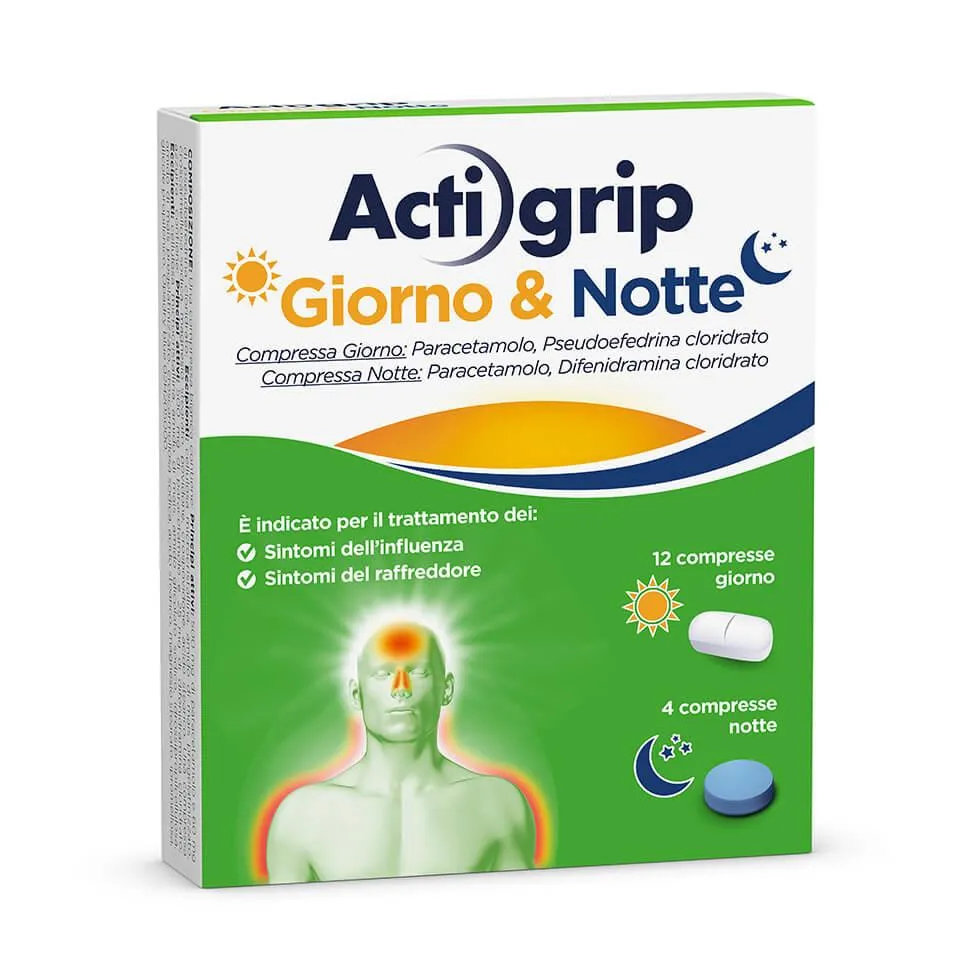
Table of Contents
- Package leaflet: Information for the patient
- ACTIGRIP DAY & NIGHT tablets
- 1. What ACTIGRIP GIORNO E NOTTE is and what it is used for
- 2. What you need to know before taking ACTIGRIP DAY AND NIGHT
- 3. HOW TO TAKE ACTIGRIP DAY AND NIGHT
- 4. Possible side effects
- 5. How to store ACTIGRIP DAY AND NIGHT
- 6. Package contents and other information
Package leaflet: Information for the patient
ACTIGRIP DAY & NIGHT tablets
Paracetamol, Pseudoephedrine hydrochloride, Diphenhydramine hydrochloride
Please read all of this leaflet carefully before taking this medicine because it contains important information for you.
Always take this medicine exactly as described in this leaflet or as your doctor or pharmacist has instructed you.
- Keep this leaflet. You may need to read it again.
- If you need more information or advice, consult your pharmacist.
- If you experience any side effects, including those not listed in this leaflet, tell your doctor or pharmacist. See section 4.
- Consult your doctor if you do not notice any improvement or if your symptoms worsen after 3 days of treatment.
Contents of this leaflet:
- What ACTIGRIP DAY & NIGHT is and what it is used for
- What you need to know before taking ACTIGRIP DAY & NIGHT
- How to take ACTIGRIP DAY & NIGHT
- Possible side effects
- How to store ACTIGRIP DAY & NIGHT
- Contents of the pack and other information
1. What ACTIGRIP GIORNO E NOTTE is and what it is used for
ACTIGRIP GIORNO E NOTTE is a medicine used for the treatment of cold and flu symptoms.
2. What you need to know before taking ACTIGRIP DAY AND NIGHT
Do not take ACTIGRIP DAY AND NIGHT if:
- you are allergic to paracetamol, hydrochloride pseudoephedrine, hydrochloride diphenhydramine, or any of the other ingredients of this medicine (listed in section 6);
- you have high blood pressure (hypertension) or heart diseases (cardiovascular diseases);
- you have very high blood pressure (severe hypertension) or uncontrolled hypertension due to medication;
- you suffer from severe acute (sudden) or chronic (long-term) kidney disease or renal failure;
- you have had a stroke or think you may be at risk for this condition (for example, if you have high blood pressure, diabetes, high cholesterol, or smoke);
- you are currently taking or have taken within the last two weeks medicines for depression known as monoamine oxidase inhibitors (MAOIs);
- you suffer or have suffered from seizures or epilepsy;
- you have glaucoma (increased pressure inside the eye with possible worsening of vision);
- you have experienced symptoms due to a condition known as favism or fava bean disease, which causes a reduction in red blood cells (glucose-6-phosphate dehydrogenase deficiency);
- you have a narrowing (stenosis) of the stomach or intestine (gastrointestinal tract), bladder, urethra, or ureters (urogenital tract);
- you suffer from asthma;
- you suffer from diabetes;
- you have increased thyroid function (hyperthyroidism);
- you have an enlarged prostate volume causing problems such as difficulty urinating or frequent need to urinate (prostatic hypertrophy);
- you are pregnant or think you might be pregnant, or are breastfeeding.
Do not use ACTIGRIP DAY AND NIGHT in children under 12 years of age.
Warnings and precautions
Talk to your doctor or pharmacist before taking ACTIGRIP DAY AND NIGHT if you suffer from
severe haemolytic anaemia (a disease that destroys red blood cells) or have a blood disorder known as
glucose-6-phosphate dehydrogenase deficiency;
- you have liver problems, take medicines that affect its function, or consume large amounts of alcohol (alcoholism);
- you have respiratory problems such as emphysema or chronic bronchitis;
- you have kidney problems (reduced kidney function);
- you have thyroid problems;
- you are concurrently taking analgesics, antipyretics, anticoagulants, or antiplatelet agents.
During treatment with ACTIGRIP DAY & NIGHT, inform your doctor immediately if:
- you suffer from serious illnesses, including severe renal impairment or sepsis (when bacteria and their toxins circulate in the blood causing organ damage), malnutrition, chronic alcoholism, or if you are also taking flucloxacillin (an antibiotic). In patients with these conditions, a serious condition called metabolic acidosis (an abnormality in blood and fluids) has been reported when paracetamol is used regularly over a prolonged period or when paracetamol is taken together with flucloxacillin. Symptoms of metabolic acidosis may include: severe breathing difficulties with deep, rapid breathing, drowsiness, nausea, and vomiting.
Stop using ACTIGRIP DAY AND NIGHT and consult your doctor if you do not notice improvement or
if you notice worsening of symptoms or the appearance of new symptoms.
Cases of reversible posterior encephalopathy syndrome (PRES) and reversible cerebral vasoconstriction syndrome (RCVS) have been reported following the use of medicines containing pseudoephedrine.
PRES and RCVS are rare conditions that may result in reduced blood supply to the brain.
Stop using Actigrip Day and Night immediately and seek immediate medical assistance if
you develop symptoms that could indicate PRES or RCVS (see section 4 “Possible adverse effects” for symptoms).
With ACTIGRIP DAY AND NIGHT, sudden abdominal pain or rectal bleeding may occur due to inflammation of the colon (ischaemic colitis). If you experience these gastrointestinal symptoms, stop using ACTIGRIP DAY AND NIGHT and contact your doctor or seek immediate medical assistance. (See section 4 “Possible adverse effects”).
With ACTIGRIP DAY AND NIGHT, reduced blood flow to the optic nerve may occur. If sudden vision loss occurs, stop taking ACTIGRIP DAY AND NIGHT and consult your doctor or a healthcare facility immediately. See
section 4.
One of the active ingredients in ACTIGRIP DAY AND NIGHT, pseudoephedrine, may lead to abuse, and high doses of pseudoephedrine can be toxic. Continued use may lead to taking more than the recommended dose of ACTIGRIP DAY AND NIGHT to achieve the desired effect, thereby increasing the risk of overdose. The maximum recommended dose and treatment duration must not be exceeded (see section 3).
ACTIGRIP DAY AND NIGHT should be discontinued if, for example, high blood pressure, rapid heartbeat, feeling unwell, nausea, headache, or worsening of headache occur.
Important information about paracetamol
- High doses of paracetamol may cause adverse reactions, even serious ones, especially affecting the liver, kidneys, and blood. BE CAREFUL: the total daily dose of paracetamol should not exceed 4 grams per day.
Do not use ACTIGRIP DAY AND NIGHT at doses higher than recommended, for prolonged periods,
or simultaneously with other medicines containing paracetamol (see “Other medicines and
ACTIGRIP DAY AND NIGHT”).
Serious skin reactions
During treatment with paracetamol, although very rarely, serious skin reactions have been reported, manifesting as redness, blistering, pus formation, and skin peeling (e.g., acute generalized exanthematous pustulosis (AGEP), Stevens-Johnson syndrome, toxic epidermal necrolysis (TEN), and drug reaction with eosinophilia and systemic symptoms (known as DRESS syndrome) (see section 4. “Possible adverse effects”). In the early stages of therapy, patients appear to be at higher risk: the reaction typically occurs within the first stages of treatment.
Serious skin reactions such as acute generalized exanthematous pustulosis (AGEP) have been reported with products containing pseudoephedrine. This acute pustular eruption may occur within the first 2 days of treatment, with fever and numerous small pustules, mostly non-follicular, arising from a widespread oedematous erythema, primarily located in skin folds, trunk, and upper limbs. If you develop a generalized febrile erythema associated with pustules, stop taking ACTIGRIP DAY AND NIGHT and contact your doctor or seek immediate medical assistance. (See section 4. “Possible adverse effects”).
STOP treatment with ACTIGRIP DAY AND NIGHT and contact your doctor if you notice any
skin reaction or other signs of allergy (see section 4).
- Due to its paracetamol content, ACTIGRIP DAY AND NIGHT may affect the results of certain laboratory tests, such as blood tests measuring uric acid (uricemia) and glucose (glycemia).
For those engaged in sports: using the medicine without therapeutic need constitutes doping and may lead to a positive anti-doping test.
Other medicines and ACTIGRIP DAY AND NIGHT
Inform your doctor or pharmacist if you are taking, have recently taken, or might take any other medicine.
Do not take ACTIGRIP DAY AND NIGHT with:
- other medicines containing paracetamol or those that reduce fever (antipyretics) and pain (analgesics: NSAIDs, selective COX-2 inhibitors, corticosteroids);
- other medicines containing diphenhydramine, even for topical use (e.g., creams).
BE CAREFUL: some of the following medicines may interact with ACTIGRIP DAY AND NIGHT:
- anticholinergic drugs, for example medicines used to treat mood disorders such as antidepressants (tricyclics and MAOIs), atropine, and other psychotropic drugs;
- hypnotics, sedatives, and tranquilizers;
- antihistamines;
- sympathomimetic drugs, such as medicines that reduce nasal swelling (decongestants) or reduce appetite (anorectics, amphetamine-like drugs);
- antihypertensives such as methyldopa, alpha and beta-blockers, debrisochinone, guanethidine, betanidine, and bretylium (medicines for high blood pressure);
- cholestyramine (used to lower blood cholesterol);
- metoclopramide or domperidone (used to treat nausea and vomiting);
- medicines that delay blood clotting (anticoagulants), such as warfarin or other coumarins;
- anticonvulsants or antiepileptics (medicines used to treat epilepsy) such as glutethimide, phenobarbital, carbamazepine;
- rifampicin (a medicine used to treat tuberculosis);
- cimetidine (a medicine used for peptic ulcer);
- probenecid (a medicine used in gout);
- flucloxacillin (an antibiotic), due to a serious risk of blood and fluid abnormalities (called metabolic acidosis) that require urgent treatment (see section 2).
- ACTIGRIP DAY AND NIGHT with alcohol Do not drink alcohol while using ACTIGRIP DAY AND NIGHT as this may interfere with your treatment and/or increase the risk of adverse events, especially affecting the liver.
Pregnancy and breastfeeding
If you are pregnant, suspect you may be pregnant, plan to become pregnant, or are breastfeeding, consult your doctor or pharmacist before taking this medicine.
The active ingredients in ACTIGRIP DAY AND NIGHT cross the placenta and are excreted in breast milk: the use of ACTIGRIP DAY AND NIGHT is contraindicated during pregnancy and
breastfeeding.
Driving and using machines
The blue tablets of ACTIGRIP DAY AND NIGHT may cause drowsiness. Make sure you do not experience this adverse effect before driving vehicles or operating machinery.
3. HOW TO TAKE ACTIGRIP DAY AND NIGHT
Take this medicine exactly as stated in this leaflet or as directed by your doctor or pharmacist. If you have any doubts, consult your doctor or pharmacist.
Check the table below to ensure you take the correct dose.
- Take the tablets orally (by mouth) without chewing them.
- Do not exceed the recommended doses. If you have any doubts, consult your doctor or pharmacist. Follow the dosing instructions carefully.
- ACTIGRIP DAY AND NIGHT contains 2 types of tablets of different colours, which must be taken at different times of the day.
Children under 12 years of age
Do not use ACTIGRIP DAY AND NIGHT in children under 12 years of age.
Adults and children over 12 years of age
Age Dose
Adults and children over 12 years During the day
of age 1 white tablet, 3 times daily: 1 in the morning, 1 at
midday, and 1 in the afternoon.
In the evening
1 blue tablet, taken in the evening before going to bed.
- Do not take more than 3 white tablets per day.
- If you do not feel better, or if you develop high fever or other adverse effects after 3 consecutive days of treatment, stop taking the medicine.
If you take more ACTIGRIP DAY AND NIGHT than you should, you may experience serious adverse effects, particularly affecting the liver, blood, and heart. Contact your doctor immediately or go to the nearest hospital, even if you feel well, as these effects may appear several hours after ingestion.
Keep this medicine out of the reach of children. In case of overdose, seek medical help immediately or contact a poison control centre without delay.
If you forget to take ACTIGRIP DAY AND NIGHT
Do not take a double dose to make up for the missed dose.
Be careful: always wait 4–6 hours between one dose and the next.
If you have any doubts about how to use this medicine, consult your doctor or pharmacist.
4. Possible side effects
Like all medicines, this medicine can cause side effects, although not everyone will experience them.
Stop taking ACTIGRIP DAY AND NIGHT immediately and contact your doctor urgently if you develop symptoms that could be signs of posterior reversible encephalopathy syndrome (PRES) and reversible cerebral vasoconstriction syndrome (RCVS). These include:
- Severe headache with sudden onset
- Nausea
- Vomiting
- Confusion
- Seizures
- Changes in vision
Very common side effects (may affect more than 1 in 10 people):
- Abdominal and stomach pain
- Indigestion (dyspepsia)
- Diarrhea
- Vomiting, dry throat
- Headache
- Drowsiness
- Sedation
- Excitation
- Increased sweating
- Sleep disorders
- Blurred vision
- Skin rash
- Urticaria
- Dry nose
Common side effects (may affect up to 1 in 10 people):
- Itching (pruritus)
- Contact dermatitis
- Inflammation of the skin or mucous membranes
- Low blood pressure including dizziness or lightheadedness when standing up (orthostatic/postural hypotension)
- Irregular heartbeat (arrhythmia)
- Increased heart rate (tachycardia)
- Nervousness
- Insomnia
- Dizziness
- Ringing or buzzing in the ears (tinnitus)
- Movement coordination problems (ataxia)
- Euphoria
- Tremors
- Low blood pressure (hypotension)
- Reduced mucous secretions
- Double vision (diplopia)
- Blurred vision
- Increased eye pressure with visual disturbances (glaucoma, closed-angle glau游戏副本
5. How to store ACTIGRIP DAY AND NIGHT
Keep this medicine out of the sight and reach of children.
Store below 25°C and in the original packaging to protect the medicine from light and moisture.
Do not use this medicine after the expiry date stated on the packaging. The expiry date refers to the last day of that month.
Do not dispose of medicines via wastewater or household waste. Ask your pharmacist how to dispose of medicines you no longer use. This will help protect the environment.
6. Package contents and other information
What ACTIGRIP DAY AND NIGHT contains
The active substances are: paracetamol, hydrochloride pseudoephedrine and hydrochloride diphenhydramine.
- 1 white tablet contains: 500 mg of paracetamol and 60 mg of hydrochloride pseudoephedrine;
- 1 blue tablet contains: 500 mg of paracetamol and 25 mg of hydrochloride diphenhydramine.
The other components are:
- 1 white tablet contains: microcrystalline cellulose, pregelatinized corn starch, sodium croscarmellose, magnesium stearate, povidone, crospovidone, stearic acid;
- 1 blue tablet contains: microcrystalline cellulose, corn starch, sodium glycolate starch, hydroxypropylcellulose, pregelatinized corn starch, sodium croscarmellose, stearic acid, magnesium stearate, hypromellose, Opadry blue 02H205000 (containing propylene glycol).
Description of the appearance of ACTIGRIP DAY AND NIGHT and package contents
ACTIGRIP DAY AND NIGHT is available in a pack containing 12 white tablets and 4 blue tablets.
Marketing Authorization Holder
Johnson & Johnson S.p.A, Via Ardeatina, km 23,500 - 00071 Santa Palomba – Pomezia - Roma
Manufacturer
JNTL Consumer Health (France) SAS - Domaine de Maigremont 27100 Val de Reuil France.