Aclasta
Italy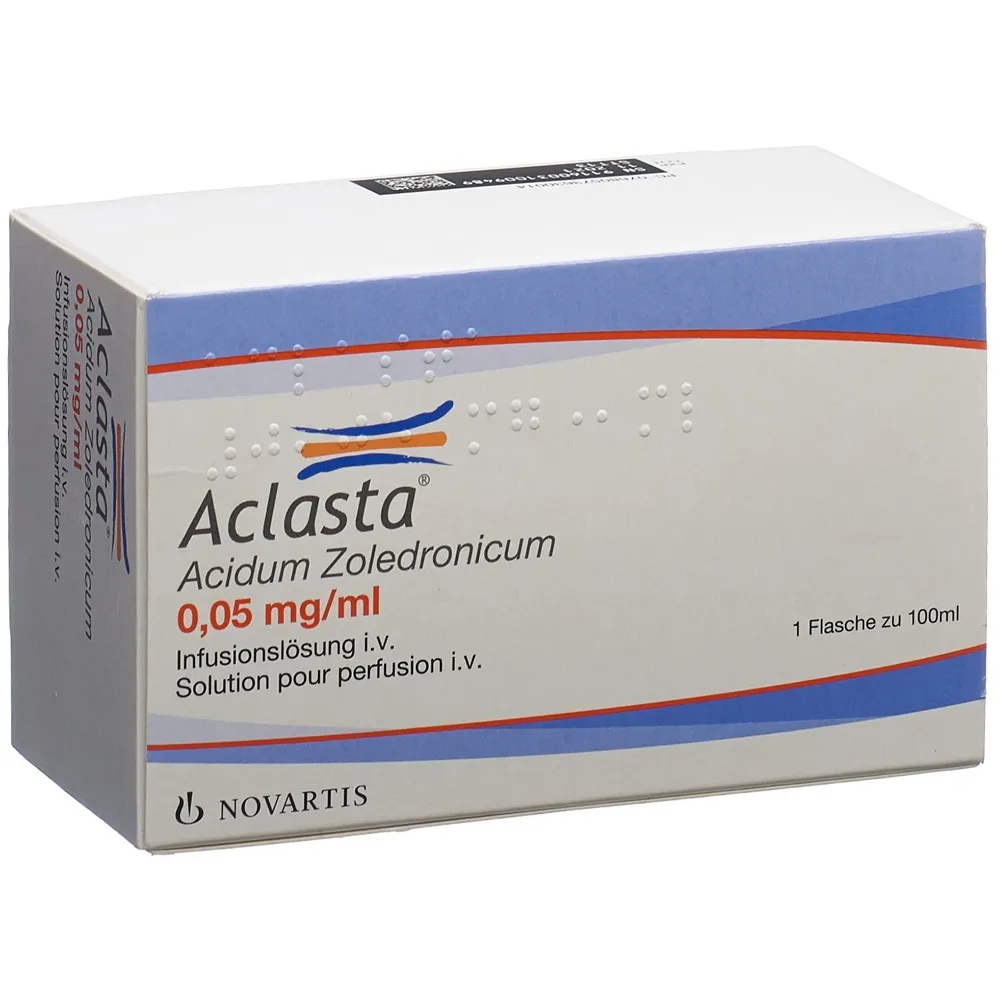
Table of Contents
Package leaflet: Information for the user
Aclasta 5 mg infusion solution
zoledronic acid
Please read this leaflet carefully before you are given this medicine because
it contains important information for you.
- Keep this leaflet. You may need to read it again.
- If you have any questions, ask your doctor, pharmacist or nurse.
- If you get any side effects, talk to your doctor, pharmacist or nurse. This includes any possible side effects not listed in this leaflet. See section 4.
Contents of this leaflet
- What Aclasta is and what it is used for
- What you need to know before you are given Aclasta
- How to use Aclasta
- Possible side effects
- How to store Aclasta
- Contents of the pack and other information
1. What Aclasta is and what it is used for
Aclasta contains the active substance zoledronic acid. It belongs to a group of medicines called bisphosphonates and is used to treat postmenopausal women and adult men with osteoporosis or corticosteroid-induced osteoporosis due to treatment for inflammation, as well as Paget's disease of bone in adults.
Osteoporosis
Osteoporosis is a disease that causes thinning and weakening of bones. It is common in women after menopause but can also occur in men. At menopause, the ovaries stop producing the female hormone oestrogen, which helps maintain bone health. After menopause, bone loss occurs, bones become weaker and are more likely to break. Osteoporosis can also occur in men and women due to long-term use of steroids, which may affect bone strength. Many patients with osteoporosis have no symptoms but are still at risk of bone fractures because osteoporosis has made their bones more fragile. Reduced levels of circulating sex hormones, mainly oestrogens derived from androgens, also play a role in the more gradual bone loss observed in men. In both women and men, Aclasta strengthens bones and reduces the risk of fracture.
Aclasta is also used in patients who have recently experienced a hip fracture due to minor trauma such as a fall and are therefore at risk of further bone fractures.
Paget's disease of bone
It is normal for old bone to be removed and replaced by new bone tissue. This process is called bone remodelling. In Paget's disease, bone remodelling occurs too rapidly, and the new bone forms in a disorganised way, making it weaker than normal. If left untreated, bones may become deformed, painful and prone to fracture. Aclasta works by normalising the bone remodelling process, ensuring normal bone formation and thereby restoring bone strength.
2. What you need to know before you are given Aclasta
Carefully follow all instructions provided by your doctor, pharmacist, or nurse before you are given Aclasta.
Aclasta must not be given to you
- if you are allergic to zoledronic acid, other bisphosphonates, or any of the excipients in this medicine (listed in section 6).
- if you have hypocalcemia (i.e. if your blood calcium levels are too low).
- if you have severe kidney problems.
- if you are pregnant.
- if you are breastfeeding.
Warnings and precautions
Talk to your doctor before you are given Aclasta:
- if you are being treated with any medicine containing zoledronic acid, which is also the active substance in Aclasta (zoledronic acid is used in adult patients with certain types of cancer to prevent bone complications or to reduce calcium levels).
- if you have kidney problems or have had them in the past.
- if you cannot take a daily calcium supplement.
- if you have had part or all of your parathyroid glands in the neck surgically removed.
- if sections of your intestine have been removed.
An adverse effect called osteonecrosis of the jaw/mandible (bone damage of the jaw/mandible) has been reported in post-marketing experience in patients treated with Aclasta (zoledronic acid) for the treatment of osteoporosis. Osteonecrosis of the jaw/mandible may occur even after discontinuation of treatment.
It is important to try to prevent the onset of osteonecrosis of the jaw/mandible, as it is a painful condition that may be difficult to treat. To reduce the risk of developing osteonecrosis of the jaw/mandible, there are certain precautions you should take.
Before receiving treatment with Aclasta, talk to your doctor, pharmacist, or nurse if:
- you have any mouth or dental problems such as poor dental health, gum disease, or if you have planned dental extractions;
- you do not receive routine dental care or have not had a dental check-up for a long time;
- you are a smoker (as this may increase the risk of dental problems);
- you have previously been treated with a bisphosphonate (used to treat or prevent bone disorders);
- you are taking medicines called corticosteroids (such as prednisolone or dexamethasone);
- you have cancer.
Your doctor may ask you to have a dental examination before starting treatment with Aclasta.
During treatment with Aclasta, you must maintain good oral hygiene (including regular tooth cleaning) and receive routine dental check-ups. If you wear dentures, ensure they are properly fitted. If you are undergoing dental treatment or need dental surgery (e.g. tooth extractions), inform your doctor and tell your dentist that you are being treated with Aclasta. Immediately inform your doctor and dentist if you experience any mouth or dental problems such as tooth loss, pain, swelling, non-healing sores, or discharge, as these may be signs of osteonecrosis of the jaw/mandible.
Monitoring tests
Your doctor should perform a blood test to check your kidney function (creatinine levels) before each Aclasta infusion. It is important that you drink at least two glasses of fluid (e.g. water) within a few hours before your Aclasta treatment, as instructed by your healthcare provider.
Children and adolescents
Aclasta is not recommended for use in individuals under 18 years of age.
Other medicines and Aclasta
Inform your doctor, pharmacist, or nurse if you are taking, have recently taken, or might take any other medicines.
It is important for your doctor to know all the medicines you are taking, especially if you are already taking other medicines that may be potentially harmful to the kidneys (e.g. aminoglycosides) or diuretics (“water tablets”) that may cause dehydration.
Pregnancy and breastfeeding
Aclasta must not be given to you if you are pregnant, suspect you may be pregnant, planning a pregnancy, or breastfeeding.
Ask your doctor, pharmacist, or nurse for advice before taking this medicine.
Driving and using machines
If you feel dizzy while taking Aclasta, do not drive or operate machinery until you feel better.
Aclasta contains sodium
This medicine contains less than 1 mmol of sodium (23 mg) per 100 ml vial of Aclasta and is therefore essentially “sodium-free”.
3. How to use Aclasta
Follow carefully all instructions given by your doctor or nurse. If you have any doubts, consult your
doctor or nurse.
Osteoporosis
The usual dose is 5 mg, administered by your doctor or nurse as a single intravenous infusion once a year.
The infusion will last at least 15 minutes.
In the case of a recent hip fracture, administration of Aclasta is recommended two or more weeks after
surgical repair of the hip fracture.
It is important to take calcium and vitamin D supplements (e.g. in tablet form) as directed by your doctor.
For osteoporosis, Aclasta works for one year. Your doctor will inform you when to return for the next dose.
Paget's disease
For the treatment of Paget's disease, Aclasta should only be prescribed by physicians experienced in the
treatment of bone Paget's disease.
The usual dose is 5 mg, administered by your doctor or nurse as an initial intravenous infusion.
The infusion will last at least 15 minutes. Aclasta may work for more than one year, and your doctor will
inform you whether further treatment is needed.
Your doctor may advise you to take calcium and vitamin D supplements (e.g. in tablet form) for at least the
first ten days following administration of Aclasta. It is important that you follow this advice carefully so that
your blood calcium level does not become too low in the period following the infusion. Your doctor will
inform you about possible symptoms associated with hypocalcemia.
Aclasta with food and drink
Make sure you drink enough fluids (at least one or two glasses) before and after treatment with Aclasta, as
instructed by your doctor. This will help prevent dehydration. On the day of Aclasta treatment, you may
eat normally. This is particularly important for patients taking diuretics (water pills) and for elderly patients
(65 years of age or older).
If you forget a dose of Aclasta
Contact your doctor or hospital as soon as possible to schedule a new appointment.
Before stopping treatment with Aclasta
If you are considering stopping treatment with Aclasta, attend your next scheduled appointment and
discuss this with your doctor. Your doctor will be able to advise you and decide for how long treatment
should continue.
If you have any doubts about how to use this medicine, consult your doctor, pharmacist, or nurse.
4. Possible side effects
Like all medicines, this medicine can cause side effects, although not everybody will experience them.
Side effects related to the first infusion are very common (occur in more than 30% of patients) but become less common with subsequent infusions. Most side effects such as fever and chills, muscle or joint pain, and headache occur within the first three days after administration of Aclasta. Symptoms are usually mild to moderate and resolve within three days. Your doctor may advise you to take a mild pain reliever such as ibuprofen or paracetamol to reduce these side effects. The likelihood of experiencing side effects decreases with subsequent doses of Aclasta.
Some side effects may be serious
Common (may affect up to 1 in 10 people)
In patients treated with Aclasta for postmenopausal osteoporosis, irregular heart rhythm (atrial fibrillation) has been observed. It is currently unclear whether Aclasta is the cause of this irregular heart rhythm, but you must inform your doctor if you experience such symptoms after receiving Aclasta.
Uncommon (may affect up to 1 in 100 people)
Swelling, redness, pain, and itching of the eyes or light sensitivity.
Very rare (may affect up to 1 in 10,000 people)
Contact your doctor if you experience ear pain, ear discharge, and/or ear infection. These episodes could be signs of bone damage in the ear.
Not known (frequency cannot be estimated from available data)
Pain in the mouth and/or jaw, swelling or sores in the mouth or jaw that do not heal, discharge, numbness, or a feeling of heaviness in the jaw, or tooth loss; these could be signs of severe bone tissue deterioration of the jaw (osteonecrosis). Inform your doctor and dentist immediately if such symptoms occur while you are being treated with Aclasta or after stopping treatment.
Kidney problems (e.g. reduced urine output) may occur. Your doctor will perform a blood test to check your kidney function before each Aclasta infusion. It is important that you drink at least one or two glasses of fluid (e.g. water) within a few hours before treatment with Aclasta, as advised by your healthcare provider.
If you experience any of these side effects, inform your doctor immediately.
Aclasta may also cause other side effects
Very common (may affect more than 1 in 10 people)
Fever
Common (may affect up to 1 in 10 people)
Headache, dizziness, malaise, vomiting, diarrhoea, muscle pain, bone and/or joint pain, back, arm or leg pain, influenza-like symptoms (e.g. fatigue, chills, joint and muscle pain), chills, feeling tired and lack of interest, weakness, pain, feeling unwell, swelling and/or pain at the infusion site.
In patients with Paget's disease, symptoms due to low calcium levels in the blood have been reported, such as muscle spasms, numbness, or tingling, particularly around the mouth area.
Uncommon (may affect up to 1 in 100 people)
Influenza, upper respiratory tract infections, decreased red blood cell count, loss of appetite, insomnia, drowsiness which may include reduced alertness and consciousness, tingling or numbness sensation, extreme fatigue, tremor, temporary loss of consciousness, eye infection or irritation or inflammation with pain and redness, dizziness, increased blood pressure, hot flushes, cough, shortness of breath, stomach discomfort, abdominal pain, constipation, dry mouth, heartburn, rash, excessive sweating, itching, skin redness, neck pain, muscle, bone and/or joint stiffness, joint swelling, muscle spasms, shoulder pain, chest and rib cage muscle pain, joint inflammation, muscle weakness, abnormal kidney function tests, frequent abnormal need to urinate, swelling of hands, ankles or feet, thirst, toothache, altered taste.
Rare (may affect up to 1 in 1,000 people)
Rarely, particularly in patients receiving long-term treatment for osteoporosis, an unusual femur fracture may occur. Contact your doctor if you experience pain, weakness, or discomfort in your thigh, hip, or groin, as this could be an early sign of a possible femur fracture. Low levels of phosphate in the blood.
Not known (frequency cannot be estimated from available data)
Severe allergic reactions including dizziness and breathing difficulties, swelling mainly of the face and throat, low blood pressure, dehydration secondary to acute phase reactions (post-infusion symptoms such as fever, vomiting, and diarrhoea).
Reporting of side effects
If you experience any side effect, including those not listed in this leaflet, talk to your doctor, pharmacist, or nurse. You can also report side effects directly through the national reporting system listed in Annex V. By reporting side effects, you can help provide more information on the safety of this medicine.
5. How to store Aclasta
Your doctor, pharmacist, or nurse is informed about the appropriate way to store
Aclasta.
- Keep this medicine out of the sight and reach of children.
- Do not use this medicine after the expiry date stated on the carton and vial following "Exp".
- The unopened vial does not require any special storage conditions.
- After opening the vial, the product must be used immediately to avoid microbial contamination. If not used immediately, the storage times and conditions prior to use are the responsibility of the user and should normally not exceed 24 hours at 2°C – 8°C. Allow the solution taken from the refrigerator to reach room temperature before use.
6. Package contents and other information
What Aclasta contains
- The active substance is zoledronic acid. Each 100 ml vial of solution contains 5 mg of zoledronic acid (as monohydrate). One ml of solution contains 0.05 mg of zoledronic acid (as monohydrate).
- The other components are mannitol, sodium citrate, and water for injections.
Description of the appearance of Aclasta and contents of the pack
Aclasta is a clear, colourless solution. It is supplied in 100 ml plastic vials as an infusion solution ready for use. It is available in single packs containing one vial or in multi-dose packs containing five vials. Not all pack sizes may be marketed.
Marketing Authorization Holder
Sandoz Pharmaceuticals d.d.
Verovškova ulica 57
1000 Ljubljana
Slovenia
Manufacturer
Novartis Pharma GmbH
Roonstraße 25
D-90429 Nuremberg
Germany
LEK Pharmaceuticals d.d.,
Verovškova ulica 57,
1526 Ljubljana,
Slovenia
For further information about this medicinal product, please contact the local representative of the Marketing Authorization Holder:
België/Belgique/Belgien Lietuva
Sandoz N.V. Sandoz Pharmaceuticals d.d
Telecom Gardens Branch Office Lithuania
Medialaan 40 Seimyniskiu 3A
B-1800 Vilvoorde LT – 09312 Vilnius
Tél/Tel: +32 (0)2 722 97 97 Tel: +370 5 2636 037
България Luxembourg/Luxemburg
КЧТ Сандоз България Sandoz N.V.
Teл.: +359 2 970 47 47 Telecom Gardens
Medialaan 40
B-1800 Vilvoorde
Tél/Tel: +32 (0)2 722 97 97
Česká republika Magyarország
Sandoz s.r.o. Sandoz Hungária Kft.
Na Pankráci 1724/129 Bartók Béla út 43-47
CZ-140 00, Praha 4 H-1114 Budapest
Tel: +420 225 775 111 Tel: +36 1 430 2890
office.cz@ sandoz.com [email protected]
Danmark Malta
Sandoz A/S Sandoz Pharmaceuticals d.d.
Edvard Thomsens Vej 14 Verovskova 57
DK-2300 København S SI-1000 Ljubljana
Tlf: +45 6395 1000 Slovenia
[email protected] Tel: +356 21222872
Deutschland Nederland
Hexal AG Sandoz B.V.
Industriestr. 25 Hospitaaldreef 29,
D-83607 Holzkirchen NL-1315 RC Almere
Tel: +49 8024 908-0 Tel: +31 (0)36 5241600
[email protected] [email protected]
Eesti Norge
Sandoz d.d. Eesti filiaal Sandoz A/S
Pärnu mnt 105 Edvard Thomsens Vej 14
EE – 11312 Tallinn DK-2300 København S
Tel: +372 6652405 Danmark
Tlf: +45 6395 1000
[email protected]
Ελλάδα Österreich
SANDOZ HELLAS Sandoz GmbH
ΜΟΝΟΠΡΟΣΩΠΗ Α.Ε. Biochemiestr. 10
Τηλ: +30 216 600 5000 A-6250 Kundl
Tel: +43(0)1 86659-0
España Polska
Bexal Farmacéutica, S.A. Sandoz Polska Sp. z o.o.
Centro Empresarial Parque Norte ul. Domaniewska 50 C
Edificio Roble 02 672 Warszawa
C/ Serrano Galvache, 56 Tel.: +48 22 209 7000
28033 Madrid [email protected]
Tel: +34 900 456 856
France Portugal
Sandoz SAS Sandoz Farmacêutica Lda.
49, avenue Georges Pompidou Tel: +351 211 964 000
F-92300 Levallois-Perret
Tél: +33 1 49 64 48 00
Hrvatska România
Sandoz d.o.o. Sandoz S.R.L.
Maksimirska 120 Strada Livezeni Nr. 7a
10 000 Zagreb 540472 Târgu Mureș
Tel : +385 1 235 3111 Tel: +40 21 407 51 60
[email protected]
Ireland Slovenija
Sandoz Pharmaceuticals d.d. Lek farmacevtska družba d.d.
Verovškova ulica 57 Verovškova 57
1000 Ljubljana SI-1526 Ljubljana
Slovenia Tel: +386 1 580 21 11
[email protected]
Ísland Slovenská republika
Sandoz A/S Sandoz d.d. - organizačná zložka
Edvard Thomsens Vej 14 Žižkova 22B
DK-2300 Copenhagen S 811 02 Bratislava
Denmark Tel: +421 2 48 200 600
Tlf: +45 6395 1000 [email protected]
[email protected]
Italia Suomi/Finland
Sandoz S.p.A. Sandoz A/S
Largo Umberto Boccioni, 1 Edvard Thomsens Vej 14
I-21040 Origgio / VA DK-2300 Copenhagen S
Tel: +39 02 96 54 1 Denmark
[email protected] Puh: + 358 010 6133 400
[email protected]
Κύπρος
Sandoz Pharmaceuticals d.d.
Verovskova 57
SI-1000 Ljubljana
Slovenia
Tel: +357 22 69 0690
Sverige
Sandoz A/S
Edvard Thomsens Vej 14
DK-2300 Copenhagen S
Denmark
Tel: +45 6395 1000
[email protected]
Latvija
Sandoz d.d. Latvia filiāle
K.Valdemāra 33 – 29
LV-1010 Rīga
Tel: +371 67892006
Other sources of information
More detailed information on this medicinal product is available on the website of the European Medicines Agency: http://www.ema.europa.eu
INFORMATION FOR HEALTHCARE PROFESSIONALS
The following information is intended exclusively for healthcare professionals (see section 3):
How to prepare and administer Aclasta
- Aclasta 5 mg solution for infusion is ready for use.
For single use only. Any unused solution must be discarded. The solution should only be used if it is clear, particle-free, and shows no discolouration. Aclasta must not be mixed or administered intravenously with other medicinal products and must be administered through a separate infusion line with a vented membrane at a constant infusion rate. The infusion time must not be less than 15 minutes. Aclasta must not come into contact with calcium-containing solutions. If stored in the refrigerator, allow the solution to reach room temperature before administration. Aseptic techniques must be followed during infusion preparation. The infusion must be administered in accordance with standard medical practice.
How to store Aclasta
- Keep Aclasta out of the sight and reach of children.
- Do not use this medicinal product after the expiry date stated on the carton and vial after "Exp".
- The unopened vial does not require any special storage conditions.
- After opening the vial, the product should be used immediately to avoid microbial contamination. If not used immediately, the in-use storage times and conditions prior to use are the responsibility of the user and should normally not exceed 24 hours at 2°C - 8°C. Allow refrigerated solution to reach room temperature before administration.