Zytiga 500 mg film-coated tablets
Spain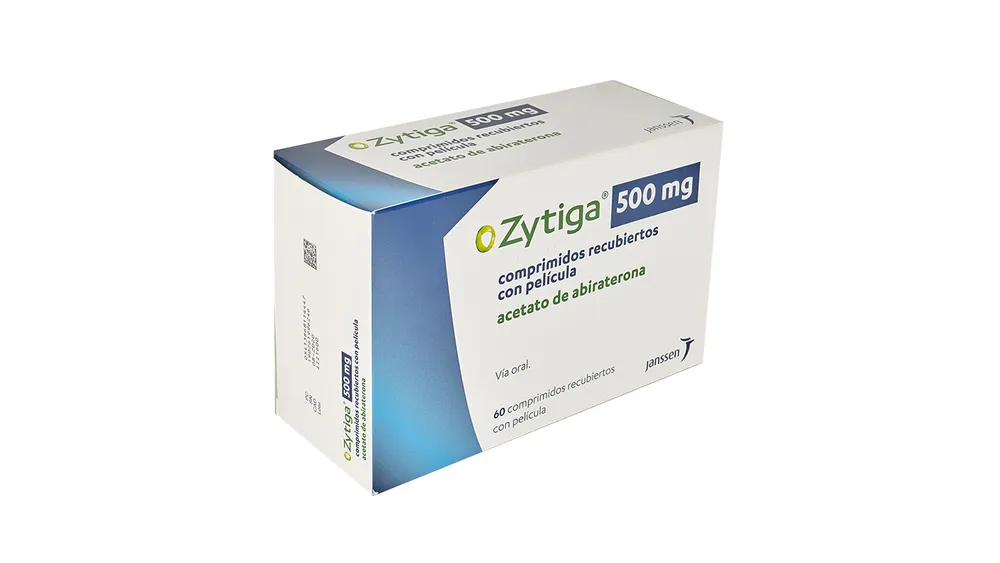
Table of Contents
Patient Information Leaflet
Introduction
Patient Information Leaflet
ZYTIGA 500 mg film-coated tablets
abiraterone acetate
Read the entire leaflet carefully before you start taking this medicine, as it contains important information for you.
- Keep this leaflet as you may need to read it again.
- If you have any questions, consult your doctor or pharmacist.
- This medicine has been prescribed for you only, and you should not give it to others, even if they have the same symptoms as you, because it may harm them.
- If you experience any adverse effects, consult your doctor or pharmacist, even if they are effects not listed in this leaflet. See section 4.
Contents of the leaflet
- What ZYTIGA is and what it is used for
- What you need to know before taking ZYTIGA
- How to take ZYTIGA
- Possible side effects
- How to store ZYTIGA
- Contents of the pack and other information
1. What ZYTIGA is and what it is used for
ZYTIGA contains a medicine called abiraterone acetate. It is used to treat prostate cancer in adult men when the disease has spread to other parts of the body. ZYTIGA works by stopping your body from producing testosterone, thereby helping to slow the growth of prostate cancer.
When ZYTIGA is prescribed at an early stage of the disease and there is still response to hormonal treatment, it is used in combination with a therapy to reduce testosterone (androgen deprivation therapy).
When you take this medicine, your doctor will also prescribe another medicine called prednisone or prednisolone to reduce the risk of developing high blood pressure, fluid retention (accumulation of too much fluid in the body), or low levels of a chemical substance called potassium in your blood.
2. What you need to know before taking ZYTIGA
Do not take ZYTIGA
- if you are allergic to abiraterone acetate or any of the other ingredients of this medicine (listed in section 6).
- if you are a woman, especially if you are pregnant. ZYTIGA is intended for use only in male patients.
- if you have severe liver disease.
- in combination with Ra-223 (used for the treatment of prostate cancer).
Do not take this medicine if any of the above apply to you. If you are in doubt, consult your doctor or pharmacist before taking this medicine.
Warnings and precautions
Talk to your doctor or pharmacist before starting this medicine:
- if you have liver problems
- if you have been diagnosed with high blood pressure, heart failure, or low potassium levels in the blood (low potassium levels may increase the risk of heart rhythm problems)
- if you have had other heart or blood vessel problems
- if you have a fast or irregular heartbeat
- if you have difficulty breathing
- if you have gained weight rapidly
- if you have swelling in your feet, ankles, or legs
- if you have previously taken a medicine called ketoconazole for prostate cancer
- about the need to take this medicine with prednisone or prednisolone
- about possible adverse effects on your bones
- if you have high blood sugar levels.
Inform your doctor if you have been diagnosed with any heart or blood vessel disorders, including heart rhythm problems (arrhythmia), or if you are being treated with medicines for these conditions.
Inform your doctor if you develop yellowing of the skin or eyes, dark urine, or severe nausea or vomiting, as these may be signs or symptoms of liver problems. Rarely, liver function failure (called acute liver failure) may occur, which can lead to death.
A decrease in red blood cells, reduced sex drive, and cases of muscle weakness and/or muscle pain may occur.
ZYTIGA must not be administered in combination with Ra-223 due to a possible increased risk of bone fracture or death.
If you plan to take Ra-223 after treatment with ZYTIGA and prednisone/prednisolone, you must wait 5 days before starting Ra-223 treatment.
If you are unsure whether any of the above apply to you, consult your doctor or pharmacist before taking this medicine.
Blood tests
ZYTIGA may affect your liver even if you do not have any symptoms. While you are taking this medicine, your doctor will perform periodic blood tests to monitor any effects on your liver.
Children and adolescents
This medicine must not be used in children or adolescents. If a child or adolescent accidentally ingests ZYTIGA, go immediately to the hospital and bring the package leaflet with you to show the emergency doctor.
Other medicines and ZYTIGA
Talk to your doctor or pharmacist before taking any medicine.
Tell your doctor or pharmacist if you are taking, have recently taken, or might need to take any other medicines. This is important because ZYTIGA may increase the effects of a number of medicines, including medicines for the heart, sedatives, some medicines for diabetes, herbal medicines (e.g., St. John’s wort), and others. Your doctor may consider adjusting the dose of these medicines. In addition, some medicines may increase or decrease the effects of ZYTIGA. This could lead to adverse effects or make ZYTIGA less effective.
Androgen deprivation therapy may increase the risk of heart rhythm problems. Inform your doctor if you are taking medicines
- used to treat heart rhythm problems (e.g., quinidine, procainamide, amiodarone, and sotalol);
- that increase the risk of heart rhythm problems [e.g., methadone (used for pain relief and as part of drug addiction detoxification), moxifloxacin (an antibiotic), antipsychotics (used for serious mental illnesses)].
Talk to your doctor if you are taking any of the medicines listed above.
ZYTIGA with food
- This medicine must not be taken with food (see section 3, “How to take this medicine”).
- Taking ZYTIGA with food may cause adverse effects.
Pregnancy and breastfeeding
ZYTIGA is not indicated for use in women.
- This medicine may be harmful to the fetus if taken by a pregnant woman.
- If you have sexual intercourse with a woman of childbearing age, you must use a condom and another effective contraceptive method.
- If you have sexual intercourse with a pregnant woman, you must use a condom to protect the fetus.
Driving and using machines
It is unlikely that this medicine will affect your ability to drive or operate tools or machinery.
ZYTIGA contains lactose and sodium
- ZYTIGA contains lactose. If your doctor has diagnosed you with an intolerance to certain sugars, consult him before taking this medicine.
- This medicine contains 27 mg of sodium (a main component of cooking/table salt) per two-compressed dose. This corresponds to 1.35% of the maximum daily recommended sodium intake for an adult.
3. How to take ZYTIGA
Follow exactly the instructions for using this medicine as given by your doctor. If you are unsure, consult your doctor or pharmacist again.
How much to take
The recommended dose is 1,000 mg (two tablets) once daily.
How to take this medicine
- Take this medicine by mouth.
- Do not take ZYTIGA with food. Taking Zytiga with food may cause your body to absorb more medicine than needed, which may lead to side effects.
- Take the ZYTIGA tablets as a single daily dose on an empty stomach. ZYTIGA should be taken at least two hours after eating, and no food should be consumed for at least one hour after taking ZYTIGA. (See section 2, “ZYTIGA with food”.)
- Swallow the tablets whole with water.
- Do not split the tablets.
- ZYTIGA is administered together with a medicine called prednisone or prednisolone. Take prednisone or prednisolone exactly as instructed by your doctor.
- You will need to take prednisone or prednisolone every day while you are taking ZYTIGA.
- If you have a medical emergency, the amount of prednisone or prednisolone you take may need to be adjusted. Your doctor will advise you if this is necessary. Do not stop taking prednisone or prednisolone unless your doctor tells you to.
Your doctor may also prescribe other medicines while you are taking ZYTIGA and prednisone or prednisolone.
If you take more ZYTIGA than you should
If you take more than you should, contact your doctor or go to hospital immediately.
If you forget to take ZYTIGA
- If you forget to take ZYTIGA or prednisone or prednisolone, take your usual dose the next day.
- If you forget to take ZYTIGA or prednisone or prednisolone for more than one day, contact your doctor immediately.
If you stop taking ZYTIGA
Do not stop taking ZYTIGA or prednisone or prednisolone unless your doctor tells you to.
If you have any further questions about the use of this medicine, ask your doctor or pharmacist.
4. Possible adverse effects
Like all medicines, this medicine can cause adverse effects, although not everyone experiences them.
Stop taking ZYTIGA and contact your doctor immediately if you experience any of the following effects:
- Muscle weakness, muscle cramps, or increased heart rate (palpitations).
These may be signs of low potassium levels in your blood.
Other adverse effects include:
Very common (may affect more than 1 in 10 people):
Fluid retention in the legs or feet, decreased potassium levels in the blood, elevations in liver function tests, high blood pressure, urinary tract infection, diarrhea.
Common (may affect up to 1 in 10 people):
High levels of fats in the blood, chest pain, irregular heartbeat (atrial fibrillation), heart failure, tachycardia, serious infections called sepsis, bone fractures, indigestion, blood in the urine, skin rash.
Uncommon (may affect up to 1 in 100 people):
Problems with the adrenal glands (related to salt and water imbalances), abnormal heart rhythm (arrhythmia), muscle weakness and/or muscle pain.
Rare (may affect up to 1 in 1,000 people):
Lung inflammation (also known as allergic alveolitis).
Liver function failure (also known as acute liver failure).
Frequency not known (cannot be estimated from available data):
Heart attack, changes in electrocardiogram (ECG) (QT prolongation), and severe allergic reactions with difficulty swallowing or breathing, swelling of the face, lips, tongue or throat, or itchy rash.
Loss of bone density may occur in men receiving treatment for prostate cancer. ZYTIGA in combination with prednisone or prednisolone may increase this loss of bone density.
Reporting of adverse effects
If you experience any adverse effect, consult your doctor or pharmacist, even if it is a possible adverse effect not listed in this leaflet. You can also report them directly through the national reporting system included in Appendix V. By reporting adverse effects, you can help provide more information on the safety of this medicine.
5. Storage of ZYTIGA
- Keep this medicine out of the sight and reach of children.
- Do not use this medicine after the expiry date stated on the carton, the cardboard box, and the blister pack. The expiry date is the last day of the month indicated.
- No special storage conditions are required.
- Medicines should not be disposed of via wastewater or household waste. Ask your pharmacist how to dispose of any unused medicines and their packaging. This will help protect the environment.
6. Contents of the pack and other information
Composition of ZYTIGA
- The active substance is abiraterone acetate. Each film-coated tablet contains 500 mg of abiraterone acetate.
- The other components are microcrystalline cellulose (silicified), sodium croscarmellose, hypromellose 2910 (15 mPa.s), lactose monohydrate, magnesium stearate, colloidal anhydrous silica, and sodium lauryl sulfate (see section 2, “ZYTIGA contains lactose and sodium”). The film coating contains iron oxide black (E172), iron oxide red (E172), macrogol 3350, polyvinyl alcohol, talc, and titanium dioxide.
Nature and contents of the container
- ZYTIGA tablets are purple, oval-shaped, film-coated tablets (20 mm long by 10 mm wide), with “AA” engraved on one side and “500” on the other side.
- Each 28-day pack contains 56 film-coated tablets in 4 cardboard boxes, each containing 14 film-coated tablets.
- Each 30-day pack contains 60 film-coated tablets in 5 cardboard boxes, each containing 12 film-coated tablets.
- Some pack sizes may not be marketed.
Marketing Authorization Holder
Janssen-Cilag International NV
Turnhoutseweg 30
B-2340 Beerse
Belgium
Manufacturer
Janssen-Cilag SpA
Via C. Janssen
Borgo San Michele
I-04100 Latina, Italy
For further information about this medicinal product, please contact the local representative of the Marketing Authorization Holder:
Belgium/Belgium/Belgium Janssen-Cilag NV Tel/Tel: +32 14 64 94 11 | Lithuania UAB "JOHNSON & JOHNSON" Tel: +370 5 278 68 88 |
| Luxembourg/Luxembourg Janssen-Cilag NV Tel/Tel: +32 14 64 94 11 |
Czech Republic Janssen-Cilag s.r.o. Tel. +420 227 012 227 | Hungary Janssen-Cilag Kft. Tel.: +36 1 884 2858 |
Denmark Janssen-Cilag A/S Tlf: +45 45 94 82 82 | Malta AM MANGION LTD. Tel: +356 2397 6000 |
Germany Janssen-Cilag GmbH Tel: +49 2137 955 955 | Netherlands Janssen-Cilag B.V. Tel: +31 76 711 1111 |
Estonia UAB "JOHNSON & JOHNSON" Estonia branch Tel: +372 617 7410 | Norway Janssen-Cilag AS Tlf: +47 24 12 65 00 |
Greece Janssen-Cilag Pharmaceutical Α.Ε.Β.Ε. Tel: +30 210 80 90 000 | Austria Janssen-Cilag Pharma GmbH Tel: +43 1 610 300 |
Spain Janssen-Cilag, S.A. Tel: +34 91 722 81 00 | Poland Janssen-Cilag Polska Sp. z o.o. Tel.+48 22 237 60 00 |
France Janssen-Cilag Tel: 0 800 25 50 75 / +33 1 55 00 40 03 | Portugal Janssen-Cilag Farmacêutica, Lda. Tel: +351 214 368 600 |
Croatia Johnson & Johnson S.E. d.o.o. Tel: +385 1 6610 700 | Romania Johnson & Johnson România SRL Tel: +40 21 207 1800 |
Ireland Janssen Sciences Ireland UC Tel: +353 1 800 709 122 | Slovenia Johnson & Johnson d.o.o. Tel: +386 1 401 18 00 |
Iceland Janssen-Cilag AB c/o Vistor hf. Tel: +354 535 7000 | Slovakia Johnson & Johnson, s.r.o. Tel: +421 232 408 400 |
Italy Janssen-Cilag SpA Tel: 800.688.777 / +39 02 2510 1 | Finland Janssen-Cilag Oy Tel: +358 207 531 300 |
Cyprus Varnavas Chatzipanagis Ltd Tel: +357 22 207 700 | Sweden Janssen-Cilag AB Tel: +46 8 626 50 00 |
Latvia UAB "JOHNSON & JOHNSON" Latvia branch Tel: +371 678 93561 | United Kingdom (Northern Ireland) Janssen Sciences Ireland UC Tel: +44 1 494 567 444 |

Date of the most recent review of this leaflet:
Other sources of information
Detailed information on this medicinal product is available on the website of the European Medicines Agency: http://www.ema.europa.eu/, and on the website of the Spanish Agency of Medicines and Medical Devices (AEMPS) (http://www.aemps.gob.es/).