Zolgensma 2 x 10e13 vector genomes/ml solution for infusion
Spain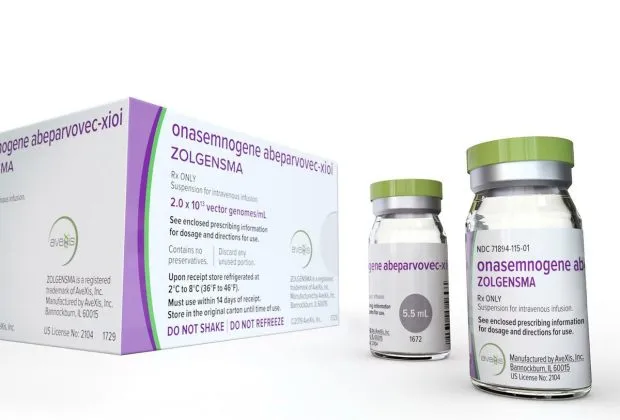
Table of Contents
Package leaflet: Information for the user
Introduction
Package leaflet: information for the user
Zolgensma 2 x 10¹³ vector genomes/ml solution for infusion
onasemnogene abeparvovec
This medicinal product is subject to additional monitoring, which will allow quicker identification of new safety information. You can help by reporting any adverse reactions your child may experience. Section 4 includes information on how to report adverse reactions.
Read all of this leaflet carefully before this medicine is administered to your child, because it contains important information.
- Keep this leaflet, as you may need to read it again.
- If you have any questions, ask your child's doctor or nurse.
- If your child experiences any adverse reactions, consult your child's doctor or nurse, even if they are adverse reactions not listed in this leaflet. See section 4.
Contents of the leaflet
- What Zolgensma is and what it is used for
- What you need to know before your child is given Zolgensma
- How Zolgensma is administered
- Possible adverse reactions
- How to store Zolgensma
- Contents of the pack and other information
1. What Zolgensma is and what it is used for
What Zolgensma is
Zolgensma is a type of medicine called a "gene therapy". It contains the active substance onasemnogene abeparvovec, which carries human genetic material.
What Zolgensma is used for
Zolgensma is used to treat spinal muscular atrophy (SMA), a serious and rare inherited disease.
How Zolgensma works
SMA occurs when a gene needed to produce an essential protein called "survival motor neuron" (SMN) protein is missing or abnormal. The lack of SMN protein leads to the death of nerves that control muscles (motor neurons). This causes muscles to weaken and waste away, eventually leading to loss of movement.
This medicine works by providing a fully functional copy of the SMN gene, helping the body produce sufficient amounts of SMN protein. The gene is delivered into the cells where it is needed, using a modified virus that does not cause disease in humans.
2. What you need to know before your child is given Zolgensma
DO NOT use Zolgensma
- if your child is allergic to onasemnogene abeparvovec or to any of the other ingredients of this medicine (listed in section 6).
Warnings and precautions
Your child’s doctor will check for antibodies before treatment to help determine whether this medicine is suitable for your child.
Infusion-related reactions and serious allergic reactions
Infusion-related reactions and serious allergic reactions may occur during or shortly after your child receives Zolgensma. Possible signs to watch for include itchy rash, pale skin, vomiting, swelling of the face, lips, mouth or throat (which may cause difficulty swallowing or breathing), and/or changes in heart rate and blood pressure. Immediately inform your child’s doctor or nurse if you notice any of these or other new signs or symptoms during or shortly after treatment with Zolgensma. Before your child is discharged, the doctor will provide you with information on what to do if your child experiences new or recurring side effects once you leave the medical facility.
Liver problems
Talk to your child’s doctor or nurse before this medicine is administered if your child has previously had any liver problems. This medicine may cause an increase in liver enzymes (proteins in the body) or damage the liver. Liver injury may become severe, including liver failure and death. After administration of this medicine, watch for possible signs in your child such as vomiting, jaundice (yellowing of the whites of the eyes and skin), or decreased level of alertness (for more information, see section 4). Immediately inform your child’s doctor if you notice any symptoms suggesting liver damage.
Your child will have a blood test to monitor liver function before starting treatment with Zolgensma. Regular blood tests will also be performed for at least 3 months after treatment to detect any increases in liver enzymes.
Infection
An infection (e.g., cold, flu, or bronchiolitis) before or after treatment with Zolgensma could lead to more serious complications. Caregivers and individuals in close contact with the patient should follow infectious disease prevention guidelines (e.g., hand hygiene, covering mouth when coughing or sneezing, limiting contact). It is important to monitor for signs of infection such as cough, wheezing, sneezing, runny nose, sore throat, or fever. Immediately inform your child’s doctor if you notice symptoms suggesting infection before or after treatment with Zolgensma.
Regular blood tests
This medicine may reduce the number of blood platelets (thrombocytopenia). It is important to monitor for possible signs of low platelet count after your child receives Zolgensma, such as unusual bruising or bleeding (see more information in section 4). Most reported cases of low platelet counts occurred within the first three weeks after administration of Zolgensma.
Before starting Zolgensma treatment, your child will have a blood test to monitor blood cell counts (including red blood cells and platelets), as well as troponin I levels in the body. A blood test will also be performed to check creatinine levels, which indicate kidney function. Regular blood tests will be conducted for some time after treatment to detect any changes in platelet levels.
Increased troponin I levels
Zolgensma may increase levels of a heart protein called troponin I. This can be detected through laboratory tests performed by your child’s doctor as needed.
Abnormal blood clotting in small blood vessels (thrombotic microangiopathy)
Cases of thrombotic microangiopathy have been reported in patients, usually within the first two weeks after treatment with Zolgensma. Thrombotic microangiopathy is associated with a decrease in red blood cells and platelets (cells involved in blood clotting) and may be fatal. These blood clots may affect your child’s kidneys. Your child’s doctor may perform blood tests (platelet count) and monitor blood pressure. After your child receives Zolgensma, watch for signs such as easy bruising, seizures (fits), or reduced wetting of diapers (for more information, see section 4). If your child shows any of these signs, seek urgent medical attention.
Donation of blood, organs, tissues, and cells
After your child has received Zolgensma, they must not donate blood, organs, tissues, or cells. This is because Zolgensma is a gene therapy medicine.
Other medicines and Zolgensma
Inform your doctor or nurse if your child is taking, has recently taken, or might need to take any other medicines.
Prednisolone
Your child will also be given a corticosteroid such as “prednisolone” for 2 months or longer (see also section 3) as part of treatment with Zolgensma. The corticosteroid will help manage any potential increase in liver enzymes your child may experience after receiving Zolgensma.
Vaccines
Because corticosteroids may affect the immune system (defenses), your child’s doctor may decide to delay certain vaccinations while your child is receiving corticosteroid treatment. Consult your child’s doctor or nurse if you have any questions.
Additional information for parents/caregivers
Spinal Muscular Atrophy (SMA)
Zolgensma may rescue living motor neurons, but it does not rescue dead motor neurons. Children with less severe symptoms of SMA (such as absent reflexes or reduced muscle tone) may have enough living motor neurons and could therefore benefit significantly from treatment with Zolgensma. Zolgensma may be less effective in children with severe muscle weakness or paralysis, breathing difficulties, inability to swallow, or significant malformations (e.g., heart defects), including patients with SMA type 0, as there may be limited potential for improvement after treatment with Zolgensma. Your child’s doctor will decide whether this medicine should be administered.
Risk of tumors due to possible vector insertion into DNA
There is a possibility that treatments like Zolgensma could insert into the DNA of human cells. Consequently, due to the nature of the medicine, Zolgensma could contribute to an increased risk of tumors. Discuss this with your child’s doctor. If a tumor develops, your child’s doctor may request a tissue sample for evaluation.
Hygiene care
The active substance in Zolgensma may be temporarily excreted through your child’s bodily waste, known as “excretions.” Parents and caregivers should practice good hand hygiene for up to 1 month after your child receives Zolgensma. Use protective gloves when handling your child’s bodily fluids or waste, and then thoroughly wash hands with soap and warm running water or an alcohol-based hand sanitizer. Double-bagging should be used for disposal of soiled diapers and other waste. Disposable diapers may continue to be discarded with household waste.
You should follow these instructions for at least 1 month after your child’s treatment with Zolgensma. Speak with your child’s doctor or nurse if you have any questions.
3. How Zolgensma is administered
Zolgensma will be administered by a physician or trained nurse experienced in the management of the child's disease.
The physician will calculate the amount of Zolgensma your child will receive based on the child's body weight. Zolgensma will be given intravenously (into a vein) as a single infusion lasting approximately 1 hour.
Zolgensma will be given to your child ONLY ONCE.
Your child will also receive prednisolone (or another corticosteroid) by mouth, starting 24 hours before administration of Zolgensma. The corticosteroid dose will also depend on your child's weight. Your child's physician will calculate the total dose to be administered.
Your child will receive daily corticosteroid treatment for about 2 months after Zolgensma administration, or until liver enzymes decrease to acceptable levels. The physician will gradually reduce the corticosteroid dose until it can be completely discontinued.
If you have any further questions, ask your child's physician or nurse.
4. Possible adverse effects
Like all medicines, this medicine may cause adverse effects, although not everyone gets them.
Seek urgent medical attention if your child experiences any of the following serious adverse effects:
Common (may affect up to 1 in 10 people):
- bruising or bleeding that lasts longer than usual after an injury – these may be signs of a decrease in platelets
Uncommon (may affect up to 1 in 100 people):
- vomiting, jaundice (yellowing of the whites of the eyes and skin), or decreased level of alertness. These may be signs of liver damage (including liver failure).
- easy bruising, seizures (fits), or reduced urine production – these may be signs of thrombotic microangiopathy.
- infusion-related reactions (see section 2, “Warnings and precautions”).
Rare (may affect up to 1 in 1,000 people):
- severe allergic reactions (see section 2, “Warnings and precautions”).
Talk to your child’s doctor or nurse if your child experiences any other adverse effects. These may include the following:
Very common (may affect more than 1 in 10 people):
- increased liver enzymes observed in blood tests.
Common (may affect up to 1 in 10 people):
- vomiting;
- fever;
- increased troponin I (a heart protein) seen in blood tests.
Reporting of adverse effects
If your child experiences any type of adverse effect, consult your child’s doctor or nurse, even if it is a possible adverse effect not listed in this leaflet. You may also report them directly through the national reporting system included in Appendix V. By reporting adverse effects, you can help provide more information on the safety of this medicine.
5. Storage of Zolgensma
Keep this medicine out of the sight and reach of children.
This information is intended for healthcare professionals who prepare and administer the medicine.
Do not use this medicine after the expiry date stated on the vial label and carton after EXP. The expiry date refers to the last day of the month indicated.
Vials will be transported frozen (at ‑60 ºC or lower).
Upon receipt, vials must be immediately refrigerated at a temperature between 2 °C and 8 °C, and kept in the original carton. Treatment with Zolgensma must be initiated within 14 days of receiving the vials.
This medicine contains genetically modified organisms. Unused medicines or waste materials must be disposed of in accordance with local guidelines for the handling of biological waste. Since this medicine will be administered by a physician, the physician is responsible for the proper disposal of the product. These measures will help protect the environment.
6. Contents of the pack and other information
Composition of Zolgensma
- The active substance is onasemnogene abeparvovec. Each vial contains onasemnogene abeparvovec at a nominal concentration of 2 × 10¹³ vector genomes/ml.
- The other components are tromethamine, magnesium chloride, sodium chloride, poloxamer 188, hydrochloric acid (for pH adjustment), and water for injections.
Appearance of the product and contents of the container
Zolgensma is a solution for infusion that is transparent to slightly opaque, colourless to off-white.
Zolgensma may be supplied in vials containing a nominal fill volume of 5.5 ml or 8.3 ml. Each vial is for single use only.
Each carton will contain between 2 and 14 vials.
Marketing Authorization Holder
Novartis Europharm Limited
Vista Building
Elm Park, Merrion Road
Dublin 4
Ireland
Manufacturer responsible for production
Novartis Pharmaceutical Manufacturing GmbH
Biochemiestraße 10
6336 Langkampfen
Austria
Novartis Pharma GmbH
Sophie-Germain-Strasse 10
90443 Nuremberg
Germany
Further information on this medicinal product is available upon request by contacting the local representative of the Marketing Authorization Holder:
Belgium/Belgium/Belgium Novartis Pharma N.V. Tel/Tel: +32 2 246 16 11 | Lithuania SIA Novartis Baltics Lithuania branch Tel: +370 5 269 16 50 |
| Luxembourg/Luxembourg Novartis Pharma N.V. Tél/Tel: +32 2 246 16 11 |
Czech Republic Novartis s.r.o. Tel: +420 225 775 111 | Hungary Novartis Hungária Kft. Tel.: +36 1 457 65 00 |
Denmark Novartis Healthcare A/S Tlf.: +45 39 16 84 00 | Malta Novartis Pharma Services Inc. Tel: +356 2122 2872 |
Germany Novartis Pharma GmbH Tel: +49 911 273 0 | Netherlands Novartis Pharma B.V. Tel: +31 88 04 52 111 |
Estonia SIA Novartis Baltics Estonia branch Tel: +372 66 30 810 | Norway Novartis Norge AS Tlf: +47 23 05 20 00 |
Greece Novartis (Hellas) S.A.E. Tel: +30 210 281 17 12 | Austria Novartis Pharma GmbH Tel: +43 1 86 6570 |
Spain Novartis Farmacéutica, S.A. Tel: +34 93 306 42 00 | Poland Novartis Poland Sp. z o.o. Tel.: +48 22 375 4888 |
France Novartis Pharma S.A.S. Tél: +33 1 55 47 66 00 | Portugal Novartis Farma ‑ Pharmaceutical Products, S.A. Tel: +351 21 000 8600 |
Croatia Novartis Hrvatska d.o.o. Tel. +385 1 6274 220 | Romania Novartis Pharma Services Romania SRL Tel: +40 21 31299 01 |
Ireland Novartis Ireland Limited Tel: +353 1 260 12 55 | Slovenia Novartis Pharma Services Inc. Tel: +386 1 300 75 50 |
Iceland Vistor hf. Tel: +354 535 7000 | Slovakia Novartis Slovakia s.r.o. Tel: +421 2 5542 5439 |
Italy Novartis Farma S.p.A. Tel: +39 02 96 54 1 | Finland Novartis Finland Oy Puh/Tel: +358 (0)10 6133 200 |
Cyprus Novartis Pharma Services Inc. Tel: +357 22 690 690 | Sweden Novartis Sverige AB Tel: +46 8 732 32 00 |
Latvia SIA Novartis Baltics Tel: +371 67 887 070 |
Date of the most recent review of this summary
Other sources of information
Detailed information on this medicine is available on the website of the European Medicines Agency: https://www.ema.europa.eu/. There are also links to other websites on rare diseases and orphan medicinal products.
This information is intended for healthcare professionals only:
Important: Please consult the product information/summary of product characteristics before using the medicine.
Each vial is for single use only.
This medicine contains genetically modified organisms. Local regulations for the handling of biological hazardous waste must be followed.
Handling
- Zolgensma must be handled aseptically under sterile conditions.
- Personal protective equipment (including gloves, safety goggles, sleeves, and laboratory coat) must be worn when handling or administering Zolgensma. Personnel must not handle Zolgensma if they have cuts or abrasions on the skin.
- Any spills of Zolgensma must be cleaned up with absorbent gauze pads, and the spill area must be disinfected with a sodium hypochlorite solution, followed by alcohol wipes. All materials used for cleaning must be placed in a double waste bag and disposed of according to local regulations for handling biological hazardous waste.
- Disposal of all materials that may have come into contact with Zolgensma (e.g., vials, all materials used for injection, including needles and sterile gauze) must be carried out in accordance with local regulations for handling biological hazardous waste.
Accidental exposure
Accidental exposure to Zolgensma must be avoided.
In case of skin exposure, the affected area must be thoroughly washed with soap and water for at least 15 minutes. In case of eye exposure, the affected area must be thoroughly rinsed with water for at least 15 minutes.
Storage
Vials will be transported frozen (at -60 °C or lower). Upon receipt, vials must be immediately refrigerated at 2 °C to 8 °C in their original packaging. Treatment with Zolgensma must be initiated within 14 days of receiving the vials. The date of receipt must be marked on the original packaging before storing the medicine in the refrigerator.
Preparation
Vials must be thawed before use:
- For packages containing up to 9 vials – thaw for approximately 12 hours in the refrigerator (2 °C to 8 °C) or 4 hours at room temperature (20 °C to 25 °C).
- For packages containing up to 14 vials – thaw for approximately 16 hours in the refrigerator (2 °C to 8 °C) or 6 hours at room temperature (20 °C to 25 °C).
Do not use Zolgensma without complete thawing.
Once thawed, the medicine must not be refrozen.
After thawing, gently rotate the Zolgensma vial. DO NOT shake.
Do not use this medicine if particles or discoloration are observed after the medicine has been thawed and before administration.
After thawing, Zolgensma should be administered as soon as possible.
Administration
Zolgensma will be administered to patients only ONCE.
The dose of Zolgensma and the exact number of vials required for each patient are calculated based on the patient's body weight (see sections 4.2 and 6.5 of the product information/summary of product characteristics).
To administer Zolgensma, withdraw the full dose volume into a syringe. Once the dose volume has been withdrawn into the syringe, it must be administered within 8 hours. Remove all air from the syringe before administering to the patient via intravenous infusion through a venous catheter. Insertion of a secondary (backup) catheter is recommended in case of blockage of the primary catheter.
Zolgensma must be administered using a syringe pump as a single, slow intravenous infusion lasting approximately 60 minutes. It must be administered exclusively as an intravenous infusion. Rapid intravenous injection or bolus administration must not be used. After completion of the infusion, flush the line with 9 mg/ml (0.9%) sodium chloride solution for injection.
Disposal
Any unused medicine and all materials that have come into contact with it must be disposed of in accordance with local regulations for handling biological hazardous waste.
Transient excretion of Zolgensma may occur, primarily through bodily waste. The following instructions should be provided to caregivers and family members for the proper management of patient body fluids and waste:
- Proper hand hygiene (wearing protective gloves and thorough handwashing with soap and warm running water, or an alcohol-based hand sanitizer) is required when in direct contact with patient body fluids and waste for at least one month after treatment with Zolgensma.
- Disposable diapers should be placed in sealed double plastic bags and may be discarded with household waste.