Zinosal 12.5 mg film-coated tablets EFG
Spain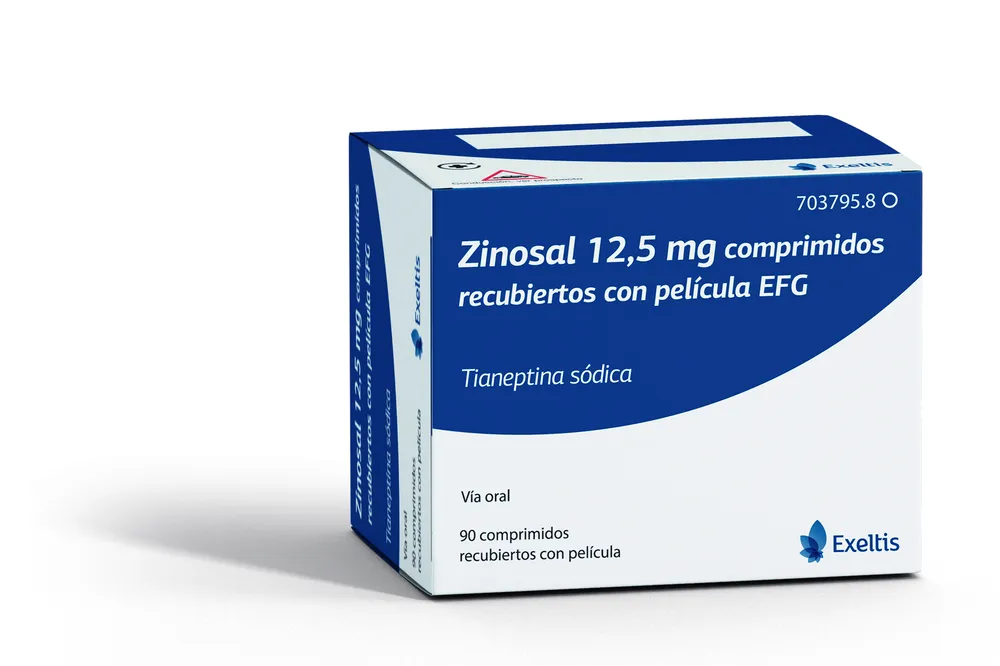
Table of Contents
Package leaflet: Information for the user
Introduction
Package leaflet: information for the user
ZINOSAL 12.5 mg film-coated tablets E.F.G.
Sodium tianeptine
Read the entire leaflet carefully before you start taking this medicine, because it contains important information for you.
- Keep this leaflet, as you may need to read it again.
- If you have any questions, ask your doctor or pharmacist.
- This medicine has been prescribed for you only, and you must not give it to other people, even if they have the same symptoms as you, because it may harm them.
- If you experience any adverse effects, consult your doctor or pharmacist, even if they are adverse effects not listed in this leaflet. See section 4.
Leaflet contents
- What Zinosal is and what it is used for
- What you need to know before taking Zinosal
- How to take Zinosal
- Possible side effects
- How to store Zinosal
- Contents of the pack and other information
1. What Zinosal is and what it is used for
Zinosal contains the active substance sodium tianeptine.
Zinosal belongs to a group of medicines known as antidepressants.
Zinosal is indicated for the treatment of major depression in adults.
2. What you need to know before taking Zinosal
Do not take Zinosal
- If you are allergic to sodium tianeptine or to any of the other ingredients of this medicine (listed in section 6).
- If you are taking other medicines for depression, such as monoamine oxidase inhibitors (MAOIs). A two-week interval is required between MAOI treatment and treatment with tianeptine. Only a 24-hour interval is required when tianeptine is being replaced with an MAOI.
Warnings and precautions
Talk to your doctor or pharmacist before starting to take Zinosal.
Precautions
Do not stop treatment abruptly; the dose should be gradually reduced over a minimum period of 7 to 14 days. You should know that, after stopping treatment with tianeptine, some side effects may occur, such as anxiety, muscle pain, abdominal pain, insomnia, and joint pain.
Children and adolescents (under 18 years)
Zinosal should not be used in the treatment of children and adolescents under 18 years of age.
Suicidal thoughts and worsening of depression
If you are depressed, you may sometimes have thoughts of harming yourself or ending your life. These thoughts may be more common when starting antidepressant treatment, as these medicines take time to start working—usually about two weeks, but sometimes longer.
You may be more likely to have such thoughts:
- If you have previously had thoughts of harming yourself or of suicide.
- If you are a young adult. Clinical trial data have shown an increased risk of suicidal behaviour in adults under 25 years of age with psychiatric disorders who were being treated with an antidepressant.
If at any time you have thoughts of harming yourself or of suicide, contact your doctor or go to hospital immediately. It may be helpful to inform a close family member or friend about your depression and ask them to read this leaflet. You may ask them to tell you if they think your depression is getting worse or if they are concerned about changes they observe in your behaviour.
If you enter a manic phase (hyperactive behaviour or thoughts), you should consult your doctor.
If you are undergoing surgery requiring general anaesthesia, treatment with Zinosal should be discontinued 24 to 48 hours before the use of anaesthesia. However, if an emergency procedure is required, it may be performed without prior discontinuation of treatment, provided appropriate surgical supervision is ensured.
If you have impaired renal function, your doctor may consider a dose adjustment necessary.
Taking Zinosal with other medicines
Inform your doctor or pharmacist if you are taking, have recently taken, or might need to take any other medicines, including those obtained without a prescription.
Tell your doctor if you are taking any of the following medicines:
- Monoamine oxidase inhibitors (MAOIs), used, for example, to treat depression (such as moclobemide, tranylcypromine, etc.) or Parkinson's disease (such as selegiline, etc.).
- Mianserin (an antidepressant).
- Other central nervous system depressants such as:
- Opioid analgesics (such as codeine, buprenorphine, fentanyl, etc.).
- Antihistamines (used to treat allergic reactions).
- Benzodiazepines (used to treat anxiety, insomnia, agitation, seizures, muscle spasms, alcohol withdrawal).
Taking Zinosal with food, drinks, and alcohol
Zinosal should be taken before meals.
Consumption of alcohol during treatment with Zinosal is not recommended.
Pregnancy and breastfeeding
If you are pregnant or breastfeeding, think you may be pregnant, or are planning to become pregnant, consult your doctor or pharmacist before using this medicine.
Unless otherwise directed by your doctor, Zinosal should not be used during pregnancy or breastfeeding.
Driving and using machines
During treatment with Zinosal, you may feel drowsy or dizzy. Do not drive or operate tools or machinery until you know how this medicine affects you.
3. How to take Zinosal
Follow exactly the instructions for use of this medicine as given by your doctor or pharmacist. If in doubt, consult your doctor or pharmacist again.
Adults
The usual dose is 3 film-coated tablets per day (12.5 mg of sodium tianeptine), one in the morning, one at midday, and one at night.
The tablets should be taken before meals.
The tablets must be swallowed whole with some water.
Use in patients over 70 years of age
The dose in patients over 70 years of age should be reduced to 2 tablets per day.
Use in children and adolescents (under 18 years of age)
Zinosal should not normally be given to children and adolescents.
Patients with renal or hepatic impairment
The dose in patients with renal impairment should be reduced to 2 tablets per day.
Dose adjustment is not required in patients with alcohol dependence with or without cirrhosis.
Duration of treatment:
- It may take several weeks before you start to feel better. Therefore, you should continue taking Zinosal even if it takes some time for you to notice an improvement in your condition.
- Do not change the dose of your medicine without first talking to your doctor.
- Continue taking the tablets for as long as your doctor recommends. If you stop treatment too early, your symptoms may return. Treatment should be maintained for at least 6 months after you feel well again.
IN ANY CASE, FOLLOW YOUR DOCTOR'S INSTRUCTIONS EXACTLY.
If you take more Zinosal than you should
In case of overdose or accidental ingestion, contact your doctor or go to the nearest hospital emergency department. Always carry the Zinosal packaging with you. You may also call the Toxicology Information Service at telephone number 91 562 04 20, stating the name of the medicine and the amount ingested. Symptoms of overdose may include: nausea, vomiting, dizziness, and drowsiness.
If you forget to take Zinosal
Do not take a double dose to make up for forgotten doses.
If you forget to take your tablet, take it as soon as you remember. If it is almost time for your next dose, take the next dose at the usual time.
If you stop taking Zinosal
Treatment with Zinosal must not be stopped abruptly; the dose should be gradually reduced over a period of 7–14 days.
Do not stop taking your film-coated tablets, even if you feel well, unless your doctor tells you to do so.
If you have any further questions about the use of this medicine, ask your doctor or pharmacist.
4. Possible adverse effects
Like all medicines, Zinosal can cause adverse effects, although not everyone experiences them.
The following adverse effects have been reported with the use of Zinosal:
Frequent adverse effects (may affect up to 1 in 10 people) include:
- Anorexia (eating disorder)
- Nightmares
- Insomnia
- Drowsiness
- Dizziness
- Headache
- Collapse
- Tremor
- Vision disturbances
- Hot flushes
- Rapid or irregular heartbeat, chest pain
- Difficulty breathing
- Dry mouth, constipation, abdominal pain, nausea, vomiting, flatulence, diarrhoea, heartburn
- Back pain, muscle pain
- Weakness
- Sensation of lump in the throat
Uncommon adverse effects (may affect up to 1 in 100 people) include:
- Itching, urticaria (rash)
Rare adverse effects (may affect up to 1 in 1,000 people) include:
- Substance abuse and dependence, particularly in patients under 50 years of age with a history of drug or alcohol abuse
Adverse effects with unknown frequency:
- Suicide and suicidal behaviour. See section Warnings and precautions.
If you experience any adverse effects, consult your doctor or pharmacist, even if they are adverse effects not listed in this leaflet.
Reporting of adverse effects:
If you experience any type of adverse effect, consult your doctor or pharmacist, even if it is a possible adverse effect not listed in this leaflet. You may also report them directly via the Spanish Pharmacovigilance System for Human Medicinal Products: https://www.notificaRAM.es. By reporting adverse effects, you can help provide more information on the safety of this medicine.
5. Storage of Zinosal
Keep this medicine out of the sight and reach of children.
Do not use this medicine after the expiry date which appears on the blister and the cardboard box after EXP.
The expiry date is the last day of the month indicated.
PVC/PVdC/Aluminum blister:
Do not store above 25°C.
Aluminum/Aluminum blister:
No special storage conditions required.
Medicines must not be disposed of via wastewater or household waste. Dispose of unused medicines and their containers at the SIGRE collection point at your pharmacy. If you are unsure, ask your pharmacist how to dispose of medicines and containers you no longer need. This will help protect the environment.
6. Contents of the pack and other information
Composition of Zinosal:
The active substance is sodium tianeptine. Each film-coated tablet contains 12.5 mg of tianeptine in the form of the sodium salt.
Other components are:
Tablet core:
Mannitol (E421)
Corn starch
Hydroxypropylcellulose (E463)
Magnesium stearate
Film coating:
Methylhydroxypropylcellulose (E464)
Microcrystalline cellulose (E460)
Stearic acid (E570)
Methacrylic acid copolymer
Talc (E553b)
Titanium dioxide (E171)
Triethyl citrate (E1505)
Anhydrous colloidal silica
Sodium bicarbonate (E500ii)
Yellow iron oxide (E172)
Sodium lauryl sulfate
Appearance of the product and contents of the pack
Zinosal is presented as film-coated tablets, light yellow in colour, biconvex, with a diameter of 7 mm.
Zinosal is available in PVC/PVdC/aluminum blisters and in aluminum/aluminum blisters.
Pack sizes:
30 film-coated tablets
90 film-coated tablets
Only some pack sizes may be commercially available.
Marketing Authorization Holder and Manufacturer
Marketing Authorization Holder:
Exeltis Healthcare S.L.
Avda. de Miralcampo 7
Polígono Industrial Miralcampo
19200 Azuqueca de Henares (Guadalajara)
Spain
Manufacturer:
Laboratorios Liconsa S.A.
Avda. Miralcampo 7
Polígono Industrial Miralcampo
Azuqueca de Henares
19200 Guadalajara
Spain
Date of the most recent review of this leaflet: July 2019
“Detailed and up-to-date information on this medicinal product is available on the website of the Spanish Agency for Medicines and Health Products (AEMPS) http://www.aemps.gob.es/”