Zejula 100 mg film-coated tablets
Spain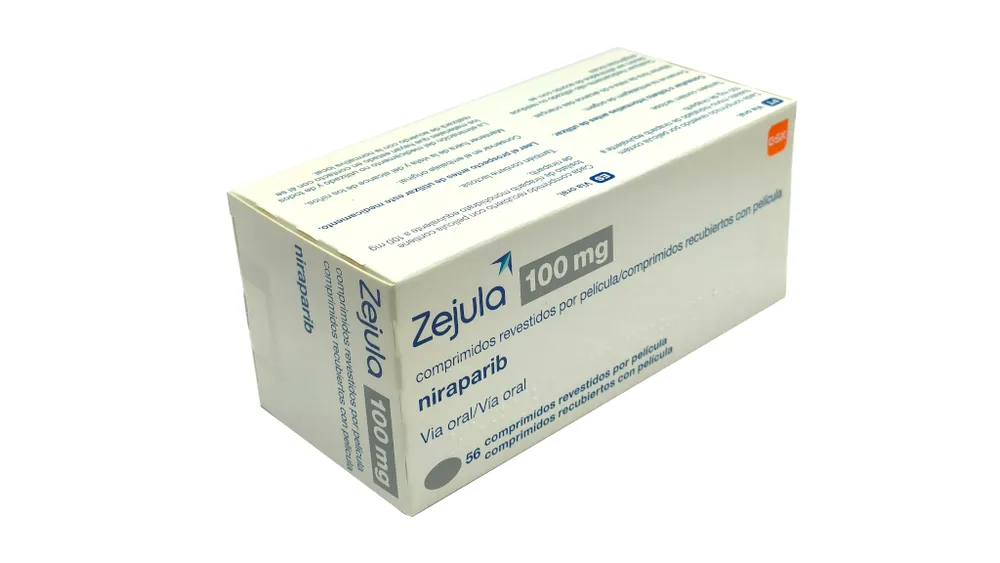
Table of Contents
Package leaflet: Information for the user
Introduction
Package leaflet: information for the patient
Zejula 100 mg film-coated tablets
niraparib
Read the entire leaflet carefully before you start taking this medicine because it contains important information for you.
- Keep this leaflet. You may need to read it again.
- If you have any questions, ask your doctor, pharmacist, or nurse.
- This medicine has been prescribed for you only. Do not pass it on to other people, even if they have the same symptoms as you, because it may harm them.
- If you experience any side effects, talk to your doctor, pharmacist, or nurse, even if they are side effects not listed in this leaflet. See section 4.
Contents of the leaflet
- What Zejula is and what it is used for
- What you need to know before taking Zejula
- How to take Zejula
- Possible side effects
- How to store Zejula
- Contents of the pack and other information
1. What Zejula is and what it is used for
What Zejula is and how it works
Zejula contains the active substance called niraparib. Niraparib is a type of antineoplastic medicine known as a PARP inhibitor. PARP inhibitors block an enzyme called poly [adenosine diphosphate ribose] polymerase (PARP). PARP helps cells repair damaged DNA, so by blocking it, the DNA of cancer cells cannot be repaired. This leads to the death of tumor cells, helping to control cancer.
What Zejula is used for
Zejula is used in adult women for the treatment of cancer of the ovary, fallopian tubes (a part of the female reproductive system that connects the ovaries to the uterus), or peritoneum (the membrane lining the abdomen).
Zejula is used for cancers that have:
- responded to previous platinum-based chemotherapy treatment, or
- recurred (relapsed) after the cancer responded to prior standard platinum-based chemotherapy treatment.
2. What you need to know before taking Zejula
Do not take Zejula
- if you are allergic to niraparib or to any of the other ingredients of this medicine (listed in section 6).
- if you are breastfeeding.
Warnings and precautions
Talk to your doctor, pharmacist, or nurse before starting this medicine or while taking this medicine, if any of the following apply to you:
Low blood cell count
Zejula reduces the number of blood cells, for example, the number of red blood cells (anemia), the number of white blood cells (neutropenia), or the number of platelets (thrombocytopenia). Signs and symptoms to monitor include fever or infection, and unusual bruising or bleeding (see section 4 for more information). Your doctor will perform regular blood tests during your treatment.
Myelodysplastic syndrome/acute myeloid leukemia
Rarely, low blood cell counts may be a sign of more serious bone marrow problems, such as "myelodysplastic syndrome" (MDS) or "acute myeloid leukemia" (AML). Your doctor may wish to examine your bone marrow to check for these conditions.
High blood pressure
Zejula may cause an increase in blood pressure, which in some cases may be severe. Your doctor will measure your blood pressure regularly during treatment. Your doctor may also prescribe medication to treat high blood pressure and, if necessary, adjust your Zejula dose. Your doctor may recommend monitoring your blood pressure at home and instruct you to contact them if your blood pressure increases.
Reversible posterior encephalopathy syndrome (PRES)
A rare neurological side effect called PRES has been associated with treatment with Zejula. If you experience headache, changes in vision, confusion, or seizures with or without high blood pressure, contact your doctor immediately.
Children and adolescents
Zejula should not be given to children under 18 years of age. This medicine has not been studied in this age group.
Other medicines and Zejula
Inform your doctor or pharmacist if you are taking, have recently taken, or might need to take any other medicines.
Zejula may affect how other medicines work. It is especially important to mention any medicine containing the active substance metformin (used to lower blood sugar), as your doctor may need to adjust the dose of metformin.
Pregnancy
Zejula must not be taken during pregnancy, as it could harm the unborn baby. If you are pregnant, think you might be pregnant, or plan to become pregnant, talk to your doctor before taking this medicine.
If you are a woman of childbearing potential, you must use a highly effective method of contraception while taking Zejula and continue using a highly effective method of contraception for 6 months after taking the last dose. Your doctor will ask you to confirm that you are not pregnant with a pregnancy test before starting treatment. Contact your doctor immediately if you become pregnant while taking Zejula.
Breastfeeding
Do not take Zejula if you are breastfeeding, as it is not known whether it passes into breast milk. If you are breastfeeding, you must stop before starting Zejula and must not resume breastfeeding until 1 month after taking the last dose. Consult your doctor before taking this medicine.
Driving and using machines
While taking Zejula, you may feel weak, unfocused, tired, or dizzy, which may affect your ability to drive or operate machinery. Exercise caution when driving or using machines.
Zejula contains lactose
If your doctor has informed you that you have an intolerance to certain sugars, consult with them before taking this medicine.
3. How to take Zejula
Follow exactly the administration instructions for this medicine given by your doctor or pharmacist. If in doubt, consult your doctor or pharmacist again.
For ovarian cancer that has responded to first-line platinum-based chemotherapy
The recommended starting dose is 200 mg (two 100 mg tablets), taken together once daily, on an empty stomach (at least 1 hour before or 2 hours after a meal) or with a light meal. If you weigh ≥ 77 kg and have a platelet count ≥ 150,000/μl before starting treatment, the recommended starting dose is 300 mg (three 100 mg tablets), taken together once daily, on an empty stomach (at least 1 hour before or 2 hours after a meal) or with a light meal.
For recurrent (relapsed) ovarian cancer
The recommended starting dose is 300 mg (three 100 mg tablets) taken together once daily, on an empty stomach (at least 1 hour before or 2 hours after a meal) or with a light meal.
Take Zejula at approximately the same time every day. If you take Zejula at bedtime, it may help manage nausea.
Your doctor may adjust your starting dose if you have liver problems.
Your doctor may recommend a lower dose if you experience adverse effects (such as nausea, fatigue, abnormal bleeding or bruising, or anemia).
Your doctor will monitor you regularly, and you will continue taking Zejula as long as you are benefiting from it and do not experience unacceptable adverse effects.
If you take more Zejula than you should
If you take a higher dose than normal, contact your doctor immediately.
If you forget to take Zejula
Do not take another dose if you miss a dose or if you vomit after taking Zejula. Take your next dose at the scheduled time. Do not take a double dose to make up for missed doses.
If you have any further questions about the use of this medicine, ask your doctor, pharmacist, or nurse.
4. Possible adverse effects
Like all medicines, this medicine can cause adverse effects, although not everyone will experience them.
Contact your doctor immediately if you notice any of the following SERIOUS adverse effects – you may need urgent medical treatment:
Very common (may affect more than 1 in 10 people)
- Bruising or bleeding for longer than usual when injured: these may be signs of a low platelet count (thrombocytopenia).
- Difficulty breathing, feeling very tired, pale skin, or increased heart rate may be signs of a low red blood cell count (anemia).
- Fever or infection: low white blood cell count (neutropenia) may increase the risk of infection. Signs may include fever, chills, feeling weak or confused, cough, or pain or burning when urinating. Some infections may be severe and may lead to death.
- Decreased number of white blood cells in the blood (leukopenia).
Common (may affect up to 1 in 10 people)
- Allergic reaction (including a severe allergic reaction that may be life-threatening). Signs include raised, itchy rash (urticarial rash) and swelling, sometimes of the face or mouth (angioedema), causing difficulty breathing, collapse, or loss of consciousness.
- Low blood cell counts due to a problem in the bone marrow or blood cancer originating in the bone marrow, such as "myelodysplastic syndrome" (MDS) or "acute myeloid leukemia" (AML).
Uncommon (may affect up to 1 in 100 people)
- Fever with low white blood cell count (febrile neutropenia).
- Decreased number of red blood cells, white blood cells, and platelets (pancytopenia).
Rare (may affect up to 1 in 1,000 people)
- Sudden increase in blood pressure, which may be a medical emergency that could cause organ damage or be life-threatening.
- A brain condition with symptoms including seizures (fits), headache, confusion, and changes in vision (Posterior Reversible Encephalopathy Syndrome or PRES), which is a medical emergency that could cause organ damage or be life-threatening.
Talk to your doctor if you experience any other adverse effects. These may include:
Very common (may affect more than 1 in 10 people)
- Feeling unwell (nausea)
- Decreased number of white blood cells in the blood
- Decreased number of platelets in the blood
- Decreased number of red blood cells in the blood (anemia)
- Feeling tired
- Feeling weak
- Constipation
- Vomiting
- Stomach pain
- Difficulty sleeping
- Headache
- Loss of appetite
- Runny or stuffy nose
- Diarrhea
- Shortness of breath
- Back pain
- Joint pain
- High blood pressure
- Indigestion (dyspepsia)
- Dizziness
- Cough
- Urinary tract infection
- Palpitations (awareness of rapid, strong, or irregular heartbeat).
Common (may affect up to 1 in 10 people)
- Sunburn-like reaction after exposure to light
- Swelling of the feet, ankles, legs, and/or hands
- Low levels of potassium in the blood
- Inflammation or swelling of the airways between the mouth and nose and the lungs, bronchitis
- Feeling of abdominal bloating
- Feeling anxious, nervous, or restless
- Feeling sad, depression
- Nosebleeds
- Weight loss
- Muscle pain
- Impairment of concentration, understanding, memory, and thinking (cognitive impairment)
- Redness in the eyes (conjunctivitis)
- Rapid heartbeats that may cause dizziness, chest pain, or difficulty breathing
- Dry mouth
- Inflammation of the mouth and/or digestive tract
- Rash
- Increased blood test values
- Abnormal blood test
- Abnormal taste in the mouth.
Uncommon (may affect up to 1 in 100 people)
- Confusion
- Inflammation of the lungs that may cause shortness of breath and difficulty breathing (non-infectious pneumonitis).
Reporting of adverse effects
If you experience any adverse effects, talk to your doctor, pharmacist, or nurse, even if they are not listed in this leaflet. You can also report them directly through the national reporting system included in Appendix V. By reporting adverse effects, you can help provide more information on the safety of this medicine.
5. Storage of Zejula
Keep this medicine out of the sight and reach of children.
Do not use this medicine after the expiry date which is stated on the carton after CAD and on the blister after EXP. The expiry date refers to the last day of the month indicated.
This medicine does not require any special storage temperature.
Store in the original packaging to protect the tablets from moisture absorption under conditions of high humidity.
Medicines must not be disposed of via wastewater or household waste. Ask your pharmacist how to dispose of medicines and packaging that you no longer need. This will help protect the environment.
6. Contents of the pack and other information
Composition of Zejula
-
The active substance is niraparib. Each film-coated tablet contains monohydrate niraparib tosylate equivalent to 100 mg of niraparib.
-
The other components (excipients) are:
Tablet core: crospovidone, monohydrate lactose, magnesium stearate, microcrystalline cellulose (E 460), povidone (E 1201), colloidal hydrated silica.
Film coating: polyvinyl alcohol (E 1203), titanium dioxide (E 171), macrogol (E 1521), talc (E 553b), black iron oxide (E 172).
This medicinal product contains lactose. For more information, see section 2.
Appearance of Zejula and contents of the pack
Zejula 100 mg film-coated tablets are grey, oval-shaped film-coated tablets marked with "100" on one side and "Zejula" on the other.
The film-coated tablets are packed in blisters or child-resistant blisters, in cartons containing:
- 84 film-coated tablets
- 56 film-coated tablets
Only certain pack sizes may be marketed.
Marketing Authorization Holder
GlaxoSmithKline Trading Services Limited
12 Riverwalk
Citywest Business Campus
Dublin 24
Ireland
D24 YK11
Manufacturer
GlaxoSmithKline Trading Services Ltd.
12 Riverwalk
Citywest Business Campus
Dublin 24
Ireland
Millmount Healthcare Ltd.
Block 7, City North Business Campus
Stamullen, Co Meath
Ireland
Glaxo Wellcome, S.A.
Avda. Extremadura, 3
09400 Aranda de Duero
Burgos
Spain
Further information on this medicinal product is available upon request by contacting the local representative of the Marketing Authorization Holder:
Belgium/Belgium/Belgium GlaxoSmithKline Pharmaceuticals s.a./n.v. Tel/Tel: + 32 (0) 10 85 52 00 | Lithuania GlaxoSmithKline Trading Services Limited Tel: + 370 80000334 |
| Luxembourg/Luxembourg GlaxoSmithKline Pharmaceuticals s.a./n.v. Belgium/Belgium Tel/Tel: + 32 (0) 10 85 52 00 |
Czech Republic GlaxoSmithKline, s.r.o. Tel: + 420 222 001 111 | Hungary GlaxoSmithKline Trading Services Limited Tel.: + 36 80088309 |
Denmark GlaxoSmithKline Pharma A/S Tlf.: + 45 36 35 91 00 | Malta GlaxoSmithKline Trading Services Limited Tel: + 356 80065004 |
Germany GlaxoSmithKline GmbH & Co. KG Tel.: + 49 (0)89 36044 8701 | Netherlands GlaxoSmithKline BV Tel: + 31 (0)33 2081100 |
Estonia GlaxoSmithKline Trading Services Limited Tel: + 372 8002640 | Norway GlaxoSmithKline AS Tlf: + 47 22 70 20 00 |
Greece GlaxoSmithKline S.A. Tel: + 30 210 68 82 100 | Austria GlaxoSmithKline Pharma GmbH Tel: + 43 (0)1 97075 0 |
Spain GlaxoSmithKline, S.A. Tel: + 34 900 202 700 | Poland GSK Services Sp. z o.o. Tel.: + 48 (0)22 576 9000 |
France Laboratoire GlaxoSmithKline Tél: + 33 (0)1 39 17 84 44 | Portugal GlaxoSmithKline – Produtos Farmacêuticos, Lda. Tel: + 351 21 412 95 00 |
Croatia GlaxoSmithKline Trading Services Limited Tel: +385 800787089 | Romania GlaxoSmithKline Trading Services Limited Tel: + 40 800672524 |
Ireland GlaxoSmithKline (Ireland) Limited Tel: + 353 (0)1 4955000 | Slovenia GlaxoSmithKline Trading Services Limited Tel: + 386 80688869 |
Iceland Vistor ehf. Tel: + 354 535 7000 | Slovakia GlaxoSmithKline Trading Services Limited Tel: + 421 800500589 |
Italy GlaxoSmithKline S.p.A. Tel: + 39 (0)45 7741111 | Finland GlaxoSmithKline Oy Tel: + 358 (0)10 30 30 30 |
Cyprus GlaxoSmithKline Trading Services Limited Tel: + 357 80070017 | Sweden GlaxoSmithKline AB Tel: + 46 (0)8 638 93 00 |
Latvia GlaxoSmithKline Trading Services Limited Tel: + 371 80205045 |
Date of the most recent review of this leaflet:
Other sources of information
Detailed information on this medicine is available on the website of the European Medicines Agency: https://www.ema.europa.eu.