Zavicefta 2 g/0.5 g powder for concentrate for solution for infusion
Spain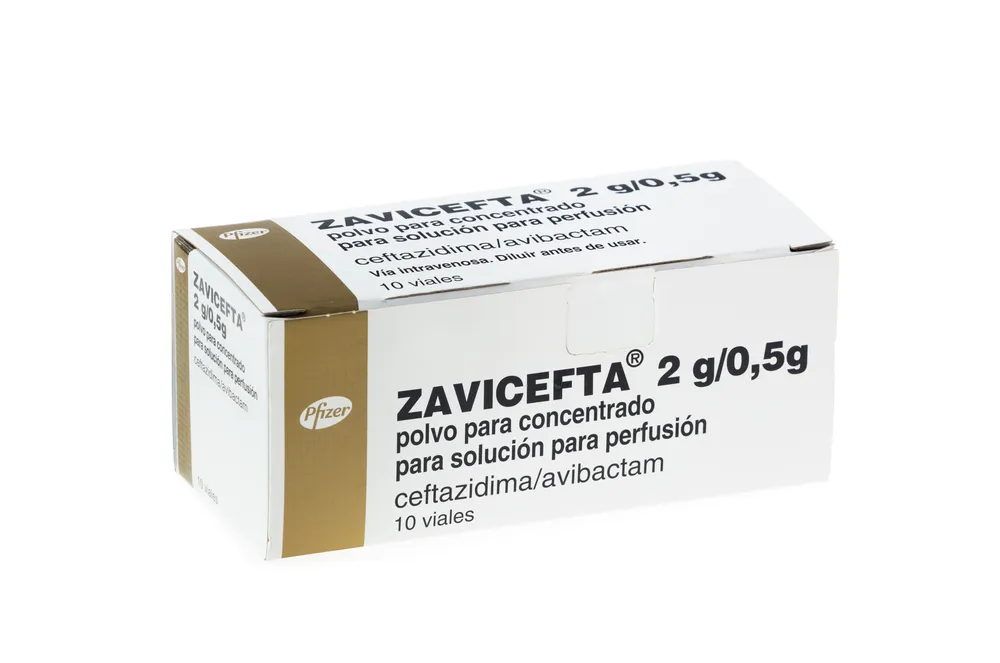
Table of Contents
Package leaflet: Information for the user
Introduction
Package leaflet: information for the user
Zavicefta 2 g/0.5 g powder for concentrate for solution for infusion
ceftazidime/avibactam
Read the entire leaflet carefully before you start using this medicine, because it contains important information for you.
- Keep this leaflet, as you may need to read it again.
- If you have any questions, consult your doctor or nurse.
- If you experience any adverse reactions, consult your doctor or nurse, even if they are adverse reactions not listed in this leaflet. See section 4.
Leaflet contents
-
What Zavicefta is and what it is used for
-
What you need to know before using Zavicefta
-
How to use Zavicefta
-
Possible side effects
- How to store Zavicefta
-
Contents of the pack and other information
1. What Zavicefta is and what it is used for
What Zavicefta is
Zavicefta is an antibiotic that contains the active substances ceftazidime and avibactam.
- Ceftazidime belongs to a group of antibiotics known as "cephalosporins". It is capable of destroying many types of bacteria.
- Avibactam is a "beta-lactamase inhibitor" that helps ceftazidime destroy certain bacteria that it cannot eliminate on its own.
What Zavicefta is used for
Zavicefta is indicated in adults and pediatric patients from birth for the treatment of:
- infections of the stomach and intestines (abdominal infections)
- infections of the bladder or kidneys known as "urinary tract infections"
- a lung infection known as "pneumonia"
- infections caused by bacteria that cannot be destroyed by other antibiotics
Zavicefta is indicated in adults for the treatment of bloodstream infections associated with abdominal, urinary tract, or lung infections.
How Zavicefta works
Zavicefta works by eliminating certain types of bacteria that can cause serious infections.
2. What you need to know before using Zavicefta
Do not use Zavicefta if
- you are allergic to ceftazidime, avibactam, or any of the other ingredients of this medicine (listed in section 6)
- you are allergic to other cephalosporins
- you have ever had a severe allergic reaction to other antibiotics belonging to the penicillin or carbapenem groups
Do not use Zavicefta if any of the above apply to you. If you are unsure, consult your doctor or nurse before using Zavicefta.
Warnings and precautions
Talk to your doctor or nurse before starting Zavicefta if:
- you have ever had an allergic reaction (even if only a skin rash) to antibiotics belonging to the penicillin or carbapenem groups
- you have kidney problems – your doctor may need to give you a lower dose to ensure you are not receiving too much medicine. This could cause symptoms such as seizures (see section If you use more Zavicefta than you should)
If any of the above apply to you (or you are unsure), consult your doctor or nurse before using Zavicefta.
Talk to your doctor or nurse if you develop diarrhoea during your treatment.
Other infections
There is a small possibility that you may develop a different infection caused by another bacterium during or after treatment with Zavicefta. This includes candidiasis (fungal infections of the mouth or genital area).
Laboratory tests
If you are due to have any laboratory tests, inform your doctor that you are being treated with Zavicefta. This is because you may develop an abnormal response in a laboratory test called the “Coombs test” or “DAT” (Direct Antiglobulin Test). This test detects antibodies that may act against red blood cells.
Zavicefta may also affect the results of certain urine sugar tests. Inform the person taking the sample that you have been administered Zavicefta.
Other medicines and Zavicefta
Inform your doctor or nurse if you are taking, have recently taken, or might need to take any other medicines.
Tell your doctor before using Zavicefta if you are taking any of the following medicines:
- an antibiotic called chloramphenicol
- a type of antibiotic called an aminoglycoside, such as gentamicin, tobramycin
- a diuretic called furosemide
- a medicine for gout called probenecid
Consult your doctor before using Zavicefta if any of the above apply to you.
Pregnancy and breastfeeding
If you are pregnant or breastfeeding, think you may be pregnant, or are planning to become pregnant, consult your doctor before using this medicine.
Driving and using machines
Zavicefta may make you feel dizzy. This may affect your ability to drive or operate machinery.
Zavicefta contains sodium
This medicine contains approximately 146 mg of sodium (the main component of table/cooking salt) per vial. This corresponds to 7.3% of the maximum daily intake of sodium recommended for an adult.
Consult your doctor or pharmacist if you require 3 or more vials per day for a prolonged period, especially if you have been advised to follow a low-salt (low-sodium) diet.
3. How to use Zavicefta
Zavicefta will be administered to you by a doctor or nurse.
How much to use
The recommended dose for adults is one vial (2 g of ceftazidime and 0.5 g of avibactam) every 8 hours. The doctor will calculate the dose for pediatric patients from birth based on the child's weight and age.
It is given by intravenous infusion—this usually takes about 2 hours.
The duration of treatment is generally 5 to 14 days, depending on the type of infection you have and how you respond to treatment.
Patients with kidney problems
If you have kidney problems, your doctor may reduce your dose. This is because Zavicefta is eliminated from your body through the kidneys.
If you use more Zavicefta than you should
Zavicefta will be administered by a doctor or nurse, so it is unlikely that you will be given an incorrect dose. However, if you experience any adverse effects or think you may have been given too much Zavicefta, inform your doctor or nurse immediately. If you receive too much Zavicefta, it may affect the brain and cause seizures or coma.
If you forget to use Zavicefta
If you think you have missed a dose, inform your doctor or nurse immediately.
If you have any further questions about the use of this medicine, ask your doctor or nurse.
4. Possible adverse effects
Like all medicines, this medicine can cause adverse effects, although not everyone gets them. The following adverse effects may occur with this medicine:
Serious adverse effects
Tell your doctor immediately if you experience any of the following serious adverse effects – you may need urgent medical treatment:
- severe allergic reactions – signs you may have include sudden swelling of the lips, face, throat or tongue, a severe rash or other serious skin reactions, difficulty swallowing or breathing, or sudden chest pain (which may be a sign of Kounis syndrome). These reactions may be potentially fatal.
- diarrhoea that worsens or does not stop, or stools containing blood or mucus – this may occur during or after stopping treatment with Zavicefta. In this situation, you should not take medicines that stop or slow down intestinal movement.
Tell your doctor immediately if you experience any of the serious adverse effects listed above.
Other adverse effects
Tell your doctor or nurse if you experience any of the following adverse effects:
Very common: (may affect more than 1 in 10 people)
- abnormal result in a laboratory test called “DAT” or “Coombs test”. This test detects antibodies that may act against your red blood cells. This may cause anaemia (which may make you feel tired) and jaundice (yellowing of the skin and eyes)
Common: (may affect up to 1 in 10 people)
- fungal infections, including infections in the mouth and vagina
- change in the number of certain types of blood cells (called "eosinophils" and "platelets") – seen in blood tests
- headache
- feeling dizzy
- feeling sick (nausea) or being sick (vomiting)
- stomach pain
- diarrhoea
- increase in the amount of certain enzymes produced by the liver – seen in blood tests
- itchy raised rash ("wheals")
- itching
- redness, pain or swelling at the injection site of Zavicefta
- fever
Uncommon: (may affect up to 1 in 100 people)
- increase in the number of a type of blood cell (called "lymphocytes") seen in blood tests
- decrease in the number of certain types of blood cells (called "leukocytes") – seen in blood tests
- tingling or numbness
- bad taste in the mouth
- increase in the level of certain substances in the blood (called "creatinine" and "urea"). These substances indicate how well your kidneys are functioning.
Rare: (may affect up to 1 in 10,000 people)
- swelling of part of the kidney causing reduced normal function
Frequency not known: (frequency cannot be estimated from the available data)
- marked decrease in the type of white blood cells in the blood that fight infection, seen in blood tests
- decrease in the number of red blood cells (haemolytic anaemia), seen in blood tests
- severe allergic reaction (see serious adverse effects, above)
- yellowing of the whites of the eyes or skin (jaundice)
- sudden onset of a severe rash or blistering or peeling of the skin, possibly accompanied by high fever or joint pain (these may be signs of more serious medical conditions such as toxic epidermal necrolysis, Stevens-Johnson syndrome, erythema multiforme, or a condition known as DRESS, Drug Reaction with Eosinophilia and Systemic Symptoms)
- swelling under the skin, especially in the lips and around the eyes
Tell your doctor or nurse if you experience any of the adverse effects listed above.
Reporting of adverse effects
If you experience any kind of adverse effect, talk to your doctor or nurse, even if it is a possible adverse effect not listed in this leaflet. You can also report them directly via the Spanish Pharmacovigilance System for Human Medicinal Products: www.notificaRAM.es. By reporting adverse effects, you can help provide more information on the safety of this medicine.
5. Zavicefta Storage
Keep this medicine out of the sight and reach of children.
Do not use this medicine after the expiry date stated on the packaging after EXP. The expiry date is the last day of the month indicated.
Store in the original packaging to protect from light.
Medicines should not be disposed of via wastewater or household waste. Ask your pharmacist how to properly dispose of unused medicines and their packaging. This will help protect the environment.
6. Contents of the pack and other information
Composition of Zavicefta
- The active substances are ceftazidime and avibactam. Each vial contains ceftazidime pentahydrate equivalent to 2 g of ceftazidime and sodium avibactam equivalent to 0.5 g of avibactam.
- Other ingredients: sodium carbonate (anhydrous) (see section “Zavicefta contains sodium”).
Appearance of the product and contents of the pack
Zavicefta is a white to yellow powder for concentrate for solution for infusion contained in a vial. It is available in cartons containing 10 vials.
Marketing Authorization Holder
Pfizer Ireland Pharmaceuticals Unlimited Company
Operations Support Group
Ringaskiddy, County Cork
Ireland
Manufacturer
ACS Dobfar, S.p.A.
Via Alessandro Fleming 2
Verona 37135
Italy
More information about this medicinal product is available upon request to the local representative of the Marketing Authorization Holder:
Belgium/Belgium/Belgium Luxembourg/Luxembourg Pfizer NV/SA Tel/Tel: +32 (0)2 554 62 11 | Lithuania Pfizer Luxembourg SARL branch in Lithuania Tel: +370 5 251 4000 |
Bulgaria Pfizer Bulgaria EOOD, Sofia Tel: +359 2 970 4333 | Hungary Pfizer Kft. Tel.: +36 1 488 37 00 |
Czech Republic Pfizer, spol. s r.o. Tel: +420 283 004 111 | Malta Vivian Corporation Ltd. Tel: +356 21344610 |
Denmark Pfizer ApS Tlf.: +45 44 20 11 00 | Netherlands Pfizer bv Tel: +31 (0)800 63 34 636 |
Germany PFIZER PHARMA GmbH Tel: +49 (0)30 550055-51000 | Norway Pfizer AS Tlf: +47 67 52 61 00 |
Estonia Pfizer Luxembourg SARL Estonia branch Tel: +372 666 7500 | Austria Pfizer Corporation Austria Ges.m.b.H. Tel: +43 (0)1 521 15-0 |
Greece Pfizer Hellas S.A. Tel: +30 210 6785800 | Poland Pfizer Polska Sp. z o.o. Tel.: +48 22 335 61 00 |
Spain Pfizer, S.L. Tel: +34 91 490 99 00 | Portugal Laboratórios Pfizer, Lda. Tel: +351 21 423 5500 |
France Pfizer Tél: +33 (0)1 58 07 34 40 | Romania Pfizer Romania S.R.L. Tel: +40 (0) 21 207 28 00 |
Croatia Pfizer Croatia d.o.o. Tel: +385 1 3908 777 | Slovenia Pfizer Luxembourg SARL Pfizer, branch for consulting in pharmaceutical activities, Ljubljana Tel: +386 (0)1 52 11 400 |
Ireland Pfizer Healthcare Ireland Unlimited Company Tel: +1800 633 363 (toll free) Tel: +44 (0)1304 616161 | Slovakia Pfizer Luxembourg SARL, organizational unit Tel: +421 2 3355 5500 |
Iceland Icepharma hf. Sími: +354 540 8000 | Finland Pfizer Oy Puh/Tel: +358 (0)9 430 040 |
Italy Pfizer S.r.l. Tel: +39 06 33 18 21 | Sweden Pfizer AB Tel: +46 (0)8 550 520 00 |
Cyprus Pfizer Hellas S.A. (Cyprus Branch) Tel: +357 22817690 | |
Latvia Pfizer Luxembourg SARL branch in Latvia Tel: +371 670 35 775 |
Date of latest review of this leaflet: 02/2025
Other sources of information
Detailed information on this medicinal product is available on the European Medicines Agency website: https://www.ema.europa.eu
This information is intended for healthcare professionals only:
Important: Please consult the Summary of Product Characteristics before prescribing.
The compatibility of Zavicefta with other medicinal products has not been established. Zavicefta must not be mixed or added to solutions containing other medicinal products.
The powder must be reconstituted with water for injections, and the resulting concentrate must then be diluted immediately prior to use. The reconstituted solution is a pale yellow, particle-free solution.
Gently mix to reconstitute and ensure complete dissolution of the contents. Parenteral medicinal products should be inspected visually for particulate matter prior to administration.
Infusion bags
If the intravenous solution is prepared with diluents listed in section 6.6 (ceftazidime concentration of 8 mg/ml), chemical and physical in-use stability has been demonstrated (from initial vial puncture) for up to 12 hours at 2 °C – 8 °C, followed by up to 4 hours at not more than 25 °C.
If the intravenous solution is prepared with diluents listed in section 6.6 (ceftazidime concentration of > 8 mg/ml to 40 mg/ml), chemical and physical in-use stability has been demonstrated (from initial vial puncture) for up to 4 hours at not more than 25 °C.
From a microbiological standpoint, the medicinal product should be used immediately unless reconstitution and dilution have been carried out under validated, controlled aseptic conditions. If not used immediately, storage periods and conditions prior to use are the responsibility of the user and should not exceed those mentioned above.
Infusion syringes
If the intravenous solution is prepared with diluents listed in section 6.6 (ceftazidime concentration ≥ 8 mg/ml to 40 mg/ml), chemical and physical in-use stability has been demonstrated (from initial vial puncture) for up to 6 hours at not more than 25 °C.
From a microbiological standpoint, the medicinal product should be used immediately unless reconstitution/dilution has been carried out under validated, controlled aseptic conditions. If not used immediately, storage periods and conditions prior to use are the responsibility of the user and should not exceed 6 hours at not more than 25 °C.
Zavicefta (ceftazidime/avibactam) is a combination medicinal product; each vial contains 2 g of ceftazidime and 0.5 g of avibactam in a fixed 4:1 ratio. Dosage recommendations are based solely on the ceftazidime component.
Standard aseptic techniques must be used for the preparation and administration of the solution. Paediatric doses may be prepared in an appropriately sized infusion bag or infusion syringe.
The resulting solution must be administered over 120 minutes.
Each vial is for single use only.
Disposal of unused medicinal product and all materials that have come into contact with it must be carried out in accordance with local regulations.
The total time interval between the start of reconstitution and the completion of intravenous infusion preparation must not exceed 30 minutes.
Instructions for preparing doses for adults and paediatric patients in an INFUSION BAG or INFUSION SYRINGE:
NOTE: The following procedure describes the steps for preparing an infusion solution with a final concentration of 8–40 mg/ml of ceftazidime. All calculations must be completed before beginning these steps.
- For paediatric patients aged 3 to 12 months, detailed steps for preparing a concentration of 20 mg/ml (sufficient for most situations) are provided below.
- For paediatric patients from birth (including preterm neonates) to <3 months of age, detailed steps for preparing a concentration of 10 mg/ml (sufficient for most situations) are provided below.
-
Prepare the reconstituted solution (167.3 mg/ml of ceftazidime):
-
Insert the syringe needle through the vial stopper and inject 10 ml of sterile water for injections.
-
Remove the needle and shake the vial until a clear solution is obtained.
-
Insert a venting needle through the vial stopper after the product has dissolved to release internal pressure (this is important to maintain product sterility).
-
Prepare the final solution for infusion (the final concentration must be 8 to 40 mg/ml of ceftazidime):
-
Infusion bag: prepare further dilutions of the reconstituted solution by transferring a correctly calculated volume of the reconstituted solution into an infusion bag containing one of the following solutions: sodium chloride 9 mg/ml (0.9%) solution for injection, dextrose 50 mg/ml (5%) solution for injection, or Ringer's lactate solution. See the table below.
-
Infusion syringe: prepare further dilutions of the reconstituted solution by transferring a correctly calculated volume of the reconstituted solution combined with a sufficient volume of diluent (sodium chloride 9 mg/ml (0.9%) solution for injection or dextrose 50 mg/ml (5%) solution for injection) into an infusion syringe.
See the table below.
Preparation of Zavicefta doses for adult and pediatric patients in INFUSION SYRINGE or INFUSION SYRINGE | |||
Zavicefta dose (ceftazidime)1 | Volume to withdraw from the reconstituted vial | Final volume after dilution in infusion bag2 | Final volume in infusion syringe3 |
2 g | Entire contents (approximately 12 ml) | From 50 ml to 250 ml | 50 ml |
1 g | 6 ml | From 25 ml to 125 ml | From 25 ml to 50 ml |
0.75 g | 4.5 ml | From 19 ml to 93 ml | From 19 ml to 50 ml |
All other doses | Volume (ml) calculated according to required dose: Dose (mg of ceftazidime) ÷ 167.3 mg/ml of ceftazidime | Volume (ml) will vary depending on the available infusion bag size and desired final concentration (must be 8 to 40 mg/ml of ceftazidime) | Volume (ml) will vary depending on the available infusion syringe size and desired final concentration (must be 8 to 40 mg/ml of ceftazidime) |
1 Based on the ceftazidime component only.
2 Dilute to a final ceftazidime concentration of 8 mg/mL for in-use stability for up to 12 hours at 2 °C – 8 °C, followed by up to 4 hours at not more than 25 °C (i.e., dilute a 2 g dose of ceftazidime in 250 mL, a 1 g dose of ceftazidime in 125 mL, a 0.75 g dose of ceftazidime in 93 mL, etc.). All other ceftazidime concentrations (from > 8 mg/mL to 40 mg/mL) have in-use stability for up to 4 hours at not more than 25 °C.
3 Dilute to a final ceftazidime concentration of ≥ 8 mg/mL to 40 mg/mL for in-use stability for up to 6 hours at not more than 25 °C.
Paediatric patients aged 3 to 12 months
NOTE: the following procedure describes the steps to prepare an infusion solution with a final concentration of 20 mg/mL of ceftazidime (sufficient for most situations). Alternative concentrations may be prepared, but must have a final concentration range of 8 to 40 mg/mL of ceftazidime.
-
Prepare the reconstituted solution (167.3 mg/mL of ceftazidime):
-
Insert the syringe needle through the vial stopper and inject 10 mL of sterile water for injections.
-
Remove the needle and shake the vial until a clear solution is obtained.
-
Insert a venting needle through the vial stopper after the product has dissolved to release internal pressure (this is important to preserve product sterility).
-
Prepare the final solution for infusion at a final concentration of 20 mg/mL of ceftazidime:
-
Prepare further dilutions of the reconstituted solution by transferring a correctly calculated volume of the reconstituted solution combined with a sufficient volume of diluent (sodium chloride 9 mg/mL (0.9%) solution for injection or dextrose 50 mg/mL (5%) solution for injection) into an infusion syringe.
-
Refer to the tables below to confirm calculations. The values shown are approximate, as rounding to the nearest graduation mark of an appropriately sized syringe may be necessary. Note that the tables do NOT include all possible calculated doses, but can be used to estimate the approximate volume to verify the calculation.
Preparation of Zavicefta (final concentration of 20 mg/mL of ceftazidime) for paediatric patients aged 3 to 12 months with creatinine clearance (CrCL) > 50 mL/min/1.73 m²
Age and Zavicefta dose (mg/kg)1 | Weight (kg) | Dose (mg of ceftazidime) | Volume of reconstituted solution to be withdrawn from vial (ml) | Volume of diluent to add for mixing (ml) |
From 6 months to 12 months 50 mg/kg of ceftazidime | 5 | 250 | 1.5 | 11 |
6 | 300 | 1.8 | 13 | |
7 | 350 | 2.1 | 15 | |
8 | 400 | 2.4 | 18 | |
9 | 450 | 2.7 | 20 | |
10 | 500 | 3 | 22 | |
11 | 550 | 3.3 | 24 | |
12 | 600 | 3.6 | 27 | |
From 3 months to <6 months 40 mg/kg of ceftazidime | 4 | 160 | 1 | 7.4 |
5 | 200 | 1.2 | 8.8 | |
6 | 240 | 1.4 | 10 | |
7 | 280 | 1.7 | 13 | |
8 | 320 | 1.9 | 14 | |
9 | 360 | 2.2 | 16 | |
10 | 400 | 2.4 | 18 |
1 Based solely on the ceftazidime component.
Preparation of Zavicefta (final concentration of 20 mg/mL of ceftazidime) for pediatric patients aged 3 to 12 months with creatinine clearance (CrCL) of 31 to 50 mL/min/1.73 m²
|
Age and dosage of Zavicefta (mg/kg)1 |
Weight (kg) |
Dosage (mg of ceftazidime) |
Volume of reconstituted solution to be withdrawn from vial (ml) |
Volume of diluent to add for mixing (ml) |
|
From 6 months to 12 months 25 mg/kg of ceftazidime |
5 |
125 |
0.75 |
5.5 |
|
6 |
150 |
0.9 |
6.6 |
|
|
7 |
175 |
1 |
7.4 |
|
|
8 |
200 |
1.2 |
8.8 |
|
|
9 |
225 |
1.3 |
9.6 |
|
|
10 |
250 |
1.5 |
11 |
|
|
11 |
275 |
1.6 |
12 |
|
|
12 |
300 |
1.8 |
13 |
|
|
From 3 months to <6 months 20 mg/kg of ceftazidime |
4 |
80 |
0.48 |
3.5 |
|
5 |
100 |
0.6 |
4.4 |
|
|
6 |
120 |
0.72 |
5.3 |
|
|
7 |
140 |
0.84 |
6.2 |
|
|
8 |
160 |
1 |
7.4 |
|
|
9 |
180 |
1.1 |
8.1 |
|
|
10 |
200 |
1.2 |
8.8 |
1 Based on the ceftazidime component only.
Preparation of Zavicefta (final concentration of 20 mg/ml of ceftazidime) for pediatric patients aged 3 to 12 months with creatinine clearance (CrCL) of 16 to 30 ml/min/1.73 m²
Age and dosage of Zavicefta (mg/kg)1 | Weight (kg) | Dosage (mg of ceftazidime) | Volume of reconstituted solution to be withdrawn from the vial (ml) | Volume of diluent to add for mixing (ml) |
From 6 months to 12 months 18.75 mg/kg of ceftazidime | 5 | 93.75 | 0.56 | 4.1 |
6 | 112.5 | 0.67 | 4.9 | |
7 | 131.25 | 0.78 | 5.7 | |
8 | 150 | 0.9 | 6.6 | |
9 | 168.75 | 1 | 7.4 | |
10 | 187.5 | 1.1 | 8.1 | |
11 | 206.25 | 1.2 | 8.8 | |
12 | 225 | 1.3 | 9.6 | |
From 3 months to <6 months 15 mg/kg of ceftazidime | 4 | 60 | 0.36 | 2.7 |
5 | 75 | 0.45 | 3.3 | |
6 | 90 | 0.54 | 4 | |
7 | 105 | 0.63 | 4.6 | |
8 | 120 | 0.72 | 5.3 | |
9 | 135 | 0.81 | 6 | |
10 | 150 | 0.9 | 6.6 |
1 Based on the ceftazidime component only.
Paediatric patients from birth (including premature infants) up to < 3 months of age:
NOTE: The following procedure describes the steps to prepare a concentrate solution for infusion with a final concentration of 10 mg/ml of ceftazidime, suitable for administering doses less than 250 mg to paediatric patients from birth (including premature infants) up to < 3 months of age. Alternative concentrations may be prepared, but must be within a final concentration range of 8 to 40 mg/ml of ceftazidime.
-
Prepare the reconstituted solution (167.3 mg/ml of ceftazidime):
-
Insert the needle of the syringe through the vial stopper and inject 10 ml of sterile water for injections.
-
Remove the needle and shake the vial until a clear solution is obtained.
-
Insert a venting needle through the vial stopper after the product has dissolved to release internal pressure (this is important to maintain product sterility).
-
Prepare the final concentrate solution for infusion at a final concentration of 10 mg/ml of ceftazidime:
-
Prepare further dilutions of the reconstituted solution by transferring 3 ml of the reconstituted solution into an infusion bag or syringe containing 47 ml of diluent (sodium chloride 9 mg/ml [0.9%] solution for injection or dextrose 50 mg/ml [5%] solution for injection) to obtain a final volume of 50 ml.
-
Mix well (e.g., gently invert the infusion bag or, using a syringe connector, gently transfer the solution back and forth at least 5 times between 2 syringes).
-
Transfer an appropriate volume of the 10 mg/ml ceftazidime concentrate solution into an infusion syringe. Refer to the table below for the volume of concentrate solution to be transferred into the infusion syringe for administration. The values shown are approximate, as rounding to the nearest syringe graduation mark may be necessary.
Note that the tables do not include all possible calculated doses, but can be used to estimate the approximate volume for verification of calculations.
Administration of Zavicefta in paediatric patients from birth (including premature infants) up to < 3 months of age using a 50 ml Zavicefta concentrate solution (final concentration of 10 mg/ml of ceftazidime) prepared with 3 ml of reconstituted solution drawn from the vial and added to 47 ml of diluent.
Age and Zavicefta dose (mg/kg)1 | Weight (kg) | Dose (mg of ceftazidime) | Volume of 10 mg/ml stock solution to be administered (ceftazidime) (ml) |
Term infants (gestation ≥ 37 weeks) from > 28 days to < 3 months or Preterm infants from > 44 weeks to < 53 weeks postmenstrual age 30 mg/kg of ceftazidime | 3 | 90 | 9 |
3.5 | 105 | 10.5 | |
4 | 120 | 12 | |
4.5 | 135 | 13.5 | |
5 | 150 | 15 | |
5.5 | 165 | 16.5 | |
6 | 180 | 18 | |
6.5 | 195 | 19.5 | |
7 | 210 | 21 | |
7.5 | 225 | 22.5 | |
8 | 240 | 24 | |
Term neonates (gestation ≥ 37 weeks) from birth to ≤ 28 days or Preterm neonates and infants from > 26 weeks to ≤ 44 weeks postmenstrual age 20 mg/kg of ceftazidime | 0.8 | 16 | 1.6 |
1 | 20 | 2 | |
1.2 | 24 | 2.4 | |
1.4 | 28 | 2.8 | |
1.6 | 32 | 3.2 | |
1.8 | 36 | 3.6 | |
2 | 40 | 4 | |
2.2 | 44 | 4.4 | |
2.4 | 48 | 4.8 | |
2.6 | 52 | 5.2 | |
2.8 | 56 | 5.6 | |
3 | 60 | 6 | |
3.5 | 70 | 7 | |
4 | 80 | 8 | |
4.5 | 90 | 9 | |
5 | 100 | 10 | |
5.5 | 110 | 11 | |
6 | 120 | 12 |
1 Based solely on the ceftazidime component.