Zanosar 1 g powder for concentrate for infusion solution
Spain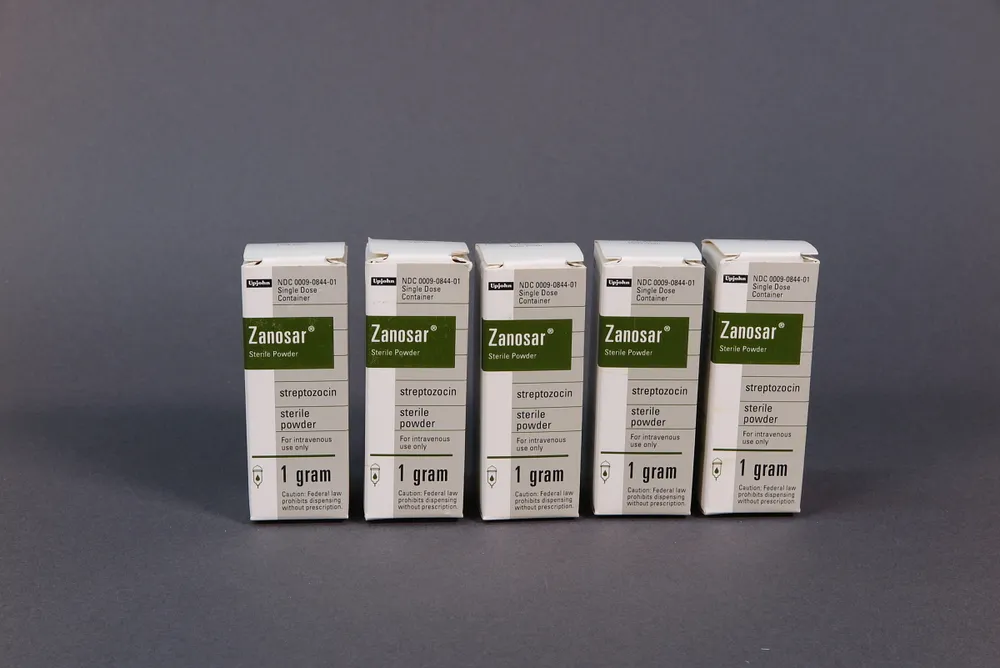
Table of Contents
Package leaflet: Information for the user
Introduction
Package leaflet: information for the patient
Zanosar 1 g powder for concentrate for solution for infusion
Streptozocin
Read the entire leaflet carefully before you start using this medicine, because it contains important information for you.
-
Keep this leaflet as you may need to read it again.
-
If you have any questions, ask your doctor, pharmacist or nurse.
-
This medicine has been prescribed for you only, and you should not give it to other people, even if they have the same symptoms as you, because it could harm them.
- If you experience any adverse reactions, consult your doctor, pharmacist or nurse, even if they are adverse reactions not listed in this leaflet. See section 4.
Leaflet contents
- What Zanosar is and what it is used for
- What you need to know before using Zanosar
- How to use Zanosar
- Possible side effects
- How to store Zanosar
- Contents of the pack and other information
1. What Zanosar is and what it is used for
This is a cytostatic medicine, which means it prevents the growth of certain cells.
It is especially indicated for the treatment of certain pancreatic tumors (neuroendocrine tumors) in adults.
This medicine, which is administered by intravenous injection, may be combined with 5-fluorouracil (5-FU).
2. What you need to know before using Zanosar
Do not use Zanosar:
- If you are allergic to the active substance (streptozocin) or to any of the other ingredients of this medicine (listed in section 6).
- If you have severe renal impairment (kidney function failure).
- In combination with certain vaccines (called live or live attenuated vaccines).
- During breastfeeding.
Warnings and precautions
Due to the renal toxicity of this medicine, you must inform your doctor if you have kidney problems. Your kidney function will be monitored regularly through blood and urine tests before, during, and after treatment.
This medicine also has liver and blood toxicity. Liver function tests should be performed periodically to detect hepatotoxicity.
Zanosar may cause nausea and vomiting. Therefore, your doctor may prescribe medications to treat these symptoms.
When combined with another medicine belonging to the same class, appropriate evaluations will be carried out more frequently.
Treatment will be administered under the supervision of a physician experienced in the use of cytostatic drugs, who will determine how your treatment tolerance will be assessed (laboratory tests, etc.).
Men and women must use an effective method of contraception during and after treatment. See "Pregnancy, breastfeeding and fertility".
Monitoring during treatment
This medicine can only be used under strict medical supervision: a medical examination and blood tests must be performed during treatment. If in doubt, consult your doctor or pharmacist.
Children and adolescents
Safety and efficacy of Zanosar have not been established in children and adolescents under 18 years of age.
Use of Zanosar with other medicines
Combinations contraindicated
This medicine MUST NOT BE USED in the following situations:
- In combination or sequential administration with other substances potentially toxic to the kidneys (unless otherwise directed by your doctor).
- In combination with certain vaccines (called live or live attenuated vaccines).
Combinations requiring caution
Inform your doctor:
- If you are taking a medicine that reduces or suppresses the body's immune defenses (immunosuppression),
- If you are taking oral anticoagulants (vitamin K antagonists).
Tell your doctor or pharmacist if you are taking, have recently taken, or might need to take any other medicine.
Pregnancy, breastfeeding and fertility
If you are pregnant, breastfeeding, think you may be pregnant, or plan to become pregnant, consult your doctor or pharmacist before using this medicine.
Contraceptive methods for men and women
You must use an effective method of contraception during treatment. A post-treatment contraception period of 90 days is recommended for men and 30 days for women.
Pregnancy
You must not use this medicine if you are pregnant, planning to conceive, or not using contraceptive methods.
Breastfeeding
It has not been determined whether this medicine passes into breast milk. As a precautionary measure, you must interrupt breastfeeding during treatment.
Fertility
Men treated with Zanosar are advised not to attempt conception for 90 days after treatment and to seek advice on sperm preservation before treatment, as streptozocin may impair male fertility.
Women should continue using contraception for 30 days after treatment.
Driving and use of machines
Zanosar may cause confusion, fatigue, or depression. Therefore, you should not drive or operate machinery if you experience any of these effects.
Zanosar contains sodium:
This medicine contains 30.1 mg of sodium (the main component of table/cooking salt) per vial. This corresponds to 1.5% of the maximum daily recommended sodium intake for an adult.
3. How to use Zanosar
This medicine must be prepared and administered only by healthcare professionals.
Your doctor will determine the dose you should receive based on your body surface area and general condition.
The treatment will be administered as an intravenous infusion into one of your veins. The infusion will last between 30 minutes and 4 hours.
Two dosage regimens are generally used:
- Administration regimen every 6 weeks: 5 consecutive days every 6 weeks;
- Administration regimen every 3 weeks: 5 consecutive days in the first week, followed by an infusion every 3 weeks.
If toxicity occurs, it may be necessary to adjust the dose or discontinue treatment.
Zanosar may cause nausea and vomiting. If this happens, your doctor may prescribe medications to treat these symptoms.
If you are given more Zanosar than you should
Appropriate supportive care will be provided.
If you have any further questions about the use of this medicine, please consult your doctor, pharmacist, or nurse.
4. Possible adverse effects
Like all medicines, Zanosar can cause side effects, although not everyone experiences them.
Very common adverse effects (may affect more than 1 in 10 people)
In some cases, treatment has had to be discontinued due to severe nausea and vomiting. Cases of diarrhea have also been reported.
Common adverse effects (may affect up to 1 in 10 people)
Renal failure (impaired kidney function), which can be severe. Your doctor may prescribe blood and urine tests before, during, and on several occasions after completion of treatment.
Adverse effects of unknown frequency (frequency cannot be estimated from available data)
- Hematological toxicity (blood toxicity), which usually involves a drop in hematocrit values (the volume percentage of red blood cells relative to total blood volume), white blood cells, and platelets. It may also increase susceptibility to infections.
- Glucose intolerance, usually mild to moderate and usually reversible.
- Confusion, apathy, depression.
- Nephrogenic diabetes insipidus (inability of the kidneys to concentrate urine).
- Hepatotoxicity (liver toxicity): increase in certain liver enzymes, abnormally low levels of albumin in the blood (hypoalbuminemia).
- Reactions at the injection site: tissue necrosis (tissue destruction) when the substance leaks outside the vein, burning sensation spreading from the injection site to the arm.
- Fever.
Reporting of adverse effects
If you experience any type of adverse effect, consult your doctor, pharmacist, or nurse, even if it is a possible adverse effect not listed in this leaflet. You may also report them directly through the Spanish Pharmacovigilance System for Human Medicinal Products: www.notificaRAM.es. By reporting adverse effects, you can help provide more information on the safety of this medicine.
5. Storage of Zanosar
Keep this medicine out of the sight and reach of children.
Do not use Zanosar after the expiry date stated on the container after EXP. The expiry date refers to the last day of the month indicated.
Before opening: store the vial in a refrigerator (2 °C to 8 °C); keep the vial in the outer packaging to protect it from light.
After opening, reconstitution, and dilution: the reconstituted solution must be diluted immediately. The resulting reconstituted solution has been shown to be physically and chemically stable for 24 hours below 25°C.
The product contains no preservatives and is intended for single use only.
From a microbiological standpoint, unless the method of opening/reconstitution/dilution excludes the risk of microbial contamination, the product should be used immediately. If not used immediately, the conditions during use are the responsibility of the user.
Medicines must not be disposed of via wastewater or household waste. Dispose of containers and unused medicines at a pharmacy’s SIGRE collection point. If in doubt, ask your pharmacist how to dispose of containers and medicines you no longer need. This will help protect the environment.
6. Contents of the container and other information
Composition of Zanosar:
Active substance:
Streptozocin 1 g (per vial of powder).
Other components:
Anhydrous citric acid
Sodium hydroxide for pH adjustment
Appearance of the product and contents of the container
This medicine appears as a sterile powder, white to pale yellow, intended for preparation for infusion.
Pack: 1 vial.
Marketing Authorization Holder and Manufacturer
Marketing Authorization Holder:
Esteve Pharmaceuticals, S.A.
Passeig de la Zona Franca, 109
08038 Barcelona
Spain
Manufacturer:
VALDEPHARM
Parc Industriel d’Incarville
Parc de la Fringale – CS10606
27106 Val de Reuil
France
This medicine is authorized in the EEA Member States under the following names:
Belgium | Streptozocin Keocyt 1g, powder for concentrate for solution for infusion |
Denmark | Zanosar |
Germany | Zanosar 1g, powder for concentrate for infusion solution |
Netherlands | Zanosar 1g, powder for concentrate for solution for infusion |
Spain | Zanosar 1g, powder for concentrate for perfusion solution |
Norway | Zanosar 1g, powder for concentrate for infusion solution, solution |
France | Zanosar 1g, powder for solution to be diluted for perfusion |
Italy | Streptozocin Keocyt |
Finland | Zanosar 1g, powder for intermediate concentrate for infusion solution, solution |
Sweden | Zanosar 1g, powder for concentrate for infusion solution, solution |
United Kingdom (Northern Ireland) | Zanosar 1g, powder for concentrate for solution for infusion |
Date of last revision of this summary: May 2021
Detailed and up-to-date information on this medicinal product is available on the website of the Spanish Agency of Medicines and Health Products (AEMPS) http://www.aemps.gob.es/
The following information is intended exclusively for healthcare professionals:
Dosage:
The dose is based on body surface area (m²).
Two different dosing regimens may be used:
Every-6-weeks regimen – 500 mg/m²/day administered intravenously over 5 consecutive days every 6 weeks until maximum benefit is achieved or until treatment-limiting toxicity is observed.
Every-3-weeks regimen – 500 mg/m²/day administered intravenously over 5 consecutive days in cycle 1, followed by 1000 mg/m² every 3 weeks in subsequent cycles.
Dosing schedules with similar dose intensity have been used in clinical studies with comparable safety and efficacy outcomes.
The optimal duration of maintenance treatment with Zanosar has not been established.
In patients with functioning tumors, serial monitoring of biological markers allows assessment of biochemical response to treatment. In patients with either functioning or non-functioning tumors, treatment response may be determined by observing measurable reductions in tumor size on imaging.
Close monitoring of renal, hepatic, and hematological function, as well as blood glucose levels, should be performed before, during, and after treatment. The degree of observed toxicity may require dose adjustment or drug discontinuation.
Anti-emetic premedication is recommended to prevent nausea and vomiting.
Precautions to be taken before handling or administering the medicinal product
The powder and solution must be handled and prepared carefully, and the use of gloves is recommended. If sterile Zanosar powder or a solution prepared from Zanosar comes into contact with skin or mucous membranes, the affected area should be washed immediately with soap and water.
Appropriate procedures for handling and disposal of anticancer drugs should be followed.
Preparation of injectable solutions of cytotoxic agents should be carried out by trained and specialized personnel familiar with the drugs used, and under conditions ensuring protection of the environment and, in particular, of personnel handling the agents. Facilities dedicated exclusively to this purpose are required. Smoking, eating, and drinking are prohibited in these areas. Personnel handling the agents must have appropriate handling equipment, including long-sleeved gowns, safety masks, safety caps, safety goggles, single-use sterile PVC gloves, protective work surface covers, waste containers, and disposal bags. Excreta and vomit should be handled with caution. Pregnant women must be warned of the risks and must avoid handling cytotoxic agents. Broken containers must be handled with the same precautions and considered contaminated waste. Disposal of contaminated waste must be carried out by incineration in rigid containers (appropriately labeled to indicate that they contain contaminated waste).
Overdose
There is no specific antidote for overdose with Zanosar, and treatment should consist of supportive measures. Overdose should be avoided by carefully calculating the dose to be administered.
Method of administration
Zanosar must be administered intravenously by infusion. The duration of intravenous infusion should range between 30 minutes and 4 hours.
Administration of Zanosar requires hyperhydration.
This medicinal product is vesicant and, as such, must be administered with caution through a freely flowing line.
In case of extravasation, administration must be stopped immediately. Healthcare professionals should apply appropriate protective measures. The initial goal is to minimize the volume of extravasated product into surrounding tissues and to aspirate as much of the product as possible from the cannula using a syringe. Cold compresses should be applied, and appropriate medical supervision is required.
Reconstitution instructions
Reconstitution of Zanosar must be performed by a healthcare professional.
Preparation of doses must take into account the patient's body surface area (see section “Dosage” above).
Each 20 mL vial of Zanosar must be reconstituted with 9.5 mL of 9 mg/mL (0.9%) sodium chloride injection solution. Dissolution of the lyophilized powder is complete within less than 2 minutes.
The resulting solution has a light golden color.
The pH of the reconstituted product is 4.
After reconstitution, each milliliter of solution contains 100 mg of streptozocin.
Next, the correct volume of reconstituted solution (see section 4.2 of the SmPC for instructions on dose calculation based on body surface area) should be diluted in 500 mL of the same solution used for reconstitution.
When Zanosar and 5-FU are coadministered, a Y-type administration system is recommended.