Yorvipath 168 micrograms/0.56 ml solution for injection in pre-filled pen
Spain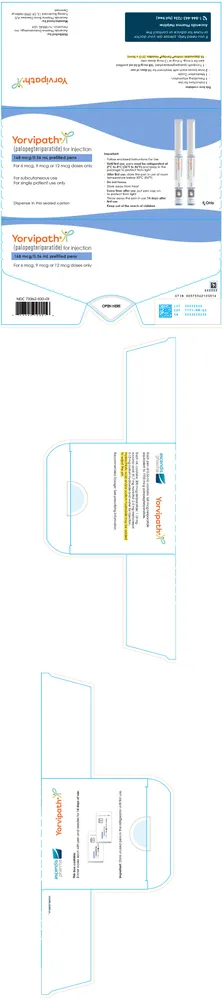
Table of Contents
Package leaflet: Information for the user
Introduction
Package leaflet: information for the patient
Yorvipath 168 micrograms/0.56 ml solution for injection in pre-filled pen
Yorvipath 294 micrograms/0.98 ml solution for injection in pre-filled pen
Yorvipath 420 micrograms/1.4 ml solution for injection in pre-filled pen
palopegteriparatide
This medicinal product is subject to additional monitoring, which will allow for faster detection of new safety information. You can help by reporting any adverse reactions you may experience. Information on how to report adverse reactions is included at the end of section 4.
Read the entire leaflet carefully before starting to use this medicine, as it contains important information for you.
- Keep this leaflet, as you may need to read it again.
- If you have any questions, consult your doctor or pharmacist.
- This medicine has been prescribed for you only, and you should not give it to other people, even if they have the same symptoms as you, since it may harm them.
- If you experience any adverse reactions, consult your doctor or pharmacist, even if they are adverse reactions not listed in this leaflet. See section 4.
Contents of the leaflet
- What Yorvipath is and what it is used for
- What you need to know before using Yorvipath
- How to use Yorvipath
- Possible side effects
- How to store Yorvipath
- Contents of the pack and other information
1. What Yorvipath is and what it is used for
Yorvipath contains the active substance palopegteriparatide. Palopegteriparatide becomes teriparatide, also known as parathyroid hormone (PTH), in the body. PTH is normally produced in the body and is necessary to maintain calcium and phosphate levels within normal ranges.
Yorvipath is used for the treatment of chronic hypoparathyroidism in adults. In people with hypoparathyroidism, the body produces very little or no PTH. As a result, they cannot maintain calcium and phosphate levels within normal ranges, leading to symptoms of the condition such as muscle spasms, twitching, and tingling sensations in the fingertips, toes, and lips. Yorvipath replaces the missing PTH to help control calcium and phosphate levels.
2. What you need to know before using Yorvipath
Do not use Yorvipath
- if you are allergic to palopegteriparatide or to any of the other ingredients of this medicine (listed in section 6)
- if you have pseudohypoparathyroidism, a condition in which the body does not respond properly to the parathyroid hormone produced by the body
Warnings and precautions
Talk to your doctor, pharmacist, or nurse before starting to use Yorvipath.
If you are being treated with Yorvipath, you may experience adverse effects related to low and high levels of calcium in the blood (see section 4 for more information). These effects are more likely to occur when starting treatment or when the dose is changed. Your doctor will monitor your calcium levels (see “Tests and monitoring” in section 3). You may be given medications to treat or help prevent these adverse effects, or your doctor may adjust your dose.
High levels of calcium in the blood may cause problems if you are taking medications containing cardiac glycosides (such as digoxin or digitoxin) (see Other medicines and Yorvipath). Your doctor will monitor your calcium levels (see “Tests and monitoring” in section 3) and cardiac glycoside levels, and will monitor you for signs and symptoms.
If you are taking Yorvipath and have severe liver or kidney impairment, your doctor will monitor your calcium levels more frequently (see “Tests and monitoring” in section 3).
Tell your doctor if you are at increased risk of a type of bone cancer called osteosarcoma. This is especially important:
- if you are receiving or have received radiation therapy to the bones
- if you have bone cancer or another type of cancer that has spread to the bones
- if you have a bone disease that increases the risk of developing osteosarcoma (for example, if you have Paget’s disease)
- if a blood test shows you have unexplained increases in bone alkaline phosphatase
If you are at risk of bone fractures, your doctor will monitor you for osteoporosis.
Children and adolescents
Yorvipath must not be used in children and adolescents under 18 years of age as it has not been studied in this age group.
Other medicines and Yorvipath
Tell your doctor, pharmacist, or nurse if you are taking, have recently taken, or might need to take any other medicines. In particular, inform your doctor if you are taking or have recently taken any of the following medicines:
- Heart medications containing cardiac glycosides (such as digoxin or digotoxine)
- Medications for the treatment of osteoporosis such as bisphosphonates, denosumab, or romosozumab
- Medications that may affect calcium levels in the blood, such as diuretics ("water tablets", such as hydrochlorothiazide or furosemide), systemic corticosteroids (medicines used to treat inflammation), and lithium (a medicine used to treat mood disorders)
Your doctor may need to adjust the dose of these medicines or the dose of Yorvipath.
Pregnancy, breastfeeding, and fertility
If you are pregnant or breastfeeding, think you may be pregnant, or are planning to become pregnant, consult your doctor or pharmacist before using this medicine.
Pregnancy
If you think you may be pregnant or are planning to become pregnant, consult your doctor. If you become pregnant during treatment, consult your doctor immediately.
Information on the safety of Yorvipath in pregnant women is limited. Your doctor will decide whether you should be treated with Yorvipath during pregnancy. If you are pregnant or planning to become pregnant, your doctor will monitor your calcium levels.
Breastfeeding
If you are breastfeeding or planning to breastfeed, consult your doctor before using Yorvipath. Your doctor will decide whether you should be treated with Yorvipath during breastfeeding. If you are breastfeeding, your doctor will monitor your calcium levels.
Fertility
It is unknown whether Yorvipath has effects on fertility.
Driving and using machines
The influence of Yorvipath on the ability to drive and use machines is negligible or very minor. However, if you experience dizziness or fainting upon standing, do not drive or use machines until you feel better.
Yorvipath contains sodium
This medicine contains less than 1 mmol of sodium (23 mg) per dose; that is, essentially "sodium-free".
3. How to use Yorvipath
Follow exactly the administration instructions for this medicine given by your doctor or nurse. If in doubt, consult your doctor again.
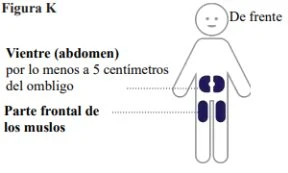
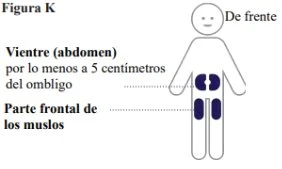
Yorvipath is administered as an injection under the skin (subcutaneous injection). This means it is injected with a short needle into the fatty tissue beneath the skin. The medicine should be injected into the abdomen or the front of the thigh. It is important to inject it each day in a different area to avoid skin damage. You may alternate between the right and left side of the abdomen and the left and right front areas of the thigh.
Before you start using the pen for the first time, your doctor, pharmacist, or nurse will show you how to inject Yorvipath. Additional help on using Yorvipath can be found in the instructions for use at the end of this leaflet.
Always use the pen exactly as described in the instructions for use.
Initiation, dose adjustment, and maintenance of Yorvipath
Your doctor will perform a blood test to monitor your calcium and vitamin D levels before starting treatment with Yorvipath.
The recommended initial dose of Yorvipath is 18 micrograms once daily. Your doctor will instruct you to gradually adjust the dose according to your response to the medicine until you reach a dose that maintains calcium levels in your body within normal limits without requiring active vitamin D or therapeutic doses of calcium. Your doctor may advise you to continue taking daily calcium supplements to meet dietary requirements. Your dose may be increased if at least 7 days have passed since the last dose adjustment. Your dose may be decreased no more than every 3 days if calcium levels in the body are too high.
Tests and monitoring
Your doctor will monitor your response to treatment:
- 7 days after starting treatment, and
- 7 to 14 days after any dose change.
This will be done through tests measuring calcium levels in blood or urine. Your doctor may instruct you to adjust the amount of calcium or vitamin D you take (in any form, including calcium-rich foods).
Instructions for use
If your dose is higher than 30 micrograms per day:
- Administer two injections, one after the other, into different injection sites.
- It is recommended to use a different Yorvipath pen for the second daily injection, even if both pens have the same colored button (same concentration).
- The table below explains how to administer the dose. If in doubt, consult your doctor again.
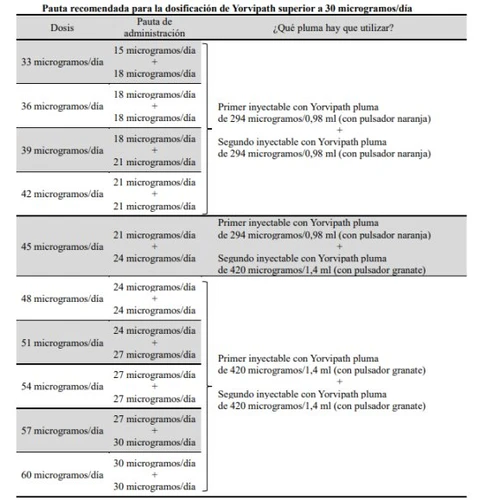
Yorvipath 294 microgram/0.98 ml pen delivers doses of 15, 18, or 21 micrograms (with orange button)
Yorvipath 420 microgram/1.4 ml pen delivers doses of 24, 27, or 30 micrograms (with maroon button)
If you use more Yorvipath than you should
Contact your doctor or nurse immediately and report your symptoms.
An overdose may lead to high levels of calcium in the blood. Symptoms may include, among others, feeling unwell (nausea, vomiting), dizziness, increased thirst, confusion, muscle weakness, and irregular heartbeat. For further information, see section 4.
If you forget to use Yorvipath
If you forget to inject a dose of Yorvipath, you may take the medicine as soon as you remember, provided that less than 12 hours have passed. For example, if you normally inject the medicine at 08:00, you may inject the missed dose before 20:00.
If you remember within 12 hours of your next scheduled dose, skip the missed dose and continue injecting your next dose as usual. For example, if you remember at 22:00 that you missed your Yorvipath injection and your next dose is scheduled for 08:00, you should not inject the missed dose.
Never take a second dose to make up for a missed dose.
If you stop using Yorvipath
Do not stop using Yorvipath without speaking to your doctor. If you interrupt treatment with Yorvipath, calcium levels in the blood may decrease and you may develop the symptoms described below (see section 4).
If you have any further questions about using Yorvipath, ask your doctor or nurse.
4. Possible side effects
Like all medicines, this medicine can cause side effects, although not everybody gets them.
Some side effects may be serious
Frequent serious side effects (may affect up to 1 in 10 people):
-
High levels of calcium in the blood (hypercalcemia)
- Symptoms may include, among others, feeling unwell (vomiting), dizziness, feeling thirsty, confusion, muscle weakness, and irregular heartbeat.
- Hypercalcemia is more likely to occur during the first 3 months after starting treatment or if your dose of Yorvipath is changed.
-
Low levels of calcium in the blood (hypocalcemia)
- Symptoms may include, among others, tingling sensation in the fingertips, toes, and lips (paraesthesia), muscle spasms and cramps, oral numbness, and seizures.
- Hypocalcemia is more likely to occur if you stop taking Yorvipath for a short period or completely, or if your dose of Yorvipath is changed.
Immediately inform your doctor if you experience any of the symptoms listed above that may indicate these side effects. Your doctor will monitor your calcium levels. Your dose of Yorvipath may need to be adjusted or your injections temporarily interrupted. You may be given medications to treat or help prevent these side effects, or you may be asked to stop taking some of your current medications. These medications may include calcium or vitamin D. You may be asked to undergo certain laboratory tests.
Other side effects include:
Very common side effects (may affect more than 1 in 10 people)
- Headache
- Tingling sensation in the fingertips, toes, and lips (paraesthesia)
- Feeling sick (nausea)
- Feeling tired (fatigue)
- Redness, bruising, pain, bleeding, rash, or swelling at the injection site (injection site reactions)
Common side effects (may affect up to 1 in 10 people)
- Fluttering sensation in the chest or very fast heartbeat (palpitations)
- Dizziness
- Feeling like you are about to lose consciousness (pre-syncope)
- Fainting (syncope)
- Dizziness, lightheadedness, or fainting when sitting or standing up (orthostatic hypotension)
- Dizziness, lightheadedness, or fainting with increased heart rate when sitting or standing up (postural orthostatic tachycardia syndrome)
- Painful mouth or sore throat (oropharyngeal pain)
- Diarrhoea
- Constipation
- Feeling unwell (vomiting)
- Abdominal pain
- Abdominal discomfort
- Joint pain (arthralgia)
- Muscle pain (myalgia)
- Weakness (asthenia)
- Thirst
- Rash
- Skin reaction to sunlight (photosensitivity reaction)
- Need to urinate at night (nocturia)
- Muscle twitching
- Pain in the bones and muscles (musculoskeletal pain)
Uncommon side effects (may affect up to 1 in 100 people)
- Chest pain
- Chest discomfort
- High blood pressure (hypertension)
Frequency not known (cannot be estimated from the available data)
- Need to urinate frequently (polyuria)
- Decreased bone density
If you experience any side effect or symptoms that concern you, inform your doctor or nurse.
Reporting of side effects
If you experience any side effect, talk to your doctor, pharmacist, or nurse, even if it is a possible side effect not listed in this leaflet. You can also report them directly through the national reporting system listed in Appendix V. By reporting side effects, you can help provide more information on the safety of this medicine.
5. Yorvipath Storage
Keep this medicine out of sight and reach of children.
Do not use this medicine after the expiry date stated on the carton after EXP. The expiry date is the last day of the month indicated.
Before first use:
Store in a refrigerator (between 2 °C and 8 °C). Do not freeze.
Keep in the original packaging with the pen cap attached to protect it from light.
After first use:
Store below 30 °C.
Keep the pen cap on the pre-filled pen to protect it from light.
Dispose of pens 14 days after first use.
Do not use this medicine if you notice that the solution is cloudy, discolored, or contains visible particles.
Medicines must not be disposed of via wastewater or household waste. Ask your pharmacist how to dispose of medicines and packaging you no longer need. This will help protect the environment.
6. Contents of the pack and other information
Composition of Yorvipath
- The active substance is palopegteriparatide.
- The other excipients are succinic acid, mannitol, metacresol, sodium hydroxide (see section 2, “Yorvipath contains sodium”), hydrochloric acid (for pH adjustment), and water for injections.
Yorvipath is a solution for subcutaneous injection in a pre-filled pen available in three presentations:
Yorvipath 168 micrograms/0.56 ml
Each pre-filled pen contains palopegteriparatide equivalent to 168 micrograms of PTH(1-34) in 0.56 ml of solvent. The concentration based on PTH(1-34) is 0.3 mg/ml.
Yorvipath 294 micrograms/0.98 ml
Each pre-filled pen contains palopegteriparatide equivalent to 294 micrograms of PTH(1-34) in 0.98 ml of solvent. The concentration based on PTH(1-34) is 0.3 mg/ml.
Yorvipath 420 micrograms/1.4 ml
Each pre-filled pen contains palopegteriparatide equivalent to 420 micrograms of PTH(1-34) in 1.4 ml of solvent. The concentration based on PTH(1-34) is 0.3 mg/ml.
Appearance of the product and contents of the pack
Yorvipath is a clear, colourless injectable solution, free from particles, in a pre-filled pen.
Yorvipath is available in packs containing 2 pre-filled pens (with 30 disposable needles or without needles) for 28 days of treatment. Each pre-filled pen is for 14 days of treatment.
Only certain pack sizes may be marketed.
The colours of the concentration are indicated on the outer and inner cartons, on the label and on the button of the pre-filled pen, as follows:
Color | Strength |
Blue | Yorvipath 168 micrograms/0.56 ml |
Orange | Yorvipath 294 micrograms/0.98 ml |
Garnet | Yorvipath 420 micrograms/1.4 ml |
Marketing Authorization Holder
Ascendis Pharma Bone Diseases A/S
Tuborg Boulevard 12
DK-2900 Hellerup
Denmark
Manufacturer Responsible
Ascendis Pharma A/S
Tuborg Boulevard 12
DK-2900 Hellerup
Denmark
For further information regarding this medicinal product, please contact the local representative of the marketing authorization holder:
Belgium/Belgium/Belgium Ascendis Pharma Bone Diseases A/S Tel/Tel: +32 2 790 6340 | Lithuania Ascendis Pharma Bone Diseases A/S Tel: +45 70 22 22 44 |
| Luxembourg/Luxembourg Ascendis Pharma Bone Diseases A/S Tél/Tel: +45 70 22 22 44 |
Czech Republic Ascendis Pharma Bone Diseases A/S Tel: +45 70 22 22 44 | Hungary Ascendis Pharma Bone Diseases A/S Tel.: +45 70 22 22 44 |
Denmark Ascendis Pharma Bone Diseases A/S Tlf.: +45 88 74 22 67 | Malta Ascendis Pharma Bone Diseases A/S Tel: +45 70 22 22 44 |
Germany Ascendis Pharma Bone Diseases A/S Tlf.: +45 88 74 22 67 | Netherlands Ascendis Pharma Bone Diseases A/S Tel: +31 20 259 2731 |
Estonia Ascendis Pharma Bone Diseases A/S Tel: +45 70 22 22 44 | Norway Ascendis Pharma Bone Diseases A/S Tlf: +47 23 50 24 80 |
Greece Ascendis Pharma Bone Diseases A/S Tel: +45 70 22 22 44 | Austria Ascendis Pharma Bone Diseases A/S Tel: +43 1 205 636 7700 |
Spain Ascendis Pharma Iberia, S.L. Tel: +34 910 798 364 | Poland Ascendis Pharma Bone Diseases A/S Tel.: +45 70 22 22 44 |
France Ascendis Pharma France SAS Tél: +33 1 72 35 02 00 | Portugal Ascendis Pharma Bone Diseases A/S Tel: +351 21 124 8316 |
Croatia Ascendis Pharma Bone Diseases A/S Tel: +45 70 22 22 44 | Romania Ascendis Pharma Bone Diseases A/S Tel: +45 70 22 22 44 |
Ireland Ascendis Pharma Bone Diseases A/S Tel: +44 20 4570 1942 | Slovenia Ascendis Pharma Bone Diseases A/S Tel: +45 70 22 22 44 |
Iceland Ascendis Pharma Bone Diseases A/S Sími: +45 70 22 22 44 | Slovakia Ascendis Pharma Bone Diseases A/S Tel: +45 70 22 22 44 |
Italy Ascendis Pharma Bone Diseases A/S Tel: +39 02 8128 1581 | Finland Ascendis Pharma Bone Diseases A/S Puh/Tel: +358 64 60 41 367 |
Cyprus Ascendis Pharma Bone Diseases A/S Tel: +45 70 22 22 44 | Sweden Ascendis Pharma Bone Diseases A/S Tel: +46 8 502 414 23 |
Latvia Ascendis Pharma Bone Diseases A/S Tel: +45 70 22 22 44 |
Date of the most recent review of this leaflet:
Other sources of information
Detailed information on this medicine is available on the website of the European Medicines Agency: https://www.ema.europa.eu. Links to other websites on rare diseases and orphan medicinal products are also available.
This leaflet is available on the website of the European Medicines Agency in all languages of the European Union/European Economic Area.
On the reverse of this leaflet, instructions for use are shown, providing information on how to inject Yorvipath.
INSTRUCTIONS FOR USE
Yorvipath
168 micrograms/0.56 ml
For doses of 6, 9 or 12 micrograms only
Injectable solution in a pre-filled pen
palopegteriparatide
Subcutaneous use
The instructions for use contain information on how to inject Yorvipath.
Additional information
If you do not understand or are unable to complete any of the steps described in the instructions for use, consult your doctor or nurse.
Important information you need to know before starting to use your Yorvipath pen Read and follow the package leaflet and these instructions for use carefully to ensure you inject Yorvipath correctly. Make sure you have received training from your doctor or nurse before administering the injection. This is important to ensure you receive the correct treatment. For correct use
|
Caring for the pen
|
Troubleshooting
You should only test the pen flow (Section 2) the first time you use a new pen (or if you suspect it may be damaged) to avoid wasting medication. The test checks that the medicine flows properly through the pen so you can receive the correct dose.
If you do not see drops at the needle tip after 5 attempts, it may be because there is no flow through the pen and needle. Change the needle (see Section 5, Step 13) and retest the pen flow (see Section 2, Steps A–C). You can confirm proper flow if you see a drop of medicine. If it still does not work, dispose of the pen and consult your healthcare professional.
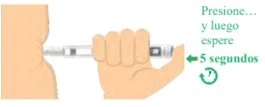
The injection is only complete when you press the injection button fully down, the dose selector has rotated back to the “?” symbol, and you have kept the pen in place on the skin for 5 seconds.
Some of the medicine may flow back into the pen or leak from the injection site onto the skin. Pressing the pen against the skin for 5 seconds helps ensure that the full dose of medicine has been injected.
The pen does not allow you to set a dose greater than the amount remaining. If your required dose is higher than the amount of medicine left in the pen, you will not be able to set the full dose. You must dispose of your pen and take the full dose using a new pen.
Unscrew and dispose of the used needle (see Section 5, Step 13). Take a new needle from the box and restart from Step 1. Each box contains one extra needle. |
Overview of the parts
Figure A
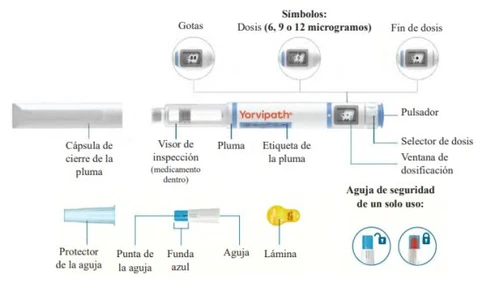
Note: There is no medication inside the needle.
You will also need
1 Preparation of the pen and needle | |
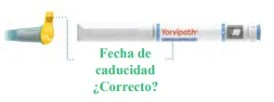
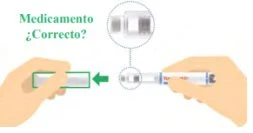
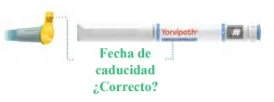
Step 1 Take your Yorvipath pen. Make sure it is the correct concentration and check the expiry date. Take a needle and check the expiry date on the needle (Figure C). Note: Remove your pen from the refrigerator 20 minutes before first use. | Figure C
|
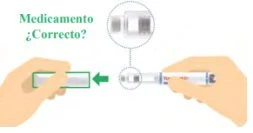
Step 2 Remove the pen cap and check the inspection window to ensure that the medicine inside the pen is clear and colourless (Figure D). Important: If visible particles are present in the medicine, do not use the pen. Use a new pen instead. | Figure D
|
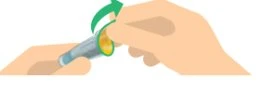
Step 3 Remove the needle seal (Figure E). This needle can only be used once and will lock after use. Always use a new needle for each injection. | Figure E
|
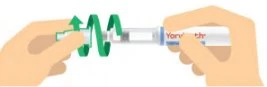
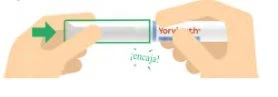
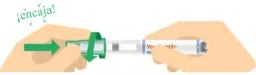
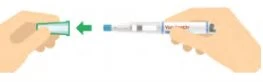
Step 4 Attach the needle straight onto your pen, then screw the needle onto the pen until secure (it will not tighten completely) (Figure F). | Figure F
|
Step 5 Remove the needle cap (Figure G) and discard it. Important: Do not touch the blue cap, as it may block the needle. | Figure G
|
|
|
| Test the pen flow (steps A – C) only the first time you use a new pen. If your pen is already in use, go to section 3, "Prepare the injection and select the dose". |
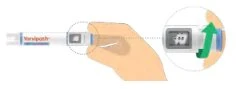
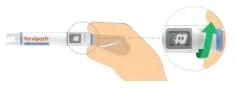
Step A Turn the dose selector to the right 2 clicks until you see the drop symbol “” in the dose window (Figure H). Note: You can always correct the selection by turning the dose selector. | Figure H
|
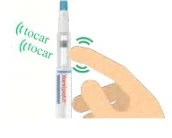
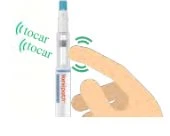
Step B Bring air bubbles to the top of the pen by tapping the inspection window (Figure I). Hold the pen with the needle tip pointing upward. Note: Small air bubbles are acceptable. | Figure I
|
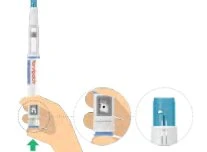
Step C Press the plunger and observe medicine droplets coming out from the needle tip. While pressing, make sure the dose selector rotates back to the symbol (Figure J). Important: If you do not see medicine droplets, repeat this test (steps A – C) up to 5 times. If no droplets appear, replace the needle and repeat the test. | Figure J
|

3 Prepare the injection and select the dose | |
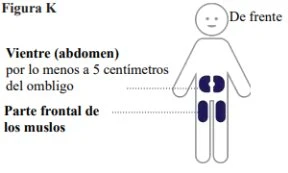
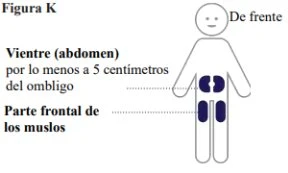
Step 6 Choose the injection site. There are two areas on your body where you can give the injection (Figure K). Do not inject into areas of red, swollen, or scarred skin. Choose a different injection site each time you give an injection. |
|
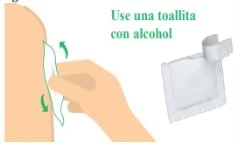
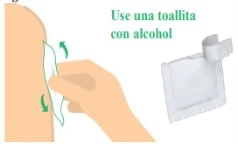
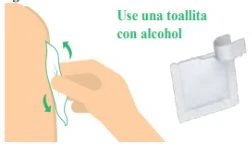
Step 7 Wash your hands and clean the injection site with an alcohol swab (Figure L). | Figure L
|
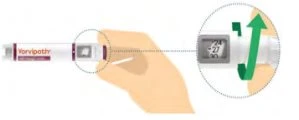
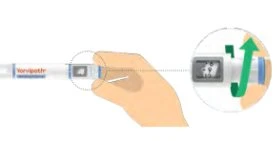
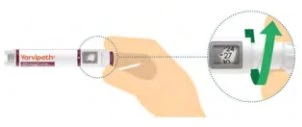
Step 8 Select your dose as prescribed by your doctor (6, 9, or 12 micrograms) by turning the dose selector to the right (Figure M). Important: Make sure not to press the button when selecting the dose, to avoid wasting the medicine. Note: Always discard your pen and use a new one if you cannot set a full dose. | Figure M
|
4 Inject the dose | |
| Use the injection technique recommended by your doctor or nurse. Read this entire section (Steps 9–12) before starting to inject. |
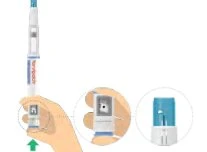
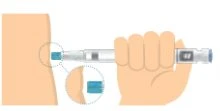
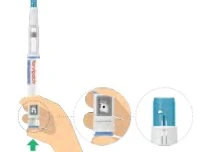
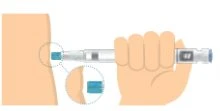
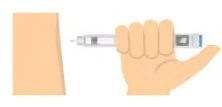
Step 9 Hold the pen so that the blue cap is placed over the injection site. Make sure you can see the dose window (Figure N). | Figure N
|
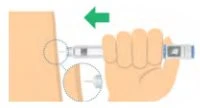
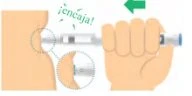
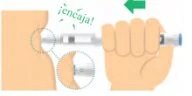
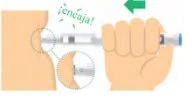
Step 10 Push the pen straight into the skin until you hear a click and the blue cap is no longer visible (Figure O). | Figure O
|
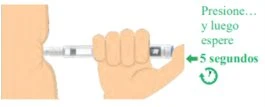
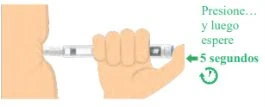
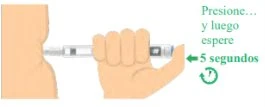
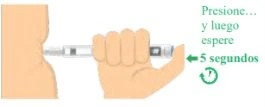
Step 11 Press the button fully down and hold it firmly for 5 seconds. Make sure the dose selector turns back to the symbol . This means the full dose has been delivered (Figure P). | Figure P
|
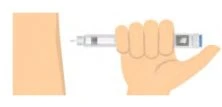
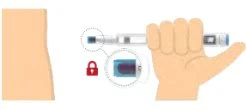
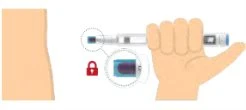
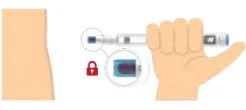
Step 12 Slowly remove the pen from the injection site. The blue cap will automatically lock over the needle and a red lockout will appear (Figure Q). | Figure Q
|
5 Dispose of the used needle | |
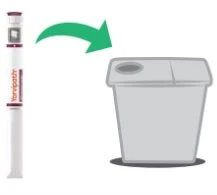
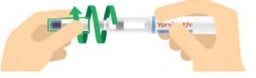
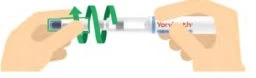
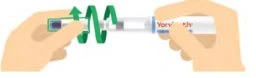
Step 13 Unscrew the needle and dispose of it safely according to local regulations (Figure R). Do not attempt to recap the needle, as you may get a needle stick from the back end. | Figure R
|
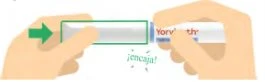
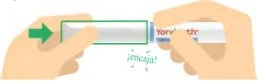
Step 14 Firmly attach the pen cap onto the pen to protect it between injections and to protect the medicine from light (Figure S). | Figure S
|
6 Dispose of the used pen |
|
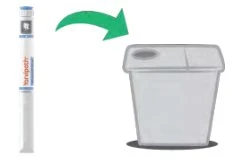
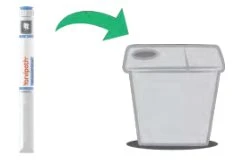
Important: Always dispose of the pen 14 days after first use according to local regulations. To keep track of when 14 days have passed, it is recommended to cover the field "?Date of opening" on the inner packaging. Always dispose of your pen and any additional needles after 14 days of use, even if there is still medication left (Figure T). This is important to ensure you receive the full effect of the medicine. | Figure T
|

INSTRUCTIONS FOR USE
Yorvipath
294 micrograms/0.98 ml
For 15, 18, or 21 microgram doses only
Injectable solution in a prefilled pen
palopegteriparatide
Subcutaneous route
The instructions for use contain
information on how to inject
Yorvipath
Additional information
If you do not understand or are unable to complete any of the steps described in the instructions for use, consult your doctor or nurse.
Important information you must know before starting to use your Yorvipath pen Read and follow the package leaflet and these instructions for use carefully to ensure you inject Yorvipath properly. Make sure you have been trained by your doctor or nurse before administering the injection. This is important to ensure you receive the correct treatment. For correct use
|
Special instructions for doses greater than 30 micrograms If your dose is greater than 30 micrograms/day:
|
Care of the pen
|
Troubleshooting
You should only test the pen flow (section 2) the first time you use a new pen (or if you suspect it may be damaged) to avoid wasting medication. The test checks that medicine flows properly through the pen so you can receive the correct dose.
If you do not see drops at the needle tip after 5 attempts, it may mean there is no flow through the pen or needle. Change the needle (see section 5, step 13) and retest the pen flow (see section 2, steps A–C). You can confirm proper flow if you see a drop of medicine. If it still does not work, dispose of the pen and consult your healthcare professional.
The injection is only complete when you press the button fully down, the dose selector has rotated back to the “?” mark, and you have kept the pen pressed against the skin for 5 seconds.
Some of the medicine may flow back into the pen or leak out from the injection site onto the skin. Pressing the pen against the skin for 5 seconds helps ensure that all the medicine has been injected.
The pen does not allow you to set a dose greater than the amount of medicine remaining. If your dose is higher than the amount of medicine left in the pen, you will not be able to set the full dose. You must dispose of your pen and administer the full dose using a new pen.
Unscrew and dispose of the used needle (see section 5, step 13). Take a new needle from the box and restart from step 1. Each box contains one additional needle. |
Overview of the parts
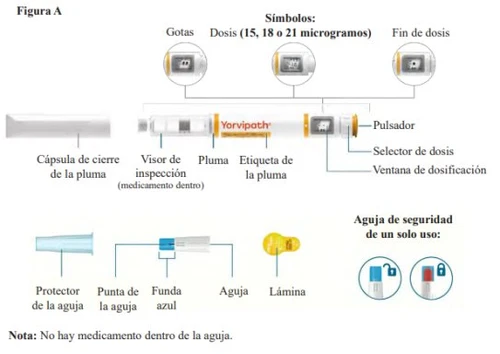
You will also need
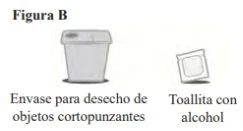
1 Preparing the pen and needle | |
Step 1 Take your Yorvipath pen. Make sure it is the correct concentration and check the expiration date. Take a needle and check the expiration date on the needle ( Figure C). Note: Remove your pen from the refrigerator 20 minutes before first use. | Figure C
|
Step 2 Remove the pen cap and check the inspection window to make sure the medicine inside the pen is clear and colorless (Figure D). Important: If the medicine has visible particles, do not use the pen. Use a new pen. | Figure D
|
Step 3 Remove the tab from the needle (Figure E). This needle can only be used once and will lock after use. Always use a new needle for each injection. | Figure E
|
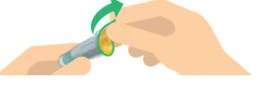
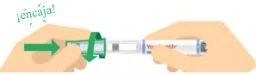
Step 4 Attach the needle straight onto your pen, then screw the needle onto the pen until secure (it will not tighten completely) (Figure F). | Figure F
|
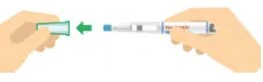
Step 5 Remove the needle shield (Figure G) and discard it. Important: Do not touch the blue cap as it may block the needle. | Figure G
|
|
|
| Test the pen flow (steps A–C) only the first time you use a new pen. If your pen is already in use, go to section 3 "Prepare the injection and select the dose". |
Step A Turn the dose selector clockwise 2 clicks until you see the drop symbol “” in the dose window (Figure H). Note: You can always correct the selection by turning the dose selector. | Figure H
|
Step B Bring air bubbles to the top of the pen by tapping the inspection window (Figure I). Hold the pen with the needle tip pointing upward. Note: Small air bubbles are acceptable. | Figure I
|
Step C Press the injection button and watch for drops of medicine to appear at the needle tip. While pressing, ensure the dose selector rotates back to the symbol (Figure J). Important: If you do not see drops of medicine, repeat this test (steps A–C) up to 5 times. If no drops appear, replace the needle and repeat the test. | Figure J
|

3 Prepare the injection and select the dose | |
Step 6 Choose the injection site. There are two areas on your body where you can administer the injection (Figure K). Do not administer the injection into red, swollen, or scarred skin. Choose a different injection site each time you give an injection. |
|
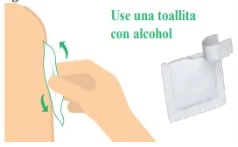
Step 7 Wash your hands and clean the injection site with an alcohol wipe (Figure L). | Figure L
|
Step 8 Select your dose as prescribed by your doctor (15, 18, or 21 micrograms) by rotating the dose selector clockwise (Figure M). Important: Make sure not to press the button while selecting the dose to avoid wasting the medication. Note: Always discard your pen and use a new one if you cannot set a complete dose. | Figure M
|
4 Inject the dose | |
| Use the injection administration technique recommended by your doctor or nurse. Read the entire section (Steps 9–12) before beginning to inject. |
Step 9 Hold the pen so that the blue cap is placed on the injection site. Make sure you can see the dose window (Figure N). | Figure N
|
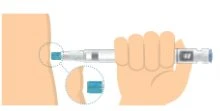
Step 10 Push the pen straight into the skin until you hear a click and the blue cap is no longer visible (Figure O). | Figure O
|
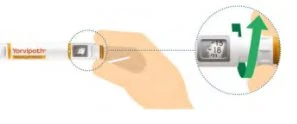
Step 11 Press the button down fully and hold it firmly for 5 seconds. Make sure the dose selector rotates back to the symbol. This means the full dose has been delivered (Figure P). | Figure P
|
Step 12 Slowly remove the pen from the injection site. The blue cap will automatically lock over the needle, and a red shield will become visible (Figure Q). | Figure Q
|
5 Dispose of the used needle | |
Step 13 Unscrew the needle and dispose of it safely according to local regulations (Figure R). Do not attempt to recap the needle, as you may get a needlestick injury from the back end. | Figure R
|
Step 14 Firmly attach the pen cap onto the pen to protect it between injections and to protect the medication from light (Figure S). | Figure S
|
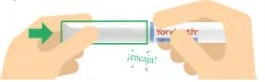
6 Dispose of the used pen |
|
Important: Always dispose of the pen 14 days after first use, according to local regulations. To keep track of when 14 days have passed, it is recommended to cover the ?Date of opening″ field on the inner packaging. Always dispose of your pen and any additional needles after 14 days of use, even if there is still medication left (Figure T). This is important to ensure you receive the full effect of the medicine. | Figure T
|

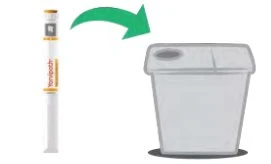
USER INSTRUCTIONS
Yorvipath
420 micrograms/1.4 ml
For doses of 24, 27 or 30 micrograms only
Injectable solution in a prefilled pen
palopegteriparatide
Subcutaneous route
The user instructions contain
information on how to inject
Yorvipath
Additional information
If you do not understand or are unable to complete any of the steps described in the user instructions, consult your doctor or nurse.
Important information you must know before starting to use your Yorvipath pen Read and follow the package leaflet and these instructions for use carefully to ensure you inject Yorvipath properly. Make sure you have received training from your doctor or nurse before administering the injection. This is important to ensure you receive the correct treatment. For correct use
|
Special instructions for doses greater than 30 micrograms/day If your dose is greater than 30 micrograms/day:
|
Care of the pen
|
Troubleshooting
You should only test the pen flow (section 2) the first time you use a new pen (or if you suspect it may be damaged) to avoid wasting medication. The test checks that the medicine flows through the pen so that you can receive the correct doses.
If you do not see drops at the tip of the needle after 5 attempts, it may be because there is no flow through the pen and needle. |
Change the needle (see section 5, step 13) and retest the pen flow (see section 2, steps A–C). You can confirm proper flow if you see a drop of medicine. If it still does not work, dispose of the pen and consult your healthcare professional.
The injection is only complete when you press the dose button fully down, the dose selector has rotated back to the “?” and you have kept the pen pressed against the skin for 5 seconds.
Some of the medicine may flow back into the pen or leak out from the injection site onto the skin. Pressing the pen against the skin for 5 seconds helps ensure that the full dose of medicine has been injected.
The pen does not allow you to set a dose greater than the amount remaining. If your dose is higher than the amount of medicine left in the pen, you will not be able to set the full dose. You must dispose of your pen and take the full dose using a new pen.
Unscrew and dispose of the used needle (see section 5, step 13). Take a new needle from the box and restart from step 1. All boxes contain an extra needle. |
Overview of the parts
Figure A
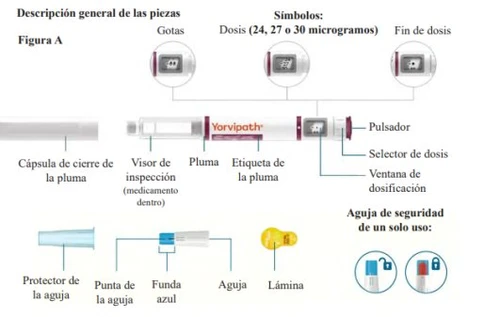
Note: There is no medication inside the needle.
You will also need
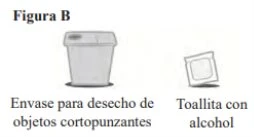
1 Preparing the pen and needle | |
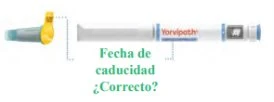
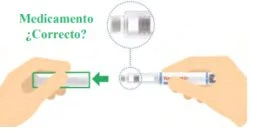
Step 1 Take your Yorvipath pen. Make sure it is the correct concentration and check the expiration date. Take a needle and check the expiration date on the needle (Figure C). Note: Remove your pen from the refrigerator 20 minutes before first use. | Figure C
|
Step 2 Remove the closure cap from the pen and check the inspection window to ensure that the medicine inside the pen is clear and colorless (Figure D). Important: If the medicine contains visible particles, do not use the pen. Use a new pen. | Figure D
|
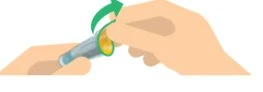
Step 3 Remove the tab from the needle (Figure E). This needle can only be used once and will lock after use. Always use a new needle for each injection. | Figure E
|
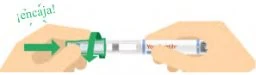
Step 4 Attach the needle directly onto your pen, and then screw the needle onto the pen until secure (it will not tighten completely) (Figure F). | Figure F
|
Step 5 Remove the needle cap (Figure G) and discard it. Important: Do not touch the blue cap as it may block the needle. | Figure G
|
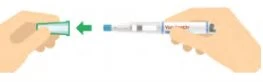
|
|
| Test the pen flow (steps A – C) only the first time you use a new pen. If your pen is already in use, go to section 3 "Prepare the injection and select the dose". |
Step A Turn the dose selector to the right 2 clicks until you see the drop symbol “” in the dose window (Figure H). Note: You can always correct the selection by turning the dose selector. | Figure H
|
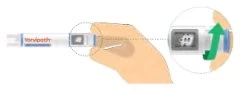
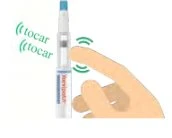
Step B Bring air bubbles to the top of the pen by tapping the inspection window (Figure I). Hold the pen with the needle tip pointing upward. Note: Small air bubbles are acceptable. | Figure I
|
Step C Press the push button and observe medication drops coming out from the needle tip. While pressing, ensure the dose selector rotates back to the symbol (Figure J). Important: If you do not see medication drops, repeat this test (steps A – C) up to 5 times. If no drops appear, replace the needle and repeat the test. | Figure J
|

3 Prepare the injection and select the dose | |
Step 6 Choose the injection site. There are two areas on your body where you can administer the injection (Figure K). Do not inject into areas of red, swollen, or scarred skin. Choose a different injection site each time you give an injection. |
|
Step 7 Wash your hands and clean the injection site with an alcohol wipe (Figure L). | Figure L
|
Step 8 Select your dose as prescribed by your doctor (24, 27, or 30 micrograms) by turning the dose selector to the right (Figure M). Important: Make sure not to press the button while selecting the dose, to avoid wasting medication. Note: Always discard your pen and use a new one if you are unable to set a full dose. | Figure M
|
4 Inject the dose | |
| Use the injection administration technique recommended by your doctor or nurse. Read this entire section (Steps 9–12) before beginning to inject. |
Step 9 Hold the pen so that the blue cap is positioned over the injection site. Make sure you can see the dose window (Figure N). | Figure N
|
Step 10 Push the pen directly against the skin until you hear a click and the blue cap is no longer visible (Figure O). | Figure O
|
Step 11 Press the button down fully and hold it firmly for 5 seconds. Make sure the dose selector rotates back to the symbol . This indicates that the full dose has been delivered (Figure P). | Figure P
|
Step 12 Slowly remove the pen from the injection site. The blue cap will automatically lock over the needle and a red lockout will be visible (Figure Q). | Figure Q
|
5 Dispose of the used needle | |
Step 13 Unscrew the needle and dispose of it safely according to local regulations (Figure R). Do not attempt to recap the needle, as you may get a needlestick injury from the back end. | Figure R
|
Step 14 Firmly attach the pen cap onto the pen to protect it between injections and to protect the medication from light (Figure S). | Figure S
|
6 Dispose of the used pen |
|
Important: Always dispose of the pen 14 days after first use, according to local regulations. To keep track of when 14 days have passed, it is recommended to cover the “Date of opening” field on the inner packaging. Always dispose of your pen and any remaining needles after 14 days of use, even if there is still medication remaining (Figure T). This is important to ensure you receive the full therapeutic effect of the medication. | Figure T
|

INSTRUCTIONS FOR USE
Yorvipath
168 micrograms/0.56 ml
For 6, 9 or 12 microgram doses only
Injectable solution in a pre-filled pen
palopegteriparatide
Subcutaneous use
The instructions for use contain information on how to inject Yorvipath.
Additional information
If you do not understand or are unable to complete any of the steps described in these instructions for use, consult your doctor or nurse.
Important information you must know before starting to use your Yorvipath pen Read and follow the package leaflet and these instructions for use carefully to ensure you inject Yorvipath properly. Make sure you have been trained by your doctor or nurse before administering the injection. This is important to ensure you receive the correct treatment. For proper use
|
Caring for the pen
|
Troubleshooting
You should only test the pen flow (Section 2) the first time you use a new pen (or if you suspect it may be damaged) to avoid wasting medication. The test checks that the medicine flows through the pen so you can receive the correct doses.
If you do not see drops at the needle tip after 5 attempts, it may be because there is no flow through the pen and needle. Change the needle (see Section 5, Step 12) and retest the pen flow (see Section 2, Steps A–C). You can confirm proper flow if you see a drop of medicine. If it still does not work, dispose of the pen and consult your healthcare professional.
The injection is complete only when you press the injection button fully down and the dose selector has rotated back to the “?” and you have kept the needle in the skin for 5 seconds.
Some of the medicine may flow back into the pen or leak out from the injection site onto the skin. Pressing the pen against the skin for 5 seconds helps ensure the full dose has been injected.
The pen does not allow you to set a dose larger than the amount remaining. If your required dose is greater than the amount of medicine left in the pen, you will not be able to set the full dose. You must dispose of your pen and take the full dose using a new pen. |
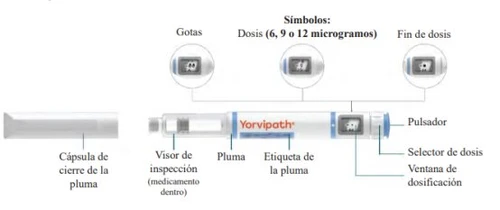
Overview of parts
Figure A
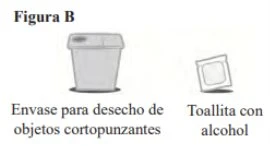
You will also need
Figure B
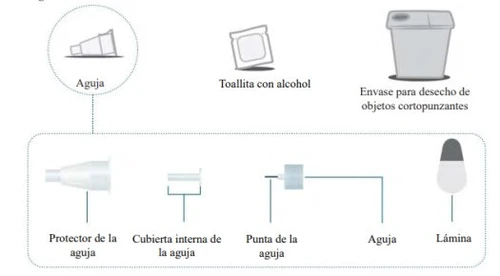
1 Preparing the pen and needle | |
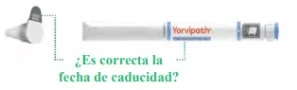
Step 1 Take your Yorvipath pen. Make sure it is the correct concentration and check the expiration date. Take a needle and check the expiration date on the needle (Figure C). Note: Remove your pen from the refrigerator 20 minutes before first use. | Figure C
|
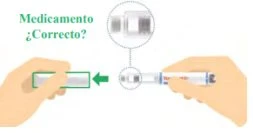
Step 2 Remove the pen cap and check the inspection window to ensure that the medication inside the pen is clear and colorless (Figure D). Important: If the medication contains visible particles, do not use the pen. Use a new pen. | Figure D
|
Step 3 Remove the tab from the needle (Figure E). This needle can only be used once. Always use a new needle for each injection. | Figure E
|
Step 4 Attach the needle straight onto your pen, then screw the needle onto the pen until it is secure (Figure F). | Figure F
|
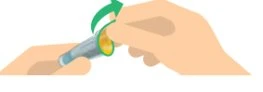
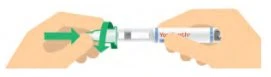
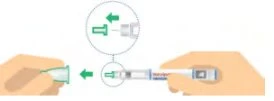
Step 5 Remove the needle protector and the inner needle cap (Figure G). Important: Do not touch the blue cap, as it may block the needle. | Figure G
|
|
|
| Test the pen flow (steps A – C) only the first time you use a new pen. If your pen is already in use, go to section 3 "Prepare the injection and select the dose". |
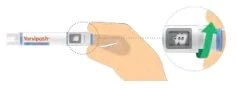
Step A Turn the dose selector to the right 2 clicks until you see the drop symbol “” in the dose window (Figure H). Note: You can always correct the selection by turning the dose selector. | Figure H
|
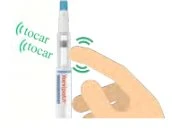
Step B Bring air bubbles to the top of the pen by tapping the inspection window (Figure I). Hold the pen with the needle tip pointing upward. Note: Small air bubbles are acceptable. | Figure I
|
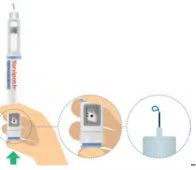
Step C Press the injection button and observe droplets of medication emerging from the needle tip. While pressing, ensure the dose selector rotates back toward the drop symbol (Figure J). Important: If you do not see medication droplets, repeat this test (steps A – C) up to 5 times. If no droplets appear, replace the needle and repeat the test. | Figure J
|

3 Prepare the injection and select the dose | |
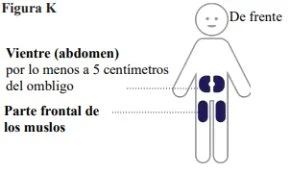
Step 6 Choose the injection site. There are two areas on your body where you can administer the injection (Figure K). Avoid injecting into red, swollen, or scarred skin areas. Choose a different injection site each time you give an injection. |
|
Step 7 Wash your hands and clean the injection site with an alcohol wipe (Figure L). | Figure L
|
Step 8 Select your dose as prescribed by your doctor (6, 9, or 12 micrograms) by turning the dose selector to the right (Figure M). Important: Make sure not to press the button when selecting the dose to avoid wasting the medication. Note: Always discard your pen and use a new one if you cannot set a full dose. | Figure M
|
4 Inject the dose | |
| Use the injection administration technique recommended by your doctor or nurse. Read this entire section (steps 9–11) before starting to inject. |
Step 9 Make sure you can see the dose window. Insert the needle into the skin (Figure N). | Figure N
|
Step 10 Press the button fully and hold it firmly for 5 seconds. Ensure that the dose selector rotates back to the symbol . This indicates that the full dose has been delivered (Figure O). | Figure O
|
Step 11 Slowly remove the pen from the injection site (Figure P). | Figure P
|
5 Dispose of the used needle | |
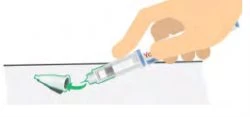
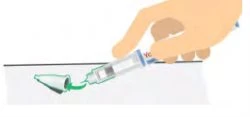
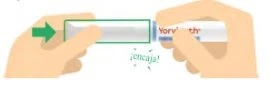
Step 12 Replace the needle cap to carefully remove the needle. Insert the needle tip into the cap and secure the cap onto the needle (Figure Q). Important: Always recap the needle before removing it to reduce the risk of needlestick injury and cross-contamination. | Figure Q
|
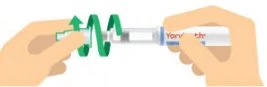
Step 13 Unscrew the needle and dispose of it safely according to local regulations (Figure R). | Figure R
|
Step 14 Firmly attach the pen cap onto the pen to protect it between injections and to protect the medication from light (Figure S). | Figure S
|
6 Dispose of the used pen |
|
Important: Always dispose of the pen 14 days after first use, in accordance with local regulations. To keep track of when 14 days have passed, it is recommended to cover the “Date of opening” field on the inner packaging. Always discard your pen after 14 days of use, even if there is medication remaining (Figure T). This is important to ensure you receive the full effect of the medication. Note: If the pen package includes needles, remember to discard the additional needle when disposing of the pen. | Figure T
|

INSTRUCTIONS FOR USE
Yorvipath
294 micrograms/0.98 ml
For doses of 15, 18, or 21 micrograms only
Injectable solution in a pre-filled pen
palopegteriparatide
Subcutaneous use
The instructions for use contain
information on how to inject
Yorvipath
Additional information
If you do not understand or are unable to complete any of the steps described in the instructions for use, consult your doctor or nurse.
Important information you must know before starting to use your Yorvipath pen Read and follow the package leaflet and these instructions for use carefully to ensure you inject Yorvipath correctly. Make sure you have received training from your doctor or nurse before administering the injection. This is important to ensure you receive the correct treatment. For correct use
|
Special instructions for doses greater than 30 micrograms/day If your dose is greater than 30 micrograms/day:
|
Pen care
|
Troubleshooting
You should only test the pen flow (section 2) the first time you use a new pen (or if you suspect it may be damaged) to avoid wasting medication. The test checks that the medicine flows through the pen so you can receive the correct dose.
If you do not see drops at the tip of the needle after 5 attempts, it may be because there is no flow through the pen and needle. Change the needle (see section 5, step 12) and test the pen flow again (see section 2, steps A–C). You can confirm proper flow if you see a drop of medicine. If it still does not work, dispose of the pen and consult your healthcare professional.
The injection is only complete when you press the plunger fully down and the dose selector has rotated back and you have kept the needle in the skin for 5 seconds.
Some of the medicine may flow back into the pen or leak out from the injection site onto the skin. Pressing the pen against the skin for 5 seconds helps ensure that all the medicine has been injected.
The pen does not allow you to set a dose higher than the amount remaining. If your dose is greater than the amount of medicine left in the pen, you will not be able to set a full dose. You must dispose of your pen and take the full dose using a new one. |
Overview of the parts
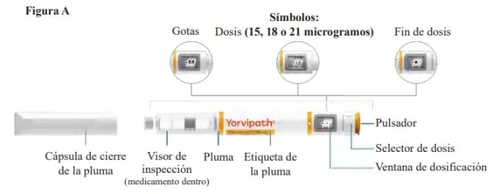
You will also need
Figure B
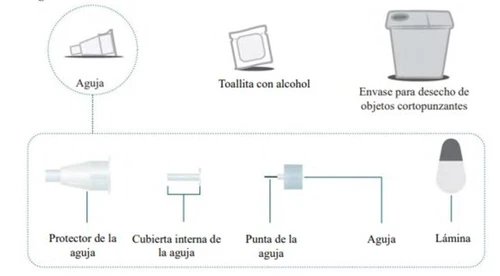
1 Preparing the pen and needle | |
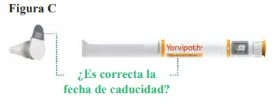
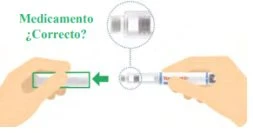
Step 1 Take your Yorvipath pen. Make sure it is the correct concentration and check the expiration date. Take a needle and check the expiration date on the needle (Figure C). Note: Take your pen out of the refrigerator 20 minutes before first use. | Figure C
|
Step 2 Remove the pen cap and check the inspection window to ensure that the medicine inside the pen is clear and colourless (Figure D). Important: If the medicine has visible particles, do not use the pen. Use a new pen. | Figure D
|
Step 3 Remove the tab from the needle (Figure E). This needle can only be used once. Always use a new needle for each injection. | Figure E
|
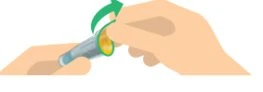
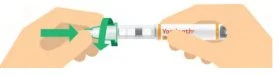
Step 4 Place the needle directly onto your pen, then screw the needle onto the pen until secure (Figure F). | Figure F
|
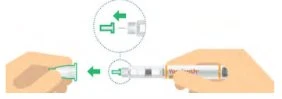
Step 5 Remove the needle protector and the inner needle cap (Figure G). Immediately discard the inner needle cap and keep the needle protector for later use. | Figure G
|
|
|
| Test the pen flow (steps A – C) only the first time you use a new pen. If your pen is already in use, go to section 3 "Prepare the injection and select the dose". |
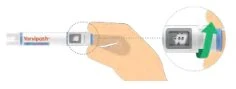
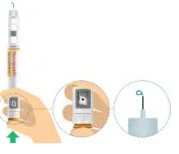
Step A Turn the dose selector to the right 2 clicks until you see the drop symbol “” in the dose window (Figure H). Note: You can always correct the selection by turning the dose selector. | Figure H
|
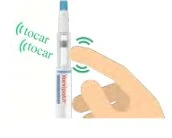
Step B Move air bubbles to the top of the pen by tapping the inspection window (Figure I). Keep the pen with the needle tip pointing upward. Note: Small air bubbles are acceptable. | Figure I
|
Step C Press the injection button and observe medication drops coming out from the needle tip. While pressing, make sure the dose selector rotates back to the symbol (Figure J). Important: If you do not see medication drops, repeat this test (steps A – C) up to 5 times. If no drops appear, replace the needle and repeat the test. | Figure J
|

3 Prepare the injection and select the dose | |
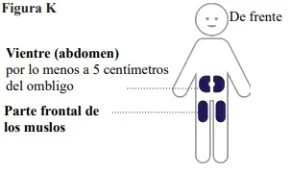
Step 6 Choose the injection site. There are two areas on your body where you can administer the injection (Figure K). Avoid injecting into red, swollen, or scarred skin areas. Choose a different injection site each time you give the injection. |
|
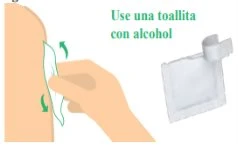
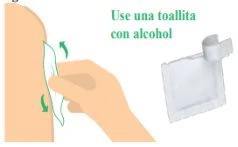
Step 7 Wash your hands and clean the injection site with an alcohol wipe ( Figure L). | Figure L
|
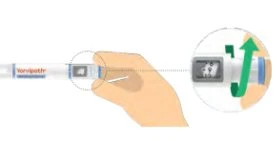
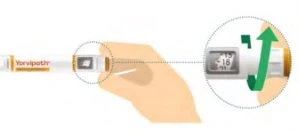
Step 8 Select your dose as prescribed by your doctor (15, 18, or 21 micrograms) by turning the dose selector to the right (Figure M). Important: Make sure not to press the push-button when selecting the dose to avoid wasting the medication. Note: Always discard your pen and use a new one if you cannot set a full dose. | Figure M
|
4 Inject the dose | |
| Use the injection administration technique recommended by your doctor or nurse. Read this entire section (Steps 9–11) before beginning to inject. |
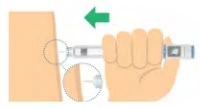
Step 9 Make sure you can see the dose window. Insert the needle into the skin (Figure N). | Figure N
|
Step 10 Press the push-button fully down and hold it firmly for 5 seconds. Ensure that the dose selector rotates back to the symbol . This indicates that the full dose has been delivered (Figure O). | Figure O
|
Step 11 Slowly remove the pen from the injection site. (Figure P) | Figure P
|
5 Dispose of the used needle | |
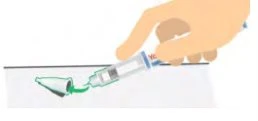
Step 12 Replace the needle cap to carefully remove the needle. Insert the needle tip into the cap and secure the cap onto the needle (Figure Q). Important: Always replace the needle cap before removing the needle to reduce the risk of needlestick injury and cross-contamination. | Figure Q
|
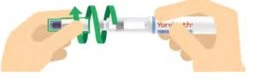
Step 13 Unscrew the needle and dispose of it safely according to local regulations (Figure R). | Figure R
|
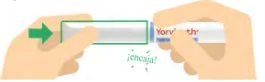
Step 14 Firmly attach the pen cap onto the pen to protect it between injections and to shield the medication from light (Figure S). | Figure S
|
6 Dispose of the used pen |
|
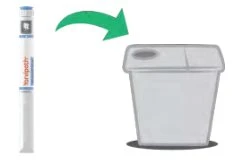
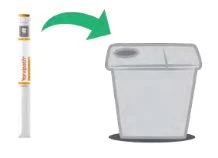
Important: Always dispose of the pen 14 days after first use, according to local regulations. To keep track of when 14 days have passed, it is recommended to cover the “Date of opening” field on the packaging. Always discard your pen after 14 days of use, even if there is still medication remaining (Figure T). This is important to ensure you receive the full therapeutic effect of the medication. | Figure T
|

INSTRUCTIONS FOR USE
Yorvipath
420 micrograms/1.4 ml
For 24, 27, or 30 microgram doses only
Injectable solution in a pre-filled pen
palopegteriparatide
Subcutaneous use
The instructions for use provide
information on how to inject
Yorvipath.
Additional information
If you do not understand or are unable to complete any of the steps described in these instructions for use, consult your doctor or nurse.
Important information you must know before starting to use your Yorvipath pen Read and follow the package leaflet and these instructions for use carefully to ensure you inject Yorvipath correctly. Make sure you have received training from your doctor or nurse before administering the injection. This is important to ensure you receive the correct treatment. For correct use
|
Special instructions for doses greater than 30 micrograms/day If your dose is greater than 30 micrograms/day:
|
Care of the pen
|
Troubleshooting
You should only test the pen flow (section 2) the first time you use a new pen (or if you suspect it may be damaged) to avoid wasting medication. The test checks that the medicine flows properly through the pen so you can receive the correct dose.
If you do not see drops at the needle tip after 5 attempts, it may be because there is no flow through the pen and needle. Change the needle (see section 5, step 12) and retest the pen flow (see section 2, steps A–C). You can confirm proper flow if you see a drop of medicine. If it still does not work, dispose of the pen and consult your healthcare professional.
The injection is only complete when you press the dose button fully down, the dose selector has rotated back to , and you have kept the needle in the skin for 5 seconds.
Some of the medicine may flow back into the pen or leak from the injection site onto the skin. Pressing the pen against the skin for 5 seconds helps ensure that the full dose has been injected.
The pen does not allow you to set a dose greater than the amount remaining. If your dose is higher than the amount of medicine left in the pen, you will not be able to set the full dose. You must dispose of your pen and take the full dose using a new pen. |
Overview of components
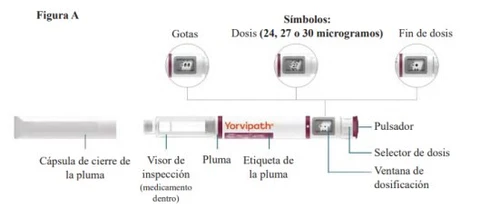
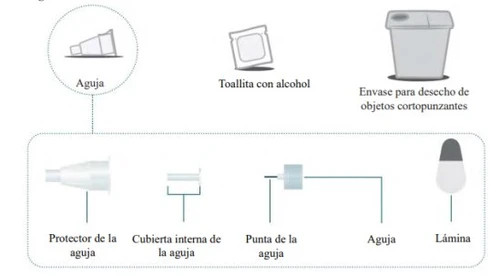
You will also need
Figure B
1 Preparation of the pen and needle | |
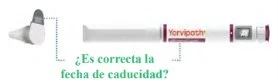
Step 1 Take your Yorvipath pen. Make sure it is the correct concentration and check the expiration date. Take a needle and check the expiration date on the needle (Figure C). Note: Remove your pen from the refrigerator 20 minutes before first use. | Figure C
|
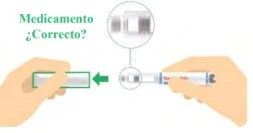
Step 2 Remove the closure cap from the pen and check the inspection window to ensure that the medicine inside the pen is clear and colorless (Figure D). Important: If visible particles are present in the medicine, do not use the pen. Use a new pen. | Figure D
|
Step 3 Remove the tab from the needle (Figure E). This needle can only be used once. Always use a new needle for each injection. | Figure E
|
Step 4 Place the needle directly onto your pen, then screw the needle onto the pen until secure (Figure F). | Figure F
|
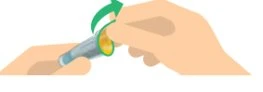
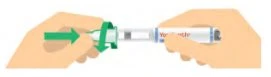
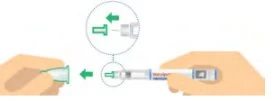
Step 5 Remove the needle cap—the inner needle cover (Figure G). Immediately discard the inner needle cover and keep the outer needle cap for later use. | Figure G
|
|
|
| Test the pen flow (Steps A–C) only the first time you use a new pen. If your pen is already in use, go to Section 3 "Prepare the injection and select the dose". |
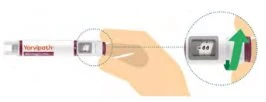
Step A Turn the dose selector to the right by 2 clicks until you see the drop symbol “” in the dose window (Figure H). Note: You can always correct the selection by turning the dose selector. | Figure H
|
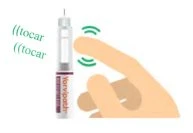
Step B Move air bubbles to the top of the pen by tapping the inspection window (Figure I). Hold the pen with the needle tip pointing upward. Note: Small air bubbles are acceptable. | Figure I
|
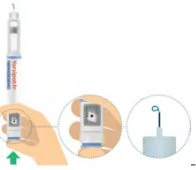
Step C Press the injection button and observe medicine droplets coming out from the needle tip. While pressing, ensure that the dose selector returns to the symbol (Figure J). Important: If no medicine droplets are seen, repeat this test (Steps A–C) up to 5 times. If still no droplets appear, change the needle and repeat the test. | Figure J
|

3 Prepare the injection and select the dose | |
Step 6 Choose the injection site. There are two areas on your body where you can administer the injection (Figure K). Avoid injecting into areas of red, swollen, or scarred skin. Choose a different injection site each time you give an injection. |
|
Step 7 Wash your hands and clean the injection site with an alcohol wipe (Figure L). | Figure L
|
Step 8 Select your dose as prescribed by your doctor (24, 27, or 30 micrograms) by turning the dose selector to the right (Figure M). Important: Make sure not to press the button while selecting the dose, to avoid wasting the medication. Note: Always discard your pen and use a new one if you cannot set a full dose. | Figure M
|
4 Inject the dose | |
| Use the injection administration technique recommended by your doctor or nurse. Read the entire section (Steps 9–11) before starting to inject. |
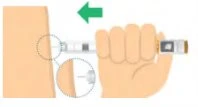
Step 9 Ensure you can see the dose window. Insert the needle into the skin (Figure N). | Figure N
|
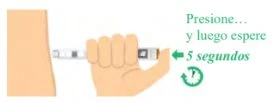
Step 10 Press and hold the button fully down for 5 seconds. Make sure the dose selector rotates back to the symbol . This indicates that the full dose has been delivered (Figure O). | Figure O
|
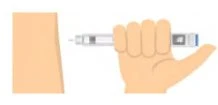
Step 11 Slowly remove the pen from the injection site (Figure P). | Figure P
|
5 Dispose of the used needle | |
Step 12 Replace the needle cap to carefully remove the needle. Place the needle tip into the cap and secure the cap onto the needle (Figure Q). Important: Always recap the needle before removing it from the pen to reduce the risk of needlestick injury and cross-contamination. | Figure Q
|
Step 13 Unscrew the needle and dispose of it safely according to local regulations (Figure R). | Figure R
|
Step 14 Firmly attach the pen cap onto the pen to protect it between injections and to protect the medication from light (Figure S). | Figure S
|
6 Dispose of the used pen |
|
Important: Always dispose of the pen 14 days after first use, in accordance with local regulations. To keep track of when 14 days have passed, it is recommended to cover the “Date of Opening” field on the inner packaging. Always discard your pen after 14 days of use, even if there is medication remaining (Figure T). This is important to ensure you receive the full therapeutic effect of the medication. Note: If the pen package includes needles, remember to dispose of any unused needles when discarding the pen. | Figure T
|