Xydalba 500 mg powder for concentrate for solution for infusion
Spain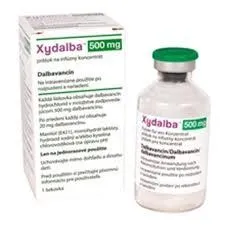
Table of Contents
Package leaflet: Information for the user
Introduction
Package leaflet: Information for the patient
Xydalba 500 mg powder for concentrate for solution for infusion
dalbavancin
Read this entire leaflet carefully before you start using this medicine, as it contains important information for you.
- Keep this leaflet, as you may need to read it again.
- If you have any questions, consult your doctor, pharmacist, or nurse.
- If you experience any adverse effects, consult your doctor, pharmacist, or nurse, even if these effects are not listed in this leaflet. See section 4.
Contents of the leaflet
- What Xydalba is and what it is used for
- What you need to know before Xydalba is administered to you
- How Xydalba is administered
- Possible side effects
- How to store Xydalba
- Contents of the pack and other information
1. What Xydalba is and what it is used for
Xydalba contains the active substance dalbavancin, which is an antibiotic belonging to the glycopeptide group.
Xydalba is used to treat skin and soft tissue infections (tissue beneath the skin) in adults and children from birth.
Xydalba works by killing certain bacteria that can cause serious infections. It kills bacteria by interfering with the formation of bacterial cell walls.
If you also have other bacteria causing the infection, your doctor may decide to treat you with additional antibiotics along with Xydalba.
2. What you need to know before you are given Xydalba
Do not use Xydalba if you are allergic to dalbavancin or to any of the other ingredients of this medicine (listed in section 6).
Warnings and precautions
Talk to your doctor, pharmacist, or nurse before receiving Xydalba:
- If you have or have had kidney problems. Depending on your age and kidney function, your doctor may need to reduce your dose.
- If you have diarrhea, or have previously had diarrhea when treated with antibiotics.
- If you are allergic to other antibiotics such as vancomycin or teicoplanin.
Diarrhea during or after treatment
If you develop diarrhea during or after your treatment, contact your doctor immediately.
Do not take any medication for diarrhea without first consulting your doctor.
Infusion-related reactions
Intravenous infusion of this type of antibiotic may cause redness of the upper body, hives, itching, or skin rashes. If you experience such reactions, your doctor may decide to interrupt the infusion or slow it down.
Other infections
The use of antibiotics may sometimes lead to a new and different infection. If this occurs, your doctor will decide on the appropriate course of action.
Other medicines and Xydalba
Inform your doctor or pharmacist if you are taking, have recently taken, or might need to take any other medicines.
Pregnancy and breastfeeding
Xydalba is not recommended during pregnancy unless clearly necessary, as it is unknown what effect it might have on the fetus. If you are pregnant or breastfeeding, think you may be pregnant, or plan to become pregnant, consult your doctor before being given this medicine. You and your doctor will decide whether Xydalba will be administered to you.
It is unknown whether Xydalba passes into human breast milk. Consult your doctor before breastfeeding. You and your doctor will decide whether Xydalba should be administered. You must not breastfeed while receiving Xydalba.
Driving and using machines
Xydalba may cause dizziness. Exercise caution when driving or operating machinery after receiving this medicine.
Xydalba contains sodium
This medicine contains less than 1 mmol of sodium (23 mg) per dose; i.e., essentially “sodium-free”.
3. How Xydalba is administered
Xydalba will be administered by a doctor or nurse.
- Adults: Xydalba is given as a single 1,500 mg dose or as two doses given one week apart: 1,000 mg on day 1 and 500 mg on day 8.
- Children and adolescents from 6 to less than 18 years of age: Xydalba is given as a single dose of 18 mg/kg (maximum 1,500 mg).
- Young children and children from 0 to less than 6 years of age: Xydalba is given as a single dose of 22.5 mg/kg (maximum 1,500 mg).
The dose for children from 0 to less than 18 years of age will be calculated by the doctor according to the child's age and weight.
Xydalba will be administered to you via an intravenous infusion (through a vein) over 30 minutes.
Patients with chronic renal impairment
If you have chronic kidney problems, your doctor may decide to reduce your dose. There is insufficient information available to recommend the use of Xydalba in children with chronic renal impairment.
If you are given more Xydalba than you should
Inform your doctor or nurse immediately if you think you may have received too much Xydalba.
If you miss a dose of Xydalba
Inform your doctor or nurse immediately if you are concerned about missing the 2nd dose.
If you have any further questions about the use of this medicine, ask your doctor, pharmacist, or nurse.
4. Possible adverse effects
Like all medicines, this medicine can cause adverse effects, although not everyone will experience them.
Serious adverse effects
Tell your doctor immediately if you experience any of these symptoms – you may need urgent medical attention:
- Sudden swelling of the lips, face, throat or tongue; severe rash; itching; tightness in the throat; drop in blood pressure; difficulty swallowing or breathing. These may be signs of a hypersensitivity reaction and can be life-threatening. This reaction has been reported as a rare adverse effect. It may affect up to 1 in 1,000 people.
- Abdominal (stomach) pain or watery diarrhoea. The symptoms may be severe or may not go away, and stools may contain blood or mucus. These may be signs of a bowel infection. In this case, you should stop taking any medicines that slow down or reduce intestinal movement. Bowel infection has been reported as an uncommon adverse effect. It may affect up to 1 in 100 people.
- Changes in hearing ability. These have been reported as an adverse effect with a similar medicine. Frequency is unknown. It is not possible to estimate frequency from the available data.
Other adverse effects reported with Xydalba are listed below.
Talk to your doctor, pharmacist, or nurse if you experience any of the following adverse effects:
Common – (may affect up to 1 in 10 people):
- Headache
- Feeling unwell (nausea)
- Diarrhoea
Uncommon – (may affect up to 1 in 100 people):
- Vaginal infections, fungal infections, oral candidiasis
- Urinary tract infections
- Anaemia (low red blood cell levels in blood), increased platelet count in blood (thrombocytosis), increased blood count of a type of white blood cells called eosinophils (eosinophilia), low levels of other types of white blood cells (leucopenia, neutropenia)
- Changes in other blood tests
- Decreased appetite
- Difficulty sleeping
- Dizziness
- Change in taste sensation
- Inflammation and swelling of superficial veins, hot flushes
- Cough
- Abdominal pain and discomfort, indigestion, constipation
- Abnormal liver function tests
- Increased alkaline phosphatase (an enzyme present in the body)
- Itching, hives
- Genital itching (in women)
- Pain, redness or swelling at the site where the infusion was given
- Feeling of warmth
- Increased levels of gamma-glutamyl transferase (an enzyme produced by the liver and other body tissues)
- Rash
- Vomiting
Rare – (may affect up to 1 in 1,000 people):
- Difficulty breathing (bronchospasm)
Reporting of adverse effects
If you experience any type of adverse effect, talk to your doctor, pharmacist, or nurse, even if it is a possible adverse effect not listed in this leaflet. You may also report them directly through the national reporting system included in Appendix V. By reporting adverse effects, you can help provide more information on the safety of this medicine.
5. Storage of Xydalba
Keep this medicine out of the sight and reach of children.
Do not use this medicine after the expiry date stated on the vial after EXP.
The expiry date is the last day of the month indicated.
This medicine does not require any special storage conditions if kept closed in its original packaging.
Do not use the prepared Xydalba infusion solution if you notice any particles or if the solution is cloudy.
Xydalba is for single use only.
Medicines should not be disposed of via wastewater or household waste. Ask your pharmacist how to properly dispose of unused medicines and their packaging. This will help protect the environment.
6. Contents of the container and other information
Composition of Xydalba
- The active substance is dalbavancin. Each vial of powder contains dalbavancin hydrochloride equivalent to 500 mg of dalbavancin.
- The other components are mannitol (E421), lactose monohydrate, hydrochloric acid and/or sodium hydroxide (only for pH adjustment).
Appearance of the product and contents of the container
Xydalba powder for concentrate for solution for infusion is supplied in a 48 ml glass vial with a green flip-off seal. The vial contains a white or off-white to pale yellow powder.
It is available in packs containing 1 vial.
Marketing Authorization Holder
AbbVie Deutschland GmbH & Co. KG
Knollstrasse
67061 Ludwigshafen
Germany
Manufacturer
Almac Pharma Services (Ireland) Limited
Finnabair Industrial Estate,
Dundalk,
Co. Louth, A91 P9KD, Ireland
Almac Pharma Services Ltd
Seagoe Industrial Estate, Craigavon,
County Armagh BT63 5UA
United Kingdom
Aziende Chimiche Riunite Angelini Francesco A.C.R.A.F. S.p.A.
Via Vecchia del Pinocchio, 22
60131 Ancona
Italy
Further information on this medicinal product is available upon request by contacting the local representative of the Marketing Authorization Holder:
Belgium/Belgium/Belgium Advanz Pharma Belgium Tel/Tel: +32 (0)800 78 941 | Lithuania Angelini Pharma S.p.A Tel: +39 06 78 0531 |
| Luxembourg/Luxembourg Amdipharm Ltd Tel: +352 27861461 |
Czech Republic Angelini Pharma Czech Republic s.r.o. Tel: +420 546 123 111 | Hungary Angelini Pharma Magyarország Kft Tel: +36 1 336 1614 |
Denmark Abcur AB Sweden Tel: +45 8082 6022 | Malta Advanz Pharma Tel: +44 (0)208 588 9131 |
Germany Advanz Pharma Germany GmbH Tel: +49 (0)800 1802 091 | Netherlands Amdipharm Ltd Tel: +31 (0)20 808 32 06 |
Estonia Lorenzo Pharma OÜ Tel: +372 6041669 | Norway Abcur AB Sweden Tel: +47 800 16 689 |
Greece ANGELINI PHARMA HELLAS MONOPROSOPI A.B.E.E. PRODUCTION AND PHARMACEUTICAL TRADE Tel: +30 210 626 9200 | Austria Angelini Pharma Österreich GmbH Tel: +43 5 9606 0 |
Spain ANGELINI PHARMA ESPAÑA, S.L. Tel: +34 93 253 45 05 | Poland Angelini Pharma Polska Sp. z o.o. Tel: +48 22 70 28 200 |
France Advanz Pharma Tel: +33 (0)1 77 68 89 17 | Portugal AbbVie, Lda. Tel: +351 (0)21 1908400 |
Croatia Angelini Pharma S.p.A Tel: +39 06 78 0531 | Romania Angelini Pharmaceuticals România SRL Tel: +40 21 331 6767 |
Ireland Advanz Pharma Tel: +352 1800 851 119 | Slovenia Angelini Pharma S.p.A Tel: +39 06 78 0531 |
Iceland Abcur AB Sweden Tel: +46 20 088 02 36 | Slovakia Angelini Pharma Slovenská republika s.r.o. Tel: +421 2 59 207 320 |
Italy Angelini Pharma S.p.A Tel: +39 071 809 809 | Finland Abcur AB Sweden Tel: +358 800 416231 |
Cyprus ANGELINI PHARMA HELLAS MONOPROSOPI A.B.E.E. PRODUCTION AND PHARMACEUTICAL TRADE Tel: +30 210 626 9200 | Sweden Abcur AB Sweden Tel: +46 (0)20 088 02 36 |
Latvia SIA Livorno Pharma Tel: +371 67211124 |
Date of last review of this summary {MM/YYYY}.
Detailed information on this medicine is available on the European Medicines Agency website: http://www.ema.europa.eu.
This information is intended for healthcare professionals only:
Important: Consult the package leaflet or summary of product characteristics before prescribing this medicine.
Xydalba must be reconstituted with sterile water for injection and subsequently diluted with 50 mg/ml (5%) glucose solution for infusion.
Xydalba vials are for single use only.
Instructions for reconstitution and dilution
Aseptic technique must be used for the reconstitution and dilution of Xydalba.
- The contents of each vial must be reconstituted by slowly adding 25 ml of water for injections.
- Do not shake. To avoid foaming, gently agitate and invert the vial alternately until the contents are completely dissolved. Reconstitution may take up to 5 minutes.
- The reconstituted concentrate in the vial contains 20 mg/ml of dalbavancin.
- The reconstituted concentrate must be a clear, colourless to yellow solution free from visible particles.
- The reconstituted concentrate must be diluted with 50 mg/ml (5%) glucose solution for infusion.
- To dilute the reconstituted concentrate, the appropriate volume of the 20 mg/ml concentrate should be transferred from the vial to an intravenous bag or bottle containing 50 mg/ml (5%) glucose solution for infusion. For example: 25 ml of concentrate contains 500 mg of dalbavancin.
- After dilution, the infusion solution must have a final concentration of 1 to 5 mg/ml of dalbavancin.
- The infusion solution must be a clear, colourless to yellow solution free from visible particles.
- If particles or discolouration are observed, the solution must be discarded.
Xydalba must not be mixed with other medicinal products or intravenous solutions. Solutions containing sodium chloride may cause precipitation and must NOT be used for reconstitution or dilution. Compatibility of the reconstituted Xydalba concentrate has only been established with 50 mg/ml (5%) glucose solution for infusion.
If a common intravenous line is used to administer other medicinal products in addition to Xydalba, the line must be flushed before and after each Xydalba infusion with 5% glucose solution for infusion.
Use in the paediatric population
For paediatric patients, the dose of Xydalba will vary depending on the child's age and weight, up to a maximum of 1,500 mg. Transfer the required dose of reconstituted dalbavancin solution, as per the instructions above and based on the child's weight, from the vial to an intravenous bag or bottle containing 50 mg/ml (5%) glucose solution for infusion. The diluted solution must have a final concentration of 1 to 5 mg/ml of dalbavancin.
Table 1 below provides guidance for preparing an infusion solution with a final concentration of 2 mg/ml or 5 mg/ml (sufficient in most cases), to be administered via syringe pump, to achieve a dose of 22.5 mg/kg in paediatric patients from birth to 12 months of age weighing 1 to 12 kg. Alternative concentrations may be prepared but must fall within the final concentration range of 1 to 5 mg/ml of dalbavancin.
Refer to Table 1 to confirm calculations. The values shown are approximate. Note that the table does not include all possible calculated doses for each age group, but may be used to estimate the approximate volume to verify calculations.
Table 1. Preparation of Xydalba (final infusion concentration 2 mg/ml or 5 mg/ml for administration via syringe pump) in paediatric patients from birth to 12 months (dose of 22.5 mg/kg)
Weight of patient (kg) |
Dose (mg) to achieve 22.5 mg/kg |
Volume of reconstituted dalbavancin solution (20 mg/ml) to withdraw from vial (ml) |
Volume of diluent 50 mg/ml (5%) glucose solution to add for mixing (ml) |
Final concentration of dalbavancin infusion solution |
Total volume administered by syringe pump (ml) |
1 |
22.5 |
1.1 ml |
90 ml |
2 mg/ml |
11.3 |
2 |
45.0 |
2.3 ml |
|||
3 |
67.5 |
3.4 ml |
|||
4 |
90.0 |
4.5 ml |
|||
5 |
112.5 |
5.6 ml |
|||
6 |
135.0 |
6.8 ml |
|||
7 |
157.5 |
7.9 ml |
|||
8 |
180.0 |
9.0 ml |
|||
9 |
202.5 |
20 ml |
60 ml |
5 mg/ml |
40.5 |
10 |
225.0 |
45.0 |
|||
11 |
247.5 |
49.5 |
|||
12 |
270.0 |
54.0 |
Disposal
Discard any unused portion of the reconstituted solution.
The disposal of unused medication and all materials that have come into contact with it must be carried out in accordance with local regulations.