Xilonibsa 10 mg/puff, solution for cutaneous spray
Spain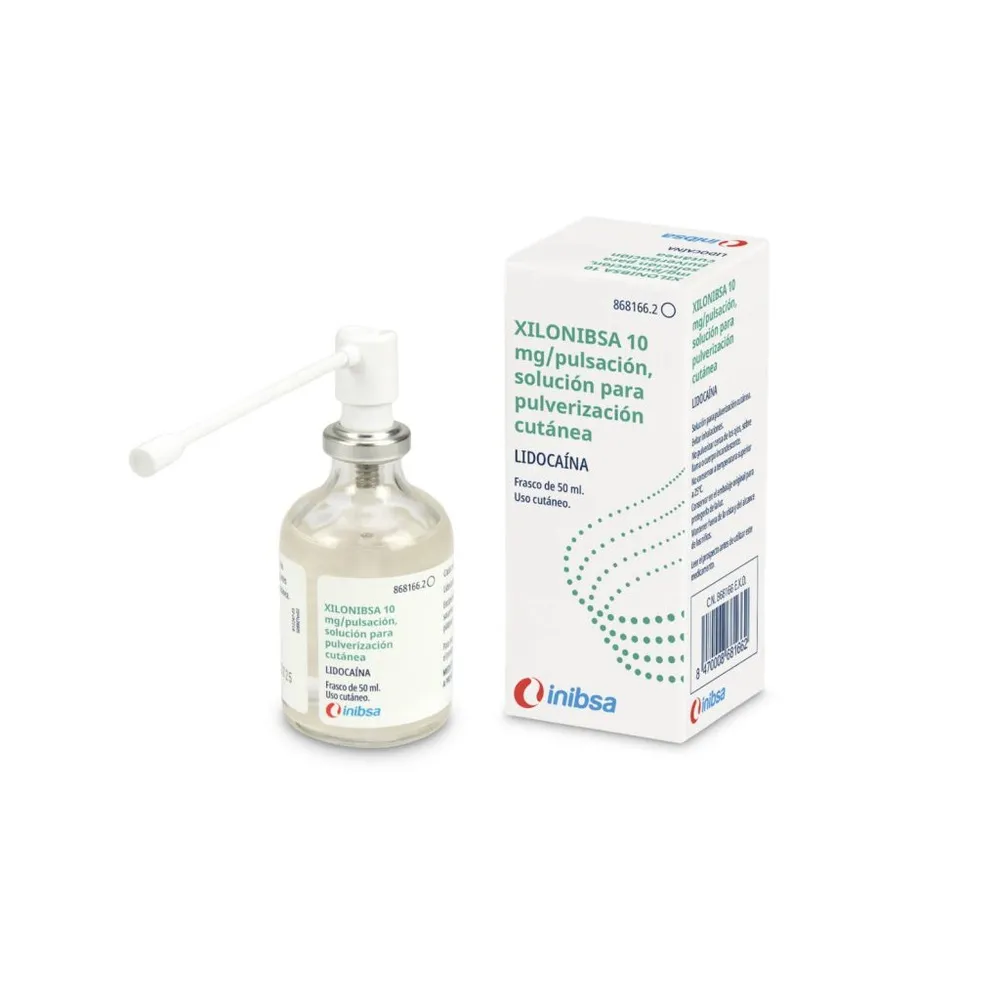
Table of Contents
- Package leaflet: Information for the user
- Introduction
- 1. What Xilonibsa 10 mg/puff is and what it is used for
- 2. What you need to know before using Xilonibsa 10 mg/puff
- 3. How to use Xilonibsa 10 mg/actuation
- 4. Possible adverse effects
- 5. Storage of Xilonibsa 10 mg/puff
- 6. Contents of the pack and other information
Package leaflet: Information for the user
Introduction
Package leaflet: information for the user
Xilonibsa 10 mg/spray, cutaneous spray solution
Lidocaine
Read the entire leaflet carefully before you start using this medicine, because it contains important information for you.
- Keep this leaflet, as you may need to read it again.
- If you have any questions, ask your doctor.
- This medicine has been prescribed for you only, and you should not give it to other people, even if they have the same symptoms as you, because it could harm them.
- If you experience any adverse effects, consult your doctor, even if they are effects not listed in this leaflet. See section 4.
Contents of the leaflet
- What Xilonibsa 10 mg/spray is and what it is used for
- What you need to know before using Xilonibsa 10 mg/spray
- How to use Xilonibsa 10 mg/spray
- Possible side effects
- How to store Xilonibsa 10 mg/spray
- Contents of the pack and other information
1. What Xilonibsa 10 mg/puff is and what it is used for
Xilonibsa 10 mg/puff contains lidocaine and belongs to the group of amide-type local anesthetics.
Xilonibsa 10 mg/puff is indicated for superficial anesthesia of the mucosa in surgery, obstetrics, dentistry, and otorhinolaryngology.
2. What you need to know before using Xilonibsa 10 mg/puff
Do not use Xilonibsa 10 mg/puff:
- if you are allergic to lidocaine or to amide-type anaesthetics, or to any of the other ingredients of this medicine (listed in section 6).
Warnings and precautions
Consult your doctor before starting to use Xilonibsa 10 mg/puff:
- if you are elderly and debilitated.
- if you have epilepsy, hypovolemia, atrioventricular block, or other conduction disorders.
- if you have bradycardia or impaired respiratory function.
- if you have impaired liver function.
- if you suffer from cardiac or circulatory failure.
- if you have renal impairment.
Excessive doses should be avoided, as well as the application of the medicine to infected or inflamed tissues, since in these cases lidocaine absorption is very rapid and systemic adverse reactions may occur.
Avoid contact of lidocaine with the eyes. In case of ocular contact, if applicable, remove contact lenses. Immediately and thoroughly rinse with water for 15 minutes, keeping the eyelids apart. Do not let the water flow into the unaffected eye. Seek immediate additional treatment from an ophthalmologist.
Patients receiving class III antiarrhythmic drugs (e.g., amiodarone) should be closely monitored and ECG monitoring should be considered, as cardiac effects may be additive.
Children
The use of Xilonibsa 10 mg/puff is not recommended in children under 6 years of age due to the risk of very rapid absorption of the anaesthetic and the risk of reflex laryngospasm in newborns.
Lidocaine should be used with caution in children over 6 years of age, without exceeding the maximum recommended dose.
Taking Xilonibsa 10 mg/puff with other medicines
Inform your doctor if you are taking, have recently taken, or might need to take any other medicines.
In particular, inform your doctor if you have recently taken or are being treated with any of the following medicines:
- Medicines used to treat epilepsy, such as phenytoin.
- Medicines used for the treatment of AIDS (atazanavir, darunavir).
- Other local or general anaesthetics (halothane).
- Diuretic medicines (acetazolamide, loop diuretics, and thiazides).
- Cimetidine or beta-blockers.
Use of Xilonibsa 10 mg/puff with food and drink
It is recommended not to eat or drink until sensation has returned, to prevent the risk of biting the inside of the mouth.
Pregnancy, breast-feeding, and fertility
If you are pregnant or breast-feeding, think you may be pregnant, or are planning to become pregnant, consult your doctor before using this medicine.
Pregnancy
The use of Xilonibsa 10 mg/puff during pregnancy is not recommended because it crosses the placental barrier. However, there is no evidence of congenital abnormalities.
The use of Xilonibsa 10 mg/puff during pregnancy should be reserved only for cases in which the potential benefit justifies the possible risks to the fetus.
Breast-feeding
Xilonibsa 10 mg/puff is excreted in breast milk, but at the therapeutic doses used, effects on newborns or breast-fed children are not expected.
Fertility
No effects on fertility have been reported with Xilonibsa 10 mg/puff.
Driving and using machines
The effect of Xilonibsa 10 mg/puff on the ability to drive and use machines is minor.
Depending on the dose and site of administration, local anaesthetics may affect mental function and temporarily impair locomotion and coordination. When administering this medicine, the doctor should assess in each individual case whether reaction capacity is impaired and whether the patient may drive or operate machinery.
Xilonibsa 10 mg/puff may cause dizziness, sedation, blurred vision, and dizziness. If any of these adverse effects occur after administration of Xilonibsa 10 mg/puff, you should wait until these symptoms have subsided before driving or operating machinery.
Xilonibsa 10 mg/puff contains ethanol
This medicine contains 241 mg of alcohol (ethanol) per ml. It may cause a burning sensation on damaged skin.
3. How to use Xilonibsa 10 mg/actuation
Xilonibsa 10 mg/actuation will be administered by your doctor.
The lowest dose providing the required anesthetic effect should be used, avoiding the use of excessive doses.
No more than 20 actuations should be applied to achieve the desired anesthesia in adults.
In dentistry
It is recommended to administer 1 to 5 applications onto the mucosa.
In otorhinolaryngology
When used for maxillary sinus puncture, 3 sprays are recommended.
In gynecology-obstetrics
Approximately 20 sprays (equivalent to 200 mg) are recommended.
Note that the maximum dose within 24 hours for an adult weighing approximately 70 kg is 200 mg (corresponding to 20 applications with the dosing valve). No more than 20 applications should be administered per adult patient. If dosing is based on the patient's body weight, the dose should not exceed 3 mg/kg body weight per day.
Use in children
The lidocaine dose in children should be adjusted according to the nature of the procedure and patient characteristics. In children over 6 years of age, the maximum dose should be calculated based on body weight, using 3 mg/kg body weight per day as the recommended maximum daily dose.
The use of Xilonibsa 10 mg/actuation is not recommended in children under 6 years of age.
If you use more Xilonibsa 10 mg/actuation than you should
As with other local anesthetics, excessive dosing or rapid absorption may lead to systemic reactions affecting the CNS and the cardiovascular system. In such cases, treatment will consist of maintaining vital signs, and if seizures occur, administering short-acting barbiturates (e.g. thiopental) or benzodiazepines (diazepam) intravenously.
In case of overdose or accidental ingestion, contact the Toxicology Information Service. Telephone 91 562 04 20.
4. Possible adverse effects
Like all medicines, this medicine may cause adverse effects, although not everyone will experience them.
Xilonibsa 10 mg/puff may cause local irritation (cough, sneezing) at the time of administration or immediately afterwards.
Other adverse reactions that may occur with the use of this medicine are:
Rare adverse effects (may affect up to 1 in 1,000 patients).
Cardiac disorders: Hypotension, arrhythmias, bradycardia, cardiac arrest.
Nervous system disorders: Metallic taste, tinnitus, dizziness, nausea, vomiting, anxiety, tremors, nystagmus, headache, increased respiratory rate, paresthesia (loss of sensation accompanied by burning) of the lip and/or tongue, unconsciousness and seizures, coma, and respiratory arrest (in case of overdose).
Respiratory disorders: Tachypnea followed by bradypnea, possibly leading to apnea.
Very rare adverse effects (may affect up to 1 in 10,000 patients).
General disorders and administration site reactions: Allergic reactions, skin rash, erythema, pruritus, edema of the tongue, mouth, lips, or throat, and, in the most severe cases, anaphylactic shock.
Reporting of adverse effects
If you experience any type of adverse effect, consult your doctor, even if it is a possible adverse effect not listed in this leaflet. You may also report them directly through the Spanish Pharmacovigilance System for Human Medicines: www.notificaram.es. By reporting adverse effects, you can help provide more information on the safety of this medicine.
5. Storage of Xilonibsa 10 mg/puff
Keep this medicine out of the sight and reach of children.
Do not store above 25°C.
Keep in the original packaging to protect from light.
Do not use this medicine after the expiry date stated on the container. The expiry date refers to the last day of the month indicated.
Medicines should not be disposed of via wastewater or household waste. Ask your pharmacist how to dispose of any unused medicines and their containers. This helps protect the environment.
6. Contents of the pack and other information
Composition of Xilonibsa 10 mg/actuation
- The active substance is lidocaine.
- The other excipients are ethanol 96%, menthol, saccharin, macrogol 400, banana flavour, and purified water.
Appearance of the product and contents of the container
Xilonibsa 10 mg/actuation is a clear or practically clear solution with a characteristic odour.
Xilonibsa 10 mg/actuation is supplied in a 50 ml bottle containing approximately 500 actuations. Each bottle contains a metering valve delivering a dose of 10 mg lidocaine per actuation.
Marketing Authorisation Holder and Manufacturer
Laboratorios Inibsa, S.A.
Ctra. Sabadell a Granollers, km. 14.5
08185 Lliçà de Vall (Barcelona)
Spain
Telephone: +34 938 609 500
Fax: +34 938 439 695
e-mail: [email protected]
Local representative
LAPHYSAN S.A.U.
Anabel Segura, 11 Edificio A, 4th Floor, Door D
28108 Alcobendas (Madrid)
Spain
Date of the most recent revision of this leaflet: May 2016
Detailed information on this medicine is available on the website of the Spanish Agency for Medicines and Health Products (AEMPS) http://www.aemps.gob.es/