Xermelo 250 mg film-coated tablets
Spain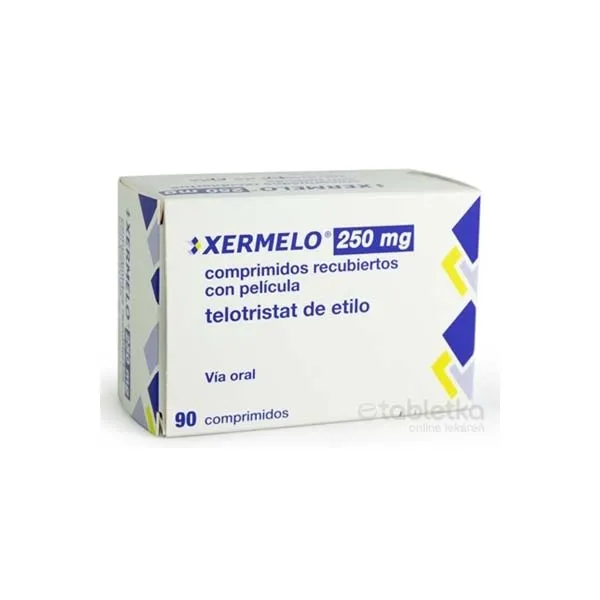
Table of Contents
Patient Information Leaflet
Introduction
Package leaflet: Information for the patient
Xermelo 250 mg film-coated tablets
telotristat ethyl
This medicinal product is subject to additional monitoring, which will allow for faster detection of new safety information. You can help by reporting any side effects you may experience. Information on how to report side effects is provided at the end of section 4.
Read this entire leaflet carefully before starting to take this medicine, as it contains important information for you.
- Keep this leaflet, as you may need to refer to it again.
- If you have any questions, consult your doctor or pharmacist.
- This medicine has been prescribed for you personally; do not give it to others, even if they have the same symptoms as you, since it could harm them.
- If you experience any side effects, consult your doctor, pharmacist, or nurse, even if they are side effects not listed in this leaflet. See section 4.
Contents of the leaflet
- What Xermelo is and what it is used for
- What you need to know before taking Xermelo
- How to take Xermelo
- Possible side effects
- How to store Xermelo
- Contents of the pack and other information
1. What Xermelo is and what it is used for
What Xermelo is
This medicine contains the active substance telotristat ethyl.
What Xermelo is used for
This medicine is used in adults with a condition called "carcinoid syndrome", which occurs when a tumour, known as a "neuroendocrine tumour", releases a substance called serotonin into the bloodstream.
Your doctor will prescribe this medicine if your diarrhoea is not well controlled with injections of other medicines called "somatostatin analogues" (lanreotide or octreotide). You must continue receiving injections of these other medicines while you are taking Xermelo.
How Xermelo works
When the tumour releases too much serotonin into the bloodstream, it can cause diarrhoea.
This medicine works by reducing the amount of serotonin produced by the tumour and thereby reducing diarrhoea.
2. What you need to know before taking Xermelo
Do not take Xermelo:
- If you are allergic to telotristat or to any of the other ingredients of this medicine
(listed in section 6).
Warnings and precautions
Talk to your doctor or pharmacist before starting Xermelo:
- If you have liver problems. This is because this medicine has not been studied in patients with severe liver problems. Your doctor will decide whether your daily dose of Xermelo should be reduced. Your doctor will also monitor your liver function.
- If you have kidney problems. This is because this medicine has not been fully studied
in patients with kidney problems.
Look out for adverse effects
Immediately inform your doctor if you experience any of the following signs and symptoms indicating that your liver may not be working properly:
- Feeling nauseous or vomiting (unexplained nausea or vomiting), abnormally dark urine, yellowing of the skin or eyes, pain on the right side of the abdomen.
Your doctor will perform blood tests to check your liver function and will decide whether you should continue taking this medicine.
Talk to your doctor or pharmacist:
- If you feel discouraged, depressed, or lose interest in or no longer enjoy your usual activities while taking this medicine.
- If you have signs of constipation, because telotristat reduces the number of bowel movements.
Tests
- Your doctor may perform blood tests before you start taking this medicine and during treatment. These are to check that your liver is functioning normally.
Children and adolescents
This medicine is not recommended for patients under 18 years of age, as it has not been studied in this age group.
Other medicines and Xermelo
Tell your doctor or pharmacist if you are taking, have recently taken, or might need to take any other medicines. This is because Xermelo may affect how other medicines work, or other medicines may affect how Xermelo works. This may mean that your doctor needs to adjust your doses. You should inform your doctor about all medicines, including:
- Medicines for diarrhoea. Both Xermelo and these medicines reduce the number of bowel movements, and taking them together may cause severe constipation. Your doctor may need to adjust the dose of your medicines.
- Medicines used to treat epilepsy, such as valproic acid.
- Medicines used to treat neuroendocrine tumours, such as sunitinib or everolimus.
- Medicines used to treat depression, such as bupropion or sertraline.
- Medicines used to prevent transplant rejection, such as cyclosporine.
- Medicines used to lower cholesterol levels, such as simvastatin.
- Oral contraceptives, such as ethinylestradiol.
- Medicines used to treat high blood pressure, such as amlodipine.
- Octreotide. If you require treatment with subcutaneous octreotide injections, you should receive the injection at least 30 minutes after taking Xermelo.
Pregnancy and breastfeeding
If you are pregnant or breastfeeding, think you might be pregnant, or are planning to become pregnant, consult your doctor or pharmacist before taking this medicine.
You must not take this medicine if you are pregnant or could be pregnant. It is unknown how telotristat may affect the baby.
Women must use effective contraceptive methods during treatment with this medicine.
You must not breastfeed while taking Xermelo, as this medicine could pass into the breast milk and harm the baby.
Driving and using machines
Telotristat may have a minor effect on the ability to drive or use machines or tools. If you feel tired, you should wait until you feel better before driving or using machines or tools.
Xermelo contains lactose
Xermelo contains lactose (a type of sugar). If your doctor has informed you that you have an intolerance to certain sugars, consult with them before taking this medicine.
3. How to take Xermelo
Follow exactly the instructions for use of this medicine provided by your doctor or pharmacist. If you are unsure, consult your doctor or pharmacist again.
How much to take
The recommended dose is one tablet (250 mg) three times a day. The maximum dose of Xermelo is 750 mg in 24 hours.
Your doctor will decide how long you should take Xermelo.
If you have liver problems, your doctor will decide whether your daily dose of Xermelo should be reduced.
Taking this medicine
- Always take this medicine with a meal or some food.
- You must continue receiving somatostatin analogue injections (lanreotide or octreotide) while taking Xermelo.
If you take more Xermelo than you should
You may feel nauseous, have diarrhea, or stomach pain. Speak to a doctor. Take the medicine packaging with you.
If you forget to take Xermelo
If you forget to take a dose, take the next dose at the scheduled time, skipping the missed dose. Do not take a double dose to make up for the missed doses.
If you stop taking Xermelo
Do not stop taking Xermelo without consulting your doctor.
If you have any further questions about the use of this medicine, ask your doctor or pharmacist.
4. Possible adverse effects
Like all medicines, this medicine can cause adverse effects, although not everyone will experience them.
Tell your doctor immediately if you notice any of the following adverse effects:
- Feeling nauseous or having nausea, abnormally dark urine, yellowing of the skin or eyes, pain in the upper right side of the abdomen. These may be signs that the liver is not working properly. This could be reflected in changes in blood test results, such as increased liver enzymes: gamma-glutamyl transferase (very common, may affect more than 1 in 10 people), transaminases and alkaline phosphatase in blood (common, may affect up to 1 in 10 people).
Other adverse effects
Tell your doctor, pharmacist, or nurse if you notice any of the following adverse effects:
Very common adverse effects:
- Abdominal pain
- Feeling tired or weak (fatigue)
Common adverse effects:
- Gas
- Fever
- Headache
- Constipation
- Bloating
- Decreased appetite
- Swelling (fluid retention in the body)
Tell your doctor, pharmacist, or nurse if you notice any of the adverse effects listed above.
Reporting of adverse effects
If you experience any type of adverse effect, consult your doctor, pharmacist, or nurse, even if it is a possible adverse effect not listed in this leaflet. You may also report them directly through the national reporting system included in Appendix V. By reporting adverse effects, you can help provide more information on the safety of this medicine.
5. Storage of Xermelo
Keep this medicine out of the sight and reach of children.
Do not use this medicine after the expiry date stated on the packaging and blister after EXP. The expiry date refers to the last day of the month indicated.
Medicines must not be disposed of via wastewater or household waste. Ask your pharmacist how to properly dispose of unused medicines and their packaging. This will help protect the environment.
6. Contents of the pack and other information
Composition of Xermelo
- The active substance is telotristat ethyl. Each tablet contains telotristat etiprate equivalent to 250 mg of telotristat ethyl.
- The other components are: anhydrous lactose (see section 2 “Xermelo contains lactose”), hydroxypropyl cellulose, sodium croscarmellose, magnesium stearate, colloidal anhydrous silica, polyvinyl alcohol (partially hydrolysed) (E1203), titanium dioxide (E171), macrogol 3350 (E1521) and talc (E553b).
Nature of the product and contents of the pack
The tablets are white to off-white, film-coated and oval-shaped. Each tablet measures approximately 17 mm in length and 7.5 mm in width, with the imprint “T-E” on one side and “250” on the other. The tablets are packed in aluminium-PVC/PCTFE/PVC blisters. The blisters are contained in a cardboard carton.
Pack sizes of 90 and 180 tablets. Only certain pack sizes may be marketed.
Marketing Authorisation Holder
SERB SAS
40 Avenue George V
75008 Paris
France
Manufacturer
Beaufour Ipsen Industrie
Rue Ethé Virton
28100 Dreux
France
Date of the most recent review of this leaflet:
Other sources of information
Detailed information on this medicine is available on the European Medicines Agency website: http://www.ema.europa.eu. Links to other websites on rare diseases and orphan medicines are also provided.