Winrevair 45 mg powder and solvent for solution for injection
Spain
Table of Contents
Package leaflet: Information for the patient
Introduction
Package leaflet: information for the patient
Winrevair 45 mg powder and solvent for injectable solution
Winrevair 60 mg powder and solvent for injectable solution
sotatercept
This medicinal product is subject to additional monitoring, which will allow rapid identification of new safety information. You can help by reporting any side effects you may experience. See the end of section 4 for information on how to report side effects.
Read all of this leaflet carefully before you start using this medicine, because it contains important information for you.
- Keep this leaflet, as you may need to read it again.
- If you have any questions, ask your doctor, pharmacist, or nurse.
- This medicine has been prescribed for you only and must not be given to other people, even if they have the same symptoms as you, because it could harm them.
- If you experience any side effects, talk to your doctor, pharmacist, or nurse, even if they are side effects not listed in this leaflet. See section 4.
Contents of the leaflet
- What Winrevair is and what it is used for
- What you need to know before using Winrevair
- How to use Winrevair
- Possible side effects
- How to store Winrevair
- Contents of the pack and other information
1. What Winrevair is and what it is used for
Winrevair contains the active substance sotatercept.
It is used in combination with other treatments for pulmonary arterial hypertension (PAH) in adults. PAH is a type of high blood pressure that affects the arteries in the lungs. In PAH, these arteries become narrowed, making it harder for the heart to pump blood through them, leading to symptoms such as fatigue, dizziness, and shortness of breath.
Winrevair acts on the underlying causes of PAH responsible for the narrowing of the lung arteries, thereby improving the heart's ability to pump blood to the lungs and delaying disease progression. It can relieve PAH symptoms, help increase life expectancy, and reduce the need for lung transplantation or hospitalization due to PAH.
2. What you need to know before you start using Winrevair
Do not use Winrevair
- if you are allergic to sotatercept or to any of the other components of this medicine (listed in section 6).
- if your platelet count in the blood is persistently very low.
Warnings and precautions
Winrevair may increase hemoglobin levels in the blood, decrease the number of platelets in the blood, or increase the risk of serious bleeding.
Consult your doctor or pharmacist before starting to use Winrevair and during treatment if you experience:
- high levels of hemoglobin in the blood (a protein in red blood cells that carries oxygen).
This may increase the likelihood of forming a blood clot that could block a blood vessel. Your doctor will check your hemoglobin levels with periodic blood tests before each of your first 5 doses of Winrevair, before each subsequent dose if necessary, and periodically while you are using this medicine.
- decreased number of platelets in the blood (cells that help blood to clot).
This may cause easy bruising, prolonged bleeding from cuts, and nosebleeds. Your doctor will check your platelet count with periodic blood tests before each of your first 5 doses of Winrevair, before each subsequent dose if necessary, and periodically while you are using this medicine. If your platelet count remains persistently very low, your doctor will not start treatment.
- signs and symptoms of serious bleeding:
|
coughing |
|
|
|
|
|
|
|
These are signs and symptoms of serious bleeding, which may occur if you use Winrevair and are more likely to occur if you use Winrevair with certain medications. Your doctor will inform you how to recognize them. Contact your doctor if you notice any of these signs or symptoms. Serious bleeding may lead to hospitalization, the need for a blood transfusion or other treatments, and could be life-threatening.
Children and adolescents
Do not administer this medicine to children and adolescents under 18 years of age. It is unknown whether this medicine is safe and effective in individuals under 18 years of age.
Other medicines and Winrevair
Inform your doctor or pharmacist if you are taking, have recently taken, or might need to take any other medicines.
Pregnancy, breastfeeding, and fertility
If you are pregnant or breastfeeding, think you may be pregnant, or plan to become pregnant, consult your doctor or pharmacist before using this medicine.
Pregnancy:
Winrevair may harm the fetus.
This medicine is not recommended during pregnancy. Your doctor must perform a pregnancy test before you start treatment, and you must use an effective method of contraception during treatment and for at least four months after receiving the last dose of Winrevair. Ask your doctor or pharmacist about contraceptive methods that may be appropriate for you.
Inform your doctor immediately if you become pregnant or think you might be pregnant while using this medicine.
Breastfeeding:
It is unknown whether Winrevair passes into breast milk. Do not breastfeed during treatment and for at least four months after receiving the last dose of Winrevair. Consult your doctor or pharmacist about the best way to feed your baby.
Fertility:
Winrevair may reduce female and male fertility.
Driving and use of machines
It is unlikely that this medicine will affect your ability to drive or operate machinery.
Winrevair contains sodium
This medicine contains less than 1 mmol of sodium (23 mg) per dose; hence, it is essentially “sodium-free”.
Winrevair contains polysorbate 80
This medicine contains 0.20 mg of polysorbate 80 in each ml of reconstituted solution. Polysorbates may cause allergic reactions. Inform your doctor if you have any known allergies.
3. How to use Winrevair
Follow exactly the administration instructions for this medicine given by your doctor, pharmacist, or nurse. If in doubt, consult your doctor, pharmacist, or nurse again.
The recommended dosing schedule is one injection every 3 weeks.
Your dose
- Your dose of Winrevair depends on your body weight and blood tests. Your treatment will start with a dose of 0.3 mg/kg, which will be increased to 0.7 mg/kg.
- Your doctor will tell you how much Winrevair to use and when to use it. It is very important that you follow your doctor's instructions.
- Do not use Winrevair more frequently than your doctor has instructed. If you are unsure about when to use Winrevair, consult your doctor or pharmacist.
Your doctor will monitor your dose
- Before each of your first 5 doses, or before any subsequent dose if necessary, and periodically during treatment with Winrevair, your doctor will perform blood tests. This allows monitoring and determination of the most appropriate dose for you.
- Your doctor may adjust the dose, delay, or discontinue treatment depending on your response to Winrevair.
How you will use Winrevair
You will use Winrevair as an injection just under the skin (subcutaneous (SC)) only in the following injection sites:
- Abdomen, at least 5 cm away from the navel, or
- Upper thigh
Note: If your doctor or nurse administers the injection, they may also use the upper arm as an injection site, as they have been trained in the correct procedure.
Before using Winrevair
- If your doctor decides that you or your caregiver may administer Winrevair injections at home, you or your caregiver must receive training. This training will teach you the correct way to prepare and inject Winrevair. Do not attempt to inject Winrevair yourself until your doctor has shown you how to do it properly.
- Your doctor will tell you how much Winrevair to administer and when to administer it.
- Read the separate leaflet “Instructions for use” provided with Winrevair.
If you use less or more Winrevair than you should
If you use less or more Winrevair than prescribed, consult your doctor or pharmacist.
If you forget to use Winrevair
If you miss the prescribed dose of Winrevair and less than three days have passed since it should have been administered, administer it immediately and continue with the original schedule for the next dose. If you miss the prescribed dose of Winrevair and more than three days have passed since it should have been administered, your injection schedule will need to be adjusted; consult your doctor or pharmacist.
If you stop using Winrevair
Do not change the dose or stop using Winrevair without first talking to your doctor.
If you have any further questions about the use of this medicine, ask your doctor, pharmacist, or nurse.
4. Possible adverse effects
Like all medicines, this medicine can cause adverse effects, although not everyone will experience them.
Serious adverse effects:
Consult your doctor or pharmacist immediately if you notice:
- Easy bruising, prolonged bleeding from cuts, and nosebleeds. These could be signs of a low platelet count (thrombocytopenia). This will be detected in your blood tests.
Additionally, your doctor will carry out periodic blood tests to check whether you have:
- Elevated levels of hemoglobin.
The serious adverse effect described above may affect more than 1 in 10 people.
Other possible adverse effects:
Consult your doctor or pharmacist if you notice any of the following effects:
Very common (may affect more than 1 in 10 people):
- Headache
- Nosebleeds (epistaxis)
- Spider veins or tiny blood vessels appearing as pink or red lines on the skin (telangiectasia)
- Diarrhea
- Dizziness
- Skin rash
- Bleeding gums
- Back pain
Common (may affect up to 1 in 10 people):
- High blood pressure
- Skin redness
- Itching at the injection site
- Urinary tract infection (kidney, bladder, or urethra) which may cause pain in the lower back or abdomen and burning when urinating.
Frequency not known (cannot be estimated from available data):
- Fluid accumulation around the heart (pericardial effusion)
Reporting of adverse effects
If you experience any type of adverse effect, consult your doctor, pharmacist, or nurse, even if it is a possible adverse effect not listed in this leaflet. You may also report them directly through the national reporting system included in Appendix V. By reporting adverse effects, you can help provide more information on the safety of this medicine.
5. Storage of Winrevair
Keep this medicine out of the sight and reach of children.
Do not use this medicine after the expiry date stated on the vial and outer packaging, following "EXP". The expiry date refers to the last day of the month indicated.
Store in a refrigerator (between 2 ºC and 8 ºC). Do not freeze. Keep in the original packaging to protect from light.
This medicine should be administered immediately after mixing the powder with sterile water for injection; however, if necessary, it may be stored for up to 4 hours after reconstitution.
Medicines must not be disposed of via wastewater or household waste. Ask your pharmacist how to dispose of medicines and packaging once they are no longer needed. This will help protect the environment.
6. Contents of the pack and other information
Composition of Winrevair
- The active substance is sotatercept. Each vial contains 45 mg or 60 mg of sotatercept. After reconstitution, each ml of solution contains 50 mg of sotatercept.
- The other components are:
- In the powder: monohydrate citric acid (E330), sodium citrate (E331) (see section 2 “Winrevair contains sodium”), polysorbate 80 (E433) (see section 2 “Winrevair contains polysorbate 80”), and sucrose.
- In the solvent: water for injections.
Presentation of the product and contents of the pack
Winrevair is a powder and solvent for injectable solution (powder for injection). The white to off-white powder is contained in a 2 ml glass vial containing 45 mg or 60 mg of sotatercept. The solvent is clear, colourless water for injections supplied in a pre-filled syringe of 1 ml or 1.3 ml.
Winrevair 45 mg is available in:
- Pack containing 1 vial of 45 mg (powder), 1 pre-filled syringe of 1.0 ml (solvent), 1 vial adapter, 1 dosing syringe, 1 needle, and 4 alcohol-impregnated wipes.
- Pack containing 2 vials of 45 mg (powder), 2 pre-filled syringes of 1.0 ml (solvent), 2 vial adapters, 1 dosing syringe, 1 needle, and 8 alcohol-impregnated wipes.
Winrevair 60 mg is available in:
- Pack containing 1 vial of 60 mg (powder), 1 pre-filled syringe of 1.3 ml (solvent), 1 vial adapter, 1 dosing syringe, 1 needle, and 4 alcohol-impregnated wipes.
- Pack containing 2 vials of 60 mg (powder), 2 pre-filled syringes of 1.3 ml (solvent), 2 vial adapters, 1 dosing syringe, 1 needle, and 8 alcohol-impregnated wipes.
Marketing Authorisation Holder and Manufacturer Responsible
Merck Sharp & Dohme B.V.
Waarderweg 39
2031 BN Haarlem
The Netherlands
More information about this medicinal product is available upon request by contacting the local representative of the Marketing Authorisation Holder:
Belgium/Belgium/Belgium MSD Belgium Tel/Tel: +32(0)27766211 | Lithuania UAB Merck Sharp & Dohme Tel. + 370 5 2780 247 |
| Luxembourg/Luxembourg MSD Belgium Tél/Tel: +32(0)27766211 |
Czech Republic Merck Sharp & Dohme s.r.o. Tel: +420 233 010 111 | Hungary MSD Pharma Hungary Kft. Tel.: +36 1 888 5300 |
Denmark MSD Danmark ApS Tlf.: + 45 4482 4000 | Malta Merck Sharp & Dohme Cyprus Limited Tel: 8007 4433 (+356 99917558) |
Germany MSD Sharp & Dohme GmbH Tel: +49 (0) 89 20 300 4500 | Netherlands Merck Sharp & Dohme B.V. Tel: 0800 9999000 (+31 23 5153153) |
Estonia Merck Sharp & Dohme OÜ Tel: +372 614 4200 | Norway MSD (Norge) AS Tlf: +47 32 20 73 00 |
Greece MSD Α.Φ.Ε.Ε. Tel: +30 210 98 97 300 | Austria Merck Sharp & Dohme Ges.m.b.H. Tel: +43 (0) 1 26 044 |
Spain Merck Sharp & Dohme de España, S.A. Tel: +34 91 321 06 00 | Poland MSD Polska Sp. z o.o. Tel: +48 22 549 51 00 |
France MSD France Tél: + 33 (0) 1 80 46 40 40 | Portugal Merck Sharp & Dohme, Lda Tel: +351 21 4465700 |
Croatia Merck Sharp & Dohme d.o.o. Tel: + 385 1 6611 333 | Romania Merck Sharp & Dohme Romania S.R.L. Tel: +40 21 529 29 00 |
Ireland Merck Sharp & Dohme Ireland (Human Health) Limited Tel: +353 (0)1 2998700 | Slovenia Merck Sharp & Dohme, inovativna zdravila d.o.o. Tel: +386 1 5204 201 |
Iceland Vistor hf. Sími: + 354 535 7000 | Slovakia Merck Sharp & Dohme, s. r. o. Tel: +421 2 58282010 |
Italy MSD Italia S.r.l. Tel: 800 23 99 89 (+39 06 361911) | Finland/Finland MSD Finland Oy Puh/Tel: +358 (0)9 804 650 |
Cyprus Merck Sharp & Dohme Cyprus Limited Tel.: 800 00 673 (+357 22866700) | Sweden Merck Sharp & Dohme (Sweden) AB Tel: +46 77 5700488 |
Latvia SIA Merck Sharp & Dohme Latvija Tel.: + 371 67025300 |
Date of last review of this leaflet: {MM/YYYY}.
Detailed information on this medicine is available on the European Medicines Agency website: https://www.ema.europa.eu.
This information is intended for healthcare professionals only:
Winrevair powder and solvent for injectable solution must be reconstituted prior to use and should be administered as a single injection based on patient weight (see section 4.2 of the Summary of Product Characteristics for the recommended dosing regimen).
Refer to the separate Instructions for Use leaflet provided with this leaflet for detailed, step-by-step instructions on how to prepare and administer Winrevair powder and solvent for injectable solution. Below is an overview of the reconstitution and administration instructions.
Reconstitution instructions
- Remove the kit from the refrigerator and wait 15 minutes for the pre-filled syringe(s) and medication to reach room temperature before preparation.
- Check the vial to ensure the medicine has not expired. The powder should be white to off-white and may appear as a solid cake or fragmented.
- Remove the cap from the vial containing the powder and clean the rubber stopper with an alcohol wipe.
- Attach the vial adapter to the vial.
- Visually inspect the pre-filled syringe for damage or leakage and inspect the sterile water inside to ensure there are no visible particles.
- Break and remove the cap from the pre-filled syringe and connect the syringe to the vial adapter.
- Inject all the sterile water from the attached syringe into the vial containing the powder:
- The pre-filled syringe supplied with the 45 mg vial contains 1.0 ml of sterile water.
- The pre-filled syringe supplied with the 60 mg vial contains 1.3 ml of sterile water.
After reconstitution, the 45 mg vial can only provide one dose of up to 0.9 ml of medication, and the 60 mg vial can only provide one dose of up to 1.2 ml of medication. The final concentration after reconstitution is 50 mg/ml.
- Gently swirl the vial to reconstitute the medication. Do not shake vigorously.
- Allow the vial to stand for 3 minutes to allow bubbles to dissipate.
- Visually inspect the reconstituted solution. When properly mixed, the reconstituted solution should be clear to opalescent and colorless to slightly brownish-yellow, and should not contain lumps or particulate matter.
- Unscrew the syringe from the vial adapter and discard the empty syringe.
- If a 2-vial kit has been prescribed, repeat the steps in this section to prepare the second vial.
- Use the reconstituted solution as soon as possible, but no later than 4 hours after reconstitution.
Preparation of the dosing syringe
- Before preparing the dosing syringe, visually inspect the reconstituted solution. The reconstituted solution should be clear to opalescent and colorless to slightly brownish-yellow, and should not contain lumps or particulate matter.
- Clean the vial adapter with an alcohol wipe.
- Remove the dosing syringe from its packaging and attach it to the vial adapter.
- Invert the syringe and vial and withdraw the appropriate volume for injection based on patient weight.
- If the prescribed dose requires two vials, withdraw the entire contents of the first vial and slowly transfer all contents into the second vial to ensure accurate dosing.
- Invert the syringe and vial and withdraw the required amount of medication.
- If necessary, push the plunger to remove excess medication or air from the syringe.
- Remove the syringe from the vial adapter and attach the needle.
Administration instructions
Winrevair must be administered as a single subcutaneous injection.
-
Select an injection site on the abdomen (at least 5 cm from the navel), upper thigh, or upper arm, and clean it with an alcohol wipe. Choose a new site for each injection, avoiding areas with scars, tenderness, or bruising.
-
If administration is to be performed by the patient or caregiver, instruct them to inject only into the abdomen or upper thigh (see the “Instructions for Use” leaflet).
-
Administer the subcutaneous injection.
-
Discard the empty syringe. Do not reuse the syringe.
Disposal of unused medicine and all materials that have come into contact with it must be carried out in accordance with local regulations.
See section 4.4 of the Summary of Product Characteristics for instructions on traceability of biological medicines.
Instructions for Use
Winrevair 45mg powder and solvent for injectable solution (pack of 1 vial)
Winrevair 60mg powder and solvent for injectable solution (pack of 1 vial)
sotatercept
IMPORTANT: Read this leaflet before using the medicine
Instructions for Use
Winrevair 45 mg powder and solvent for injectable solution (pack of 1 vial)
Winrevair 60 mg powder and solvent for injectable solution (pack of 1 vial)
This leaflet contains instructions on how to prepare and inject Winrevair powder and solvent for injectable solution. The package leaflet, also included in the pack, contains all important information for you.
Dose according to patient weight.
For subcutaneous injection only (SC) (injection directly under the skin)
Contents of this leaflet (Important):
Before you start………………………………………………………………..4
Important information for healthcare professionals………………………....5
Know the parts of the pack…………………………………………………..6
Important information you should know before injection…………………....8
How to store the pack……………………………………………………...9
Preparation steps…………………………………………………………...10
- Mix the powder medicine with the liquid…………………….12
- Withdraw the prescribed dose…………………………………..24
- Inject the medicine……………………………………………..34
How to dispose of Winrevair………………………………………………..36
Frequently asked questions…………………………………………………...38
Before you start
Read this leaflet
Read these instructions from beginning to end before using Winrevair for the first time and before each administration, as the information may have been updated.
Start with your doctor or nurse
Do not use Winrevair until your doctor or nurse has shown you or your caregiver the correct way to prepare and inject it. Your doctor or nurse must train you to self-inject Winrevair before you administer it for the first time.
Questions?
If you have any doubts about the correct way to administer Winrevair or need more information, consult your doctor, pharmacist, or nurse.
Important information for healthcare professionals
The healthcare professional must provide step-by-step training on the correct preparation and administration of Winrevair using this “Instructions for Use” leaflet, and must determine whether the patient or caregiver is capable of independently preparing and administering Winrevair.
Ensure that the patient or caregiver can correctly perform the following:
- Reconstitute the medicine
- Measure the correct amount of medicine according to the patient's prescription
- Select and prepare an appropriate injection site
- Administer the medicine by subcutaneous injection
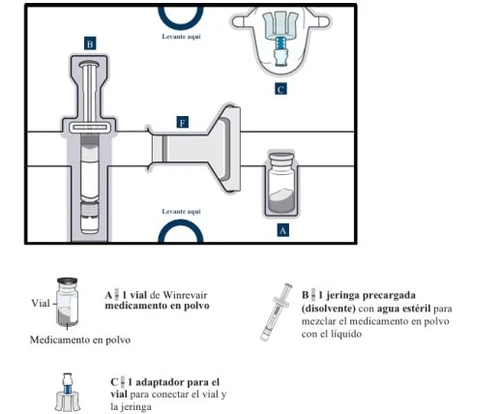
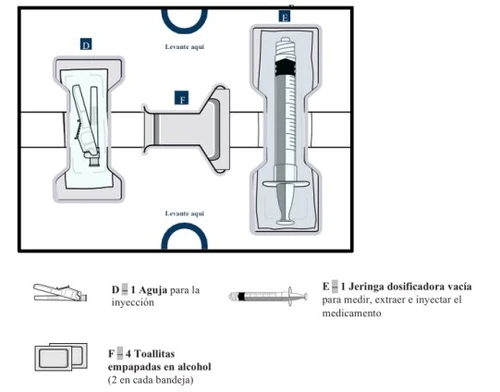
Know the parts of the pack
Upper tray: used to mix the medicine
Lower tray: used to inject the medicine
Important information you should know before injection
- This medicine must be mixed before use. Ensure that the powder in the vial is completely dissolved before injection.
- Check the prescribed dose (amount in “ml”) every time you use the medicine. The prescribed dose may change.
- Use only the materials supplied in the pack to prepare the prescribed dose.
- Do not open the pack or mix the medicine until you are ready to use it.
- Do not reuse any of the supplied materials. After injection, dispose of unused medicine and used materials in accordance with local regulations. See more information on pages 36–37.
How to store the pack
- Store the complete pack in the refrigerator, but do not freeze.
- Keep the medicine and supplied materials inside the pack and protected from light.
- Keep the pack out of sight and reach of children and pets.
Preparation steps
Any patient or caregiver who will prepare and inject Winrevair must first receive training and be considered by a healthcare professional as capable of independently administering Winrevair.
1 Check the Winrevair medicine and expiration date
Remove the Winrevair pack from the refrigerator.
Check the expiration date and look for any signs of damage in the pack or supplied materials.
Do not use if expired or damaged. Contact your doctor or pharmacist immediately to obtain a replacement pack.
Verify that you have the medicine prescribed by your doctor.
2 Allow the pack to reach room temperature, gather the supplied materials, and wash your hands
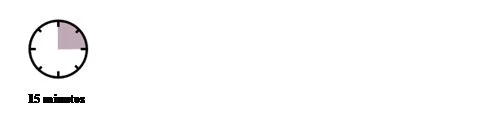
Wait 15 minutes to allow the pack to reach room temperature.
Injections are more painful if the medicine is cold.
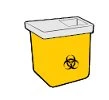
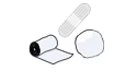
Gather the following items along with the pack and find a clean, flat surface to prepare and inject the dose.
| Sharps container |
| Gauze, cotton ball, or dressing |
Wash your hands with water and soap.

Mix the powder medicine with the liquid (Mix)
Start with the top tray
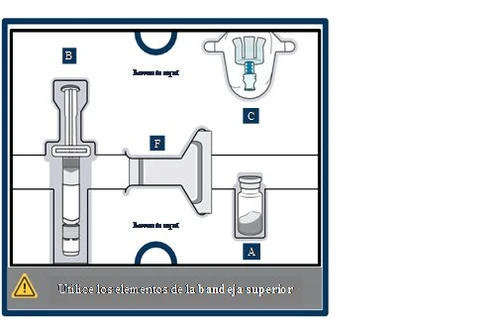
3 Remove the vial, the pre-filled syringe, and the vial adapter from the packaging
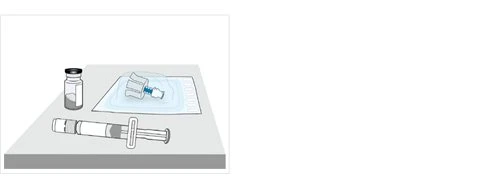
4a Check the vial and the medicine
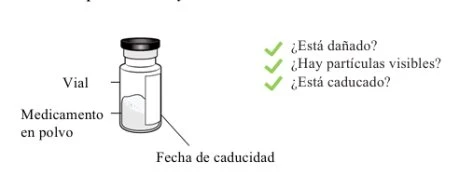
Check the label on the vial to confirm that the medicine is not expired.
Visually inspect the powder medicine. It should be white to off-white in color, and its appearance may be that of a solid cake or fragmented material.
 Do not use if it is expired, damaged, or if you see particles in it.
4b Remove the plastic cap and clean the vial
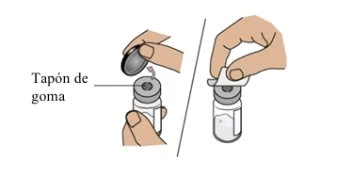
Remove the plastic cap and clean the rubber stopper on the top of the vial with an alcohol wipe.
Do not use if the vial cap is missing.
Do not touch the cleaned rubber stopper.
Set the vial aside on a clean, flat surface.
5a Attach the vial adapter to the vial
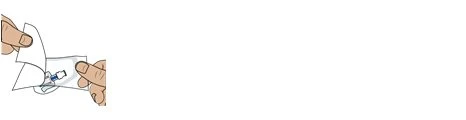
Open the vial adapter packaging and remove it from its container.
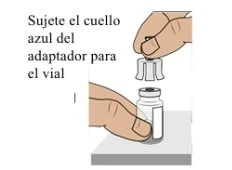
To attach the vial adapter:
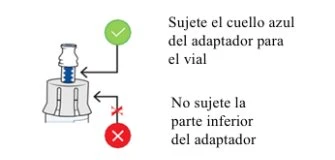
Hold the blue neck of the adapter and place the vial adapter onto the top of the vial.
Do not touch the inside of the vial adapter to keep it clean and avoid contact with sharp objects.
5b Connect the vial adapter to the vial
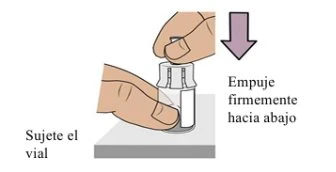
Hold the vial with one hand. Push the vial adapter firmly downward until it clicks into place (you may feel some resistance).
5c Clean the vial adapter
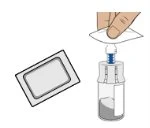
Clean the top of the vial adapter with an alcohol wipe.
6 Check the pre-filled syringe
Confirm that the product is not expired. Visually inspect that the sterile water in the pre-filled syringe is clear.
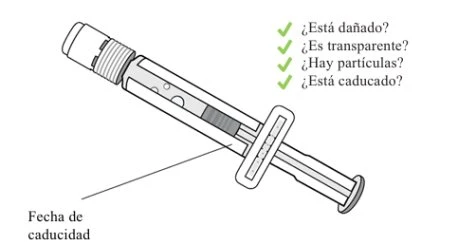
Do not use if you see clumps, particles, discoloration, or if the product is expired.
7 Break and remove the white cap from the pre-filled syringe
Break and remove the cap from the pre-filled syringe at the break point.
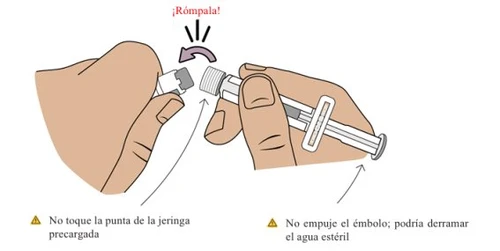
8 Connect the pre-filled syringe to the vial adapter
Next, take the medicine vial with the attached vial adapter.
Align the tip of the pre-filled syringe with the blue circle on the vial adapter.
Push and turn the pre-filled syringe onto the vial adapter until it stops turning. While turning, make sure to hold the vial adapter steady.
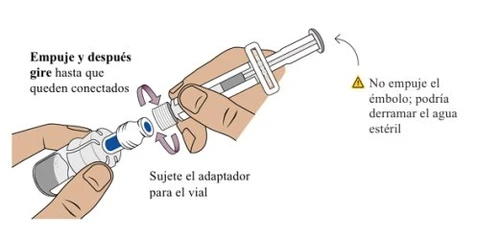
9 Transfer sterile water from the pre-filled syringe to the vial
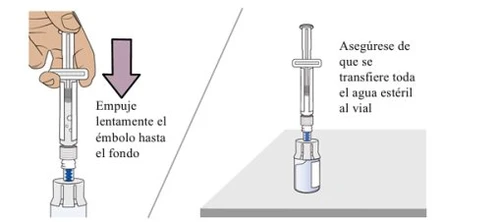
Slowly push the plunger all the way down to transfer all the sterile water into the vial (the plunger will move upward; this is normal).
10 Gently swirl to mix the medicine
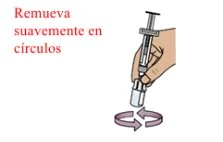
Do not shake the vial vigorously.
Hold the pre-filled syringe and gently swirl the vial in circular motions until the powder is completely dissolved. This may take up to 2 minutes. Do not shake vigorously.
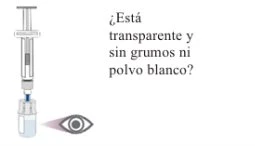
If the medicine is properly mixed, it should appear clear. If not, repeat this step until it becomes clear.
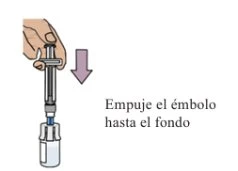
Push the plunger again to ensure all liquid enters the vial, as some liquid may have returned to the syringe (the plunger will move upward; this is normal).
11 Wait for bubbles to disappear
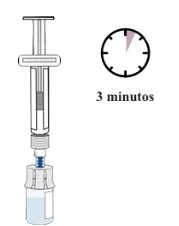
Set the vial aside to allow bubbles to dissipate.
This may take up to 3 minutes.
Before continuing, ensure that the medicine in the vial:
- Is clear to opalescent and colorless to slightly brownish-yellow.
- Has no clumps or powder.
- Has no large bubbles.
It is normal for a slight foam (small bubbles) to form around the edges of the vial.
12 Prepare the vial by removing excess air
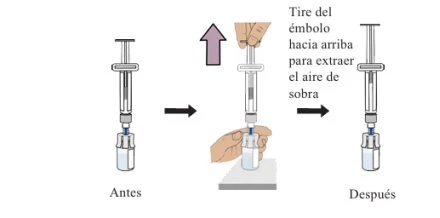
With the vial upright, gently pull the plunger upward to the top of the barrel, but be careful not to pull the plunger out of the syringe.
Practical tip: This step only removes excess air from the vial to reduce pressure and prevent medicine leakage when removing the syringe.
- Remove the pre-filled syringe from the vial
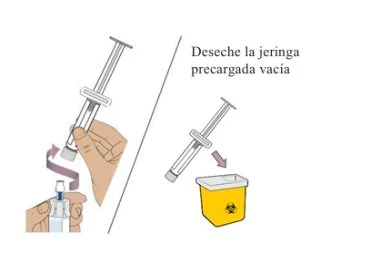
Hold the vial adapter and unscrew the syringe from the vial.
Dispose of the syringe in a sharps container.
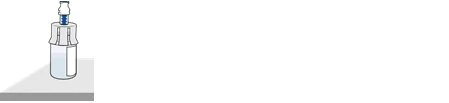
You should now have a prepared medicine vial ready for use in the following steps.
Draw up the prescribed dose (Draw up)
For the next steps, you will need:
- Mixed medicine vial
- Items from the bottom tray
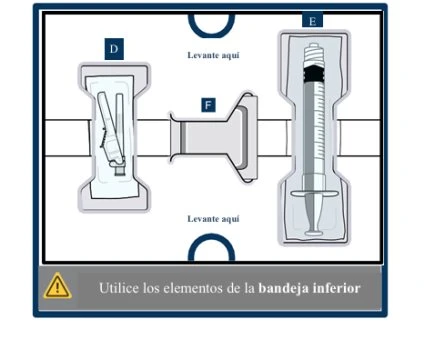
14 Clean the top of the vial adapter
Using a new alcohol wipe from the bottom tray, clean the top of the vial adapter.
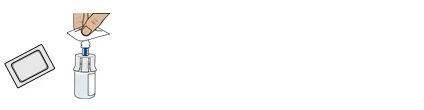
15 Remove the empty dosing syringe from its packaging
Locate the empty dosing syringe in the bottom tray and remove it from its packaging.
You will use this dosing syringe to measure the required amount of medicine (according to your prescribed dose).
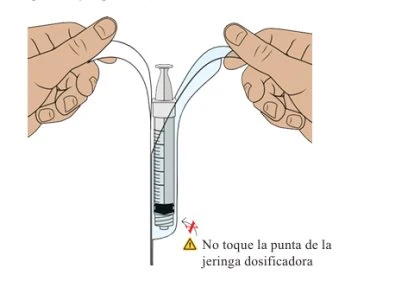
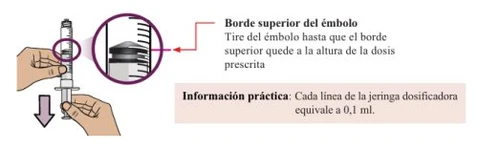
16 Introduce air into the dosing syringe
You must do this to ensure even pressure in the vial and to receive an accurate dose.
Hold the dosing syringe vertically and pull the plunger down to introduce air into the dosing syringe. Stop when you reach the “ml” amount indicated on your prescription.
17 Connect the dosing syringe to the vial
While holding the vial adapter, screw the dosing syringe onto it until it stops.
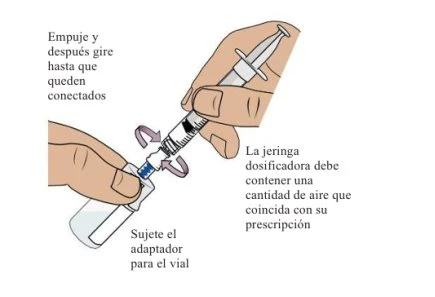
18 Insert air into the vial and then invert it
Push the plunger fully to transfer all air into the vial.
Then, keep the plunger in place with your thumb and invert the vial.
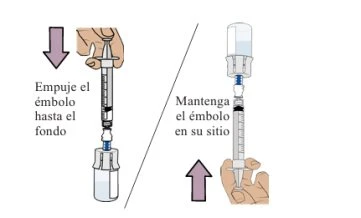
19 Pull the plunger to draw up the dose
With the vial and dosing syringe inverted, slowly pull the plunger backward.
Stop when you reach the “ml” amount indicated on your prescription.
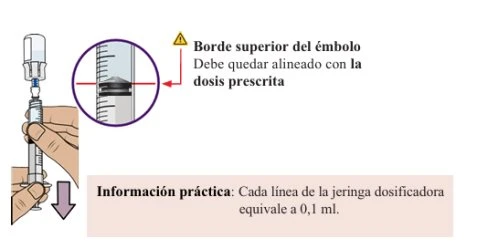
20 Check for bubbles and air pockets
Check for large air bubbles or air pockets in the syringe. You will remove excess air in the next steps.
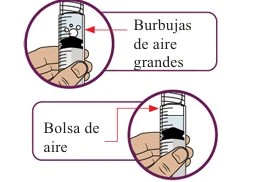
21 Remove bubbles and air pockets
If you see bubbles or an air pocket, gently tap the side of the dosing syringe to move the air to the top.
Slowly push the plunger upward to remove excess air.
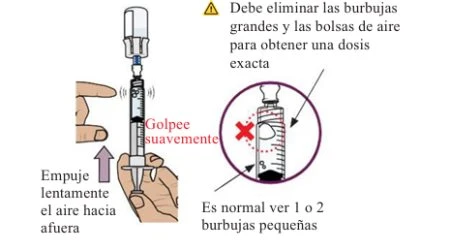
22 Compare the amount with the prescribed dose
After removing all excess air, compare the amount in the syringe with the prescribed dose.
If the amount in the syringe is less than prescribed, slowly pull the plunger back again to draw up more medicine.
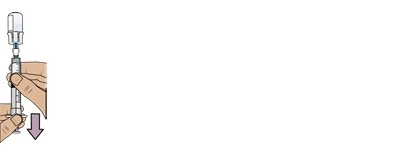
Repeat steps 19 to 21 until you reach the prescribed dose and no large bubbles remain.
23 Confirm the prescribed dose
Before continuing, verify that the dosing syringe contains the prescribed dose.
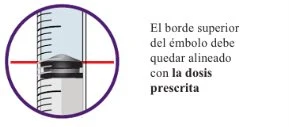
If the amount does not match the prescribed dose, repeat steps 19 to 22.
24 Remove the dosing syringe from the vial and set it aside
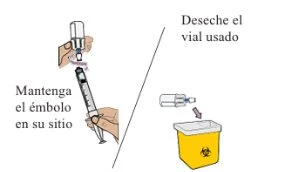
Hold the plunger in place with one hand. With the other hand, hold the vial adapter and unscrew the filled dosing syringe from the vial.
Dispose of the vial in a sharps container.
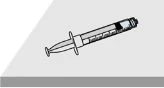
Place the filled dosing syringe on a clean, flat surface.
Do not touch the tip of the dosing syringe or let it touch any surface.
25 Attach the injection needle
Do not touch the needle hub.
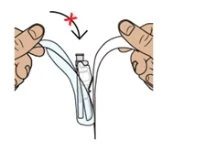
Locate the needle in the bottom tray and open its packaging.
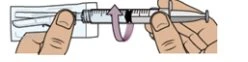
While the needle is still in its packaging, grasp the base of the needle and twist it onto the dosing syringe until it stops. Remove the needle packaging.
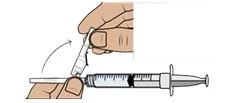
Remove the needle safety shield in the direction indicated, toward the syringe. Place the dosing syringe on a clean, flat surface.
Do not uncover the needle.
26 Choose and clean the injection site
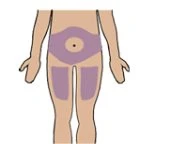
Choose an injection site on the abdomen or upper thigh. If injecting into the abdomen, avoid a 5 cm area around the navel.
Choose a different site each time you inject.
Do not inject into damaged, tender, bruised, or red-spotted skin.
Do not inject through clothing.
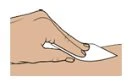
Clean the injection site with a new alcohol wipe.
Do not touch the cleaned injection site again.
You are now ready to inject the medicine.
Inject the medicine (Inject)
27 Inject the medicine
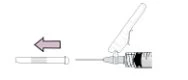
Remove the needle cap.
Dispose of the cap.
Do not touch the plunger until you are ready to inject, to avoid losing medicine.
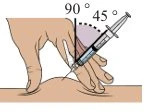
Gently pinch and hold a skin fold at the injection site. Insert the needle with a dart-like motion at a 45° to 90° angle. This helps ensure subcutaneous (under the skin) injection.
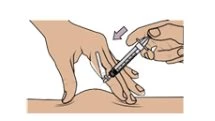
Push the plunger fully down with slow, steady pressure until the dosing syringe is empty. Confirm that all medicine has been injected.
You may now release the skin fold.
Keep your fingers away from the needle at all times.
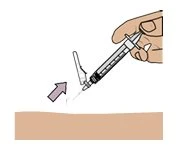
While keeping the plunger depressed, withdraw the needle from the skin at the same angle used for insertion.
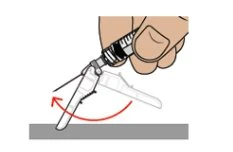
To re-engage the safety shield, press the shield against a flat surface until you hear a “click” and see the needle covered.
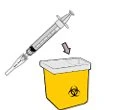
Dispose of the dosing syringe and used items in a sharps container.
Do not remove the needle from the dosing syringe.
How to dispose of Winrevair
Ask your pharmacist how to dispose of packaging and medicines you no longer need. This helps protect the environment. Be sure to follow local regulations for disposal, as they may differ from the general recommendations provided below.
|
|
| |
This product is disposable and should only be used once. | |
|
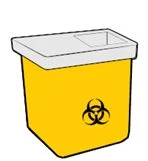
If you do not have a sharps container, you may use a household container that:
-
is made of sturdy plastic,
-
can be closed with a puncture-resistant, tight-fitting lid that prevents sharp objects from protruding,
-
remains upright and stable during use,
-
is leak-proof,
-
is properly labeled with a warning indicating it contains hazardous waste.
When the container is nearly full, follow local regulations for proper disposal.
Do not recycle the used container.
Frequently asked questions
What should I do if I bleed at the injection site?
Immediately place a cotton ball or gauze pad on the skin and apply gentle pressure. If bleeding does not stop, contact your doctor or pharmacist immediately.
Where can I find the amount of medication prescribed to me?
The amount of medication prescribed to you in "ml" is indicated on your prescription. Contact your doctor or pharmacist if you cannot find the prescribed amount of medication.
What should I do if medication accidentally spills onto the skin or work surface?
Wash the area thoroughly with water and soap immediately.
What should I do if I am unsure whether I administered the prescribed dose correctly?
Contact your doctor or pharmacist.
What should I do if the plunger of the dosing syringe moves automatically when I try to withdraw the medication from the vial?
Do not worry if the plunger moves slightly on its own when filling the dosing syringe with medication.
With one hand, hold the plunger in place to prevent it from moving.
With the other hand, unscrew the vial from the dosing syringe. Once unscrewed, you can safely release the plunger.
You can avoid this automatic movement of the plunger by injecting air into the vial before filling the dosing syringe with medication. See steps 16 to 23 for detailed instructions.
What should I do if the components in the package are damaged or altered (for example, show abnormal color, are cloudy, or contain particles)?
Do not use the components if they are damaged or altered. Contact your doctor or pharmacist to obtain a new package.
What should I do if the medication does not become clear after mixing and gently swirling?
Do not use the medication if, after gently swirling the medication vial in a circular motion for approximately 2 minutes and allowing it to rest for another 3 minutes, the vial remains cloudy or contains clumps, powder, or foreign particles. Contact your doctor or pharmacist to obtain a new package.
What should I do if sterile water does not come out of the pre-filled syringe?
Check that the vial adapter is securely connected to the vial. If not, hold the vial and firmly press the vial adapter to ensure it punctures the rubber stopper of the vial.
What should I do if I drop the package components?
Do not use any components that are damaged. If you are unsure, contact your doctor or pharmacist to obtain a new package.
Can I use a package that has been outside the refrigerator?
If the unused package has been outside the refrigerator for a prolonged period, consult your doctor or pharmacist before continuing.
Do I need to use the mixed medication immediately?
We recommend that you inject the medication immediately after mixing, but no later than 4 hours after mixing. If more than 4 hours have passed, discard any unused mixed medication. If you have any doubts or are uncertain about the process, please consult your doctor or pharmacist.
How can I get help preparing and administering the injection?
If you have any questions about the correct way to administer Winrevair or need more information, you may contact your doctor or pharmacist.
For any other information about this medicine, consult your doctor or pharmacist or the local representative of the marketing authorization holder. You can find the contact details of the local representative in the package leaflet: Patient Information
Date of the most recent review of this leaflet: {MM/YYYY}
Instructions for use
Winrevair 45mg powder and solvent for injectable solution (pack of 2 vials)
Winrevair 60mg powder and solvent for injectable solution (pack of 2 vials)
sotatercept
IMPORTANT: read this leaflet before using the medicine
Instructions for use
Winrevair 45 mg powder and solvent for injectable solution (pack of 2 vials)
Winrevair 60 mg powder and solvent for injectable solution (pack of 2 vials)
This leaflet contains instructions on how to prepare and inject Winrevair powder and solvent for injectable solution. The package leaflet, also included in the pack, contains all important information for you.
Dose according to patient weight.
For subcutaneous injection only (SC) (injection directly under the skin)
Contents of this leaflet: (Important)
Important information for healthcare professionals....................................3
Before you start..................................................................................................4
Know the parts of the pack...............................................................................6
Important information you should know before injection.................................8
How to store the pack....................................................................................9
Preparation steps...........................................................................................10
- Mix the powder medication with the liquid......................................12
- Combine the medication from both vials.............................................24
- Withdraw the prescribed dose.......................................................................30
- Inject the medication………………………………………………...36
How to dispose of Winrevair……………………………………………………...38
Frequently asked questions 40
 Important information for healthcare professionals
The healthcare professional will step-by-step demonstrate the correct preparation and administration of Winrevair using this “Instructions for use” leaflet and will decide whether the patient or caregiver is capable of independently preparing and administering Winrevair.
Ensure that the patient or caregiver can correctly perform all of the following:
- Reconstitute the medication
- Combine the medication from both vials
- Measure the correct amount of medication according to the patient's prescription
- Select and prepare an appropriate injection site
- Administer the medication by subcutaneous injection
Before you start
Read this leaflet
Read these instructions from beginning to end before using Winrevair for the first time and before each administration, as the information may have been updated.
Start with your doctor or nurse
Do not use Winrevair until your doctor or nurse has shown you or your caregiver the correct way to prepare and inject it. Your doctor or nurse must train you to self-inject Winrevair before you administer it for the first time.
Questions?
If you have any doubts about the correct way to administer Winrevair or need more information, consult your doctor, pharmacist, or nurse.
 How to use this product?
Before injecting yourself, make sure to read all instructions in this leaflet to obtain the correct dose of medication.
- Mix the medication in vial 1
- Mix the medication in vial 2
- Combine the medication from both vials
- Withdraw the prescribed dose from vial 2
- You are now ready to inject the medication
Step-by-step instructions follow on the next pages.
Know the parts of the pack
Upper tray: used to mix the medication
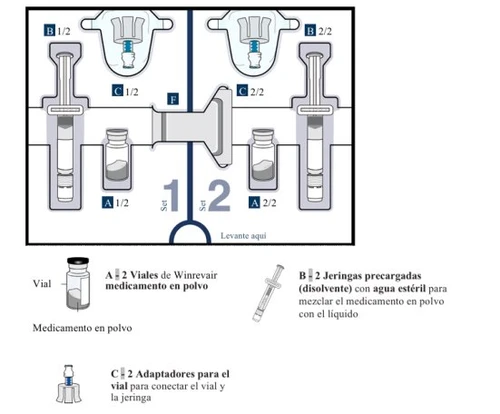
Lower tray: used to inject the medication
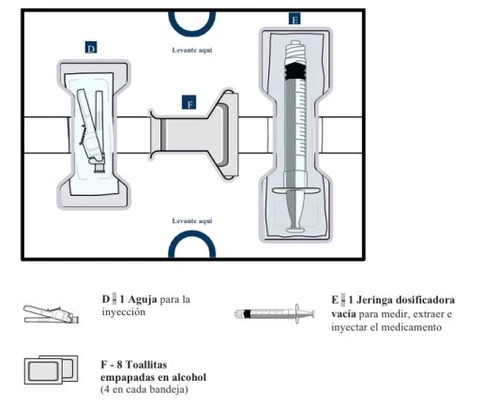
Important information you should know before injection
- You must mix this medication before using it. Ensure that the powder medication in the vial is completely dissolved before injection.
- Check the prescribed dose (amount in “ml”) every time you use the medication. The prescribed dose may change.
- Use only the materials supplied in the pack to prepare the prescribed dose.
- Do not open the pack or mix the medication until you are ready to use it.
- Do not reuse any of the supplied materials. After injection, dispose of unused medication and used materials according to local regulations. See more information on pages 38–39.
How to store the pack
- Store the complete pack in the refrigerator, but do not freeze.
- Keep the medication and supplied materials inside the pack and protected from light.
- Keep the pack out of sight and reach of children and pets.
Preparation steps
Any patient or caregiver who will prepare and inject Winrevair must first receive training and be considered by a healthcare professional as capable of independently administering Winrevair.
1 Check the Winrevair medication and expiration date
Remove the Winrevair pack from the refrigerator.
Check the expiration date and look for any signs of damage to the pack or supplied materials.
Do not use if expired or damaged. Contact your doctor or pharmacist immediately to obtain a new pack.
Confirm that you have the medication prescribed by your doctor.
2 Allow the pack to reach room temperature, gather the supplied materials, and wash your hands
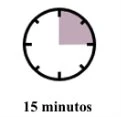
Wait 15 minutes to allow the pack to reach room temperature.
Injections are more painful if the medication is cold.
Along with the pack, gather the following items and find a clean, flat surface to prepare and inject the dose.
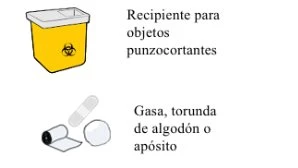
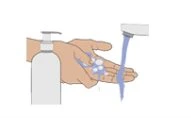
Wash your hands with water and soap.
Mix the powder medication with the liquid (Mix)
Begin with the upper tray
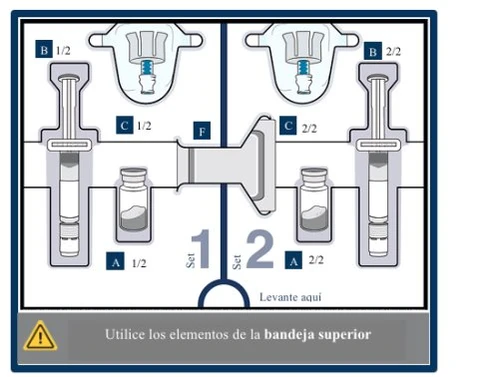
3 Remove vial 1, pre-filled syringe 1, and vial adapter 1 from the pack
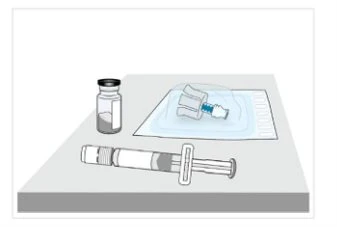
4a Check the vial and medication
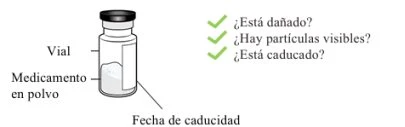
Check the vial label to confirm the medication is not expired.
Visually inspect the powder medication. It should be white to off-white and may appear as a solid cake or fragmented.
Do not use if expired, damaged, or if you see particles in it.
4b Remove the plastic cap and clean the vial
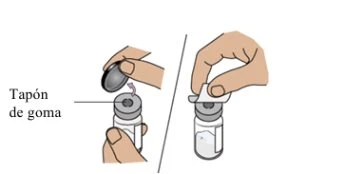
Remove the plastic cap and clean the rubber stopper on the top of the vial with an alcohol wipe.
Do not use if the vial cap is missing.
Do not touch the cleaned rubber stopper.
Set the vial aside on a clean, flat surface.
5a Attach the vial adapter to the vial
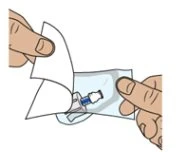
Open the vial adapter package and remove the adapter.
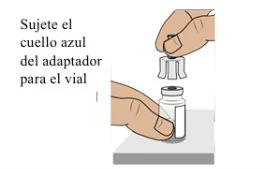
To attach the vial adapter:
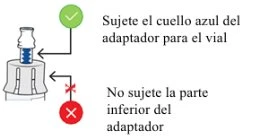
Hold the blue neck of the adapter and fit the vial adapter onto the top of the vial.
Do not touch the inside of the vial adapter to keep it clean and avoid sharps.
5b Connect the vial adapter to the vial
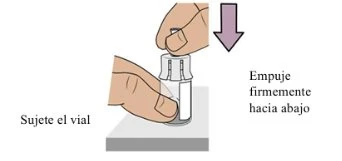
Hold the vial with one hand. Firmly push the vial adapter down until it clicks into place (you may feel resistance).
5c Clean the vial adapter
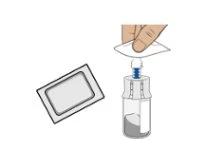
Clean the top of the vial adapter with an alcohol wipe.
6 Check the pre-filled syringe
Confirm the product is not expired. Visually inspect that the sterile water in the pre-filled syringe is clear.
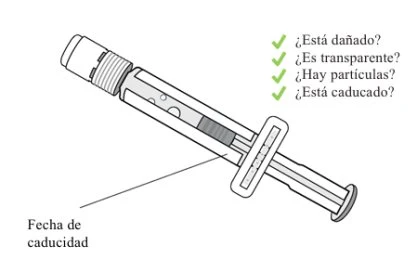
Do not use if you see clumps, particles, color changes, or if the product is expired.
7 Break and remove the white cap from the pre-filled syringe
Break and remove the cap from the pre-filled syringe at the break point.
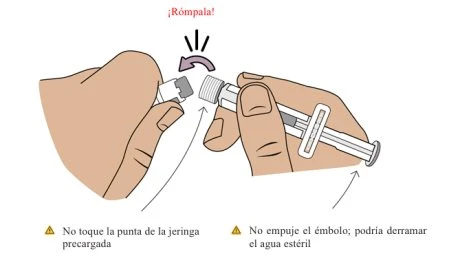
8 Connect the pre-filled syringe to the vial adapter
Next, take the medication vial with the attached vial adapter.
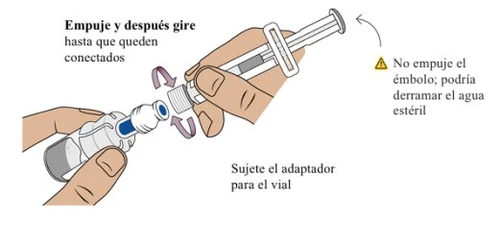
Align the tip of the pre-filled syringe with the blue circle of the vial adapter.
Push and turn the pre-filled syringe onto the vial adapter until it stops turning. While turning, make sure to hold the vial adapter.
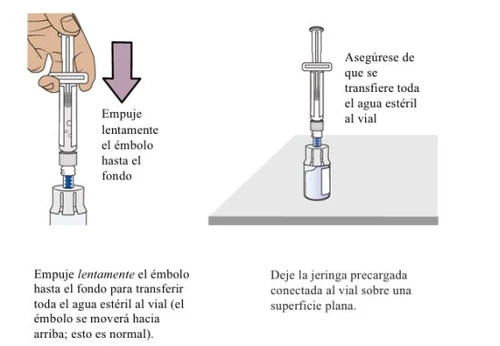
9 Transfer sterile water from the pre-filled syringe to the vial
10 Prepare vial 2, pre-filled syringe 2, and vial adapter 2
Remove vial 2, pre-filled syringe 2, and vial adapter 2 from the pack.
Important:
Go back to page 13 and repeat steps 4 to 9 to prepare vial 2.
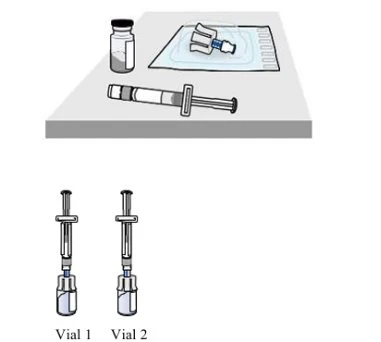
Stop and check that you have both vial 1 and vial 2 prepared.
You must have both vials prepared before proceeding to step 11.
11 Gently swirl in circles to mix the medication
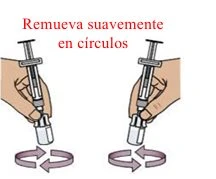
Do not shake the vials vigorously.
Hold one pre-filled syringe in each hand and gently swirl both vials in circular motions until the powder is completely dissolved. This may take up to 2 minutes. Do not shake vigorously.
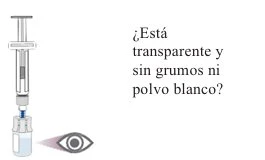
If the medication is well mixed, it should be clear. If not, repeat this step until it becomes clear.
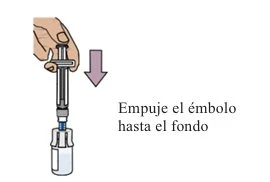
For each vial, push the plunger back in to ensure all liquid enters the vial, as some liquid may have returned to the syringe (the plunger will move upward; this is normal).
12 Wait for bubbles to disappear
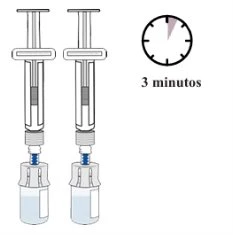
Set both vials aside to allow bubbles to disappear.
This may take up to 3 minutes.
Before continuing, ensure that the medication in the vial:
Is clear to opalescent and colorless to slightly brownish-yellow.
Has no clumps or powder.
Has no large bubbles.
It is normal for slight foam (small bubbles) to form around the edges of the vial.
13 Prepare the vial by removing excess air
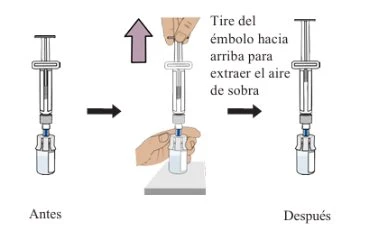
Begin with either vial. With the vial upright, gently pull the plunger upward to the top of the barrel, but be careful not to remove the plunger from the syringe.
Practical tip: This step only removes excess air from the vial to reduce pressure and prevent medication spillage when removing the syringe.
Important:
Perform this step with both vials. Stop and confirm that both vials are prepared before continuing.
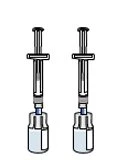
14 Remove the pre-filled syringe from the vial
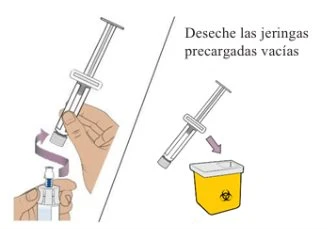
Hold the vial adapters and unscrew both syringes from the vials.
Discard both syringes into the sharps container.
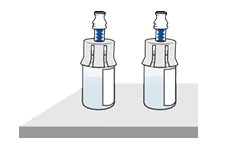
You should now have both medication vials prepared and ready to be combined in the next steps.
Combine the medication from both vials (Combine)
For the next steps, you will need:
- Vial 1 and vial 2 mixed.
- Materials from the lower tray.
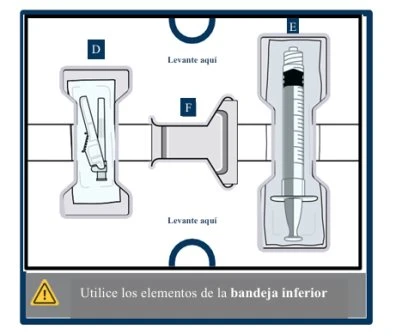
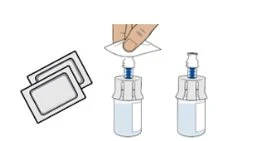
15 Clean the top of both vial adapters
Using two new alcohol wipes from the lower tray, clean the top of both vial adapters.
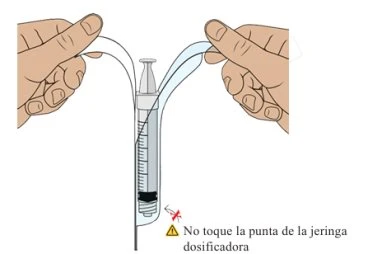
16 Remove the empty dosing syringe from its packaging
Locate the empty dosing syringe in the lower tray and remove it from its packaging.
You will use this dosing syringe to measure the amount of medication you need (according to your prescribed dose).
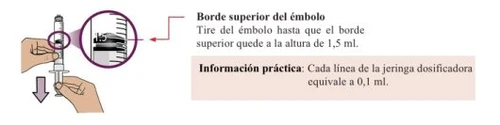
17 Introduce air into the dosing syringe
Do this to ensure uniform pressure in the vial and to receive an accurate dose.
Hold the dosing syringe vertically and pull the plunger down to introduce 1.5 ml of air.
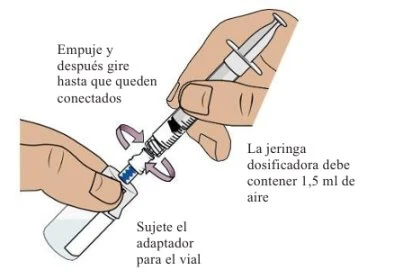
18 Connect the dosing syringe to one of the vials
While holding the vial adapter, screw the dosing syringe on until it stops.
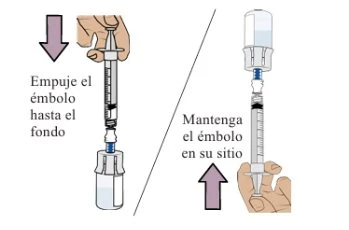
19 Introduce air into the vial and then invert it
Push the plunger fully to transfer all air into the vial.
Then, hold the plunger in place with your thumb and invert the vial.
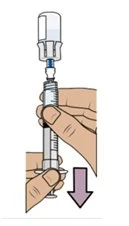
20 Empty all medication from the first vial
Slowly pull the plunger backward. Stop when you reach 1.5 ml.
This ensures all medication from the vial is in the dosing syringe.
Do not pull the plunger beyond 1.5 ml. Stop at 1.5 ml.
Be careful not to remove the plunger from the dosing syringe.
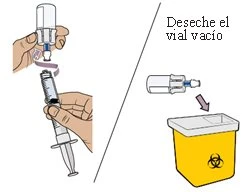
21 Remove the first vial from the dosing syringe
Hold the vial adapter and unscrew the loaded dosing syringe from the vial.
Discard the empty vial into the sharps container.
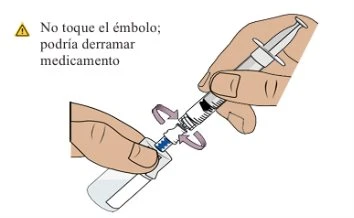
22 Connect the dosing syringe to the second vial
While holding the second vial adapter, screw the partially filled dosing syringe into the vial adapter until it stops.
23 Transfer all medication into the second vial and then invert it
Slowly push the plunger fully to transfer all medication into the vial to ensure accurate dosing. This combines the medication from both vials.
Then, hold the plunger in place with your thumb and invert the vial.
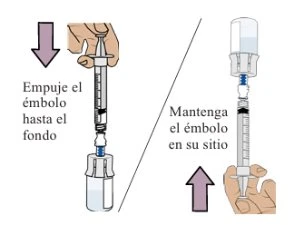
Withdraw the prescribed dose (Withdraw)
24 Pull the plunger to withdraw the dose
With the vial and dosing syringe inverted, slowly pull the plunger backward.
Stop when you reach the amount in “ml” indicated on your prescription.
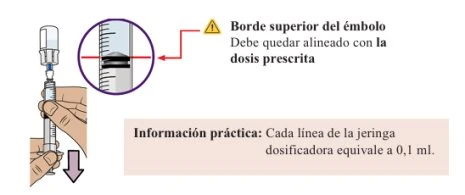
25 Check for bubbles and air pockets
Check for large air bubbles or an air pocket in the syringe. You will remove excess air in the next steps.
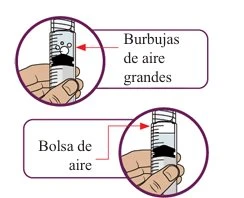
26 Remove bubbles and air pockets
If you see bubbles or an air pocket, gently tap the side of the dosing syringe to move the air to the top.
Slowly push the plunger upward to remove excess air.
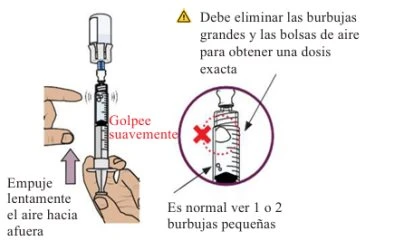
27 Compare the amount with the prescribed dose
After removing all excess air, compare the amount with the prescribed dose.
If you do not have the prescribed amount in the syringe, slowly pull the plunger back again to withdraw more medication.
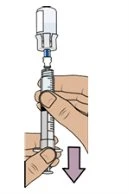
Repeat steps 24 to 26 until you reach the prescribed dose and no large bubbles are visible.
28 Confirm the prescribed dose
Before continuing, verify that you have the prescribed dose in the dosing syringe.
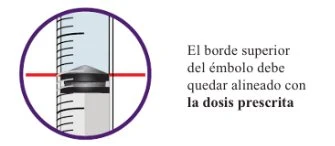
If the amount does not match the prescribed dose, repeat steps 24 to 27.
29 Remove the dosing syringe from the vial and set it aside
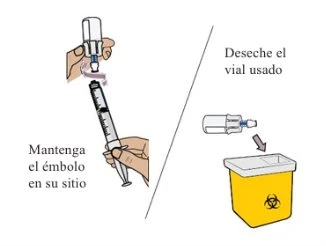
Hold the plunger in place with one hand. With the other hand, hold the vial adapter and unscrew the loaded dosing syringe from the vial.
Discard the vial into the sharps container.
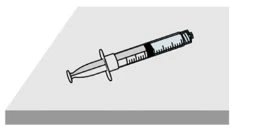
Place the loaded dosing syringe on a clean, flat surface.
Do not touch the tip of the dosing syringe or let it touch any surface.
30 Attach the injection needle
Do not touch the needle hub.
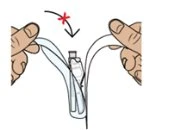
Locate the needle in the lower tray and open its packaging.
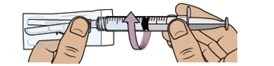
With the needle still in its packaging, hold the base of the needle and screw it onto the dosing syringe until it stops. Remove the needle packaging.
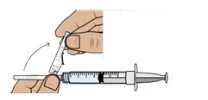
Remove the needle safety shield in the indicated direction toward the syringe. Place the dosing syringe on a clean, flat surface.
Do not remove the needle cap.
31 Choose and clean the injection site
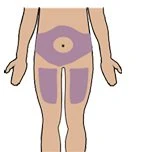
Choose an injection site on the abdomen or upper thigh. If injecting in the abdomen, avoid a 5 cm area around the navel.
Choose a different site each time you inject.
Do not inject into damaged, tender, bruised, or red-spotted skin.
Do not inject through clothing.
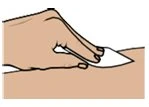
Clean the injection site with a new alcohol wipe.
Do not touch the cleaned injection site again.
You are now ready to inject the medication.
Inject the medication
32 Inject the medication (Inject)
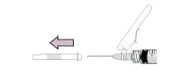
Remove the needle cap.
Discard the cap.
Do not touch the plunger until you are ready to inject, to avoid losing medication.
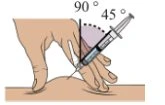
Gently pinch and hold a skin fold at the injection site. Insert the needle with a dart-like motion at a 45° to 90° angle. This helps you inject directly under the skin (subcutaneous injection).
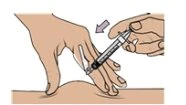
Push the plunger fully with slow, steady pressure until the dosing syringe is empty. Confirm that all medication has been injected.
You may now release the skin fold.
Keep fingers away from the needle at all times.
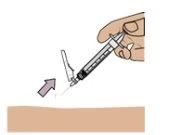
While keeping the plunger pressed, remove the needle from the skin at the same angle used for insertion.
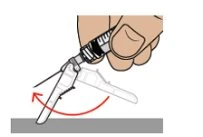
To reapply the safety shield, push it against a flat surface until you hear a “click” and see the needle covered.
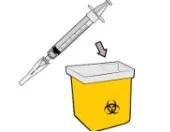
Dispose of the dosing syringe and used components in a sharps container.
Do not remove the needle from the dosing syringe.
How to dispose of Winrevair
Ask your pharmacist how to dispose of packages and medications you no longer need. This helps protect the environment. Make sure to follow local regulations for disposal, as they may differ from the general recommendations below.
|
|
| |
This product is disposable and should only be used once. | |
|
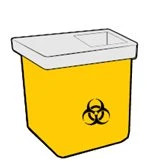
If you do not have a sharps container, you may use a household container that:
-
is made of sturdy plastic,
-
can be closed with a puncture-resistant, tightly sealed lid that prevents sharp objects from protruding,
-
remains upright and stable during use,
-
is leak-resistant,
-
is properly labeled with a warning indicating it contains hazardous waste.
When the container is nearly full, follow local regulations for proper disposal.
Do not recycle the used container.
Frequently Asked Questions
What should I do if I bleed at the injection site?
Immediately place a cotton ball or gauze pad over the skin and apply gentle pressure. If bleeding does not stop, contact your doctor or pharmacist immediately.
Where can I find the amount of medication prescribed to me?
The amount of medication prescribed to you in “ml” can be found on your prescription. Contact your doctor or pharmacist if you cannot locate the prescribed amount of medication.
What should I do if medication accidentally spills onto the skin or work surface?
Wash the area thoroughly with water and soap immediately.
What should I do if I am unsure whether I administered the prescribed dose correctly?
Contact your doctor or pharmacist.
What should I do if the plunger of the dosing syringe moves automatically when I try to withdraw the medication from the vial?
Do not be concerned if the plunger moves slightly on its own while filling the dosing syringe with medication.
With one hand, hold the plunger in place to prevent it from moving.
With the other hand, unscrew the vial from the dosing syringe. Once detached, you can safely release the plunger.
You can avoid this automatic movement of the plunger by injecting air into the vial before filling the dosing syringe with medication. See steps 17 to 28 for detailed instructions.
What should I do if the components in the package are damaged or altered (for example, if they show abnormal color, are cloudy, or contain particles)?
Do not use any components that are damaged or altered. Contact your doctor or pharmacist to obtain a new package.
What should I do if the medication does not become clear after mixing and gently swirling?
Do not use the medication if, after gently swirling the medication vial for approximately 2 minutes and allowing it to stand for another 3 minutes, the solution remains cloudy or contains clumps, powder, or foreign particles. Contact your doctor or pharmacist to obtain a new package.
What should I do if sterile water does not come out of the pre-filled syringe?
Check that the vial adapter is securely attached to the vial. If not, hold the vial and firmly press the vial adapter to ensure it punctures the rubber stopper of the vial.
What should I do if the package components are dropped?
Do not use any components that are damaged. If you are unsure, contact your doctor or pharmacist to obtain a new package.
Can I use a package that has been outside the refrigerator?
If the unused package has been outside the refrigerator for a prolonged period, consult your doctor or pharmacist before continuing.
Do I need to use the mixed medication immediately?
We recommend that you inject the medication immediately after mixing, but no later than 4 hours after mixing. If more than 4 hours have passed, discard any unused mixed medication. If you have any doubts or are uncertain about the process, please consult your doctor or pharmacist.
How can I get help preparing and administering the injection?
If you have any questions about the correct way to administer Winrevair or need further information, you may contact your doctor or pharmacist.
For any additional information about this medication, consult your doctor or pharmacist or the local representative of the marketing authorization holder. You can find the contact details of the local representative in the package leaflet: Patient Information.
Date of the most recent review of this leaflet: {MM/YYYY}