Wilzin 25 mg hard capsules
Spain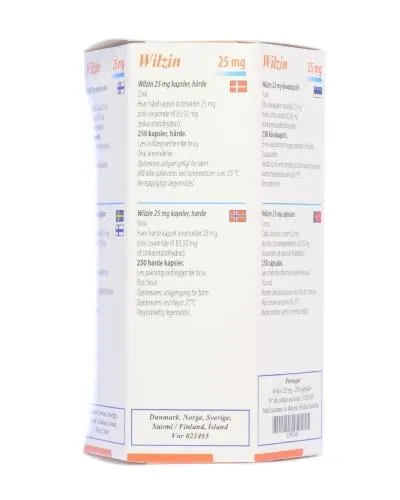
Table of Contents
Package leaflet: Information for the user
Introduction
Package leaflet: information for the user
Wilzin 25 mg hard capsules
Wilzin 50 mg hard capsules
zinc
Read the entire leaflet carefully before you start taking this medicine, because it contains important information for you.
-
Keep this leaflet, as you may need to read it again.
-
If you have any questions, ask your doctor or pharmacist.
-
This medicine has been prescribed for you, and you should not give it to other people, even if they have the same symptoms as you, because it may harm them.
-
If you experience any adverse effects, consult your doctor or pharmacist, even if these are adverse effects not listed in this leaflet. See section 4.
Contents of the leaflet
-
What Wilzin is and what it is used for
-
What you need to know before you take Wilzin
-
How to take Wilzin
-
Possible side effects
-
How to store Wilzin
-
Contents of the pack and other information
1. What Wilzin is and what it is used for
Wilzin belongs to a group of medicines called products for the alimentary tract and metabolism.
Wilzin is indicated for the treatment of Wilson's disease, a rare inherited disorder affecting copper excretion. Dietary copper, which cannot be adequately eliminated, accumulates first in the liver and subsequently in other organs such as the eyes and brain. This may lead to liver damage and neurological disorders.
Wilzin blocks the absorption of copper from the intestine and thereby prevents its transfer into the blood and accumulation in the body. Unabsorbed copper is subsequently excreted in the faeces.
Wilson's disease persists throughout the patient's life, and therefore lifelong treatment is necessary.
2. What you need to know before taking Wilzin
Do not take Wilzin:
if you are allergic (hypersensitive) to zinc or to any of the other components of this medicine (listed in section 6).
Warnings and precautions
Talk to your doctor or pharmacist before starting to take Wilzin. Because it takes time to become effective, Wilzin is generally not recommended for the initial treatment of patients with signs and symptoms of Wilson's disease.
If you are currently being treated with another anti-copper medication, for example penicillamine, your doctor may add Wilzin to your treatment before discontinuing the initial therapy.
Like other anti-copper medications such as penicillamine, your symptoms may worsen after starting treatment. In this case, you must inform your doctor.
To monitor your disease and treatment, your doctor will periodically perform blood and urine tests. This is done to ensure that you are receiving adequate treatment.
Monitoring may detect signs of insufficient treatment (excess copper) or excessive treatment (copper deficiency), both of which can be harmful, especially in children of growing age and pregnant women.
You should inform your doctor if you experience muscle weakness or abnormal sensations in the limbs, as this may indicate excessive treatment.
Other medicines and Wilzin
Inform your doctor or pharmacist if you are using, have recently used, or might need to use any other medicines, including those obtained without a prescription.
Consult your doctor before taking any other medication that could reduce the effectiveness of Wilzin, such as iron, calcium supplements, tetracyclines (antibiotics), or phosphorus. Conversely, the effectiveness of certain medications, such as iron, tetracyclines, and fluoroquinolones (antibiotics), may be reduced by Wilzin.
Taking Wilzin with food and drinks
Wilzin should be taken on an empty stomach, separated from meals. Dietary fiber and certain dairy products, in particular, delay the absorption of zinc salts. Some patients experience stomach discomfort after the morning dose. Please discuss this issue with the doctor treating your Wilson's disease if this happens to you.
This side effect may be reduced by delaying the first daily dose until mid-morning (between breakfast and lunch). It may also be minimized by taking the first dose of Wilzin with a small amount of food containing protein, such as meat (never with milk).
Pregnancy and breastfeeding
Consult your doctor if you plan to become pregnant. It is very important that you continue anti-copper treatment during pregnancy.
If you become pregnant while taking Wilzin, your doctor will decide which treatment and dosage are best for your situation.
You should avoid breastfeeding while taking Wilzin. Please discuss this with your doctor.
Driving and using machines:
No studies have been conducted on the ability to drive and use machines.
Wilzin contains Sunset Yellow FCF (E110)
The Wilzin 50 mg hard capsules contain Sunset Yellow FCF (E110), which may cause allergic reactions.
3. How to take Wilzin
Follow exactly the instructions for administering this medicine as given by your doctor. If in doubt, consult your doctor or pharmacist again. For different doses, Wilzin is available in hard capsules of 25 mg or 50 mg.
- Adults:
The usual dose is 1 hard capsule of Wilzin 50 mg (or 2 hard capsules of Wilzin 25 mg) three times a day, with a maximum dose of 1 hard capsule of Wilzin 50 mg (or 2 hard capsules of Wilzin 25 mg) five times a day.
- Children and adolescents:
The usual dose is:
- 1 to 6 years: 1 hard capsule of Wilzin 25 mg twice daily
- 6 to 16 years weighing less than 57 kg: 1 hard capsule of Wilzin 25 mg three times daily
- 16 years and older or weighing more than 57 kg: 2 hard capsules of Wilzin 25 mg or 1 hard capsule of Wilzin 50 mg three times daily.
Always take Wilzin on an empty stomach, at least 1 hour before meals or 2 to 3 hours after meals. If you do not tolerate the morning dose well (see section 4), it may be taken mid-morning, between breakfast and lunch. Wilzin may also be taken with a small amount of protein, such as meat, but never with milk.
If Wilzin has been prescribed together with another anti-copper medication, such as penicillamine, leave at least a 1-hour interval between the two medications.
For children who cannot swallow the capsules, open the capsule and mix the powder with a small amount of water (possibly with sugar or sweeteners).
If you take more Wilzin than you should
If you take more Wilzin than prescribed, you may experience nausea, vomiting, and dizziness. In this case, seek medical advice immediately.
If you forget to take Wilzin
Do not take a double dose to make up for a missed dose.
If you have any further questions about the use of this product, consult your doctor.
4. Possible adverse effects
Like all medicines, this medicine can cause adverse effects, although not everyone will experience them.
These side effects may occur with certain frequencies defined as follows:
- very common: affects more than 1 in 10 people
- common: affects 1 to 10 in 100 people
- uncommon: affects 1 to 10 in 1,000 people
- rare: affects 1 to 10 in 10,000 people
- very rare: affects fewer than 1 in 10,000 people
- frequency not known: cannot be estimated from the available data.
Common:
- Gastric irritation may occur after taking Wilzin, especially at the beginning of treatment.
- Changes in blood tests have been reported, including increases in certain liver and pancreatic enzymes.
Uncommon:
- A decrease in red blood cells and white blood cells may occur.
Reporting of adverse effects
If you experience any type of adverse effect, consult your doctor or pharmacist, even if it is a possible adverse effect not listed in this leaflet. You may also report them directly through the national reporting system detailed in Appendix V. By reporting adverse effects, you can help provide more information on the safety of this medicine.
5. Storage of Wilzin
-
Keep this medicine out of the sight and reach of children.
-
Do not use Wilzin after the expiry date stated on the packaging and on the bottle, after EXP. The expiry date refers to the last day of the month indicated.
-
Do not store above 25°C.
Medicines should not be disposed of via wastewater or household waste. Ask your pharmacist how to properly dispose of medicines and packaging you no longer need. This will help protect the environment.
6. Contents of the container and other information
Composition of Wilzin
The active substance is zinc. Each hard capsule contains 25 mg of zinc (corresponding to 83.92 mg of zinc acetate dihydrate) or 50 mg of zinc (corresponding to 167.84 mg of zinc acetate dihydrate).
The other components are corn starch and magnesium stearate. The capsule shells contain gelatin, titanium dioxide (E171), and brilliant blue FCF (E133) in Wilzin 25 mg or orange yellow FCF (E110) in Wilzin 50 mg. The printing ink contains black iron oxide (E172) and shellac.
Appearance of the product and pack contents
Wilzin 25 mg is a hard capsule, aquamarine in colour, with the imprint "93-376". Wilzin 50 mg is an opaque hard capsule, orange in colour, with the imprint "93-377".
It is available in packs of 250 hard capsules in a polyethylene bottle closed with a polypropylene and polyethylene cap. The bottle also contains a cotton filler.
Marketing Authorisation Holder
Recordati Rare Diseases
Tour Hekla
52 avenue du Général de Gaulle
F-92800 Puteaux
France
Manufacturer
Recordati Rare Diseases
Tour Hekla
52 avenue du Général de Gaulle
F-92800 Puteaux
France
or
Recordati Rare Diseases
Eco River Parc
30, rue des Peupliers
F-92000 Nanterre
France
Further information on this medicinal product is available upon request by contacting the local representative of the Marketing Authorisation Holder.
Belgium/Belgium/Belgium Recordati Tel/Tel: +32 2 46101 36 | Lithuania Recordati AB. Tel: + 46 8 545 80 230 Sweden |
| Luxembourg/Luxembourg Recordati Tel/Tel: +32 2 46101 36 Belgium/Belgium |
Czech Republic Recordati Rare Diseases Tel: +33 (0)1 47 73 64 58 France | Hungary Recordati Rare Diseases Tel: +33 (0)1 47 73 64 58 France |
Denmark Recordati AB. Tlf : +46 8 545 80 230 Sweden | Malta Recordati Rare Diseases Tel: +33 1 47 73 64 58 France |
Germany Recordati Rare Diseases Germany GmbH Tel: +49 731 140 554 0 | Netherlands Recordati Tel: +32 2 46101 36 Netherlands |
Estonia Recordati AB. Tel: + 46 8 545 80 230 Sweden | Norway Recordati AB. Tlf : +46 8 545 80 230 Sweden |
Greece Recordati Rare Diseases Tel: +33 1 47 73 64 58 France | Austria Recordati Rare Diseases Germany GmbH Tel: +49 731 140 554 0 Germany |
Spain Recordati Rare Diseases Spain S.L.U. Tel: + 34 91 659 28 90 | Poland Recordati Rare Diseases Tel: +33 (0)1 47 73 64 58 France |
France Recordati Rare Diseases Tel: +33 (0)1 47 73 64 58 | Portugal Recordati Rare Diseases SARL Tel: +351 21 432 95 00 |
Croatia Recordati Rare Diseases Tel: +33 (0)1 47 73 64 58 France | Romania Recordati Rare Diseases Tel: +33 (0)1 47 73 64 58 France |
Ireland Recordati Rare Diseases Tel: +33 (0)1 47 73 64 58 France | Slovenia Recordati Rare Diseases Tel: +33 (0)1 47 73 64 58 France |
Iceland Recordati AB. Tel: +46 8 545 80 230 Sweden | Slovakia Recordati Rare Diseases Tel: +33 (0)1 47 73 64 58 France |
Italy Recordati Rare Diseases Italy Srl Tel: +39 02 487 87 173 | Finland Recordati AB. Tel: +46 8 545 80 230 Sweden |
Cyprus Recordati Rare Diseases Tel: +33 1 47 73 64 58 France | Sweden Recordati AB. Tel: +46 8 545 80 230 |
Latvia Recordati AB. Tel: + 46 8 545 80 230 Sweden |
Date of the most recent review of this leaflet:
Detailed information on this medicine is available on the website of the European Medicines Agency: https://www.ema.europa.eu. Links to other websites on rare diseases and orphan medicinal products are also available.