Wezenla 130 mg concentrate for solution for infusion
Spain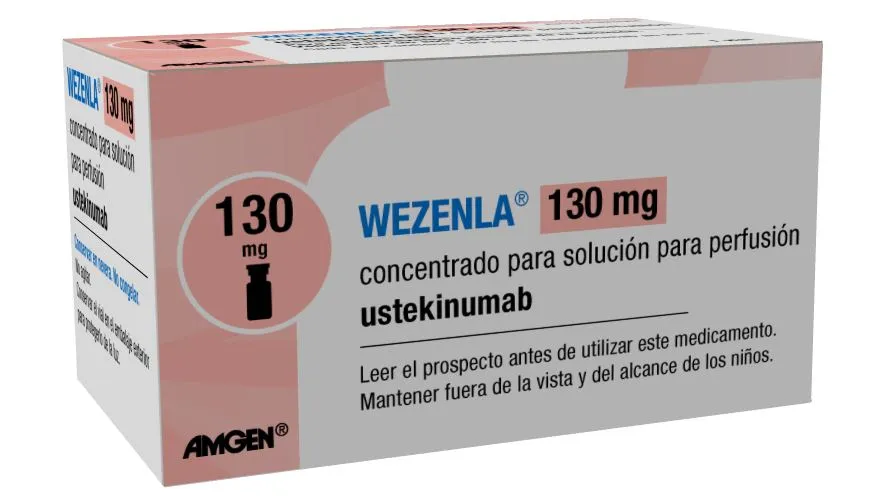
Table of Contents
Package leaflet: Information for the user
Introduction
Package leaflet: information for the patient
WEZENLA 130mg concentrate for solution for infusion
ustekinumab
This medicinal product is subject to additional monitoring, which will allow for quicker detection of new safety information. You can help by reporting any adverse reactions you may experience. Information on how to report adverse reactions is included at the end of section 4.
Read this entire leaflet carefully before you start using this medicine, as it contains important information for you.
This leaflet has been written for the person using the medicine.
- Keep this leaflet, as you may need to read it again.
- If you have any questions, consult your doctor or pharmacist.
- If you experience any adverse reactions, consult your doctor or pharmacist, even if they are not listed in this leaflet. See section 4.
Contents of this leaflet
- What WEZENLA is and what it is used for
- What you need to know before using WEZENLA
- How to use WEZENLA
- Possible adverse reactions
- How to store WEZENLA
- Contents of the pack and other information
1. What WEZENLA is and what it is used for
What WEZENLA is
WEZENLA contains the active substance “ustekinumab”, a monoclonal antibody. Monoclonal antibodies are proteins that specifically recognize and bind to certain proteins in the body.
WEZENLA belongs to a group of medicines called “immunosuppressants”. These medicines work by weakening part of the immune system.
What WEZENLA is used for
WEZENLA is used for the treatment of moderate to severe Crohn's disease in adults and children weighing at least 40 kg.
Crohn's disease is an inflammatory bowel disease. If you have Crohn's disease, you will usually have been given other medicines first. If you do not respond adequately or cannot tolerate those medicines, WEZENLA may be given to reduce the signs and symptoms of your disease.
2. What you need to know before using WEZENLA
Do not use WEZENLA
- If you are allergic to ustekinumab or to any of the other components of this medicine (listed in section 6).
- If you have an active infection that your doctor considers important.
If you are unsure whether any of the above apply to you, speak with your doctor or pharmacist before using WEZENLA.
Warnings and precautions
Talk to your doctor or pharmacist before starting to use WEZENLA. Your doctor will assess your health status before treatment. Make sure to inform your doctor about any medical conditions you have. Also inform your doctor if you have recently been in contact with someone who may have tuberculosis. Your doctor will examine you and perform a test to detect tuberculosis before you start using WEZENLA. If your doctor believes you are at risk of tuberculosis, you may be given medication to treat it.
Watch for serious adverse effects
WEZENLA may cause serious adverse effects, including allergic reactions and infections. You should pay attention to certain signs of illness while using WEZENLA. See the complete list of these adverse effects in “Serious adverse effects” in section 4.
Before using WEZENLA, tell your doctor:
- If you have ever had an allergic reaction to WEZENLA. Consult your doctor if you are unsure.
- If you have ever had any type of cancer – because immunosuppressants like WEZENLA weaken part of the immune system. This may increase the risk of developing cancer.
- If you have previously received treatment for psoriasis with other biologics (a medicine produced from a biological source and usually administered by injection) – the risk of developing cancer may be higher.
- If you have or have recently had an infection or have any skin openings (fistula).
- If you have any new skin lesions or changes in existing lesions within the psoriasis area or on intact skin.
- If you are taking any other treatments for psoriasis and/or psoriatic arthritis – such as other immunosuppressants or phototherapy (when your body is treated with a type of ultraviolet (UV) light). These treatments may also weaken part of the immune system. The use of these treatments together with WEZENLA has not been studied. However, it may increase the likelihood of developing illnesses related to a weaker immune system.
- If you are receiving or have ever received allergy shots (immunotherapy) – it is unknown whether WEZENLA may affect these treatments.
- If you are 65 years of age or older – you may be more likely to develop infections.
If you are unsure whether any of these conditions apply to you, speak with your doctor or pharmacist before using WEZENLA.
Some patients have experienced lupus-like reactions during treatment with ustekinumab, including cutaneous lupus or lupus-like syndrome. Contact your doctor immediately if you develop a red, raised, scaly rash, sometimes with a darker border, on areas of skin exposed to sunlight, or if accompanied by joint pain.
Heart attacks and strokes
Heart attacks and strokes have been observed in a study of psoriasis patients treated with ustekinumab. Your doctor will periodically check your risk factors for heart disease and stroke to ensure they are properly managed. Seek immediate medical attention if you experience chest pain, weakness or numbness on one side of the body, facial paralysis, or speech or vision problems.
Children and adolescents
The use of WEZENLA is not recommended in children weighing less than 40 kg with Crohn’s disease, as it has not been studied in this age group.
Use of WEZENLA with other medicines, vaccines
Inform your doctor or pharmacist:
- If you are taking, have recently taken, or might take any other medicines.
- If you have recently been vaccinated or are due to receive a vaccine. Certain types of vaccines (live vaccines) should not be given while you are using WEZENLA.
- If you received WEZENLA during pregnancy, inform your infant’s doctor about your treatment with WEZENLA before the infant receives any vaccine, including live vaccines such as the BCG vaccine (used to prevent tuberculosis). Live vaccines are not recommended for your infant during the first twelve months after birth if you received WEZENLA during pregnancy, unless your infant’s doctor advises otherwise.
Pregnancy and breastfeeding
- If you are pregnant, think you may be pregnant, or plan to become pregnant, consult your doctor before using this medicine.
- No increased risk of birth defects has been observed in babies exposed to WEZENLA in the womb. However, experience with WEZENLA in pregnant women is limited. Therefore, it is preferable to avoid using WEZENLA during pregnancy.
- If you are a woman of childbearing age, you are advised to avoid becoming pregnant and to use adequate contraception while using WEZENLA and for at least 15 weeks after the last dose of WEZENLA.
- Ustekinumab can cross the placenta to the fetus. If you received WEZENLA during pregnancy, your infant may have an increased risk of developing an infection.
- It is important to inform your infant’s doctors and other healthcare professionals if you received WEZENLA during your pregnancy before the infant receives any vaccine. Live vaccines, such as the BCG vaccine (used to prevent tuberculosis), are not recommended for your infant during the first twelve months after birth if you received WEZENLA during pregnancy, unless your infant’s doctor recommends otherwise.
- Ustekinumab may be excreted in breast milk in very small amounts. Inform your doctor if you are breastfeeding or plan to breastfeed. You and your doctor will decide whether to breastfeed or use WEZENLA. Do not do both at the same time.
Driving and using machines
The influence of WEZENLA on the ability to drive and use machines is negligible or none.
WEZENLA contains sodium
WEZENLA contains less than 1 mmol of sodium (23 mg) per dose; this is essentially “sodium-free”. However, before administration, WEZENLA is mixed with a solution containing sodium. Speak with your doctor if you are on a low-salt diet.
WEZENLA contains polysorbate 80
WEZENLA contains 10.4 mg of polysorbate 80 (E 433) in each dosage unit, equivalent to 0.40 mg/ml. Polysorbates may cause allergic reactions. Inform your doctor if you have any known allergies.
3. How to use WEZENLA
WEZENLA should be used under the guidance and supervision of a physician experienced in the diagnosis and treatment of Crohn's disease.
Your doctor will administer WEZENLA 130 mg concentrate for solution for infusion through a drip into a vein in your arm (intravenous infusion) for at least one hour. Ask your doctor when your infusions should be given and about follow-up appointments.
How much WEZENLA is administered
Your doctor will decide the amount of WEZENLA you should receive and the duration of treatment.
Adults aged 18 years and older
- Your doctor will calculate the recommended intravenous infusion dose for you based on your body weight.
Your body weight | Dosage |
≤ 55 kg | 260 mg |
> 55 kg to ≤ 85 kg | 390 mg |
> 85 kg | 520 mg |
- After the initial intravenous dose, you will receive the next dose of 90 mg of WEZENLA via an injection under the skin (subcutaneous injection) 8 weeks later, and thereafter every 12 weeks.
Children with Crohn's disease weighing at least 40 kg
- Your doctor will calculate the recommended intravenous infusion dose for you based on your body weight.
Your body weight | Dosage |
≥?40 to ≤?55 kg | 260 mg |
>?55 kg to ≤?85 kg | 390 mg |
>?85 kg | 520 mg |
- After the initial intravenous dose, you will receive the next dose of 90 mg of WEZENLA as an injection under the skin (subcutaneous injection) 8 weeks later, and thereafter every 12 weeks.
How WEZENLA is administered
- The first dose of WEZENLA for the treatment of Crohn's disease is given by a doctor as an intravenous infusion into a vein in the arm.
Consult your doctor if you have any questions about treatment with WEZENLA.
If you forget to use WEZENLA
If you miss a dose or fail to attend your appointment for administration, speak with your doctor to schedule another appointment.
If you stop treatment with WEZENLA
Stopping use of WEZENLA is not dangerous. However, if you discontinue treatment, your symptoms may return.
If you have any further questions about the use of this medicine, ask your doctor or pharmacist.
4. Possible adverse effects
Like all medicines, this medicine can cause adverse effects, although not everyone experiences them.
Serious adverse effects
Some patients may experience serious adverse effects that may require urgent treatment.
Allergic reactions – these may require urgent treatment. Contact your doctor or seek immediate medical help if you notice any of the following signs.
-
Severe allergic reactions ("anaphylaxis") are rare in the population using WEZENLA (may affect up to 1 in 1,000 people). Signs include:
-
difficulty breathing and swallowing
-
low blood pressure, which may cause dizziness or mild headaches
-
swelling of the face, lips, mouth, or throat.
- Common signs of an allergic reaction include rash and hives (these may affect up to 1 in 100 people).
Infusion-related reactions – If you are being treated for Crohn's disease, your first dose of WEZENLA is administered as an intravenous infusion (a drip into a vein). Some patients have experienced severe allergic reactions during the infusion.
In rare cases, lung-related allergic reactions and lung inflammation have been reported in patients treated with ustekinumab. Inform your doctor immediately if you develop symptoms such as cough, difficulty breathing, or fever.
If you experience a severe allergic reaction, your doctor may decide that you should not use WEZENLA again.
Infections – these may require urgent treatment. Contact your doctor immediately if you notice any of these signs.
- Nasal or throat infections and the common cold are common (may affect up to 1 in 10 people)
- Chest infections are uncommon (may affect up to 1 in 100 people)
- Inflammation of tissues beneath the skin ("cellulitis") is uncommon (may affect up to 1 in 100 people)
- Herpes (a type of painful blistering rash) is uncommon (may affect up to 1 in 100 people)
WEZENLA may affect your ability to fight infections. Some of these infections may become serious and may be caused by viruses, fungi, bacteria (including tuberculosis), or parasites. They include infections that primarily occur in people with weakened immune systems (opportunistic infections). Opportunistic infections of the brain (encephalitis, meningitis), lungs, and eyes have been reported in patients receiving ustekinumab treatment.
You should monitor for signs of infection while using WEZENLA. These include:
- fever, flu-like symptoms, night sweats, weight loss
- feeling tired or short of breath; persistent cough
- skin that is warm, red, and painful, or a painful blistering skin rash
- burning sensation when urinating
- diarrhea
- visual deterioration or loss of vision
- headache, neck stiffness, light sensitivity, nausea, or confusion.
Contact your doctor immediately if you notice any of these signs of infection, as they may indicate serious infections such as chest infections, skin infections, herpes, or opportunistic infections that could lead to severe complications. You should also inform your doctor if you have any infection that does not go away or keeps returning. Your doctor may decide that you should not use WEZENLA until the infection resolves. Also contact your doctor if you have any open cuts or ulcers that could become infected.
Skin peeling – increased redness and widespread skin peeling may be symptoms of erythrodermic psoriasis or exfoliative dermatitis, which are serious skin disorders. If you notice any of these symptoms, you must inform your doctor immediately.
Other adverse effects
Common adverse effects (may affect up to 1 in 10 people):
- Diarrhea
- Nausea
- Vomiting
- Feeling tired
- Dizziness
- Headache
- Itching ("pruritus")
- Back, muscle, or joint pain
- Sore throat
- Redness and pain at the injection site
- Sinusitis
Uncommon adverse effects (may affect up to 1 in 100 people):
- Dental infections
- Vaginal yeast infections
- Depression
- Nasal congestion or stuffiness
- Bleeding, bruising, hardening, swelling, and itching at the injection site
- Feeling weak
- Drooping eyelid and facial muscle weakness on one side of the face ("facial paralysis" or "Bell's palsy"), which is usually temporary
- A change in psoriasis with redness and new small yellow or white blisters, sometimes accompanied by fever (pustular psoriasis)
- Skin peeling (skin exfoliation)
- Acne
Rare adverse effects (may affect up to 1 in 1,000 people):
- Redness and peeling of the skin over a large area of the body, which may cause itching or pain (exfoliative dermatitis). Similar symptoms may develop as a natural change in psoriasis symptoms (erythrodermic psoriasis)
- Inflammation of small blood vessels, which may cause a skin rash with small red or purple bumps, fever, or joint pain (vasculitis)
Very rare adverse effects (may affect up to 1 in 10,000 people):
- Blisters on the skin, which may be red and cause itching and pain (bullous pemphigoid)
- Cutaneous lupus or lupus-like syndrome (a red, raised, scaly rash in sun-exposed skin areas, possibly accompanied by joint pain).
Reporting of adverse effects
If you experience any adverse effect, talk to your doctor or pharmacist, even if it is a possible adverse effect not listed in this leaflet. You can also report them directly through the national reporting system included in Appendix V. By reporting adverse effects, you can help provide more information on the safety of this medicine.
5. Storage of WEZENLA
- WEZENLA 130 mg concentrate for solution for infusion is administered in a hospital or medical centre and patients do not need to store or handle it.
- Keep this medicine out of the sight and reach of children.
- Store in a refrigerator (between 2 °C and 8 °C). Do not freeze.
- Keep the vial in the outer packaging to protect it from light.
- Do not shake WEZENLA vials. Prolonged vigorous shaking may damage the product.
Do not use this medicine:
- After the expiry date stated on the label and packaging following “CAD” or “EXP”. The expiry date refers to the last day of the month indicated.
- If the liquid changes colour, becomes cloudy, or contains floating foreign particles (see section 6 “Appearance of WEZENLA and contents of the container”).
- If you know or suspect it has been exposed to extreme temperatures (such as accidental overheating or freezing).
- If the product has been vigorously shaken.
- If the seal is broken.
WEZENLA is for single use only. Any unused diluted infusion solution remaining in the vial or syringe must be discarded in accordance with local regulations.
6. Contents of the pack and other information
Composition of WEZENLA
- The active substance is ustekinumab. Each vial contains 130 mg of ustekinumab in 26 ml.
- The other components are disodium edetate dihydrate, L-histidine, L-histidine monohydrochloride monohydrate, L-methionine, polysorbate 80 (E 433), sucrose, sodium hydroxide (for pH adjustment) and water for injections.
What WEZENLA looks like and contents of the pack
WEZENLA is a concentrate for solution for infusion, ranging from clear to opalescent and from colourless to pale yellow. It is supplied in a container containing one single-dose 30 ml glass vial. Each vial contains 130 mg of ustekinumab in 26 ml of concentrate for solution for infusion.
Marketing Authorisation Holder and Manufacturer
Amgen Technology (Ireland) UC,
Pottery Road,
Dun Laoghaire,
Co Dublin,
Ireland
Marketing Authorisation Holder
Amgen Technology (Ireland) UC,
Pottery Road,
Dun Laoghaire,
Co Dublin,
Ireland
Manufacturer
Amgen NV
Telecomlaan 5-7
1831 Diegem
Belgium
For further information about this medicinal product, please contact the local representative of the Marketing Authorisation Holder:
Belgium/Belgium/Belgium s.a. Amgen n.v. Tel/Tel: +32 (0)2 7752711 | Lithuania Amgen Switzerland AG Vilnius Branch Tel: +370 5 219 7474 |
| Luxembourg/Luxembourg s.a. Amgen Belgium/Belgium Tel/Tel: +32 (0)2 7752711 |
Czech Republic Amgen s.r.o. Tel: +420 221 773 500 | Hungary Amgen Kft. Tel.: +36 1 35 44 700 |
Denmark Amgen, branch of Amgen AB, Sweden Tlf.: +45 39617500 | Malta Amgen S.r.l. Italy Tel: +39 02 6241121 |
Germany Amgen GmbH Tel: +49 89 1490960 | Netherlands Amgen B.V. Tel: +31 (0)76 5732500 |
Estonia Amgen Switzerland AG Vilnius Branch Tel: +372 586 09553 | Norway Amgen AB Tlf: +47 23308000 |
Greece Amgen Hellas Pharmaceutical E.P.E. Tel: +30 210 3447000 | Austria Amgen GmbH Tel: +43 (0)1 50 217 |
Spain Amgen S.A. Tel: +34 93 600 18 60 | Poland Amgen Biotechnologia Sp. z o.o. Tel.: +48 22 581 3000 |
France Amgen S.A.S. Tél: +33 (0)9 69 363 363 | Portugal Amgen Biofarmacêutica, Lda. Tel: +351 21 4220606 |
Croatia Amgen d.o.o. Tel: +385 (0)1 562 57 20 | Romania Amgen Romania SRL Tel: +4021 527 3000 |
Ireland Amgen Ireland Limited Tel: +353 1 8527400 | Slovenia AMGEN zdravila d.o.o. Tel: +386 (0)1 585 1767 |
Iceland Vistor Sími: +354 535 7000 | Slovakia Amgen Slovakia s.r.o. Tel: +421 2 321 114 49 |
Italy Amgen S.r.l. Tel: +39 02 6241121 | Finland Amgen AB, branch in Finland/Amgen AB, filial i Finland Puh/Tel: +358 (0)9 54900500 |
Cyprus C.A. Papaellinas Ltd Tel: +357 22741 741 | Sweden Amgen AB Tel: +46 (0)8 6951100 |
Latvia Amgen Switzerland AG Riga Branch Tel: +371 257 25888 |
Date of the most recent review of this package leaflet
Other sources of information
Detailed information on this medicine is available on the European Medicines Agency website: https://www.ema.europa.eu
The following information is intended exclusively for healthcare professionals:
Traceability:
In order to improve the traceability of biological medicines, the name and batch number of the administered medicine should be clearly recorded.
Instructions for dilution:
WEZENLA concentrate for solution for infusion must be diluted, prepared, and infused by a healthcare professional using an aseptic technique.
- Calculate the dose and number of WEZENLA vials required based on the patient's body weight (see section 3, Table 1, Table 2). Each 26 ml vial of WEZENLA contains 130 mg of ustekinumab.
- Withdraw and then discard a volume from the 250 ml infusion bag of 0.9% sodium chloride solution (9 mg/ml) equivalent to the volume of WEZENLA to be added (discard 26 ml of sodium chloride per vial of WEZENLA required: for 2 vials, discard 52 ml; for 3 vials, discard 78 ml; for 4 vials, discard 104 ml).
- Withdraw 26 ml of WEZENLA from each required vial and add it to the 250 ml infusion bag. The final volume of the infusion bag must be 250 ml. Mix gently.
- Visually inspect the diluted solution before infusion. Do not use if particulate matter, discoloration, or foreign particles are observed.
- Infuse the diluted solution over a minimum period of one hour.
- Use only an in-line infusion system with a sterile, pyrogen-free, low protein-binding filter (pore size 0.2 micrometers).
- Each vial is for single use only, and any unused medicine must be discarded according to local regulations.
Storage
If necessary, the diluted solution for infusion may be stored at room temperature.
Chemical and physical in-use stability has been demonstrated for 24 hours at temperatures between 15°C and 25°C after dilution to concentrations between 0.86 mg/ml and 2.60 mg/ml. Do not return to the refrigerator. Do not freeze.