Wellvone 750 mg/5 ml oral suspension
Spain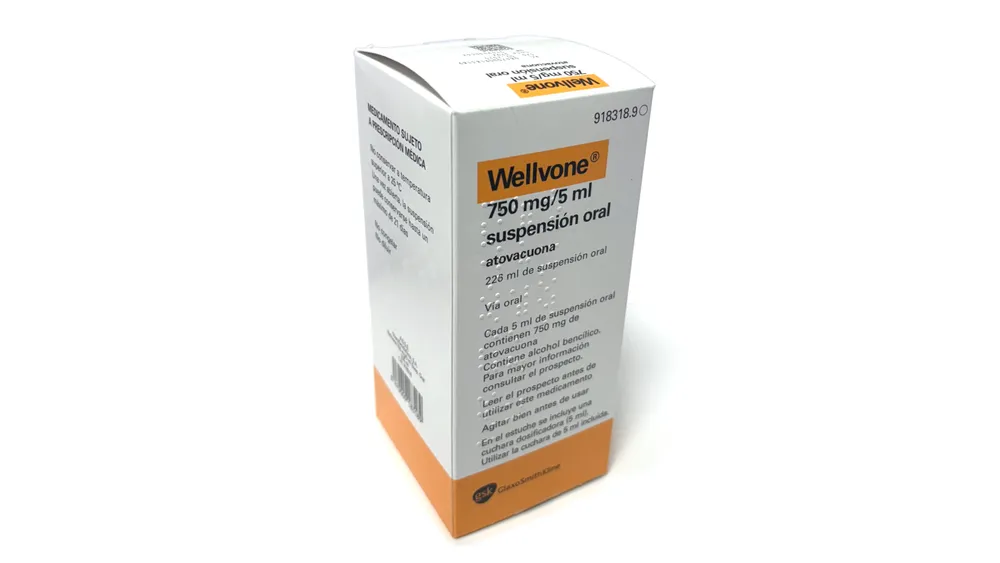
Table of Contents
Package leaflet: Information for the user
Introduction
Package leaflet: information for the user
Wellvone 750 mg/5 ml oral suspension
atovaquone
Read the entire leaflet carefully before you start taking this medicine, because it contains important information for you.
- Keep this leaflet, as you may need to read it again.
- If you have any questions, consult your doctor or pharmacist.
- This medicine has been prescribed for you only, and you should not give it to other people, even if they have the same symptoms as you, because it may harm them.
- If you experience any adverse reactions, consult your doctor or pharmacist, even if they are adverse reactions not listed in this leaflet. See section 4.
Leaflet contents
- What Wellvone is and what it is used for
- What you need to know before taking Wellvone
- How to take Wellvone
- Possible side effects
- How to store Wellvone
- Contents of the pack and other information
1. What Wellvone is and what it is used for
Wellvone is used to treat a lung infection called Pneumocystis pneumonia (PCP) in people who cannot take co-trimoxazole (a combination of trimethoprim and sulfamethoxazole).
This disease is caused by an organism called Pneumocystis jiroveci (which was formerly known as Pneumocystis carinii).
The active substance in Wellvone is atovaquone. Wellvone belongs to a group of antiparasitic medicines known as antiprotozoals.
2. What you need to know before starting to take Wellvone
Do not take Wellvone
- if you are allergic to atovaquone or to any of the other ingredients of this medicine (listed in section 6).
Consult your doctor or pharmacist before starting to take Wellvone.
Take special care with Wellvone
Before you start taking Wellvone, your doctor needs to know:
- if you have any kidney or liver disease
- if you have diarrhea, especially when starting treatment. Diarrhea reduces the body's absorption of Wellvone, so the treatment may not be effective
- if you are over 65 years of age.
Inform your doctor if any of these apply to you. Your doctor may consider that Wellvone is not suitable for you or that you need additional monitoring while taking it.
Pregnancy, breastfeeding and fertility
- If you are pregnant, do not take Wellvone unless your doctor recommends it. If you become pregnant while taking Wellvone, consult your doctor whether you should continue treatment. Consult your doctor or pharmacist before taking this medicine during pregnancy.
- Do not breast-feed while taking Wellvone. It is not known whether Wellvone passes into breast milk; if it does, it may harm the baby.
Other medicines and Wellvone
Tell your doctor or pharmacist if you are taking, have recently taken or might need to take any other medicines, including herbal remedies or other medicines obtained without a prescription.
Some medicines may reduce the effectiveness of Wellvone, or Wellvone itself may alter the effect of other medicines taken at the same time. These include:
- the antibiotics rifampicin and rifabutin
- the antibiotic tetracycline
- metoclopramide, used to treat nausea and vomiting
- indinavir, zidovudine or didanosine, used to treat HIV
- efavirenz or certain highly active protease inhibitors used to treat HIV
- etoposide, used to treat cancer.
Tell your doctor if you are taking any of these substances. Your doctor may consider that Wellvone is not suitable for you, or that you need additional monitoring while taking it.
Remember to inform your doctor if you start taking any other medicines during treatment with Wellvone.
Taking Wellvone with food and drink
Always take Wellvone with food – preferably with fatty meals. This will increase the amount of Wellvone absorbed by your body and make your treatment more effective.
Ask your doctor which foods are suitable.
If you have difficulty taking Wellvone with food, speak with your doctor to consider the possibility of alternative treatment.
Driving and using machines
Your ability to drive or operate machinery is not expected to be affected while taking Wellvone.
Wellvone contains benzyl alcohol
This medicine contains 50.66 mg of benzyl alcohol in each 5 ml.
Benzyl alcohol may cause allergic reactions.
Benzyl alcohol has been associated with the risk of serious adverse effects, including breathing problems ("gasping syndrome"), in newborns.
Do not administer this medicine to your newborn (up to 4 weeks of age) unless recommended by your doctor.
This medicine should not be used for more than one week in children under 3 years of age unless directed by your doctor or pharmacist.
Consult your doctor or pharmacist if you are pregnant or breastfeeding, or if you have liver or kidney disease. This is because large amounts of benzyl alcohol may accumulate in your body and cause adverse effects (metabolic acidosis).
Wellvone contains sodium
This medicine contains less than 1 mmol of sodium (23 mg) per 5 ml, i.e., essentially "sodium-free".
3. How to take Wellvone
Follow exactly the instructions for use of this medicine given by your doctor or pharmacist. If in doubt, consult your doctor or pharmacist again.
Shake the bottle well before use.
Do not dilute Wellvone.
Always take Wellvone with food – preferably with meals high in fat. This will increase the amount of Wellvone absorbed and make your treatment more effective.
How much to take
The recommended dose of Wellvone in adults is one 5 ml spoonful (containing 750 mg of atovaquone), twice daily for 21 days. Use the 5 ml spoon provided. Wash the spoon with clean water after taking each dose.
Take one dose in the morning and another in the afternoon-evening.
If you take more Wellvone than you should
Contact your doctor or pharmacist for advice, or call the Toxicology Information Service at telephone number 91 562 04 20. If possible, show them the Wellvone packaging.
If you forget to take Wellvone
If you forget to take a dose of Wellvone, take the next dose as soon as you remember (with food) and continue treatment as before. Do not take a double dose to make up for forgotten doses.
If you stop treatment with Wellvone
Take Wellvone for the length of time recommended by your doctor. Do not stop taking it unless instructed by your doctor – even if you feel better. If you do not complete the full course of treatment, the infection may return.
If you have any further questions about the use of this medicine, ask your doctor or pharmacist.
4. Possible adverse effects
Like all medicines, this medicine can cause adverse effects, although not everyone experiences them.
Very common adverse effects (may affect more than 1 in 10 people)
- nausea
- rash
- pruritus.
Common adverse effects (may affect up to 1 in 10 people)
- diarrhea
- vomiting
- headache
- sleep problems (insomnia)
- high temperature (fever)
- allergic reactions, sometimes severe. These include the following symptoms:
- sudden wheezing, tightness in the chest or throat, difficulty breathing
- swelling of eyelids, face, lips, tongue, or other parts of the body
- hives (urticaria).
Other common adverse effects that may appear in blood tests are:
- low levels of sodium in the blood (hyponatremia)
- increased levels of liver enzymes
- reduction in the number of red blood cells in the blood (anemia), which may cause fatigue, headaches, and difficulty breathing
- decrease in the number of certain types of white blood cells in the blood (neutropenia).
Uncommon adverse effects (may affect up to 1 in 100 people)
- increased levels of amylase (a digestive enzyme produced by the pancreas) in blood tests.
Other adverse effects
Other adverse effects have been reported in a very small number of people, with frequency not known:
- skin rash, which may form blisters resembling small targets (a dark center surrounded by a paler area, with a dark ring around the edge) (erythema multiforme)
- widespread rash with blisters and peeling of the skin, especially around the mouth, nose, eyes, and genitals (Stevens–Johnson syndrome).
? If you notice any of these symptoms, contact a doctor urgently.
Reporting of adverse effects
If you experience any type of adverse effect, consult your doctor or pharmacist, even if it is a possible adverse effect not listed in this leaflet. You may also report them directly via the Spanish Pharmacovigilance System for Human Medicinal Products: www.notificaRAM.es. By reporting adverse effects, you can help provide more information on the safety of this medicine.
5. Storage of Wellvone
Keep this medicine out of sight and reach of children.
Do not use this medicine after the expiry date stated on the label of the bottle. After opening, the suspension can be stored for a maximum of 21 days.
Do not store above 25 °C. Do not freeze.
Medicines must not be disposed of via wastewater or household waste. Dispose of empty containers and unused medicines at a SIGRE collection point at your pharmacy. If you are in doubt, please consult your pharmacist on how to properly dispose of unused containers and medicines. This will help protect the environment.
6. Contents of the pack and other information
Composition of Wellvone
Each 5 ml spoonful of Wellvone suspension contains 750 mg of the active substance, atovaquone (1 ml of Wellvone contains 150 mg of atovaquone). The other components are benzyl alcohol (E1519), xanthan gum, poloxamer 188, sodium saccharin, purified water, and tutti frutti flavour (sweet orange oil, concentrated orange oil, propylene glycol (E1520), benzyl alcohol (E1519), vanillin, acetaldehyde, amyl acetate and ethyl butyrate). For further information on benzyl alcohol and sodium in Wellvone, see section 2.
If you think you may be allergic to any of these ingredients:
Tell your doctor and do not take Wellvone
Appearance of the product and contents of the pack
Wellvone is a yellow oral suspension. The medicine is supplied in a 240 ml plastic bottle with a child-resistant safety cap containing 226 ml of oral suspension. Each pack includes a dosing spoon (5 ml).
Marketing Authorization Holder:
GlaxoSmithKline, S.A.
P.T.M. C/ Severo Ochoa, 2
28760 Tres Cantos (Madrid)
Tel: +34 900 202 700
Manufacturer responsible:
GlaxoSmithKline Trading Services Limited
12 Riverwalk
Citywest Business Campus
Dublin 24
Ireland
Date of the most recent revision of this leaflet: July 2023
Detailed and up-to-date information on this medicine is available on the website of the Spanish Agency of Medicines and Health Products (AEMPS) http://www.aemps.gob.es/.