Wakix 18 mg film-coated tablets
Spain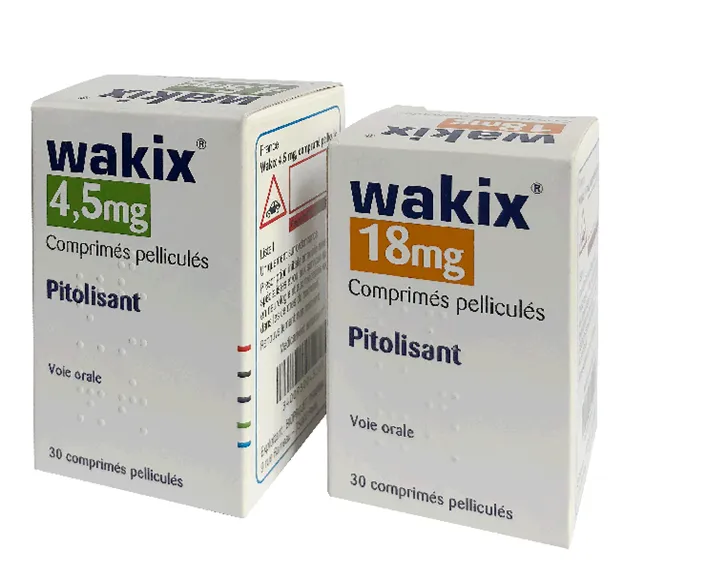
Table of Contents
Package leaflet: Information for the user
Introduction
Package leaflet: Information for the user
Wakix 4.5 mg film-coated tablets
Wakix 18 mg film-coated tablets
pitolisant
This medicinal product is subject to additional monitoring, which will allow rapid identification of new information on its safety. You can help by reporting any adverse reactions you may experience. Information on how to report adverse reactions is included at the end of section 4.
Read all of this leaflet carefully before you start taking this medicine, as it contains important information for you.
- Keep this leaflet, as you may need to read it again.
- If you have any questions, ask your doctor or pharmacist.
- This medicine has been prescribed for you only, and you must not give it to other people, even if they have the same symptoms as you, since it may harm them.
- If you experience any adverse reactions, talk to your doctor or pharmacist, even if they are adverse reactions not listed in this leaflet. See section 4.
Contents of this leaflet
- What Wakix is and what it is used for
- What you need to know before taking Wakix
- How to take Wakix
- Possible side effects
- How to store Wakix
- Contents of the pack and other information
1. What Wakix is and what it is used for
Wakix contains the active substance pitolisant. It is a medicine used to treat adult patients, adolescents, and children over 6 years of age with narcolepsy, with or without cataplexy.
Narcolepsy is a condition that causes excessive daytime sleepiness and a tendency to fall asleep suddenly in inappropriate situations (sleep attacks). Cataplexy usually begins with a sudden onset of muscle weakness or paralysis without loss of consciousness, occurring in response to sudden emotional reactions such as anger, fear, joy, laughter, or surprise.
The active substance, pitolisant, binds to receptors on brain cells involved in promoting wakefulness. This helps to counteract daytime sleepiness and cataplexy, and to promote a state of alertness.
2. What you need to know before taking Wakix
Do not take Wakix:
- If you are allergic to pitolisant or to any of the other ingredients of this medicine (listed in section 6).
- If you have severe liver problems, as pitolisant is normally broken down in the liver and its levels may become excessively high in patients with severely impaired liver function.
- If you are breastfeeding (lactation period).
Warnings and precautions
Talk to your doctor before starting Wakix if you are in any of the following situations:
- You have previously experienced anxiety or depression with suicidal thoughts.
- You have liver or kidney problems, as your dose may need to be adjusted.
- You have a gastric ulcer or are taking any medicine that may irritate the stomach (such as nonsteroidal anti-inflammatory drugs), as gastrointestinal reactions have been reported with Wakix.
- You have obesity or anorexia, as your body weight may change (increase or decrease) while taking Wakix.
- You have heart problems. Your doctor should regularly monitor these conditions during treatment with Wakix.
- If you have severe epilepsy.
If you are in any of these situations, consult your doctor or pharmacist before taking Wakix.
Other points you should discuss with your doctor or pharmacist:
Some people with psychiatric history have reported suicidal thoughts while taking this medicine. Inform your doctor immediately if you feel depressed or have suicidal thoughts (see section 4). Ask a close family member or friend to help you detect signs of depression or other changes in your behavior.
Children
Wakix must not be given to children under 6 years of age.
Taking Wakix with other medicines
Tell your doctor or pharmacist if you are taking, have recently taken, or might need to take any other medicines. Wakix may affect how other medicines work, and other medicines may affect how Wakix works. Your doctor may need to adjust your dose.
In particular, you should be cautious if you are taking Wakix together with certain antidepressants (e.g., imipramine, clomipramine, and mirtazapine) and certain medicines for allergic conditions (antihistamines such as pheniramine maleate, chlorpheniramine, diphenhydramine, promethazine, mepyramine, and doxylamine).
Consult your doctor or pharmacist if you are taking any of the following medicines: rifampicin (antibiotic), phenytoin, carbamazepine, and phenobarbital (used mainly to control seizures), quinidine, digoxin (used to treat arrhythmia), paroxetine, fluoxetine, venlafaxine, duloxetine (antidepressants), St. John’s wort (Hypericum perforatum), a herbal medicine for depression, bupropion (antidepressant or smoking cessation aid), cinacalcet (used to treat parathyroid gland disorders), terbinafine (used to treat fungal infections), metformin, repaglinide (used to treat diabetes), docetaxel, irinotecan (used to treat cancer), cisapride (used to treat esophageal reflux), pimozide (used to treat certain mental disorders), halofantrine (used to treat malaria), efavirenz (antiviral for HIV treatment), morphine, paracetamol (used as an analgesic), dabigatran (used to treat bleeding disorders), warfarin (used to treat heart conditions), probenecid (used to treat gout and gouty arthritis). Pitolisant may be used with modafinil and sodium oxybate.
Wakix may reduce the effectiveness of hormonal contraceptives; therefore, another reliable contraceptive method should be used (see section "Pregnancy").
Pregnancy and breastfeeding
If you are pregnant or breastfeeding, think you may be pregnant, or plan to become pregnant, consult your doctor or pharmacist before using this medicine.
Pregnancy
Wakix must not be used during pregnancy unless prescribed by your doctor. There is insufficient information available to determine specific risks associated with the use of Wakix during pregnancy. Women must use contraceptive methods during treatment with Wakix and for at least 21 days after stopping treatment. Since Wakix may reduce the effectiveness of hormonal contraceptives, another reliable contraceptive method must be used.
Breastfeeding
In animals, Wakix passes into breast milk. Patients taking Wakix must discontinue breastfeeding.
Driving and using machines
You should be cautious when performing activities requiring attention, such as driving or operating machinery. If you are unsure whether your condition negatively affects your ability to drive, consult your doctor.
3. How to take Wakix
Follow exactly the administration instructions for this medicine as given by your doctor or pharmacist. If in doubt, please consult your doctor or pharmacist again.
Adults
Treatment usually starts with a dose of 9 mg once daily, and is gradually increased over three weeks to reach the most appropriate dose. At any time, your doctor may increase or reduce the dose depending on the patient's response and tolerance to the medicine.
It may take several days before the benefits of the medicine are noticeable, and maximum benefit is usually observed after several weeks of treatment.
Do not change the doses of Wakix on your own. Any change in dosage must be prescribed and supervised by your doctor.
For a dose of 4.5 mg, take one 4.5 mg tablet.
For a dose of 9 mg, take two 4.5 mg tablets.
For a dose of 18 mg, take one 18 mg tablet.
For a dose of 36 mg, take two 18 mg tablets.
Adolescents and children over 6 years of age
Treatment usually starts with a dose of 4.5 mg once daily, and is gradually increased over three weeks to reach the most appropriate dose (see above).
If you weigh less than 40 kg, you must not take more than 18 mg per day.
Wakix should be taken once daily orally, in the morning with breakfast.
A dose of Wakix should not be taken in the afternoon, as the patient might experience difficulty sleeping.
If you take more Wakix than you should
If you take too many Wakix tablets, contact the nearest hospital emergency department or consult your doctor or pharmacist immediately. You may experience headache, stomach pain, nausea, or irritability. You may also have difficulty sleeping. Bring this leaflet and any remaining tablets with you.
If you forget to take Wakix
If you forget to take your medicine, take the next dose at the usual time. Do not take a double dose to make up for the missed dose.
If you stop taking Wakix
You should continue taking Wakix for the duration prescribed by your doctor. Do not stop taking Wakix suddenly on your own.
If you have any further questions about the use of this medicine, ask your doctor or pharmacist.
4. Possible adverse effects
Like all medicines, this medicine can cause adverse effects, although not everyone experiences them. If you experience any adverse effect, consult your doctor.
Frequent adverse effects (may affect up to 1 in 10 people):
- Difficulty sleeping, feeling anxious, feeling irritable, feeling depressed, trouble sleeping
- Headaches, sensation of spinning (vertigo), loss of balance, tremors
- Nausea, vomiting, indigestion
- Tiredness (fatigue)
Uncommon adverse effects (may affect up to 1 in 100 people):
- Sweating
- Increased or decreased appetite
- Edema
- Feeling nervous, seeing or hearing things that are not real
- Emotional instability
- Abnormal dreams
- Tension
- Difficulty falling asleep at the beginning, in the middle, or at the end of the night, difficulty staying asleep, excessive drowsiness, drowsiness
- State of indifference with lack of emotion
- Nightmares
- Feeling restless and unable to stay still
- Panic reaction
- Suicidal thoughts
- Altered or increased sexual interest
- Sudden transient episode of muscle weakness, uncontrollable muscle spasms, or leg movements
- Impaired attention
- Migraine
- Epilepsy
- Weakness
- Lack of coordination of movement, slow body movements
- Tingling sensation, pins and needles, pricking, or burning of the skin
- Sudden and unpredictable episodes of mobility and immobility
- Feeling of instability
- Decreased visual acuity, abnormal contraction or spasm of the eyelid
- Perceiving sounds that do not exist
- Irregular heartbeat, fast or slow heart rate, increase or decrease in blood pressure, hot flush
- Yawning
- Dry mouth
- Diarrhea, stomach discomfort or pain, constipation, heartburn, stomach discomfort or pain, gastritis, excess acidity in the digestive tract
- Itching, skin disorder in which the nose and cheeks are unusually red, excessive sweating
- Joint pain, low back pain, muscle stiffness, muscle weakness, muscle and bone pain, pain in fingers and toes
- Abnormal urination
- Irregular uterine bleeding
- Loss of strength or extreme tiredness, chest pain, malaise, edema, weight gain, weight loss, abnormal electrocardiogram (ECG), abnormal blood values related to liver function
Rare adverse effects (may affect up to 1 in 1,000 people):
- Loss of appetite, increased appetite
- Abnormal behavior, confused state, depressive state, excitability, feeling of emotional and mental uneasiness, feeling of seeing or hearing things that are not real during sleep
- Loss of consciousness, tension headache, memory disorder, poor quality of sleep
- Abdominal discomfort, difficulty or pain when swallowing, flatulence, inflammation of the digestive tract
- Skin infection, abnormally high sensitivity to sunlight
- Neck pain and chest pain
- Spontaneous abortion
- Pain, night sweats, feeling of tightness
- Elevated blood levels of the enzyme creatine phosphokinase, abnormal general physical condition, disturbance in the electrical recording of the heart (ECG)
Reporting of adverse effects
If you experience any adverse effects, talk to your doctor or pharmacist, even if they are adverse effects not listed in this leaflet. You can also report them directly through the national reporting system included in Appendix V. By reporting adverse effects, you can help provide more information on the safety of this medicine.
5. Storage of Wakix
Keep this medicine out of the sight and reach of children.
Do not use this medicine after the expiry date which is stated on the box after EXP. The expiry date is the last day of the month indicated.
This medicine does not require any special storage conditions.
Medicines should not be disposed of via wastewater or household waste. Ask your pharmacist how to dispose of medicines and packaging you no longer need. This will help protect the environment.
6. Contents of the container and other information
Composition of Wakix
The active substance is pitolisant.
Wakix 4.5 mg tablets
Each tablet contains pitolisant hydrochloride equivalent to 4.45 mg of pitolisant.
Wakix 18 mg tablets
Each tablet contains pitolisant hydrochloride equivalent to 17.8 mg of pitolisant.
The other components are microcrystalline cellulose, crospovidone type A, talc, magnesium stearate, colloidal anhydrous silica, polyvinyl alcohol, titanium dioxide (E 171) and macrogol 3350.
Appearance of the product and contents of the container
Wakix 4.5 mg is presented as white film-coated, round, biconvex tablets, 3.7 mm in diameter, marked with "5" on one side.
Wakix 18 mg is presented as white film-coated, round, biconvex tablets, 7.5 mm in diameter, marked with "20" on one side.
Wakix is marketed in bottles containing 30 or 90 tablets.
Wakix 4.5 mg: Available in packs containing 1 bottle of 30 tablets.
Wakix 18 mg: Available in packs containing 1 bottle of 30 tablets, packs containing 1 bottle of 90 tablets, or multiple packs of 90 tablets (3 bottles of 30 tablets).
Only certain pack sizes may be commercially available.
Marketing Authorization Holder
Bioprojet Pharma
9, rue Rameau
75002 Paris
France
Manufacturer
Wakix 18 mg
Inpharmasci
ZI N°2 de Prouvy-Rouvignies
1 rue Nungesser
59121 Prouvy
France
Wakix 4.5 mg
Patheon
40 Boulevard de Champaret
38300 Bourgoin-Jallieu
France
For more information about this medicinal product, please contact the local representative of the Marketing Authorization Holder:
Belgium/Belgium/Belgium Bioprojet Benelux 0032(0)78050202 | Lithuania UAB Norameda +370 5 2306499 |
GTS Solution +40 21 528 02 92 | Luxembourg/Luxembourg Bioprojet Benelux 0032(0)78050202 |
Czech Republic BIOXA Therapeutics (Czech) s.r.o. +420 606 501 778 | Hungary UAB Norameda +370 5 2306499 |
Denmark Zambon Sweden, filial of Zambon Nederland B.V. +46 (0)10 33 50 800 | Malta Bioprojet Pharma 0033 (0)1 47 03 66 33 |
Germany Bioprojet Deutschland GmbH 030/3465 5460-0 | Netherlands Bioprojet Benelux N.V. 088 34 34 100 |
Estonia UAB Norameda Eesti filiaal +372 514 2118 | Norway Zambon Sweden, filial of Zambon Nederland B.V. +46 (0)10 33 50 800 |
Greece Bioprojet Pharma 0033 (0)1 47 03 66 33 | Austria AOP Orphan Pharmaceuticals GmbH 0043 1 503 72 44 |
Spain Bioprojet Pharma 0033 (0)1 47 03 66 33 | Poland Norameda Polska Sp. z o.o. +48 504 278 778 |
France Bioprojet Pharma 0033 (0)1 47 03 66 33 | Portugal Ferrer Portugal, S.A 00351 214 449 600 |
Croatia Lenis farmacevtika d.o.o. +386 1 23 50 700 Ireland Bioprojet Pharma 0033 (0)1 47 03 66 33 | Romania GTS Solution +40 21 528 02 92 Slovenia Lenis farmacevtika d.o.o. +386 1 23 50 700 |
Iceland Bioprojet Pharma 0033 (0)1 47 03 66 33 | Slovakia BIOXA Therapeutics s.r.o. +421 907 927 010 |
Italy Bioprojet Italia srl +39 02 84254830 | Finland/Sweden Zambon Sweden, filial of Zambon Nederland B.V. +46 (0)10 33 50 800 |
Cyprus Bioprojet Pharma 0033 (0)1 47 03 66 33 | Sweden Zambon Sweden, filial of Zambon Nederland B.V. +46 (0)10 33 50 800 |
Latvia Lenis farmacevtika d.o.o. +386 1 23 50 700 | United Kingdom (Northern Ireland) Bioprojet Pharma 0033 (0)1 47 03 66 33 |
Date of the most recent review of this leaflet:
Other sources of information
Detailed information on this medicinal product is available on the website of the European Medicines Agency:
http://www.ema.europa.eu.
This leaflet can be found on the European Medicines Agency website in all languages of the European Union/European Economic Area.