Vyvgart 1.000 mg solution for injection
Spain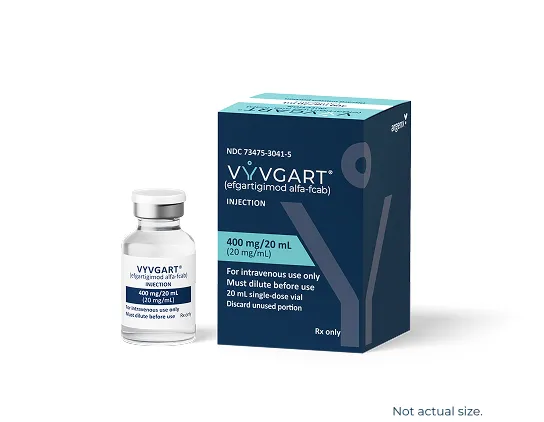
Table of Contents
Package leaflet: Information for the user
Introduction
Package leaflet: information for the patient
Vyvgart 1 000 mg injectable solution
efgartigimod alfa
This medicinal product is subject to additional monitoring, which will allow quicker detection of new safety information. You can help by reporting any adverse reactions you may experience. Information on how to report adverse reactions is provided at the end of section 4.
Read all of this leaflet carefully before you start using this medicine, because it contains important information for you.
- Keep this leaflet, as you may need to read it again.
- If you have any questions, ask your doctor, pharmacist, or nurse.
- This medicine has been prescribed for you only. Do not give it to other people, even if they have the same symptoms as you, as it may harm them.
- If you experience any adverse reactions, consult your doctor, pharmacist, or nurse, even if they are adverse reactions not listed in this leaflet. See section 4.
Contents of this leaflet
- What Vyvgart is and what it is used for
- What you need to know before using Vyvgart
- How to use Vyvgart
- Possible adverse reactions
- How to store Vyvgart
- Contents of the pack and other information
1. What Vyvgart is and what it is used for
What Vyvgart is
Vyvgart contains the active substance efgartigimod alfa. Efgartigimod alfa binds to a protein in the body called neonatal Fc receptor (FcRn) and blocks it. By blocking FcRn, efgartigimod alfa reduces the levels of immunoglobulin G (IgG) autoantibodies, which are immune system proteins that mistakenly attack parts of a person's body.
What Vyvgart is used for
Vyvgart is used in combination with standard therapy to treat adults with generalized myasthenia gravis (gMG), an autoimmune disease that causes muscle weakness. gMG can affect multiple muscle groups throughout the body. The disease can also cause shortness of breath, extreme fatigue, and difficulty swallowing.
In patients with gMG, IgG autoantibodies attack and damage proteins in the nerves called acetylcholine receptors. Due to this damage, nerves are unable to properly stimulate muscle contraction, leading to muscle weakness and difficulty moving. By binding to the FcRn protein and reducing levels of autoantibodies, Vyvgart may improve the ability of muscles to contract and reduce disease symptoms and their impact on daily activities.
Vyvgart is also used to treat adults with chronic inflammatory demyelinating polyneuropathy (CIDP), a form of autoimmune disease. CIDP causes muscle weakness and/or numbness, primarily in the legs and arms. Vyvgart may protect nerves from immune attacks and reduce disease symptoms and their impact on daily activities.
2. What you need to know before using Vyvgart
Do not use Vyvgart
- if you are allergic to efgartigimod alfa or to any of the other ingredients of this medicine (listed in section 6).
Warnings and precautions
Talk to your doctor before starting treatment with Vyvgart.
MGFA Class V
Your doctor cannot prescribe this medicine if you are on a ventilator due to muscle weakness from MG (myasthenic crisis).
Infections
Treatment with Vyvgart may reduce your body's natural resistance to infections. Inform your doctor if you have any infection before starting Vyvgart.
Infusion reactions and allergic reactions
Vyvgart contains a protein that may cause reactions such as rash or itching in some people. Vyvgart may cause anaphylactic reactions (serious allergic reactions). If you experience allergic reactions such as swelling of the face, lips, throat, or tongue that makes swallowing or breathing difficult, shortness of breath, feeling faint, or skin rash during or after the infusion, inform your doctor immediately.
Immunizations (vaccinations)
Inform your doctor if you have received any vaccine within the last 4 weeks, or if you plan to be vaccinated in the near future.
Children and adolescents
Do not administer this medicine to children under 18 years of age, as the safety and efficacy of Vyvgart have not been established in this population.
Elderly patients
No special precautions are required for patients over 65 years of age.
Other medicines and Vyvgart
Inform your doctor if you are taking, have recently taken, or might need to take any other medicines.
Pregnancy, breastfeeding, and fertility
If you are pregnant or breastfeeding, think you may be pregnant, or are planning to become pregnant, consult your doctor or pharmacist before using this medicine.
Driving and using machines
Vyvgart is not expected to affect your ability to drive or use machines.
Vyvgart contains sodium
This medicine contains less than 1 mmol of sodium (23 mg) per vial; essentially “sodium-free”.
Vyvgart contains polysorbate
This medicine contains 2.7 mg of polysorbate 20 in each vial, equivalent to 0.4 mg/ml. Polysorbates may cause allergic reactions. Inform your doctor if you have any known allergy.
3. How to use Vyvgart
Follow exactly the instructions for administration of this medicine given by your doctor or pharmacist. If you are unsure, consult your doctor or pharmacist again.
What dose of Vyvgart you will receive and how often
Generalized myasthenia gravis
The recommended dose is 1,000 mg administered in cycles of one injection per week for 4 weeks. Your doctor will decide when further treatment cycles are needed.
If you are already being treated with intravenous Vyvgart and wish to switch to subcutaneous Vyvgart, you should receive the subcutaneous injection instead of your next intravenous infusion at the beginning of the next treatment cycle.
Chronic inflammatory demyelinating polyneuropathy
The recommended dose is 1,000 mg, one injection per week. Depending on your response to treatment, your doctor may adjust this to one injection every 2 weeks.
Vyvgart injection
Vyvgart is administered by injection under the skin (subcutaneously). You and your doctor should decide whether, after appropriate training, you or your caregiver may inject Vyvgart. The first self-injection must be performed in the presence of your healthcare professional. It is important that you do not attempt to inject Vyvgart before receiving training from a healthcare professional.
If you or your caregiver will be injecting Vyvgart, you or your caregiver must carefully read and follow the Instructions for Use at the end of this leaflet (see “Important Instructions for Use”). Speak with your doctor, pharmacist, or nurse if you have any questions about how to administer an injection.
If you use more Vyvgart than you should
Since Vyvgart is administered in a single-use vial, it is unlikely that you will receive too much. However, if you are concerned, contact your doctor, pharmacist, or nurse for advice.
If you missed or forgot an appointment to receive Vyvgart
Keep track of your next dose. It is important to use Vyvgart exactly as prescribed by your doctor.
- If you forgot to take your dose within three days of the scheduled date, take your dose as soon as you remember, then continue with your original dosing schedule.
- If you forgot to take your dose for more than three days, ask your doctor when you should take the next dose.
- If you missed an appointment, contact your doctor immediately for advice.
Do not take a double dose to make up for missed doses.
If you interrupt treatment with Vyvgart
Interrupting or stopping treatment with Vyvgart may cause your symptoms to return. Consult your doctor before interrupting treatment with Vyvgart. Your doctor will explain the potential adverse effects and risks. Your doctor will also want to monitor you closely.
If you have any further questions about the use of this medicine, ask your doctor, pharmacist, or nurse.
4. Possible adverse effects
Like all medicines, this medicine can cause adverse effects, although not everyone will experience them.
Your doctor will explain the possible adverse effects and the risks and benefits of Vyvgart to you before treatment.
Tell your doctor immediately if you notice:
Signs of a severe allergic reaction (anaphylactic reaction), such as swelling of the face, lips, throat or tongue causing difficulty swallowing or breathing, shortness of breath, feeling faint or a skin rash during or after the injection.
If you are unsure about the adverse effects listed below, ask your doctor to explain them to you.
Very common (may affect more than 1 in 10 patients)
- Infections of the nose and throat (upper respiratory tract)
- Reactions at the injection site, which may include redness, itching, pain. These injection site reactions are usually mild to moderate and typically occur one day after the injection.
Common (may affect up to 1 in 10 patients)
- Pain or burning sensation when urinating, which may be a sign of a urinary tract infection
- Inflammation of the airways in the lungs (bronchitis)
- Muscle pain (myalgia)
- Nausea
Frequency not known (cannot be estimated from available data)
- Allergic reactions during or after injection
- Swelling of the face, lips, throat or tongue causing difficulty swallowing or breathing, shortness of breath
- Pale skin, weak and rapid pulse, or feeling faint
- Sudden rash, itching, or hives
Reporting of adverse effects
If you experience any type of adverse effect, consult your doctor, even if it is a possible adverse effect not listed in this leaflet. You may also report them directly through the national reporting system included in Appendix V. By reporting adverse effects, you can help provide more information on the safety of this medicine.
5. Vyvgart Storage
Keep this medicine out of the sight and reach of children.
Do not use this medicine after the expiry date stated on the carton and label after “EXP”. The expiry date refers to the last day of the month indicated.
Store in a refrigerator (between 2 °C and 8 °C). Do not freeze.
If necessary, unopened vials may be stored at room temperature (up to 30 °C) for a maximum of 3 days. After storage at room temperature, unopened vials may be returned to the refrigerator. The total time outside the refrigerator and stored at room temperature must not exceed 3 days.
Keep in the original packaging to protect from light.
Do not use this medicine if particles are observed.
Medicines must not be disposed of via wastewater or household waste. Ask your pharmacist how to dispose of medicines and packaging you no longer need. This will help protect the environment.
6. Contents of the pack and other information
Composition of Vyvgart
- The active substance is efgartigimod alfa. Each vial contains 1,000 mg of efgartigimod alfa in 5.6 ml. Each ml contains 180 mg of efgartigimod alfa.
- The other components are: recombinant human hyaluronidase (rHuPH20), L-histidine, L-histidine monohydrochloride monohydrate, L-methionine, polysorbate 20, sodium chloride, sucrose, water for injections. See section 2 "Vyvgart contains sodium".
Nature and contents of the container
Vyvgart is a ready-to-use solution, slightly yellow, clear to slightly turbid, supplied as a subcutaneous injectable solution.
Marketing Authorisation Holder and Manufacturer
argenx BV
Industriepark-Zwijnaarde 7
9052 Gent
Belgium
Further information on this medicinal product is available by contacting the local representative of the Marketing Authorisation Holder:
Belgium/Belgium/Belgium argenx BV Tel/Tel: +32 (0)9 39 69 394/+32 (0)800 54 477 | Lithuania argenx BV Tel: +370 (0) 800 80 052 |
Bulgaria argenx BV Tel.: +359 (0)800 46 273 | Luxembourg/Luxembourg argenx BV Tel: +352 800 25 233 |
Czech Republic argenx BV Tel: +420 800 040 854 | Hungary argenx BV Tel.: +36 800 88 578 |
Denmark argenx BV Tlf.: +45 80 25 41 88 | Malta argenx BV Tel: +356 800 65 101 |
Germany argenx Germany GmbH Tel: +49 (0)800 180 3963 | Netherlands argenx BV Tel: +31 (0)800 023 2882 |
Estonia argenx BV Tel: +372 800 010 0919 Greece Medison Pharma Greece Single Member Societe Anonyme Tel: +30 210 0100 188 | Norway argenx BV Tlf: +47 800 62 225 Austria argenx BV Tel: +43 (0)800 017936 |
Spain argenx Spain S.L. Tel: +34 900 876 188 | Poland argenx BV Tel.: +48 800 005 155 |
France argenx France SAS Tel: +33 (0)1 88 89 89 92 | Portugal argenx BV Tel: +351 800 180 844 |
Croatia argenx BV Tel: +385 (0)800 806 524 | Romania argenx BV Tel: +40 (0)800 360 912 |
Ireland argenx BV Tel: +353 1800 851 868 | Slovenia argenx BV Tel: +386 (0)80 688 955 |
Iceland argenx BV Tel: +354 800 4422 | Slovakia argenx BV Tel: +421 (0)800 002 646 |
Italy argenx Italia s.r.l Tel: +39 800 729 052 | Finland argenx BV Tel: +358 0800 412 838 |
Cyprus argenx BV Tel: +357 800 77 122 | Sweden argenx BV Tel: +46 (0)20 12 74 56 |
Latvia argenx BV Tel: +371 80 205 267 |
Date of the most recent review of this leaflet:
Other sources of information
Detailed information on this medicine is available on the website of the European Medicines Agency: https://www.ema.europa.eu. There are also links to other websites on rare diseases and orphan medicinal products.
--------------------------------------------------------------------------------------------------------------------Important instructions for use
Vyvgart 1,000 mg injectable solution
efgartigimod alfa
Subcutaneous route
Read and understand these instructions for use before administering the Vyvgart injection.
If you or your caregiver intend to administer Vyvgart, your healthcare professional will instruct you on how to inject it. Your healthcare professional must train you or your caregiver on how to properly prepare and administer the Vyvgart injection before first use. A demonstration of appropriate self-administration under the supervision of a healthcare professional is required. It is important that you do not attempt to inject the medicine until you have received training and you or your caregiver are confident in knowing how to use Vyvgart. Ask your healthcare professional if you have any questions.
Important information you should know before administering a subcutaneous injection of Vyvgart.
- For subcutaneous use only.
- The vial is for single use only. Do not store vials, even if they are not empty.
- Do not use a vial if you notice unusual cloudiness or visible particles. The medicine should appear slightly yellow, from clear to slightly cloudy.
- Do not shake the vial during handling.
- Do not use damaged vials or vials without the protective cap. Report and return damaged vials or vials without the cap to the pharmacy.
Storage of Vyvgart
- Store in a refrigerator (between 2 °C and 8 °C).
- Do not freeze.
- If necessary, unopened vials may be stored at room temperature (up to 30 °C) for a maximum of 3 days. After storage at room temperature, unopened vials may be returned to the refrigerator. The total time outside the refrigerator at room temperature must not exceed 3 days.
- Store in the original packaging to protect from light.
- Keep this medicine out of the sight and reach of children.
| |
1 vial containing Vyvgart |
|
Package leaflet and Vyvgart instructions for use |
|
Additional materials not included Store additional materials at room temperature in a dry place | |
Alcohol wipes |
|
10 ml syringe |
|
18-gauge transfer needle, ≥38 mm in length |
|
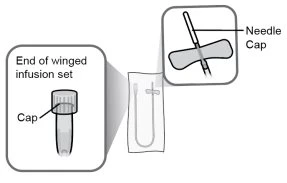
25-gauge microdrip set, 30 cm tubing, maximum priming volume 0.4 ml |
|
Sterile gauze |
|
Adhesive dressing |
|
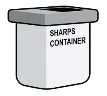
Sharps container |
|
 Package contents



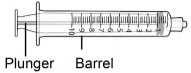

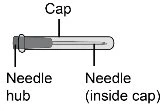



Preparation of the material
Step 1 Remove the vial box from the refrigerator. | |
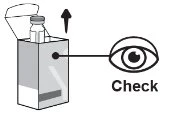
Step 2 Take the vial out of the box and check that:
If any of the above conditions are not met, do not administer the injection and inform the pharmacy. |
|
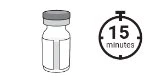
Step 3 Wait at least 15 minutes for the vial to warm up naturally to room temperature. Check that the medication in the vial is slightly yellow, ranging from clear to slightly cloudy, and does not contain visible particles.
|
|
Step 4 Gather the following additional supplies:
| |
Step 5 5a. Clean the work area. 5b. Wash hands with soap and dry thoroughly. | |
Preparation of the Syringe | |
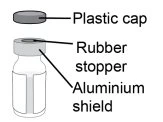
Step 6 Remove the vial's protective plastic cap. The aluminum seal should remain in place. |
|
Step 7 Clean the rubber stopper with a new alcohol wipe. Allow it to air dry naturally for at least 30 seconds. Do not blow on the rubber stopper. | |
Step 8 Unwrap the syringe and transfer needle. Insert the transfer needle into the syringe and turn clockwise until securely attached. Do not touch the tip of the syringe or the underside of the needle to avoid contamination and risk of infection. |
|
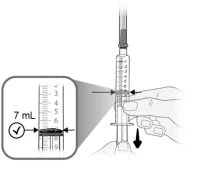
Step 9 Slowly pull back the plunger and draw 6.2 to 6.8 ml of air into the syringe. |
|
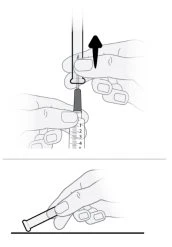
Step 10 10a. Hold the syringe at the hub where the needle attaches to the syringe. 10b. Hold the transfer needle cap and carefully pull it off the needle. 10c. Place the transfer needle cap cap-side down on a clean, flat surface.
|
|
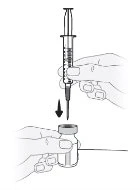
Step 11 Keep the vial upright on a flat surface and insert the transfer needle through the center of the disinfected rubber stopper. Do not puncture the vial's rubber stopper more than once to prevent leakage. |
|
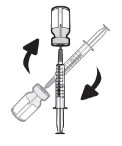
Step 12 Turn the vial upside down while keeping the transfer needle inserted. |
|
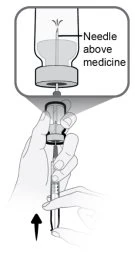
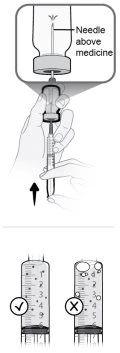
Step 13 13a. Ensure the transfer needle in the vial is pointing upward, with the needle tip above the medication solution. 13b. Gently push the plunger to inject all the air from the syringe into the empty space above the medication solution in the vial. 13c. Keep your finger pressed on the syringe plunger. Do not inject air into the medication solution, as this may create air bubbles or foam. |
|
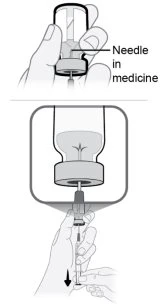
Step 14 Fill the syringe as follows: 14a. Keep your finger pressed on the syringe plunger and lower the tip of the transfer needle into the medication solution near the neck of the vial (close to the cap), ensuring the needle tip is fully submerged in the solution. 14b. Slowly pull back the plunger, keeping the transfer needle tip in the solution to avoid introducing air bubbles or foam into the syringe. Fill the syringe with the entire contents of the vial. |
|
Step 15 Remove any large air bubbles, if present. 15a. Keep the transfer needle in the vial and check for large air bubbles in the syringe. 15b. Remove large air bubbles by gently tapping the syringe with your fingers until the bubbles rise to the top. 15c. Move the transfer needle tip above the medication solution and slowly push the plunger upward to expel the air bubbles from the syringe. 15d. To remove any remaining medication from the vial, reinsert the transfer needle tip into the solution and slowly pull back the plunger until all contents are in the syringe. 15e. Repeat the steps above until all large air bubbles are removed. If not all liquid can be withdrawn, place the vial upright to access the remaining amount. |
|
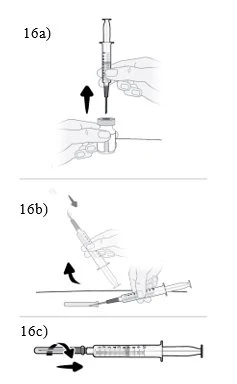
Step 16 16a. Rotate the vial upright and remove the syringe and transfer needle from the vial. 16b. With one hand, slide the transfer needle into the cap and lift to cover the needle. 16c. Once the transfer needle is covered, screw the cap onto the syringe to secure it completely. |
|
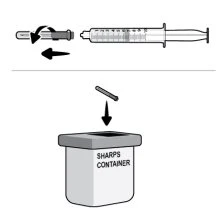
Step 17 17a. Gently pull the transfer needle and turn it counterclockwise to remove it from the syringe. 17b. Dispose of the transfer needle in the sharps container. |
|




Preparation of Vyvgart injection
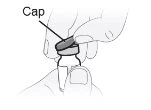
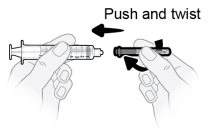
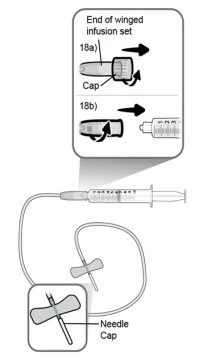
Step 18 18a. Remove the cap from the end of the microinfusion set. 18b. Push and gently twist the end of the microinfusion set clockwise onto the syringe until securely attached. The final syringe setup should resemble the figure on the right.
|
|
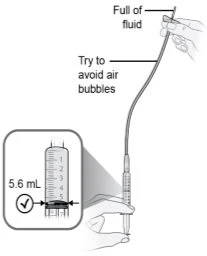
Step 19 19a. Fill the microinfusion set tubing by gently pushing the syringe plunger until it reaches the 5.6 ml mark. A small amount of liquid should be visible at the needle tip. 19b. Place the assembled syringe and microinfusion set on a clean, flat surface. Do not wipe away any excess medication solution expelled from the infusion set during tubing fill. |
|
Step 20 Select the injection site
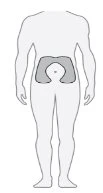
Choose a different injection site each time (rotate sites) to minimize discomfort. Note: Do not inject into areas where the skin is red, bruised, tender, hard, or areas containing moles or scars. |
|
Step 21 Disinfect the injection site using a new alcohol wipe. Use circular motions, cleaning from the inside outward. Allow the area to air dry for at least 30 seconds. Do not touch the injection site after disinfecting. |


Vyvgart Injection
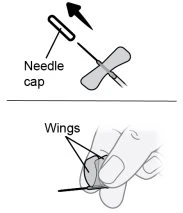
Step 22 22a. Carefully remove the needle cap from the microinfusion set. 22b. Fold the wings of the infusion set upward and hold them between the thumb and index finger, with the needle beneath the wings. Note: To avoid infection, ensure the needle does not come into contact with anything before skin insertion. |
|
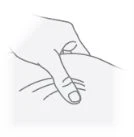
Step 23 With the free hand, pinch a fold of skin around the disinfected injection site and lift it upward. Grasp enough skin to create a "tent" into which the needle will be inserted. Do not grasp the skin too tightly to avoid bruising. |
|
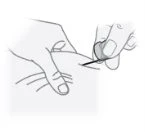
Step 24 Insert the needle into the center of the pinched skin at an angle of approximately 45 degrees. Note: The needle should be inserted gently into the skin. If resistance is felt, slightly withdraw the needle. |
|
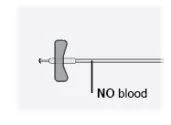
Step 25 Inspect the infusion set. Ensure there is no blood present. Important: If blood is visible, slightly withdraw the needle without removing it from the skin. |
|
Step 26 Administer the injection by pushing the syringe plunger with constant pressure until no medication remains in the syringe. This delivers the recommended dose of 5.6 ml. The injection typically takes between 30 and 90 seconds. Note:
| |
Step 27 27a. After injecting the entire solution, remove the needle from the skin. 27b. Cover the injection site with a sterile dressing, such as an adhesive bandage. Note: If a small drop of blood appears after needle removal, do not be concerned. This may occur if the needle nicks the skin during withdrawal. Clean the blood with sterile gauze and apply gentle pressure. Further bleeding should not occur. Apply a sterile dressing to cover the area. |

Vyvgart elimination
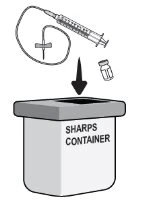
Step 28 Remove (discard) the microinfusion set (with the attached needle and syringe) and the vial into the sharps container. If you do not have a sharps container available, you may use a household container provided that it:
Dispose of the full container according to your doctor’s or pharmacist’s instructions. Note: Always keep the sharps container out of sight and out of reach of children. |
|