Vyvgart 1,000 mg solution for injection in pre-filled syringe
Spain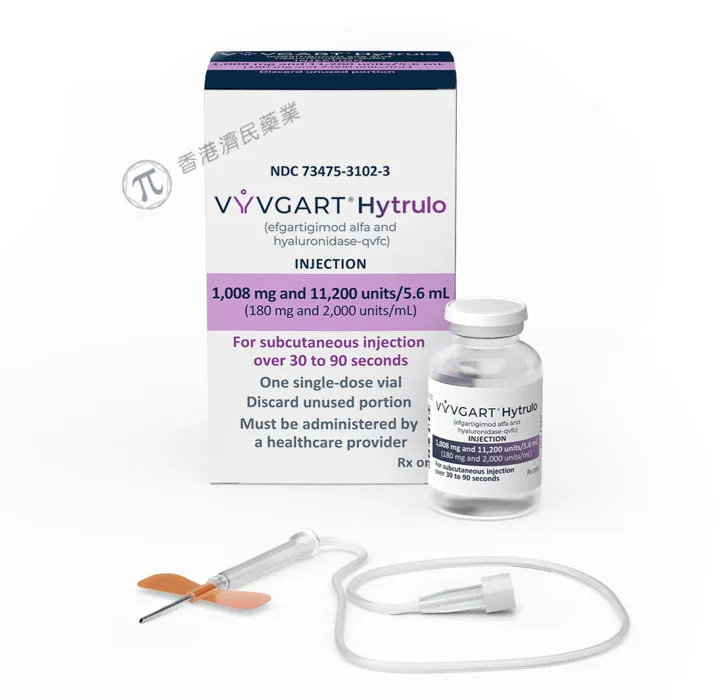
Table of Contents
Package leaflet: Information for the user
Introduction
Package leaflet: information for the patient
Vyvgart 1 000 mg solution for injection in pre-filled syringe
efgartigimod alfa
This medicinal product is subject to additional monitoring, which will allow quicker detection of new safety information. You can help by reporting any side effects you may experience. Information on how to report side effects is provided at the end of section 4.
Read all of this leaflet carefully before you start using this medicine, because it contains important information for you.
- Keep this leaflet, as you may need to read it again.
- If you have any questions, ask your doctor, pharmacist, or nurse.
- This medicine has been prescribed for you only and must not be given to other people, even if they have the same symptoms as you, because it may harm them.
- If you experience any side effects, consult your doctor, pharmacist, or nurse, even if they are side effects not listed in this leaflet. See section 4.
Leaflet contents
- What Vyvgart is and what it is used for
- What you need to know before using Vyvgart
- How to use Vyvgart
- Possible side effects
- How to store Vyvgart
- Contents of the pack and other information
1. What Vyvgart is and what it is used for
What Vyvgart is
Vyvgart contains the active substance efgartigimod alfa. Efgartigimod alfa binds to a protein in the body called neonatal Fc receptor (FcRn) and blocks it. By blocking FcRn, efgartigimod alfa reduces the levels of immunoglobulin G (IgG) autoantibodies, which are immune system proteins that mistakenly attack parts of a person's own body.
What Vyvgart is used for
Vyvgart is used in combination with standard therapy to treat adults with generalized myasthenia gravis (gMG), an autoimmune disease that causes muscle weakness. gMG can affect multiple muscle groups throughout the body. The disease may also cause shortness of breath, extreme fatigue, and difficulty swallowing.
In patients with gMG, IgG autoantibodies attack and damage proteins in the nerves called acetylcholine receptors. Due to this damage, nerves are unable to properly stimulate muscle contraction, resulting in muscle weakness and difficulty moving. By binding to the FcRn protein and reducing autoantibody levels, Vyvgart can improve the ability of muscles to contract and reduce disease symptoms and their impact on daily activities.
Vyvgart is also used to treat adults with chronic inflammatory demyelinating polyneuropathy (CIDP), a form of autoimmune disease. CIDP causes muscle weakness and/or numbness, primarily in the legs and arms. Vyvgart may protect nerves from immune attacks and reduce disease symptoms and their impact on daily activities.
2. What you need to know before starting to use Vyvgart
Do not use Vyvgart
- if you are allergic to efgartigimod alfa or to any of the other ingredients of this medicine (listed in section 6).
Warnings and precautions
Talk to your doctor before starting to use Vyvgart.
MGFA Class V
Your doctor cannot prescribe this medicine if you are on a ventilator due to muscle weakness from MG (myasthenic crisis).
Infections
Treatment with Vyvgart may reduce your natural resistance to infections. Inform your doctor if you have any infection before starting Vyvgart.
Injection reactions and allergic reactions
Vyvgart contains a protein that may cause reactions such as rash or itching in some people. Vyvgart may cause an anaphylactic reaction (serious allergic reaction). If you experience allergic reactions such as swelling of the face, lips, throat, or tongue making it difficult to swallow or breathe, shortness of breath, feeling faint, or skin rash during or after the injection, inform your doctor immediately.
Immunizations (vaccines)
Inform your doctor if you have received any vaccine within the last 4 weeks, or if you plan to receive a vaccine in the near future.
Children and adolescents
Do not administer this medicine to children under 18 years of age, as the safety and efficacy of Vyvgart have not been established in this population.
Elderly patients
No special precautions are required for treatment of patients over 65 years of age.
Other medicines and Vyvgart
Inform your doctor if you are taking, have recently taken, or might need to take any other medicines.
Pregnancy, breastfeeding and fertility
If you are pregnant or breastfeeding, think you may be pregnant, or plan to become pregnant, consult your doctor or pharmacist before using this medicine.
Driving and using machines
Vyvgart is not expected to affect the ability to drive or use machines.
Vyvgart contains sodium
This medicine contains less than 1 mmol of sodium (23 mg) per syringe; this is essentially “sodium-free”.
Vyvgart contains polysorbate
This medicine contains 2.1 mg of polysorbate 80 in each syringe, equivalent to 0.4 mg/ml. Polysorbates may cause allergic reactions. Inform your doctor if you have any known allergy.
3. How to use Vyvgart
Follow exactly the instructions for administering this medicine as given by your doctor or pharmacist. If in doubt, consult your doctor or pharmacist again.
What dose of Vyvgart you will receive and how often
Generalized myasthenia gravis
The recommended dose is 1,000 mg administered in cycles of one injection per week for 4 weeks. Your doctor will decide when further treatment cycles are needed.
If you are already being treated with intravenous Vyvgart and wish to switch to subcutaneous Vyvgart, you should receive the subcutaneous injection instead of your intravenous infusion at the beginning of your next treatment cycle.
Chronic inflammatory demyelinating polyneuropathy
The recommended dose is 1,000 mg, one injection per week. Depending on your response to treatment, your doctor may adjust this to one injection every 2 weeks.
Vyvgart injection
Vyvgart is administered by injection under the skin (subcutaneously). You and your doctor should decide whether, after proper training, you or your caregiver can inject Vyvgart. The first self-injection must be performed under the supervision of a healthcare professional. It is important that you do not attempt to inject Vyvgart before receiving training from a healthcare professional.
If you or your caregiver will be injecting Vyvgart, you or your caregiver must carefully read and follow the Instructions for Use at the end of this leaflet (see “Important Instructions for Use”). Speak with your doctor, pharmacist, or nurse if you have any questions about how to administer an injection.
If you use more Vyvgart than you should
Since Vyvgart is administered in a single-use vial, it is unlikely that you will receive too much. However, if you are concerned, contact your doctor, pharmacist, or nurse for advice.
If you missed or forgot an appointment to receive Vyvgart
Keep a record of your next dose. It is important that you use Vyvgart exactly as prescribed by your doctor.
- If you missed your dose within three days of the scheduled date, take your dose as soon as you remember, then continue with your original dosing schedule.
- If you missed your dose for more than three days, ask your doctor when you should take your next dose.
- If you missed an appointment, contact your doctor immediately for advice.
Do not take a double dose to make up for missed doses.
If you stop using Vyvgart
Stopping or discontinuing treatment with Vyvgart may cause your symptoms to return. Consult your doctor before stopping treatment with Vyvgart. Your doctor will explain the potential adverse effects and risks. Your doctor will also want to monitor you closely.
If you have any further questions about the use of this medicine, ask your doctor, pharmacist, or nurse.
4. Possible adverse effects
Like all medicines, this medicine may cause adverse effects, although not everyone will experience them.
Your doctor will explain the possible adverse effects and the risks and benefits of Vyvgart to you before treatment.
Tell your doctor immediately if you notice:
Signs of a severe allergic reaction (anaphylactic reaction) such as swelling of the face, lips, throat or tongue causing difficulty swallowing or breathing, shortness of breath, feeling faint or skin rash during or after the injection.
If you are unsure about which adverse effects are listed below, ask your doctor to explain them to you.
Very common (may affect more than 1 in 10 people)
- Infections of the nose and throat (upper respiratory tract)
- Reactions at the injection site, which may include redness, itching, pain. These injection site reactions are usually mild to moderate and typically occur one day after the injection.
Common (may affect up to 1 in 10 people)
- Pain or burning sensation when urinating, which may be a sign of urinary tract infection
- Inflammation of the airways in the lungs (bronchitis)
- Muscle pain (myalgia)
- Nausea.
Frequency not known (cannot be estimated from the available data)
- Allergic reactions during or after the injection.
- Swelling of the face, lips, throat or tongue causing difficulty swallowing or breathing, shortness of breath.
- Pale skin, weak and rapid pulse, or feeling faint.
- Sudden rash, itching, or hives.
Reporting of adverse effects
If you experience any type of adverse effect, consult your doctor, even if it is a possible adverse effect not listed in this leaflet. You may also report them directly through the national reporting system included in Appendix V. By reporting adverse effects, you can help provide more information on the safety of this medicine.
5. Vyvgart Storage Instructions
Keep this medicine out of the sight and reach of children.
Do not use this medicine after the expiry date stated on the carton and label following “EXP”. The expiry date refers to the last day of the month indicated.
Store in a refrigerator (between 2 °C and 8 °C). Do not freeze.
The unopened pre-filled syringe may also be stored at room temperature, in the original carton, not exceeding 30 °C, for a single period of up to 1 month after removal from the refrigerator. If not used within this 1-month period, or upon reaching the expiry date, whichever occurs first, the syringe must be discarded.
Keep in the original packaging to protect from light.
Do not use this medicine if particles are observed.
Medicines must not be disposed of via wastewater or household waste. Ask your pharmacist how to properly dispose of unused medicines and their packaging. This helps protect the environment.
6. Contents of the pack and other information
Composition of Vyvgart
- The active substance is efgartigimod alfa. Each pre-filled syringe contains 1,000 mg of efgartigimod alfa in 5.0 ml. Each ml contains 200 mg of efgartigimod alfa.
- The other components are: recombinant human hyaluronidase (rHuPH20), L-arginine hydrochloride, L-histidine, L-histidine monohydrochloride monohydrate, L-methionine, polysorbate 80 (E433), sodium chloride, sucrose, water for injections. See section 2 “Vyvgart contains sodium”.
Nature of the product and pack contents
Vyvgart is a ready-to-use solution, slightly yellow, clear to slightly turbid, supplied as a subcutaneous injectable solution in a pre-filled syringe.
Marketing Authorisation Holder and Manufacturer Responsible
argenx BV
Industriepark-Zwijnaarde 7
9052 Gent
Belgium
Further information on this medicinal product is available upon request by contacting the local representative of the Marketing Authorisation Holder:
Belgium/Belgium/Belgien argenx BV Tel/Tel: +32 (0) 93969394/+32 (0) 800 54477 | Lithuania argenx BV Tel: +370 (0)800 80 052 |
Bulgaria argenx BV Tel.: +359 (0)800 46 273 | Luxembourg/Luxembourg argenx BV Tél/Tel: +352 800 25 233 |
Czech Republic argenx BV Tel: +420 800 040 854 | Hungary argenx BV Tel.: +36 800 88 578 |
Denmark argenx BV Tlf.: +45 80 25 41 88 | Malta argenx BV Tel: +356 800 65 101 |
Germany argenx Germany GmbH Tel: +49 (0)800 180 3963 | Netherlands argenx BV Tel: +31 (0)800 023 2882 |
Estonia argenx BV Tel: +372 800 010 0919 Greece Medison Pharma Greece Single Member Societe Anonyme Tel: +30 210 0100 188 | Norway argenx BV Tlf: +47 800 62 225 Austria argenx BV Tel: +43 (0)800 017936 |
Spain argenx Spain S.L. Tel: +34 900 876 188 | Poland argenx BV Tel.: +48 800 005 155 |
France argenx France SAS Tél: +33 (0)1 88 89 89 92 | Portugal argenx Spain S.L. Sucursal Em Portugal Tel: +351 800 180 844 |
Croatia argenx BV Tel: +385 (0)800 806 524 | Romania argenx BV Tel: +40 (0)800 360 912 |
Ireland argenx BV Tel: +353 1800 851 868 | Slovenia argenx BV Tel: +386 (0)80 688 955 |
Iceland argenx BV Sími: +354 800 4422 | Slovakia argenx BV Tel: +421 (0)800 002 646 |
Italy argenx Italia s.r.l Tel: +39 800 729 052 | Finland argenx BV Puh/Tel: +358 (0)800 412 838 |
Cyprus argenx BV Tel: +357 800 77 122 | Sweden argenx BV Tel: +46 (0)20 12 74 56 |
Latvia argenx BV Tel: +371 80 205 267 |
Date of the most recent review of this leaflet:
Other sources of information
Detailed information on this medicine is available on the website of the European Medicines Agency: https://www.ema.europa.eu. There are also links to other websites about rare diseases and orphan medicinal products.
Important instructions for use
Vyvgart 1000 mg solution for injection in pre-filled syringe
efgartigimod alfa
For subcutaneous use
In order to improve the traceability of biological medicinal products, the name and batch number of the administered medicine should be clearly recorded.
Read and understand these instructions for use before administering the Vyvgart injection.
If you or your caregiver intend to administer Vyvgart, your healthcare professional will instruct you on how to inject it. Your healthcare professional must train you or your caregiver on how to properly prepare and administer the Vyvgart injection before using it for the first time. A demonstration of correct self-administration under the supervision of a healthcare professional is required. It is important that you do not attempt to inject the medicine until you have received training and you or your caregiver are confident in knowing how to use Vyvgart. Ask your healthcare professional if you have any questions.
Important information you should know before administering a subcutaneous injection of Vyvgart
- For subcutaneous use only.
- The pre-filled syringe is for single use only and must not be reused.
- Do not use the pre-filled syringe if it has been stored at room temperature for more than 1 month.
- Do not use the pre-filled syringe after the expiry date.
- Do not use the pre-filled syringe if it is cracked, broken, or damaged, or if the cap is missing. Report and return damaged pre-filled syringes to the pharmacy.
- Do not use the pre-filled syringe if the medicine has changed colour or contains particles. The medicine should be colourless or pale yellow. A slight opalescence is normal.
- Do not shake the pre-filled syringe.
Storage of Vyvgart in pre-filled syringe
- Store in a refrigerator (between 2 °C and 8 °C).
- Do not freeze.
- The unopened pre-filled syringe may also be stored at room temperature in its original carton at temperatures up to 30 °C for a single continuous period of up to 1 month after removal from the refrigerator. If not used within this 1-month period, or after the expiry date—whichever occurs first—the syringe must be discarded.
- Keep in the original packaging to protect from light.
- Keep this medicine out of the sight and reach of children.
Parts of the pre-filled syringe
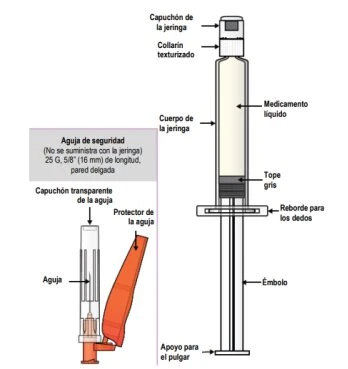
Preparation and inspection of materials
1. Remove the box from the refrigerator 1.1 Remove the prefilled syringe pack from the refrigerator. 1.2 Take one prefilled syringe out of the pack and return the remaining syringes to the refrigerator for later use. 1.3 Remove the prefilled syringe from the tray. | |
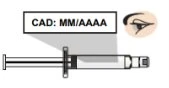
2.1 Check the expiration date on the prefilled syringe.
|
2.2 Check the condition of the pre-filled syringe and its cap.
Do not use the pre-filled syringe if it is cracked, broken, or damaged, or if the cap is missing. |
2.3 Check the appearance of the medication contained in the pre-filled syringe. The medication should be colorless or pale yellow. A slight cloudiness is normal.
Do not use the pre-filled syringe if the medication has changed color or contains particles |
Preparation for injection
Place the pre-filled syringe on a clean, flat surface and let it rest for at least 30 minutes to reach room temperature.
|
| ||
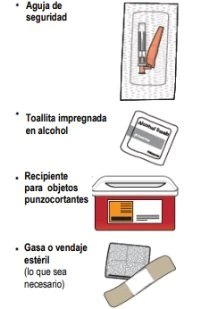
4.1 Prepare the following materials, which are not provided with the pre-filled syringe. 4.2 Wash your hands with soap and water. |
| ||
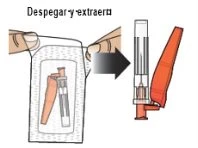
5.1 Carefully open the package and remove the needle. Dispose of the package in household waste. |
| ||
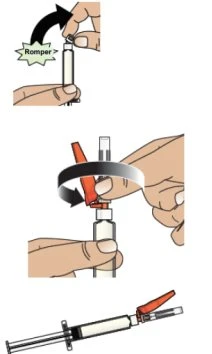
5.2 Bend the cap of the pre-filled syringe to one side to detach it, and then remove it from the pre-filled syringe. Dispose of the syringe cap in household waste and place the pre-filled syringe on a clean, flat surface.
5.3 Hold the pre-filled syringe with one hand and attach the needle to the syringe by twisting it (clockwise/to the right) until resistance is felt. The needle is now attached to the pre-filled syringe. |
| ||
6.1 Choose an injection site on the abdomen (stomach area) that is at least 5 cm away from the navel. Change the injection site for each administration.
6.2 Clean the selected injection site with an alcohol wipe and allow it to air dry.
|
|

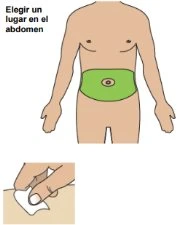
Vyvgart Injection
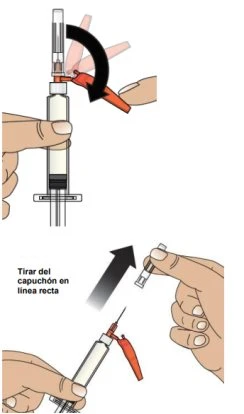
the needle cap 7.1 Pull back the needle shield. Remove the needle shield. Note: The needle shield will be used after the injection to cover the needle and prevent needlestick injuries. 7.2 Hold the pre-filled syringe body and remove the transparent needle cap by pulling it straight off to expose the needle. Dispose of the needle cap in household waste.
|
| |
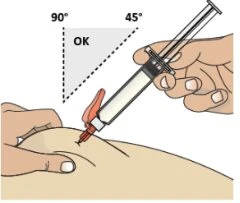
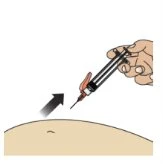
8.1 Pinch the injection site clean. Without releasing the pinch, insert the needle at an angle between 45 and 90 degrees into the pinched skin. Then, release the pinched skin.
|
| |
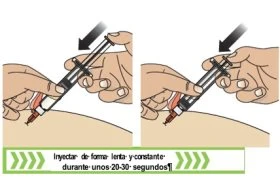
8.2 Slowly push the plunger all the way to inject the medication. The injection should take about 20-30 seconds. You will feel resistance as you press. If you experience any discomfort, inject more slowly. It is perfectly acceptable to make a pause or change your grip during the injection.
8.3 Once the entire liquid medication has been injected, remove the needle from the skin by pulling it out without changing the angle. |
|
Disposal of the used syringe
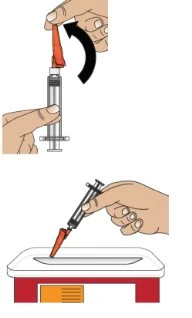
9 Cover the needle and dispose of it 9.1 Gently press the needle shield over the needle until it clicks and covers it. This helps prevent accidental needlestick injuries.
9.2 Place the used syringe with the attached needle into the sharps container immediately after use.
If you do not have a sharps container, you may use any container provided it meets the following conditions:
Dispose of the entire container following the instructions provided by your doctor, nurse, or pharmacist. |
| ||
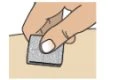
If a small amount of blood or fluid appears at the injection site, press with a gauze pad until bleeding stops. If needed, a bandage may be applied. |
|