VYNDIQEL 20 mg soft capsules
Spain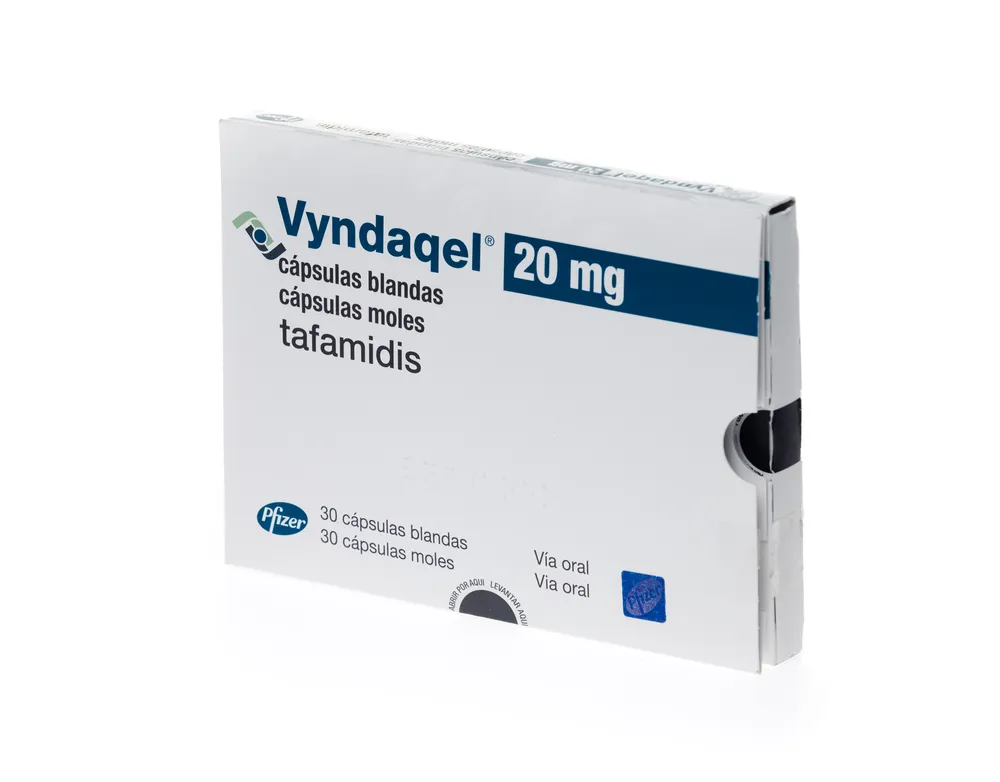
Table of Contents
Package leaflet: Information for the user
Introduction
Package leaflet: information for the user
Vyndaqel 20 mg soft capsules
tafamidis meglumine
This medicine is under additional monitoring, which will allow for faster detection of new safety information. You can help by reporting any side effects you may experience. Information on how to report side effects is included at the end of section 4.
Read this entire leaflet carefully before you start taking this medicine, as it contains important information for you.
- Keep this leaflet, as you may need to refer to it again.
- If you have any questions, consult your doctor, pharmacist or nurse.
- This medicine has been prescribed for you only and must not be given to other people, even if they have the same symptoms as you, since it could harm them.
- If you experience any side effects, consult your doctor, pharmacist or nurse, even if they are side effects not listed in this leaflet. See section 4.
Contents of the leaflet
- What Vyndaqel is and what it is used for
- What you need to know before taking Vyndaqel
- How to take Vyndaqel
- Possible side effects
- How to store Vyndaqel
- Contents of the pack and other information
1. What Vyndaqel is and what it is used for
Vyndaqel contains the active substance tafamidis.
Vyndaqel is a medicine used to treat a disease called transthyretin amyloidosis. Transthyretin amyloidosis occurs due to impaired function of a protein called transthyretin (TTR). TTR is a protein that transports other substances, such as hormones, throughout the body.
In patients with this disease, TTR breaks down and may form fibres called amyloid. Amyloid can accumulate around nerves (known as transthyretin amyloid polyneuropathy or ATTR-PN) and in other parts of the body. This amyloid causes the symptoms of the disease. When this happens, it prevents normal function.
Vyndaqel can prevent the breakdown of TTR and the formation of amyloid. This medicine is used to treat adult patients with this disease who have nerve involvement (patients with symptomatic polyneuropathy) to delay the progression of the disease.
2. What you need to know before taking Vyndaqel
Do not take Vyndaqel
If you are allergic to tafamidis meglumine or to any of the other ingredients of this medicine (listed in section 6).
Warnings and precautions
Talk to your doctor, pharmacist, or nurse before starting to take Vyndaqel.
- Women who could become pregnant must use a contraceptive method while taking Vyndaqel and continue using it for one month after stopping treatment with Vyndaqel. There are no data on the use of Vyndaqel in pregnant women.
Children and adolescents
Children and adolescents do not have symptoms of transthyretin amyloidosis. Therefore, Vyndaqel is not used in children and adolescents.
Other medicines and Vyndaqel
Inform your doctor or pharmacist if you are taking, have recently taken, or might need to take any other medicines.
You must inform your doctor or pharmacist if you are taking any of the following medicines:
- Non-steroidal anti-inflammatory drugs
- Diuretic medicines (e.g., furosemide, bumetanide)
- Medicines to treat cancer (e.g., methotrexate, imatinib)
- Statins (e.g., rosuvastatin)
- Antiviral medicines (e.g., oseltamivir, tenofovir, ganciclovir, adefovir, cidofovir, lamivudine, zidovudine, zalcitabine)
Pregnancy, breast-feeding, and fertility
If you are pregnant or breast-feeding, think you may be pregnant, or are planning to become pregnant, consult your doctor or pharmacist before using this medicine.
- You must not take Vyndaqel if you are pregnant or breast-feeding.
- If you could become pregnant, you must use a contraceptive method during treatment and for one month after stopping treatment.
Driving and using machines
Vyndaqel is considered to have no or negligible influence on the ability to drive and use machines.
Vyndaqel contains sorbitol
This medicine contains up to 44 mg of sorbitol per capsule. Sorbitol is a source of fructose.
3. How to take Vyndaqel
Follow exactly the instructions for using this medicine given by your doctor or pharmacist. If you are unsure, consult your doctor or pharmacist again.
The recommended dose is one Vyndaqel 20 mg capsule (tafamidis meglumine) once daily.
If you vomit after taking the medicine and can see the Vyndaqel capsule intact, you should take another dose of Vyndaqel on the same day. If you cannot see the Vyndaqel capsule, then do not take another dose; instead, take your medication as usual the next day.
Method of administration
Vyndaqel is for oral use.
The soft capsule must be swallowed whole, without crushing or cutting it.
The capsule may be taken with or without food.
Instructions for opening the blister packs
- Separate an individual blister from the blister card along the perforated line.
- Push the capsule through the aluminum foil.
If you take more Vyndaqel than you should
Do not take more capsules than your doctor has prescribed. If you take more capsules than prescribed, consult your doctor.
If you forget to take Vyndaqel
If you forget to take a dose, take the capsule as soon as you remember. If there are less than 6 hours until your next scheduled dose, skip the missed dose and take the next dose at the usual time. Do not take a double dose to make up for forgotten doses.
If you stop taking Vyndaqel
Do not stop taking Vyndaqel without first consulting your doctor. Since Vyndaqel works by stabilizing the TTR protein, if you stop taking Vyndaqel, the protein will no longer be stabilized and your condition may worsen.
If you have any further questions about the use of this medicine, ask your doctor or pharmacist.
4. Possible adverse effects
Like all medicines, this medicine can produce adverse effects, although not everyone will experience them.
Very common: may affect more than 1 in 10 people:
- Diarrhea.
- Urinary tract infection (symptoms may include: pain or burning sensation when urinating or need to urinate frequently).
- Stomach ache or abdominal pain.
Reporting of adverse effects
If you experience any type of adverse effect, consult your doctor, pharmacist, or nurse, even if it is a possible adverse effect not listed in this leaflet. You may also report them directly through the national reporting system included in Appendix V. By reporting adverse effects, you can help provide more information on the safety of this medicine.
5. Storage of Vyndaqel
Keep this medicine out of the sight and reach of children.
Do not use this medicine after the expiry date stated on the blister and carton. The expiry date is the last day of the month indicated.
Do not store above 25 °C.
Medicines must not be disposed of via wastewater or household waste. Ask your pharmacist how to dispose of medicines and packaging you no longer need. This will help protect the environment.
6. Contents of the pack and other information
Composition of Vyndaqel
-
The active substance is tafamidis. Each capsule contains 20 mg of micronized tafamidis meglumine, equivalent to 12.2 mg of tafamidis.
-
The other components are: gelatin (E 441), glycerol (E 422), sorbitol (E 420) (see section 2 “Vyndaqel contains sorbitol”), mannitol (E 421), sorbitan, yellow iron oxide (E 172), titanium dioxide (E 171), purified water, macrogol 400 (E 1521), sorbitan monooleate (E 494), polysorbate 80 (E 433), ethanol, isopropyl alcohol, polyvinyl alcohol phthalate, propylene glycol (E 1520), carmine (E 120), brilliant blue FCF (E 133), and ammonium hydroxide (E 527).
Nature and contents of the container
Vyndaqel soft capsules are yellow, opaque, oblong-shaped (approximately 21 mm) and marked with “VYN 20” in red. Vyndaqel is available in two pack sizes of single-dose PVC/PA/Alu/PVC-Alu blister packs: a pack containing 30 x 1 soft capsules and a multiple pack containing 90 soft capsules, consisting of 3 boxes each containing 30 x 1 soft capsules. Only certain pack sizes may be marketed.
Marketing Authorization Holder Pfizer Europe MA EEIG Boulevard de la Plaine 17 1050 Bruxelles Belgium | Manufacturer Pfizer Service Company BV Hoge Wei 10 1930 Zaventem Belgium O Millmount Healthcare Limited Block-7, City North Business Campus Stamullen K32 YD60 Ireland O Pfizer Manufacturing Deutschland GmbH Mooswaldallee 1 79108 Freiburg Im Breisgau Germany |
You can request further information about this medicinal product by contacting the local representative of the marketing authorization holder:
Belgium/Belgium/Belgium Pfizer NV/SA Tel/Tel: +32 (0)2 554 62 11 | Lithuania Pfizer Luxembourg SARL branch in Lithuania Tel: +370 5 251 4000 |
Bulgaria Pfizer Bulgaria EOOD, Business Park Sofia Tel: +359 2 970 4333 | Hungary Pfizer Kft. Tel.: +36 1 488 37 00 |
Czech Republic Pfizer, spol. s r.o. Tel: +420 283 004 111 | Malta Vivian Corporation Ltd. Tel: +356 21344610 |
Denmark Pfizer ApS Tlf.: +45 44 20 11 00 | Netherlands Pfizer bv Tel: +31 (0)800 63 34 636 |
Germany PFIZER PHARMA GmbH Tel: +49 (0)30 550055-51000 | Norway Pfizer AS Tlf: +47 67 52 61 00 |
Estonia Pfizer Luxembourg SARL Estonia branch Tel: +372 666 7500 | Austria Pfizer Corporation Austria Ges.m.b.H. Tel: +43 (0)1 521 15-0 |
Greece Pfizer Hellas A.E. Tel: +30 210 6785800 | Poland Pfizer Polska Sp. z o.o., Tel.: +48 22 335 61 00 |
Spain Pfizer, S.L. Tel: +34 91 490 99 00 | Portugal Laboratórios Pfizer, Lda. Tel: +351 21 423 5500 |
France Pfizer Tél: +33 (0)1 58 07 34 40 | Romania Pfizer Romania S.R.L. Tel: +40 (0) 21 207 28 00 |
Croatia Pfizer Croatia d.o.o. Tel: +385 1 3908 777 | Slovenia Pfizer Luxembourg SARL Pfizer, advisory branch for pharmaceutical activities, Ljubljana Tel: +386 (0)1 52 11 400 |
Ireland Pfizer Healthcare Ireland Unlimited Company Tel: +1800 633 363 (toll free) Tel: +44 (0)1304 616161 | Slovakia Pfizer Luxembourg SARL, organizational unit Tel: +421 2 3355 5500 |
Iceland Icepharma hf. Sími: +354 540 8000 | Finland Pfizer Oy Puh/Tel: +358 (0)9 430 040 |
Italy Pfizer S.r.l. Tel: +39 06 33 18 21 | Sweden Pfizer AB Tel: +46 (0)8 550 520 00 |
Cyprus Pfizer Hellas A.E. (Cyprus Branch) Tel: +357 22817690 | |
Latvia Pfizer Luxembourg SARL branch in Latvia Tel: +371 670 35 775 |
Date of the most recent review of this leaflet: 02/2025.
This medicine has been authorised under "exceptional circumstances".
This type of approval means that, due to the rarity of the disease, it has not been possible to obtain complete information on this medicine.
The European Medicines Agency will review any new information on this medicine that becomes available each year, and this leaflet will be updated as necessary.
Other sources of information
Detailed information on this medicine is available on the website of the European Medicines Agency: http://www.ema.europa.eu. Links to other websites on rare diseases and orphan medicines are also provided.
If you have difficulty seeing or reading this leaflet, or if you would like it in a different format, please contact the local number of the marketing authorisation holder listed in this leaflet.