Vpriv 400 units powder for solution for infusion
Spain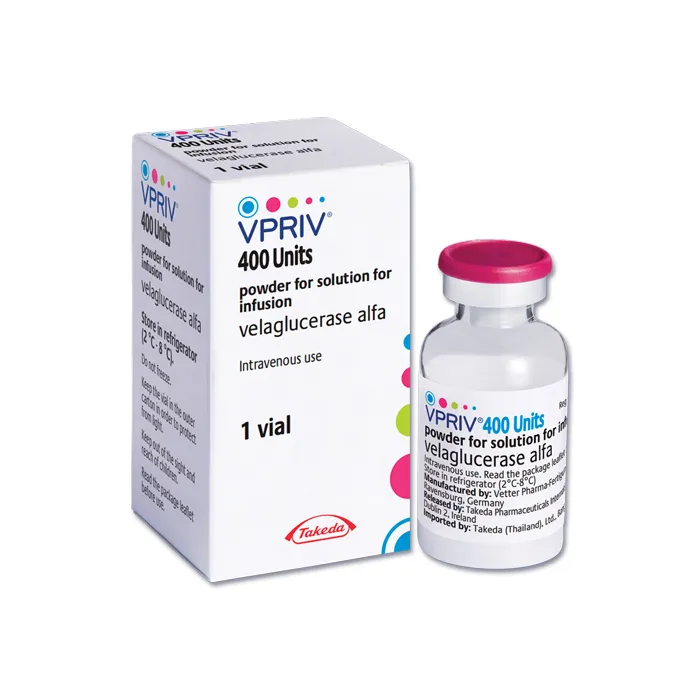
Table of Contents
Package leaflet: Information for the user
Introduction
Package leaflet: information for the user
VPRIV 400 units powder for solution for infusion
velaglucerase alfa
Read all of this leaflet carefully before you start using this medicine, because it contains important information for you.
- Keep this leaflet. You may need to read it again.
- If you have any questions, ask your doctor.
- This medicine has been prescribed for you only, and you must not give it to other people, even if they have the same symptoms as you, because it may harm them.
- If you experience any side effects, talk to your doctor, including any side effects not listed in this leaflet (see section 4).
Contents of this leaflet
- What VPRIV is and what it is used for
- What you need to know before you use VPRIV
- How to use VPRIV
- Possible side effects
- How to store VPRIV
- Contents of the pack and other information
1. What VPRIV is and what it is used for
VPRIV is a long-term enzyme replacement therapy (ERT) for patients with type 1 Gaucher disease.
Gaucher disease is a genetic disorder caused by the absence or deficiency of an enzyme called glucocerebrosidase. When this enzyme is missing or does not function properly, a substance called glucocerebroside accumulates in cells throughout the body. The buildup of this material leads to the signs and symptoms seen in Gaucher disease.
VPRIV contains a substance called velaglucerase alfa, which is designed to replace the missing or defective enzyme, glucocerebrosidase, in patients with Gaucher disease.
2. What you need to know before using VPRIV
Do not use VPRIV
- if you are highly allergic to velaglucerase alfa or to any of the other ingredients of this medicine (listed in section 6).
Warnings and precautions
Talk to your doctor before using VPRIV
- If you receive treatment with VPRIV, you may experience adverse reactions during or after the infusion (see section 4, Possible side effects). These reactions are called infusion-related reactions and may present as hypersensitivity reactions with symptoms such as nausea, rash, difficulty breathing, back pain, chest discomfort (chest tightness), hives, joint pain, or headache.
- In addition to symptoms of hypersensitivity reactions, infusion-related reactions may also manifest as dizziness, high blood pressure, fatigue, fever, itching, blurred vision, or vomiting.
If you experience any of these symptoms, you must inform your doctor immediately.
- You may be given other medications to treat or help prevent future reactions. These medications may include antihistamines, antipyretics, and corticosteroids.
Inform your doctor if you have previously experienced any infusion-related reaction with any other ERT (enzyme replacement therapy) for Gaucher disease.
Children
Do not use in children under 4 years of age, as there is no experience with the use of this medicine in this age group.
Use of VPRIV with other medicines
Tell your doctor if you are taking, have recently taken, or might need to take any other medicines.
Pregnancy
Gaucher disease may become more active in women during pregnancy and in the weeks following childbirth. Women with Gaucher disease who are pregnant or considering becoming pregnant should consult their doctor before using this medicine.
Breast-feeding
It is unknown whether VPRIV can pass into breast milk. If you are breast-feeding or planning to breast-feed, you should consult your doctor before receiving this medicine. Your doctor will help you decide whether you should stop breast-feeding or discontinue the use of VPRIV, taking into account the benefits of breast-feeding for the baby and the benefits of VPRIV for the mother.
Consult your doctor or pharmacist before receiving this medicine.
Driving and using machines
The influence of VPRIV on the ability to drive and use machines is negligible or none.
VPRIV contains sodium
This medicine contains less than 23 mg of sodium (1 mmol) per vial, which means it is essentially "sodium-free".
3. How to use VPRIV
This medicine must be used only under the supervision of a physician experienced in the treatment of Gaucher disease; this physician will also determine the dose you should receive.
It must be administered by a physician or nurse via intravenous infusion. Under medical supervision, VPRIV may be self-administered (by you or your caregiver) after proper training has been provided by the physician and/or nurse. Self-administration must take place in the presence of a responsible adult.
Dosage
The recommended dose is 60 units/kg administered every two weeks.
If you are currently receiving treatment for Gaucher disease with another ERT (enzyme replacement therapy) and your physician wishes to switch you to VPRIV, you may initially receive VPRIV at the same dose and frequency as your previous ERT.
Use in children and adolescents
VPRIV may be given to children and adolescents (aged 4 to 17 years) at the same dose and frequency as in adults.
Use in elderly patients
VPRIV may be administered to elderly patients (over 65 years of age) at the same dose and frequency as in adults.
Response to treatment
Your physician will monitor your response to treatment and may adjust the dose (up or down) over time.
If you tolerate infusions well at the clinic, your physician or nurse may administer them at your home.
Administration
VPRIV is supplied in a vial as a compacted powder, which must be mixed with sterile water and then further diluted in a 9 mg/ml (0.9%) sodium chloride solution for intravenous infusion.
Once prepared, your physician or nurse will administer the medicine by intravenous infusion over a period of 60 minutes.
For self-administration, the dose and infusion rate must not be altered without the approval of the physician responsible for treatment.
If you use more VPRIV than you should
If you think you have used more VPRIV than you should, contact your physician.
If you use less VPRIV than you should
If you think you have used less VPRIV than you should, contact your physician.
If you forget to use VPRIV
If you have missed an infusion of VPRIV, contact your physician.
If you stop using VPRIV
If you discontinue treatment with VPRIV, contact your physician. If you stop treatment, your symptoms may return. If you have any further questions about the use of this medicine, ask your physician.
4. Possible adverse effects
Like all medicines, VPRIV can cause adverse effects, although not everyone experiences them.
Severe allergic reactions have occurred frequently (may affect 1 in 10 people), including difficulty breathing, chest discomfort (chest tightness), nausea, swelling of the face, lips, tongue or throat (anaphylactic/anaphylactoid reactions). Skin allergic reactions such as hives, severe rash or itching are also frequent. If any of these reactions occur, inform your doctor immediately.
Most adverse effects, including allergic reactions, occurred during or shortly after the infusion. These reactions are called infusion-related reactions.
- If a severe reaction occurs, your doctor at the clinic will immediately stop the intravenous infusion and begin appropriate medical treatment.
- If you are receiving treatment at home and experience a severe infusion-related reaction, including anaphylaxis, stop the infusion immediately, seek urgent medical attention immediately, and contact your doctor.
- If reactions are severe and/or there is a loss of effectiveness of this medicine, your doctor will perform a blood test to check for the presence of antibodies that could affect your treatment outcome.
- The doctor or nurse may decide to continue administering VPRIV even if you experience an infusion-related reaction. Your condition will be closely monitored.
Other infusion-related reactions that occurred very frequently (may affect more than 1 in 10 people) include headache, dizziness, fever/increased body temperature, back pain, joint pain and fatigue, as well as increased blood pressure (reported frequently), blurred vision and vomiting (reported infrequently). If any of these reactions occur, inform your doctor immediately.
Other adverse effects include:
Very common adverse effects (may affect more than 1 in 10 people):
- bone pain
- weakness/loss of strength
- stomach pain
Common adverse effects (may affect up to 1 in 10 people):
- prolonged time for a wound to stop bleeding, which may lead to easy bleeding, spontaneous bleeding and bruising
- skin redness
- rapid heartbeat
- development of antibodies against VPRIV (see section 2)
- decreased blood pressure
Reporting of adverse effects
If you experience any adverse effects, consult your doctor or pharmacist, even if they are possible adverse effects not listed in this leaflet. You may also report them directly through the national reporting system detailed in Appendix V. By reporting adverse effects, you can help provide more information on the safety of this medicine.
5. Storage of VPRIV
Keep this medicine out of sight and reach of children.
Do not use this medicine after the expiry date stated on the packaging and label after the letters EXP. The expiry date refers to the last day of the month indicated.
Store in a refrigerator (between 2 °C and 8 °C).
Do not freeze.
Keep the vial in the outer packaging to protect it from light.
Reconstituted and diluted solution for infusion:
Use immediately. Do not exceed 24 hours at a temperature of 2 °C to 8 °C.
Do not use VPRIV if the solution is discoloured or contains foreign particles.
Medicines should not be disposed of via wastewater or household waste. Ask your pharmacist how to dispose of medicines you no longer need. This will help protect the environment.
6. Contents of the container and other information
Composition of VPRIV
- The active substance is velaglucerase alfa.
Each vial contains 400 units of velaglucerase alfa.
After reconstitution, one ml of solution contains 100 units of velaglucerase alfa.
- The other components are sucrose, sodium citrate dihydrate, citric acid monohydrate and polysorbate 20 (see section 2, "VPRIV contains sodium").
Presentation of the product and contents of the container
20 ml glass vial containing a white to off-white powder for solution for infusion.
Pack sizes of 1, 5 or 25 vials.
Only certain pack sizes may be marketed.
Marketing Authorization Holder and Manufacturers
Marketing Authorization Holder
Takeda Pharmaceuticals International AG Ireland Branch
Block 2 Miesian Plaza
50-58 Baggot Street Lower
Dublin 2
D02 HW68
Ireland
Manufacturers
Takeda Pharmaceuticals International AG Ireland Branch
Block 2 Miesian Plaza
50-58 Baggot Street Lower
Dublin 2
D02 HW68
Ireland
Shire Pharmaceuticals Ireland Limited
Block 2 & 3 Miesian Plaza
50 – 58 Baggot Street Lower
Dublin 2
Ireland
Further information on this medicinal product is available upon request by contacting the local representative of the Marketing Authorization Holder:
Belgium/Belgium/Belgium Takeda Belgium NV Tel/Tel: +32 2 464 06 11 | Lithuania Takeda, UAB Tel: +370 521 09 070 |
| Luxembourg/Luxembourg Takeda Belgium NV Tel/Tel: +32 2 464 06 11 |
Czech Republic Takeda Pharmaceuticals Czech Republic s.r.o. Tel: +420 234 722 722 | Hungary Takeda Pharma Kft. Tel.: +36 1 270 7030 |
Denmark Takeda Pharma A/S Tlf: +45 46 77 10 10 | Malta Drugsales Ltd Tel: +356 21419070 |
Germany Takeda GmbH Tel: +49 (0)800 825 3325 | Netherlands Takeda Nederland B.V. Tel: +31 20 203 5492 |
Estonia Takeda Pharma OÜ Tel: +372 6177 669 | Norway Takeda AS Tlf: +47 800 800 30 |
Greece Takeda HELLAS S.A. Tel: +30 210 6387800 | Austria Takeda Pharma Ges.m.b.H. Tel: +43 (0) 800-20 80 50 |
Spain Takeda Farmacéutica España S.A Tel: +34 917 90 42 22 | Poland Takeda Pharma Sp. z o.o. Tel.: +48223062447 |
France Takeda France SAS Tel: +33 1 40 67 33 00 | Portugal Takeda Farmacêuticos Portugal, Lda. Tel: +351 21 120 1457 |
Croatia Takeda Pharmaceuticals Croatia d.o.o. Tel: +385 1 377 88 96 | Romania Takeda Pharmaceuticals SRL Tel: +40 21 335 03 91 |
Ireland Takeda Products Ireland Ltd Tel: 1800 937 970 | Slovenia Takeda Pharmaceuticals farmacevtska družba d.o.o. Tel: +386 (0) 59 082 480 |
Iceland Vistor hf. Sími: +354 535 7000 | Slovakia Takeda Pharmaceuticals Slovakia s.r.o. Tel: +421 (2) 20 602 600 |
Italy Takeda Italia S.p.A. Tel: +39 06 502601 | Finland/Suomi Takeda Oy Puh/Tel: 0800 795 079 |
Cyprus A.POTAMITIS MEDICARE LTD Tel: +357 22583333 | Sweden Takeda Pharma AB Tel: 020 795 079 |
Latvia Takeda Latvia SIA Tel: +371 67840082 | United Kingdom (Northern Ireland) Takeda UK Ltd Tel: +44 (0) 3333 000 181 |
Date of the most recent review of this leaflet: 11/2024.
Other sources of information
Detailed information on this medicinal product is available on the European Medicines Agency website: http://www.ema.europa.eu. It also provides links to other websites on rare diseases and orphan medicinal products.
This information is intended for healthcare professionals only:
VPRIV is a powder for solution for infusion. It requires reconstitution and dilution and is intended for intravenous infusion only. VPRIV is for single use only and must be administered through a 0.2 or 0.22 µm filter. Any unused solution must be discarded. VPRIV must not be infused together with other medicinal products in the same infusion, as compatibility with other products in solution has not been evaluated. The total volume of the infusion must be administered over a period of 60 minutes.
Use aseptic techniques.
Prepare VPRIV as follows:
- Determine the number of vials to reconstitute based on the patient's body weight and the indicated dose.
- Remove the required number of vials from the refrigerator. Reconstitute each vial using sterile water for injections:
Vial size | Sterile water for injection |
400 units | 4.3 ml |
- After reconstitution, gently mix the vials. Do not shake.
- Before dilution, inspect the solution in the vials visually; the solution should be clear to slightly opalescent and colorless. Do not use if the solution is discolored or if foreign particles in suspension are observed.
- Withdraw the calculated volume of drug from the corresponding number of vials. A residual amount of solution will remain in the vial:
Vial size | Extractable volume |
400 units | 4.0 ml |
- Dilute the required total volume in 100 ml of sodium chloride 9 mg/ml (0.9%) solution for infusion. Mix gently. Do not shake. Begin infusion within 24 hours after reconstitution.
From a microbiological standpoint, use the medicine immediately. If not used immediately, the storage times and conditions prior to use are the responsibility of the user. Do not exceed 24 hours at a temperature between 2°C and 8°C.
Do not dispose of the medicine via wastewater or household waste. Dispose of unused medicine and all materials that have come into contact with it according to local regulations.
Traceability
In order to improve the traceability of biological medicines, clearly record the name and batch number of the administered medicine.