Voltaren 1 mg/ml eye drops solution
Spain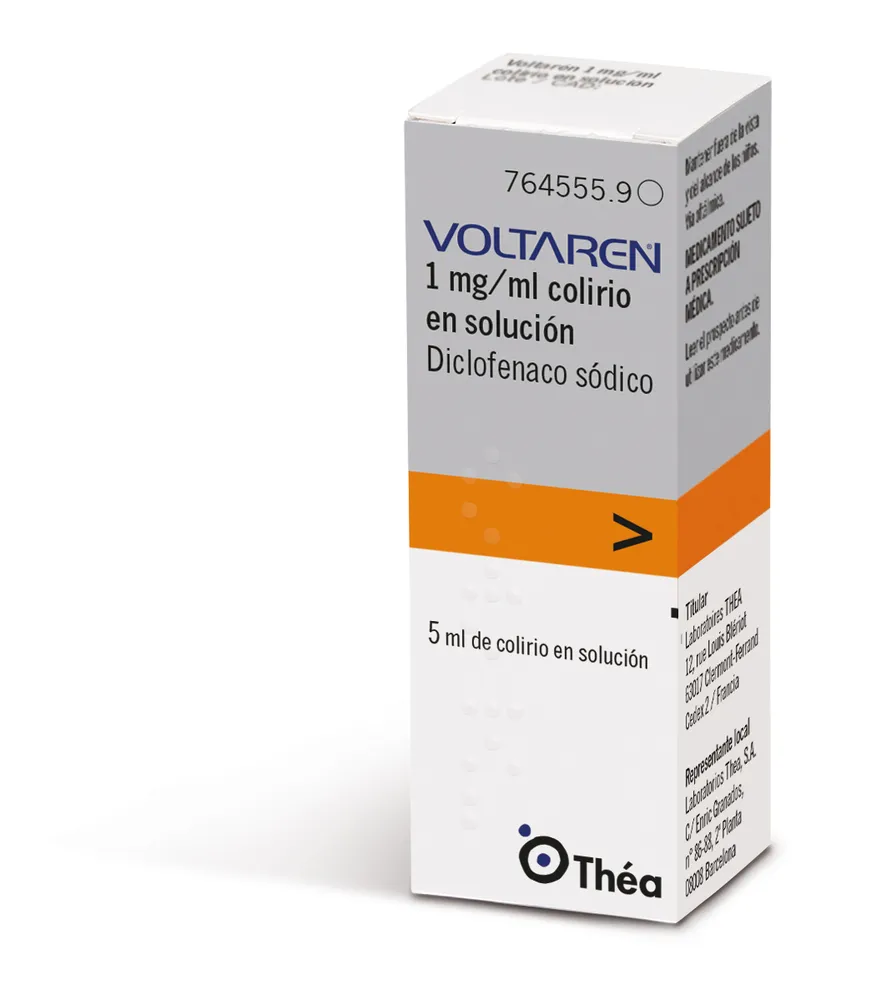
Table of Contents
Patient Information Leaflet
Introduction
Patient Information Leaflet
Voltarén 1 mg/ml eye drops, solution
Diclofenac sodium
Read all of this leaflet carefully before you start using this medicine, because it contains important information for you.
- Keep this leaflet, as you may need to read it again.
If you have any questions, ask your doctor or pharmacist.
- This medicine has been prescribed for you only, and you should not give it to other people even if they have the same symptoms as you, because it may harm them.
- If you experience any adverse reactions, consult your doctor or pharmacist, even if they are adverse reactions not listed in this leaflet. See section 4.
Leaflet contents
- What Voltarén eye drops are and what they are used for
- What you need to know before using Voltarén eye drops
- How to use Voltarén eye drops
- Possible side effects
- How to store Voltarén eye drops
- Contents of the pack and other information
1. What Voltarén eye drops is and what it is used for
Voltarén eye drops contains as its active substance sodium diclofenac, a non-steroidal anti-inflammatory drug (NSAID), with anti-inflammatory and pain-relieving (analgesic) properties.
The mechanism of action of the non-steroidal anti-inflammatory drugs is based on the inhibition of prostaglandin biosynthesis, which play an essential role in the development of inflammation and pain.
Voltarén eye drops is indicated for:
Post-operative treatment of inflammation in the anterior segment of the eye, as well as for the inhibition of intraoperative pupil constriction (miosis) during cataract surgery.
Treatment of ocular pain and sensitivity to light (photophobia) following surgery for the correction of myopia, hyperopia, and astigmatism.
2. What you need to know before using Voltarén eye drops
Do not use Voltarén eye drops:
- if you are allergic to diclofenac or to any of the other ingredients of this medicine (listed in section 6).
- if you suffer from asthma attacks, urticaria, or acute rhinitis when taking acetylsalicylic acid or other drugs with similar prostaglandin synthetase-inhibiting activity.
- if you have previously shown hypersensitivity to acetylsalicylic acid or to derivatives of phenylacetic acid, which belong to the same chemical group as the active substance in this medicine or other non-steroidal anti-inflammatory drugs (NSAIDs), as there may be a risk of cross-sensitivity to these drugs.
Warnings and precautions
Consult your doctor or pharmacist before starting to use Voltarén eye drops.
- When there is infection or risk of infection, Voltarén eye drops should be administered together with appropriate antibiotic therapy.
- If you have problems with stopping bleeding or are taking any medication that may prolong bleeding time, inform your doctor before using Voltarén eye drops (see section "Other medicines and Voltarén eye drops").
- If you are using eye drops known as corticosteroids, consult your doctor before using this medicine.
- Eye drops are not intended for injection. Voltarén eye drops must never be injected subconjunctivally or introduced directly into the interior of the eye.
- Do not exceed the recommended dose in the dosage instructions, as more frequent application than recommended may lead to complications in the cornea.
- Using the same container by more than one person may lead to transmission of infections.
- Do not wear contact lenses during administration of this medicine (see section "Voltarén eye drops contain benzalkonium chloride").
Children
Voltarén eye drops are not indicated for use in children. Experience in this population is limited.
Other medicines and Voltarén eye drops
Inform your doctor or pharmacist if you are taking, have recently taken, or might need to take any other medicines.
If you are receiving concomitant treatment with eye drop medications known as corticosteroids, inform your doctor, as there may be a risk of complications.
If you need to use other ophthalmic medications, you should wait at least 5 minutes between applications.
Pregnancy, breastfeeding, and fertility
If you are pregnant or breastfeeding, think you may be pregnant, or are planning to become pregnant, consult your doctor or pharmacist before using this medicine.
Voltarén eye drops must not be used during the last three months of pregnancy. You should not use Voltarén eye drops during the first six months of pregnancy unless strictly necessary and recommended by your doctor. If treatment is required during this period, the lowest possible dose for the shortest possible duration should be used.
Oral formulations (e.g., tablets) of diclofenac may cause adverse effects on the fetus. It is unknown whether the same risk applies to Voltarén eye drops when used in the eyes.
Driving and use of machines
You may experience blurred vision immediately after applying Voltarén eye drops. Do not drive or operate machinery until this effect has disappeared.
Voltarén eye drops contain benzalkonium chloride
This medicine contains 0.0014 mg of benzalkonium chloride per drop, equivalent to 0.05 mg/ml.
Benzalkonium chloride can be absorbed by soft contact lenses and may alter the color of contact lenses. Remove contact lenses before using this medicine and wait 15 minutes before reinserting them.
Benzalkonium chloride may cause ocular irritation, especially if you have dry eye or other corneal diseases (the transparent layer at the front of the eye). Consult your doctor if you experience a foreign body sensation, stinging, or eye pain after using this medicine.
3. How to use Voltarén eye drops
Follow exactly the instructions for administration of this medicine as given by your doctor. If in doubt, consult your doctor or pharmacist again.
Your doctor will determine the duration of your treatment.
For ophthalmic use.
The dosage of Voltarén eye drops is determined by the severity of the condition. Unless otherwise prescribed by your doctor, apply 1 drop (0.03 mg of sodium diclofenac) into the conjunctival sac (the space between the eye and the eyelid) 4 to 5 times daily.
For the treatment of pain and photophobia, administer 1 drop into the eye to be operated on 30 to 60 minutes before surgery, followed by 1 drop one or two times within the first 10 minutes after completion of the procedure, then 1 drop 4 times daily for 2 days.
Use in elderly patients
There is no indication that the dose needs to be modified in elderly patients.
Use in children
Voltarén eye drops are not indicated for use in children.
Instructions for administration
- With freshly washed hands, open the container, taking care that the cap and dropper do not touch any surface.
- Tilt your head backward, gently pull down the lower eyelid and instill one drop into the conjunctival sac (the space between the eye and the eyelid) while looking upward, avoiding any contact between the tip of the dropper and the eye or surrounding structures.
- Immediately after instilling the eye drop, it is recommended to gently press with the fingertip on the tear duct located at the inner corner of the eye near the nose, or keep the eyes closed for 5 minutes. This increases effectiveness and reduces the risk of adverse reactions.
As this is a sterile medicine, the following instructions are recommended:
- Each patient should use their own container.
- The eye drops should be administered with maximum care, avoiding contact with the dropper (e.g., eyelids, fingers, etc.).
- After each use, close the container tightly.
- After completion of treatment, discard the medicine even if not completely used.
If you use more Voltarén eye drops than you should
In case of overdose or accidental ingestion, consult your doctor or pharmacist immediately, or call the Toxicology Information Service at 91 562 04 20, indicating the medicine and the amount ingested.
No cases of topical overdose have been reported.
If you forget to use Voltarén eye drops
Do not apply a double dose to make up for missed doses.
If you miss a dose, apply it as soon as possible, unless it is almost time for the next dose; then return to your regular dosing schedule. If you miss several doses, consult your doctor.
If you have any further questions about the use of this medicine, ask your doctor or pharmacist.
4. Possible adverse effects
Like all medicines, this medicine may produce adverse effects, although not everyone experiences them.
Ocular disorders:
Very common: eye pain. The most frequently observed adverse reaction is transient eye irritation of mild or moderate intensity. Other less frequent reactions include eye itching, eye redness, and blurred vision immediately after instillation of the eye drops.
Cases of development of small spots on the surface of the eye (punctate keratitis) or corneal disorders have been observed, usually after frequent application.
Rarely, the use of Voltarén eye drops has been associated with inflammation and ulceration of the cornea (ulcerative keratitis), corneal thinning, small spots on the surface of the eye (punctate keratitis), defects in the outermost layer of the cornea (corneal epithelial defect), and inflammation of the cornea, which could pose a risk to vision. Most of these patients had been treated for prolonged periods and were also receiving corticosteroids. Rarely, cases of dyspnea (difficulty breathing) and worsening of asthma have been reported.
Allergic-type reactions have been reported, such as redness of the surface of the eye (conjunctival hyperemia), inflammation of the surface of the eye (allergic conjunctivitis), eyelid redness (eyelid erythema), eye allergy, eyelid swelling (eyelid edema), eyelid itching (eyelid pruritus), appearance of red, itchy welts (urticaria), skin rash, eczema, redness (erythema), itching, hypersensitivity, cough, and rhinitis.
Reporting of adverse effects
If you experience any type of adverse effect, consult your doctor or pharmacist, even if it is a possible adverse effect not listed in this leaflet. You may also report them directly through the Spanish Pharmacovigilance System for Human Medicines: https://www.notificaram.es. By reporting adverse effects, you can help provide more information on the safety of this medicine.
5. Storage of Voltarén eye drops
Keep this medicine out of sight and reach of children.
No special storage conditions are required.
Do not use this medicine after the expiry date stated on the bottle and on the carton after EXP. The expiry date refers to the last day of the month indicated.
Once the bottle has been opened, it should be used within the time period established by the physician and must be discarded after a maximum of 28 days.
Medicines must not be disposed of via wastewater or household waste. Dispose of containers and unused medicines at the SIGRE collection point at your pharmacy. If you have any doubts, ask your pharmacist how to dispose of containers and medicines you no longer need. This will help protect the environment.
6. Contents of the pack and other information
Composition of Voltarén Eye Drops
- The active substance is sodium diclofenac. Each ml of eye drops contains 1 mg of sodium diclofenac.
- The other components are: benzalkonium chloride, edetate disodium, hydroxypropyl gamma-cyclodextrin, hydrochloric acid, propylene glycol, trometamol, tyloxapol and water for injection.
Appearance of the product and contents of the container
Voltarén eye drops is a solution for ophthalmic use, supplied in a dropper container (plastic bottle).
Each container holds 5 ml.
Marketing Authorization Holder and Manufacturer
Marketing Authorization Holder
Laboratoires THEA
12, rue Louis Blériot
63017 Clermont-Ferrand Cedex 2 / France
Manufacturer
Excelvision
Rue de la Lombardière
07100 Annonay / France
For further information about this medicine, please contact the local representative of the Marketing Authorization Holder:
Laboratorios Thea, S.A.
C/ Enric Granados nº 86-88, 08008 Barcelona
Date of the most recent revision of this leaflet: September 2024
Detailed information on this medicine is available on the website of the Spanish Agency of Medicines and Medical Devices (AEMPS): http://www.aemps.es/