Vitamin D3 Fresenius Kabi 14.400 IU/mL oral drops in solution EFG
Spain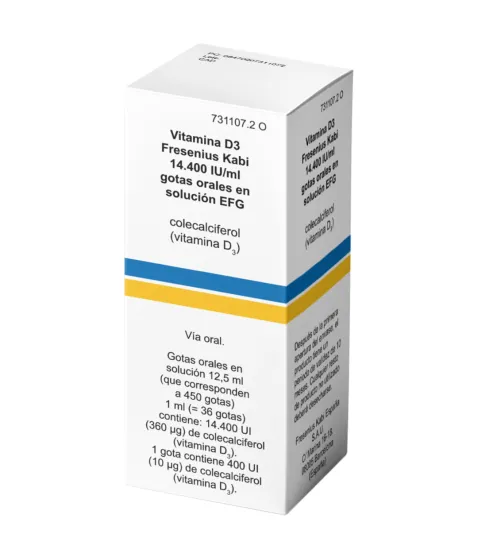
Table of Contents
- Package leaflet: Information for the user
- Introduction
- 1. What is Vitamin D3 Fresenius Kabi and what is it used for?
- 2. What you need to know before starting to take Vitamin D3 Fresenius Kabi
- 3. How to take Vitamin D3 Fresenius Kabi
- 4. Possible adverse effects
- 5. Storage of Vitamin D3 Fresenius Kabi
- 6. Contents of the pack and other information
Package leaflet: Information for the user
Introduction
Package leaflet: information for the user
Vitamina D3 Fresenius Kabi 14,400 IU/ml oral solution drops EFG
colecalciferol (vitamin D3)
Read all of this leaflet carefully before you start taking this medicine because it contains important information for you.
- Keep this leaflet. You may need to read it again.
- If you have any questions, ask your doctor or pharmacist.
- This medicine has been prescribed for you only. Do not pass it on to others, even if they have the same symptoms as you, because it may harm them.
- If you experience any side effects, talk to your doctor or pharmacist, including any side effects not listed in this leaflet. See section 4.
Contents of this leaflet
-
What Vitamina D3 Fresenius Kabi is and what it is used for
-
What you need to know before taking Vitamina D3 Fresenius Kabi
-
How to take Vitamina D3 Fresenius Kabi
-
Possible side effects
-
How to store Vitamina D3 Fresenius Kabi
-
Contents of the pack and other information
1. What is Vitamin D3 Fresenius Kabi and what is it used for?
This medicine contains the active substance colecalciferol (vitamin D3).
This medicine is used for:
- The prevention and treatment of vitamin D deficiency
- The treatment of rickets (a disease affecting bone development in children)
- As an adjunct to treatment for osteoporosis in patients at risk of vitamin D deficiency
2. What you need to know before starting to take Vitamin D3 Fresenius Kabi
Do not take Vitamin D3 Fresenius Kabi:
- if you are allergic to the active substance or to any of the other ingredients of this medicine (listed in section 6).
- if you have a condition causing high levels of calcium in the blood or increased excretion of calcium in the urine (as may occur with treatment using certain medications, such as benzothiazine derivatives, or if you are bedridden)
- if you have, or are prone to developing, kidney stones containing calcium
- if you have an excess of vitamin D
- if you suffer from severe arteriosclerosis (hardening of the arteries)
- if you have severe impairment of kidney function
Warnings and precautions
Consult your doctor or pharmacist before starting to take this medicine.
You should exercise particular caution when taking this medicine:
- if you are being treated with certain heart medications (cardiac glycosides) or thiazide diuretics
- if you have severe impairment of kidney function. In such cases, your doctor will monitor your blood levels of calcium and phosphate. The risk of soft tissue calcification should be considered.
- in cases of severe renal dysfunction, the use of colecalciferol is not recommended. Your doctor may prescribe another vitamin D supplement.
- if you have sarcoidosis (Boeck's disease), there is a risk of increased formation of the active form of vitamin D.
- in cases of decreased bone mass due to inactivity (e.g., bed rest), there is an increased risk of elevated blood calcium levels.
During long-term use, your doctor will periodically check your blood and urine calcium levels and monitor your kidney function. If necessary, your doctor may instruct you to reduce the dose or discontinue treatment.
Elevated levels of parathyroid hormone may increase vitamin D metabolism, thereby increasing vitamin D requirements.
Additional doses of vitamin D should only be taken under strict medical supervision.
Children and adolescents
The use of other vitamin D-containing products should be avoided, especially in infants. In case of doubt, the physician will decide on the appropriateness of additional use of vitamin-enriched foods or infant formulas, or vitamin D-containing medications.
Other medicines and Vitamin D3 Fresenius Kabi
Inform your doctor or pharmacist if you are taking, have recently taken, or might need to take any other medicines. This is especially important if you are taking:
- Rifampicin or isoniazid (for tuberculosis).
- Certain heart medications (cardiac glycosides), as they may enhance harmful effects due to increased calcium levels in the blood (risk of arrhythmias). Strict medical monitoring is required, which may include electrocardiogram (ECG) testing and monitoring of blood calcium levels.
- Thiazide diuretics, as they increase the risk of elevated blood calcium levels by reducing calcium excretion in the urine. In such cases, your doctor will periodically check your blood calcium levels.
- Medications for epilepsy (carbamazepine, phenobarbital, phenytoin, primidone) or certain adrenal corticosteroids (glucocorticoids, cortisone), as they may increase vitamin D requirements.
- Medications to lower blood lipids (e.g., orlistat and cholestyramine), as they may reduce vitamin D absorption in the intestine.
- Magnesium-containing medications (e.g., antacids), which should not be used during treatment with this medicine as they may increase blood magnesium levels (hypermagnesemia).
- Aluminum-containing tablets (for heartburn).
Taking Vitamin D3 Fresenius Kabi with food and drinks
Caution is advised with vitamin-enriched foods or infant formulas.
Pregnancy and breastfeeding
If you are pregnant or breastfeeding, think you might be pregnant, or are planning to become pregnant, consult your doctor or pharmacist before using this medicine.
Pregnancy
If you are pregnant and your doctor prescribes this medicine, you must strictly follow the prescribed dose, as vitamin D3 overdose may pose a risk of physical and mental retardation, as well as heart and eye disorders, in your baby.
Breastfeeding
Vitamin D and its metabolites pass into breast milk. Vitamin D overdoses in infants due to breastfeeding have not been observed. However, this should be taken into account if the infant is receiving additional vitamin D.
Driving and using machines
The effect of this medicine on the ability to drive and operate machinery is negligible or none.
3. How to take Vitamin D3 Fresenius Kabi
Follow exactly the administration instructions for this medicine as given by your doctor or pharmacist. If in doubt, consult your doctor or pharmacist again.
Your doctor will determine the appropriate dose for you. The dose depends on the condition for which this medicine has been prescribed to you. Therefore, always take the dose prescribed specifically for you, even if you know other people who take a higher dose.
Unless otherwise instructed by your doctor, the recommended dose is as follows:
Prevention of vitamin D deficiency:
The usual daily dose is:
For newborns, infants, and children from the second week of life up to 3 years of age: 1 to 2 drops.
For children from 4 years of age onwards and adolescents: 1 to 3 drops.
For adults aged 19 to 70 years: 1 to 4 drops.
For elderly patients over 70 years of age: 2 to 4 drops.
Treatment of rickets
The total amount of vitamin D required depends on the severity of the disease.
In cases of pre-existing rickets, treatment is initiated with a preparation containing a higher concentration of vitamin D for initial therapy.
Subsequently, the usual dose is 2 to 12 drops of this medicine per day.
Treatment of vitamin D deficiency
The usual daily dose is:
For children and adolescents: 5 drops per day for 6 weeks, followed by 1 to 3 drops per day.
For adults aged 19 to 70 years, and elderly patients over 70 years: 15 drops per day for 8 weeks, followed by 3 to 5 drops per day.
As an adjunct in the treatment of osteoporosis in patients at risk of vitamin D deficiency
The usual daily dose is:
For adults aged 19 years and older: 2 to 4 drops per day, or 14 to 26 drops per week.
Method of administration
This medicine must be taken orally. The best way is to administer it drop by drop directly into the mouth or, if necessary, mix it with a spoon and some liquid.
If you feel that the effect of this medicine is too strong or too weak, consult your doctor or pharmacist.
Instructions for use
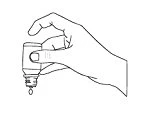
To administer, hold the bottle in an upright position and gently tap the base of the bottle with your finger until the first drop appears.
If you take more Vitamin D3 Fresenius Kabi than you should
In case of overdose with this medicine, contact a doctor immediately.
Symptoms of overdose may include the following: headache, loss of appetite, weakness, weight loss, digestive disturbances (nausea, vomiting, constipation), growth disturbances, increased urine volume, increased fluid intake, signs of paralysis, lethargy, increased blood pressure, and, in severe cases, irregular heartbeat.
The doctor will assess the severity of the intoxication and determine the required treatment.
If you forget to take Vitamin D3 Fresenius Kabi
Do not take a double dose to make up for missed doses.
If you stop taking Vitamin D3 Fresenius Kabi
No withdrawal symptoms have been observed.
If you have any further questions about the use of this medicine, ask your doctor or pharmacist.
4. Possible adverse effects
Like all medicines, this medicine may cause adverse effects, although not everyone experiences them.
Vitamin D may cause the following adverse effects, especially in cases of overdose:
Disorders of metabolism and nutrition:
Excessively high levels of calcium in blood and urine (hypercalcemia, hypercalciuria).
Gastrointestinal disorders:
Constipation, bloating, nausea, stomach pain, diarrhea.
Frequency of occurrence of the above-mentioned adverse effects not known (cannot be estimated from available data).
Reporting of adverse effects
If you experience any type of adverse effect, consult your doctor or pharmacist, even if it involves possible adverse effects not listed in this leaflet. You may also report them directly via the Spanish Pharmacovigilance System for Human Medicinal Products: www.notificaram.es. By reporting adverse effects, you can help provide more information on the safety of this medicine.
5. Storage of Vitamin D3 Fresenius Kabi
- Do not store above 30°C.
- Keep the container in the outer packaging to protect it from light.
- Keep this medicine out of the sight and reach of children.
- Do not use this medicine after the expiry date stated on the label and the carton after EXP. The expiry date refers to the last day of the month indicated.
- After first opening of the container, use this medicine within a maximum period of 10 months. Any unused portion of the product should be discarded. Do not store above 25°C after first opening.
- Do not use this medicine if you observe the following: turbidity or discoloration of the solution.
Medicines must not be disposed of via wastewater or household waste. Dispose of containers and unused medicines at a SIGRE collection point at your pharmacy. If in doubt, ask your pharmacist how to dispose of containers and medicines you no longer need. This will help protect the environment.
6. Contents of the pack and other information
Composition of Vitamin D3 Fresenius Kabi
- The active substance is colecalciferol (vitamin D3).
1 ml (= 36 drops) contains:
14,400 IU (360 µg) of colecalciferol (vitamin D3)
1 drop contains 400 IU (10 µg) of colecalciferol (vitamin D3)
- The other components are:
Medium-chain triglycerides
Appearance of the product and contents of the container
Vitamin D3 Fresenius Kabi is available as oral drops (in oily solution), transparent and colourless to slightly yellowish. It is supplied in amber glass bottles containing 12.5 ml (equivalent to 450 drops) or 25 ml (equivalent to 900 drops), with a dropper dispenser and a screw cap with a polyethylene tamper-evident ring.
Only certain pack sizes may be marketed.
Marketing Authorisation Holder
Fresenius Kabi España S.A.U.
C/ Marina 16-18.
08005 Barcelona (Spain)
Manufacturer
Fresenius Kabi Austria GmbH
Estermannstraße 1
A-4020 Linz
Austria
This medicinal product is authorised in the member states of the European Economic Area under the following names:
Austria: Colecalciferol Fresenius 14.400 I.E./ml Tropfen zum Einnehmen, Lösung
Belgium: Kabivit-D3 14400 IE/ml, druppels voor oraal gebruik, oplossing
Kabivit-D3 14400 IE/ml, Tropfen zum Einnehmen, Lösung
Kabivit-D3 14400 UI/ml, solution buvable en gouttes
Bulgaria: ??????? D3 14 400 IU/ml ????????? ?????, ???????
Cyprus: KabiVit 14.400 IU/ml, π?σιμο δι?λυμα
Slovakia: Olvit D3, 14 400 IU/ml perorálne roztokové kvapky
Slovenia: Oleovit D3 14400 i.e./ml peroralne kapljice, raztopina
Spain: Vitamin D3 Fresenius Kabi 14.400 IU/ml oral solution drops EFG
Estonia: Colecalciferol Fresenius
Finland: Oleo D3 14 400 IU/ml tipat, liuos
Greece: KabiVit 14.400 IU/ml
Hungary: Vitamin D3 Fresenius Kabi 14000 NE/ml belsoleges oldatos cseppek
Ireland: Sapvit-D3 400 IU/drop Oral Drops, Solution
Latvia: Colecalciferol Fresenius 14400 SV/ml pilieni iekškigai lietošanai, škidums
Lithuania: Colecalciferol Fresenius 14400 TV/ml geriamieji lašai (tirpalas)
Malta: KabiVit 14.400 IU/ml oral drops, solution
Norway: KabiVit
Poland: OlVit D3
Portugal: Colecalciferol Kabi
United Kingdom: Sapvit-D3 14,400 IU/ml Oral Drops, Solution
Czech Republic: Olvit D3 14400 IU/ml perorální kapky, roztok
Romania: Vitamin D3 Fresenius Kabi 14 400 UI/ml picaturi orale, solutie
Sweden: Oleo D3 14 400 IE/ml orala droppar, lösning
Date of the most recent review of this leaflet: July 2021
Detailed information on this medicinal product is available on the website of the Spanish Agency of Medicines and Health Products (AEMPS): http://www.aemps.gob.es/