Vispring 0.5 mg/ml eye drops solution
Spain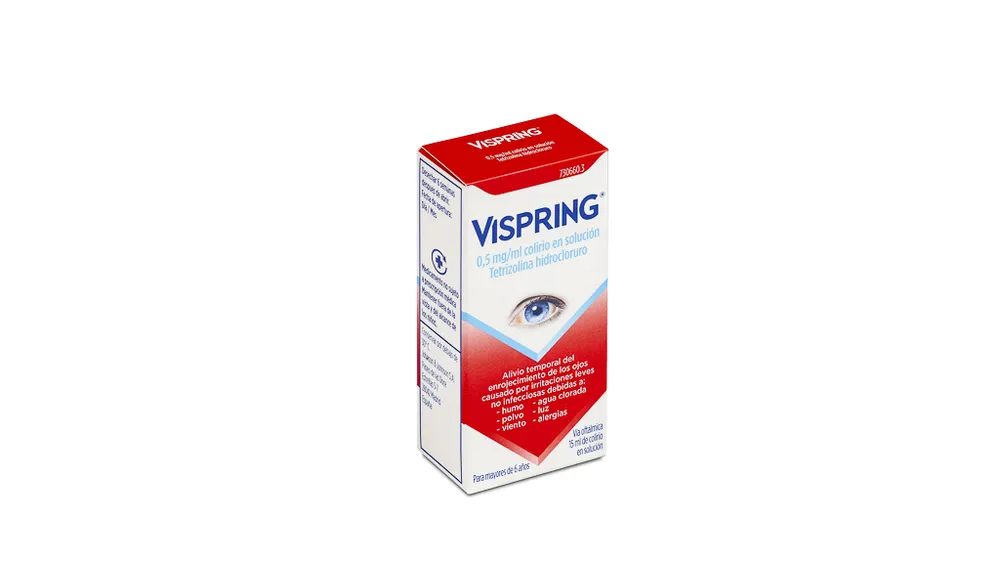
Table of Contents
- Package leaflet: Information for the user
- Introduction
- 1. What Vispring is and what it is used for
- 2. What you need to know before starting to use Vispring
- **Do not use this medicine if:**
- 3. How to use Vispring
- 4. Possible adverse effects
- 5. Storage of Vispring
- Keep this medicine out of the sight and reach of children.
- 6. Contents of the pack and other information
Package leaflet: Information for the user
Introduction
Package leaflet: information for the user
Vispring 0.5 mg/ml eye drops solution
Tetrizoline hydrochloride
Read the entire leaflet carefully before you start using this medicine because it contains important information for you.
Follow exactly the instructions for administering this medicine as described in this leaflet or as indicated by your doctor or pharmacist.
- Keep this leaflet, as you may need to read it again.
- If you need advice or more information, consult your pharmacist.
- If you experience any adverse reactions, consult your doctor or pharmacist, even if they are adverse reactions not listed in this leaflet. See section 4.
- You should consult a doctor if your condition worsens or does not improve after 2 days.
Contents of the leaflet
- What Vispring is and what it is used for
- What you need to know before using Vispring
- How to use Vispring
- Possible adverse effects
- How to store Vispring
- Contents of the pack and other information
1. What Vispring is and what it is used for
This medicine contains the active substance tetrahydrozoline hydrochloride. It belongs to a group of medicines known as ocular decongestants (medicines for use in the eye).
This medicine is used to treat temporary redness of the eyes caused by mild non-infectious irritations due to, for example, smoke, dust, wind, chlorinated water, light, or allergies in adults, adolescents, and children from the age of 2 years. Children over 2 years and under 6 years should only be treated with this medicine on the advice of a healthcare professional.
2. What you need to know before starting to use Vispring
Do not use this medicine if:
- You are allergic to tetrahydrozoline hydrochloride or any of the other ingredients of this medicine (listed in section 6).
- You have narrow-angle glaucoma.
- In children under 2 years of age.
Warnings and precautions
Consult your doctor before using this medicine if you have any of the following conditions. You may still be able to use this medicine, but you should speak to your doctor before starting treatment if you have:
- Severe cardiovascular disorders (e.g., coronary heart disease, high blood pressure, pheochromocytoma)
- Benign prostatic hyperplasia
- Metabolic disorders (e.g., hyperthyroidism, diabetes, disorders affecting the production of red blood pigment)
- Dry rhinitis (chronic inflammation in the front part of the nasal cavity)
- Dry keratoconjunctivitis (dryness of the conjunctiva and cornea)
- Glaucoma (an eye condition in which the optic nerve connecting the eye to the brain is damaged).
If there is no improvement within 48 hours, or if redness or irritation persists or worsens, or if you experience changes in vision or eye pain, stop using this medicine and consult a doctor. Irritation or redness due to infection, a foreign body in the eye, or chemical corneal injury also require medical attention. If you experience headache, vision loss, visual disturbances (e.g., appearance of floaters or double vision), sudden or severe unilateral eye redness, or pain upon exposure to light, stop using the medicine and consult a doctor immediately, as these may indicate a serious eye disease that this product will not treat.
Be careful not to use more of the medicine than recommended or for longer than advised (i.e., more than 3–5 consecutive days), as this may worsen eye redness or nasal symptoms.
When using this product, your pupils may temporarily become enlarged.
Instructions for contact lens wearers
In general, contact lenses should not be worn during ocular illness. If you wear contact lenses, remove them before applying this medicine and do not reinsert them until at least 15 minutes after application.
Children
Children under 12 years of age should only use this medicine with adult assistance.
Children over 2 and under 6 years of age
This medicine should only be used under the advice of a healthcare professional.
Children under 2 years of age
Do not use in children under 2 years of age.
Other medicines and Vispring
Before using this medicine, inform your doctor or pharmacist if you are taking, have recently taken, or might be taking any other medicines, especially other eye medications.
If you are taking antidepressant medicines known as monoamine oxidase inhibitors (MAOIs) or tricyclic antidepressants, you should avoid using them with this medicine, as this could cause an increase in blood pressure.
Pregnancy, breastfeeding and fertility
There are no adequate and well-controlled studies in pregnant or breastfeeding women with tetrahydrozoline. If you are pregnant or breastfeeding, think you may be pregnant, or are planning to become pregnant, consult your doctor or pharmacist before using this medicine.
Driving and using machines
Pupil dilation and blurred vision may occur after using this medicine. In such cases, you should not drive or operate machinery until your vision has returned to normal.
Vispring contains phosphates
This medicine contains 7.5 micrograms of phosphates in each drop. If you have severe corneal damage (the transparent layer on the front part of the eye), treatment with phosphates may, in very rare cases, lead to blurred vision due to calcium accumulation.
3. How to use Vispring
Follow exactly the instructions for use provided in this leaflet or as directed by your doctor or pharmacist. If in doubt, consult your doctor or pharmacist.
Children from 6 years, adolescents and adults:
Unless otherwise directed by a physician, apply 1 or 2 drops into the affected eye(s) 2 to 3 times daily. Remove contact lenses beforehand (see “Instructions for contact lens users”).
Children over 2 years and under 6 years:
In children aged 2 to 6 years, this medicine should only be used on the recommendation of a healthcare professional. Unless otherwise indicated, the recommended dose is 1 drop in the affected eye(s) 2 to 3 times daily.
Children under 2 years:
Do not use in children under 2 years of age.
Method of administration:
This medicine is intended for ocular use (ophthalmic route).
- Before first opening, remove the tamper-evident seal around the neck of the container by following the perforations.
- To open the child-resistant cap, press down and turn counterclockwise to unscrew.
- After opening the cap, place the container upside down. Tilt the head slightly backward. Gently squeeze the bottle to instill 1 or 2 drops into the conjunctival sac. The tip of the bottle must not come into contact with anything except the cap to avoid contamination. Never touch the eye with the tip of the container.
- After application, blink gently several times to help evenly distribute the drops.
- Close the cap by turning it clockwise until fully closed. Never touch the tip of the container. The container must remain closed between uses.
Duration of treatment:
This medicine should be used for the shortest time necessary to relieve symptoms and no longer than 5 consecutive days.
Repeated use should be done with caution, as prolonged use (even with brief interruptions of a few days) or excessive use may cause chronic inflammation and/or conjunctival atrophy.
Prolonged use may increase eye redness. If there is no improvement within 2 days, or if redness worsens or persists, discontinue use and consult your doctor.
If you use more Vispring than you should
When used in the eye, overdose symptoms are unlikely. However, accidental ingestion may cause serious side effects or poisoning, especially in children.
Serious side effects may include, among others, cardiovascular instability, drowsiness, coma, hypothermia (decreased body temperature), bradycardia (slower heart rate), hypotension (low blood pressure) or hypertension (high blood pressure), shock-like states, apnea, circulatory disturbances, vomiting, drooling, and other systemic effects such as miosis (excessive pupil constriction), lethargy (lack of energy), dryness of mucous membranes, atypical chest pain, and increased redness of the ocular and nasal mucous membranes.
In case of overdose or accidental ingestion, contact your doctor or pharmacist immediately, or call the Toxicology Information Service at telephone number 91.562.04.20 (indicating the medicine and the amount ingested).
If you forget to use Vispring
Do not use a double dose to make up for missed doses.
4. Possible adverse effects
Like all medicines, this medicine can cause adverse effects, although not everyone will experience them.
Rare (may affect up to 1 in 1,000 patients):
- Pupil dilation.
Very rare (may affect up to 1 in 10,000 people):
- Dryness of the conjunctiva with occlusion of the lacrimal puncta after prolonged use of tetrahydrozoline.
- Watery eyes after prolonged use of tetrahydrozoline.
Frequent (may affect up to 1 in 10 patients):
-
Eye irritation (pain, stinging, burning).
-
Visual disturbances.
- Rebound hyperemia.
- Mucosal burning.
- Dryness of mucous membranes.
Not known (frequency cannot be estimated from available data):
- Increased tearing.
- Eye or periocular burning, redness, irritation, swelling, pain, and itching.
Reporting of adverse effects
If you experience any type of adverse effect, consult your doctor or pharmacist, even if it is a possible adverse effect not listed in this leaflet. You can also report them directly via the Spanish Pharmacovigilance System for Human Medicines: https://www.notificaram.es. By reporting adverse effects, you can help provide more information on the safety of this medicine.
5. Storage of Vispring
Store below 25°C. Keep the container tightly closed to protect from moisture. Keep the container in the outer packaging to protect from light. Keep out of the reach and sight of children. Do not use after the expiry date stated on the container. The expiry date refers to the last day of the month. After reconstitution, use immediately. Discard any unused portion. Do not dispose of medicines via wastewater or household waste. Ask your pharmacist how to dispose of medicines you no longer use. This will help protect the environment.
Keep this medicine out of the sight and reach of children.
Do not use this medicine after the expiry date stated on the carton after EXP. The expiry date refers to the last day of the month indicated.
Store below 30°C.
Discard the product 6 weeks after unsealing and opening the container.
Do not use this medicine if you notice that the solution has changed colour or become cloudy.
Medicines must not be disposed of via wastewater or household waste. Dispose of unused containers and medicines at the Punto Sigre collection point in your pharmacy. If in doubt, ask your pharmacist how to dispose of medicines and containers you no longer need. This will help protect the environment.
6. Contents of the pack and other information
Composition of Vispring
- The active substance: 1 ml of eye drops contains 0.5 mg of tetrizoline hydrochloride.
- The other components are: glycerol, hypromellose, macrogol 400, boric acid, disodium phosphate, sodium citrate, potassium chloride, magnesium chloride, sodium lactate, glycine, ascorbic acid, dextrose, polyquaternium 42, purified water.
Appearance of Vispring and contents of the pack
Vispring is a clear, colourless to slightly yellow, particle-free ophthalmic solution.
Vispring is available in 15 ml LDPE bottles equipped with LDPE droppers and PP/HDPE caps with child-resistant closure.
Marketing Authorization Holder and Manufacturer
Marketing Authorization Holder
JNTL Consumer Health (Spain), S.L.
C/ Vía de los Poblados 1, Edificio E, planta 3
28033-MADRID
Manufacturer
JANSSEN PHARMACEUTICA N.V
Turnhoutseweg, 30
Beerse-Belgium
JOHNSON & JOHNSON GMBH
Johnson & Johnson Platz 2
41470 Neuss
Germany
This medicinal product is authorized in the Member States of the European Economic Area under the following names:
Germany | Visine Yxin Hydro |
Bulgaria | ????? ?????? (i.e. Visine Sprint) |
Croatia | Visine |
Cyprus | Vispring Advance |
Czech Republic | Visine Rapid |
Estonia | Visine |
Greece | Vispring Advance |
Hungary | Visine Rapid |
Latvia | Visine |
Lithuania | Visine |
Poland | Visine Comfort |
Portugal | Visine |
Romania | Visine Novo |
Slovakia | Visine Rapid |
Slovenia | VisiClear Yxin |
Spain | VISPRING |
Date of the most recent review of this leaflet: November 2020
Detailed and up-to-date information on this medicine is available on the website of the Spanish Agency for Medicines and Health Products (AEMPS) http://www.aemps.gob.es