Viruderm 50 mg/g ointment
Spain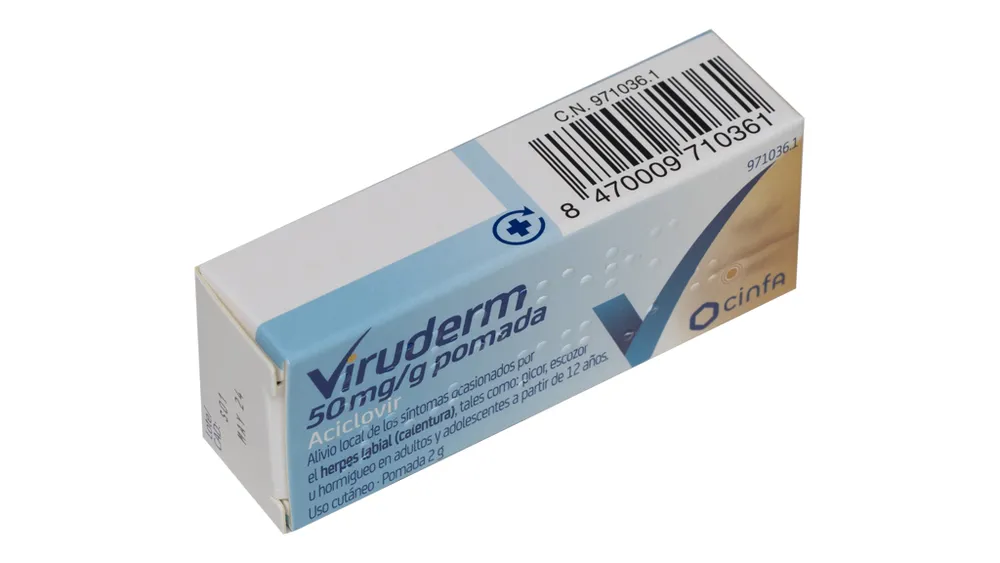
Table of Contents
Package leaflet: Information for the user
Introduction
Package leaflet: information for the user
Viruderm 50 mg/g ointment
Aciclovir
Read the entire leaflet carefully before you start using this medicine because it contains important information for you.
Follow exactly the instructions for using this medicine provided in this leaflet or those given by your doctor or pharmacist.
-
Keep this leaflet, as you may need to read it again.
-
If you need advice or further information, consult your pharmacist.
-
If you experience any adverse effects, consult your doctor or pharmacist, even if they are adverse effects not listed in this leaflet. See section 4.
-
You should consult a doctor if your condition worsens or does not improve after 10 days.
Contents of the leaflet
- What Viruderm is and what it is used for.
- What you need to know before using Viruderm.
- How to use Viruderm.
- Possible side effects.
- How to store Viruderm.
- Contents of the pack and other information
1. What Viruderm is and what it is used for
Viruderm is an ointment that contains the active substance aciclovir. Aciclovir belongs to a group of medicines known as antivirals, active against the herpes simplex virus.
It is indicated for the local relief of symptoms caused by cold sores (fever blisters), such as itching, burning, or tingling, in adults and adolescents aged 12 years and older.
You should consult a doctor if your condition worsens or does not improve after 10 days.
How does Viruderm work?
Cold sores or fever blisters occur due to an infection with a virus called herpes simplex.
Usually, a first infection occurs inside the mouth (often during childhood), which may go unnoticed. However, in children, it must be diagnosed by a doctor to avoid confusion with teething problems or other oral conditions. After this initial infection, the herpes simplex virus remains dormant in the body without causing symptoms. The infection frequently reactivates later in life, with recurrences often triggered by sunburn, colds, fever, emotional stress, anxiety, mouth injuries, menstruation, dental or surgical procedures, or drug allergies.
These recurrences typically begin with a sensation of tingling or itching on the lips, followed one or two days later by the appearance of several small blisters. These blisters then progress into open sores on the lips, which eventually form a scab.
Until the scab forms—indicating that the lesion has healed—the blisters or sores are contagious.
2. What you need to know before starting to use Viruderm
Do not use Viruderm
- If you are allergic to aciclovir or to any of the other ingredients of this medicine (listed in section 6).
- In children under 12 years of age.
Warnings and precautions
Consult your doctor or pharmacist before starting to use Viruderm.
Immunocompromised patients (for example, patients with AIDS, transplant recipients, or those undergoing radiotherapy or chemotherapy) should consult their doctor before using this medicine.
This medicine should only be used for cold sores on the lips.
- Avoid contact of the ointment with the eyes; if contact occurs, rinse thoroughly with water and consult your doctor.
Do not apply the product inside the mouth, nose, or vagina, as it may cause local irritation.
Do not use for the treatment of genital herpes.
To avoid spreading the infection:
- Wash your hands after applying the product.
- Do not let the lip lesion come into contact with other areas of your body or with the skin of other people, especially infants and children. While the lesion persists, avoid letting your lips touch bed linens if sleeping with another person, do not share towels, and use disposable tissues and paper handkerchiefs to prevent self-reinfection.
If the lesion worsens or has not healed within 10 days, stop treatment and consult your doctor.
This medicine does not prevent subsequent outbreaks or recurrence of symptoms.
Other medicines and Viruderm
Inform your doctor or pharmacist if you are using, have recently used, or might need to use any other medicines.
Although no interactions have been reported for this medicine with this route of administration, other preparations should not be applied simultaneously to the area of the cold sore during treatment without first consulting your doctor or pharmacist.
Pregnancy and breastfeeding
If you are pregnant or breastfeeding, think you may be pregnant, or are planning to become pregnant, consult your doctor or pharmacist before using this medicine.
Taking medicines during pregnancy may be dangerous for the embryo or fetus and should be monitored by your doctor.
Driving and using machines
No effects on the ability to drive or operate machinery have been reported.
3. How to use Viruderm
Follow exactly the instructions for medication administration provided in this leaflet or those given by your doctor. If in doubt, consult your doctor or pharmacist.
Lip cutaneous use.
At the very first sign of tingling, itching, or burning—before blisters appear—the virus is multiplying, and this is when treatment is most effective.
To avoid the risk of virus transmission, follow the instructions provided in the section "Warnings and precautions."
You should start treatment as soon as symptoms begin. The onset of an outbreak can be easily recognized by itching and irritation.
Apply 5 times daily, approximately every 4 hours, except during sleeping hours. Apply with your finger a sufficient amount of product to cover the affected lip area with a thin layer.
Continue treatment for 5 days. If complete healing has not occurred within 5 days, treatment may be extended for another 5 days, up to a total of 10 days.
After applying this medicine, wash your hands to prevent spreading the infection to other areas of the body or to other people.
Viruderm contains a specially formulated base and must not be diluted or used as a base for incorporating other medications.
If you feel that the effect of Viruderm is too strong or too weak, inform your doctor or pharmacist.
Use in children
Do not administer this medicine to children under 12 years of age (see section "Do not use Viruderm").
If you use more Viruderm than you should
Cases of intoxication are unlikely due to its external use; however, consult your doctor or pharmacist immediately.
In case of overdose or accidental ingestion, contact your doctor or pharmacist immediately or call the Toxicology Information Service at telephone number 91 562 04 20, indicating the medicine and the amount ingested.
If you forget to use Viruderm
Do not apply a double dose to make up for missed doses. Simply continue the treatment as soon as possible. Do not exceed the recommended frequency of applications or the recommended treatment duration.
If you stop using Viruderm
Do not interrupt treatment earlier than advised by your doctor, as healing may not be complete and the condition may recur.
If you have any further questions about the use of this medicine, ask your doctor or pharmacist.
4. Possible adverse effects
Like all medicines, this medicine can cause adverse effects, although not everyone will experience them.
Uncommon (may affect up to 1 in 100 patients):
- Transient burning or itching after application of Viruderm.
- Dryness or peeling of the skin or lips.
- Itching sensation.
Rare (may affect up to 1 in 1,000 patients):
- Redness of the skin.
- Contact dermatitis (a type of local allergy) after application. Most often, the substances causing it are components of the ointment other than aciclovir, which is the active substance.
Very rare (may affect up to 1 in 10,000 patients):
- Immediate allergic reactions, including angioedema, manifested as swelling of the throat or difficulty swallowing or breathing. If this effect is severe, you must seek medical attention immediately, as emergency measures are required.
Prolonged use of the ointment may lead to sensitisation phenomena; if these occur, treatment should be discontinued and a doctor consulted.
Reporting of adverse effects
If you experience any adverse effects, consult your doctor or pharmacist, even if they are possible adverse effects not listed in this leaflet. You can also report them directly through the Spanish Pharmacovigilance System for Human Medicinal Products: https://www.notificaram.es. By reporting adverse effects, you can help provide more information on the safety of this medicine.
5. Storage of Viruderm
Keep this medicine out of the sight and reach of children.
This medicine does not require any special storage conditions.
Once opened and after completion of treatment, dispose of the tube.
Do not use this medicine after the expiry date stated on the packaging after EXP.
The expiry date refers to the last day of the month indicated.
Medicines should not be disposed of via wastewater or household waste. Dispose of containers and unused medicines at the SIGRE Point at your pharmacy. If in doubt, ask your pharmacist how to dispose of containers and medicines you no longer need. This will help protect the environment.
6. Contents of the pack and other information
Composition of Viruderm
-
The active substance in Viruderm is aciclovir. Each gram of ointment contains 50 milligrams of aciclovir.
-
The other components are: macrogol 4000 and macrogol 400.
Appearance of the product and contents of the pack
Viruderm is a homogeneous white-tinged ointment, packed in an aluminum tube fitted with a plastic cap containing 2 g of ointment. The tube is placed in a cardboard box.
Marketing Authorization Holder and Manufacturer
Laboratorios Cinfa, S.A.
Carretera Olaz-Chipi, 10. Polígono Industrial Areta
31620 Huarte (Navarra) – Spain
Date of the most recent revision of this leaflet: July 2020
Detailed information on this medicinal product is available on the website of the Spanish Agency of Medicines and Medical Devices (AEMPS) www.aemps.gob.es