Viramune 50 mg/5 ml oral suspension
Spain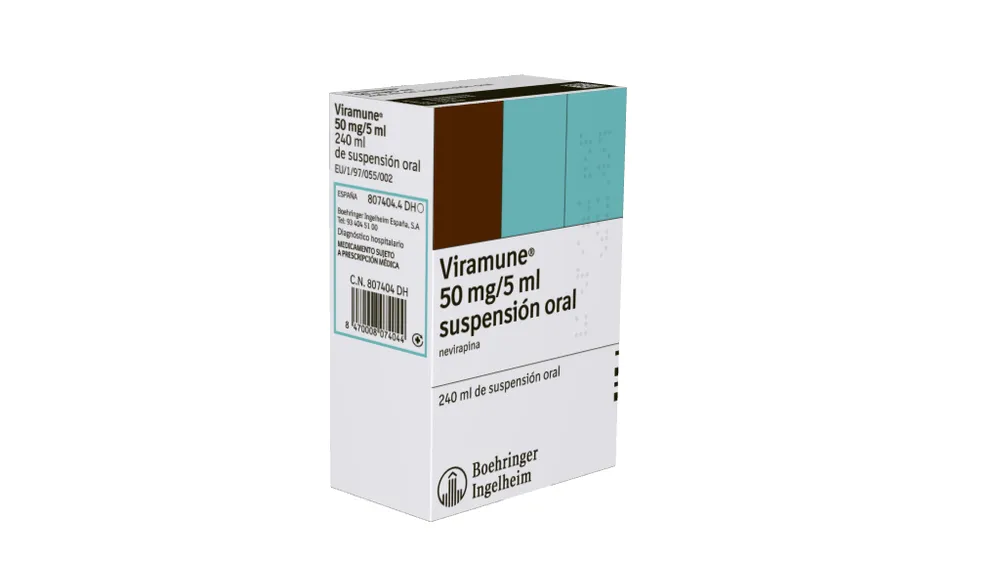
Instructions for Use
Package leaflet: Information for the user
Introduction
Package leaflet: information for the user
Viramune 50 mg/5 ml oral suspension
nevirapine
Read the entire leaflet carefully before you start taking this medicine, because it contains important information for you.
- Keep this leaflet, as you may need to read it again.
- If you have any questions, ask your doctor or pharmacist.
- This medicine has been prescribed for you only, and you should not give it to others, even if they have the same symptoms as you, because it could harm them.
- If you experience any adverse reactions, consult your doctor or pharmacist, even if they are adverse reactions not listed in this leaflet. See section 4.
Leaflet contents
- What Viramune is and what it is used for
- What you need to know before taking Viramune
- How to take Viramune
- Possible side effects
- How to store Viramune
- Contents of the pack and other information
1. What Viramune is and what it is used for
Viramune belongs to a group of medicines called antiretrovirals, which are used in the treatment of Human Immunodeficiency Virus (HIV) infection.
The active substance in this medicine is called nevirapine. Nevirapine belongs to a class of anti-HIV medicines called non-nucleoside reverse transcriptase inhibitors (NNRTIs). Reverse transcriptase is an enzyme that HIV needs in order to multiply. Nevirapine blocks the action of reverse transcriptase. By inhibiting reverse transcriptase, Viramune helps control HIV-1 infection.
Viramune is indicated for the treatment of adults, adolescents, and children of any age infected with HIV-1. You must take Viramune in combination with other antiretroviral medicines. Your doctor will advise you which medicines are appropriate for you.
If Viramune has been prescribed for your child, please note that all the information in this leaflet applies to your child (in this case, when you read “you”, replace it with “your child”).
2. What you need to know before starting Viramune
Do not take Viramune
-
if you are allergic to nevirapine or to any of the other ingredients of this medicine (listed in section 6)
-
if you have previously taken Viramune and had to stop treatment due to:
-
severe skin rash
-
skin rash accompanied by other symptoms such as:
-
fever
-
blistering
-
mouth sores
-
eye inflammation
-
facial swelling
-
general swelling
-
difficulty breathing
-
muscle or joint pain
-
general malaise
-
abdominal pain
-
hypersensitivity reactions (allergy)
-
liver inflammation (hepatitis)
-
if you have severe liver disease
-
if you previously had to discontinue treatment with Viramune due to changes in liver function
-
if you are taking any medication containing St. John's wort (Hypericum perforatum). This product may cause Viramune to become ineffective.
Warnings and precautions
Consult your doctor or pharmacist before starting to take Viramune.
During the first 18 weeks of treatment with Viramune, it is very important that you and your doctor monitor for the development of liver or skin reactions. These reactions can be serious and may even be life-threatening. The risk of such reactions is greatest during the first 6 weeks of treatment.
If you experience a severe rash or hypersensitivity (allergic reactions which may appear as a rash) together with other adverse effects such as
YOU MUST STOP TAKING VIRAMUNE AND CONTACT YOUR DOCTOR IMMEDIATELY, as these reactions may be life-threatening or fatal. If you ever experience only mild rash symptoms without any other reaction, inform your doctor immediately, who will advise you whether to discontinue Viramune. If you experience symptoms suggesting liver damage, such as
you must stop taking Viramune and contact your doctor immediately. If you have severe liver, skin, or hypersensitivity reactions while taking Viramune, DO NOT RETAKE VIRAMUNE without first consulting your doctor. You must take your dose of Viramune exactly as prescribed by your doctor. This is especially important during the first 14 days of treatment (see more information in “How to take Viramune”). |
The following patients are at higher risk of developing liver problems:
- women
- patients infected with hepatitis B or C
- patients with abnormalities in liver function tests
- treatment-naïve patients with higher CD4+ cell counts at the start of Viramune treatment (women with more than 250 cells/mm³, men with more than 400 cells/mm³)
- pre-treated patients with detectable HIV-1 viral load in plasma and CD4+ cell counts above the threshold at the start of Viramune treatment (women with more than 250 cells/mm³, men with more than 400 cells/mm³)
In some patients with advanced HIV (AIDS) and a history of opportunistic infections (AIDS-defining illnesses), signs and symptoms of inflammation from previous infections may occur shortly after starting anti-HIV treatment. These symptoms are believed to result from an improved immune response, enabling the body to fight infections that were previously present without apparent symptoms. If you notice any signs of infection, please inform your doctor immediately.
In addition to opportunistic infections, autoimmune disorders (a condition in which the immune system attacks healthy body tissue) may also occur after you have started taking medications for the treatment of your HIV infection. Autoimmune disorders may appear many months after starting treatment. If you experience any symptoms of infection or other symptoms such as muscle weakness, weakness starting in the hands and feet and progressing upward toward the trunk, palpitations, tremor, or hyperactivity, inform your doctor immediately to receive appropriate treatment.
Body fat redistribution may occur in patients receiving combination antiretroviral therapy. Consult your doctor if you notice changes in body fat (see section 4, “Possible side effects”).
In some patients receiving combination antiretroviral therapy, a bone disease called osteonecrosis (death of bone tissue due to loss of blood supply to the bone) may develop. Duration of combination antiretroviral therapy, corticosteroid use, alcohol consumption, severe immune deficiency, and high body mass index may be among the numerous risk factors for developing this condition. Symptoms of osteonecrosis include joint stiffness, pain, and discomfort, especially in the hip, knee, and shoulder, as well as difficulty moving. If you experience any of these symptoms, inform your doctor.
If you are taking nevirapine and zidovudine together, inform your doctor, as your white blood cell count may need to be monitored.
Do not take Viramune after exposure to HIV unless you have been diagnosed with HIV and your doctor has instructed you to do so.
Prednisone should not be used to treat rashes associated with Viramune.
If you are taking oral contraceptives (e.g., “the pill”) or other hormonal methods of birth control while being treated with Viramune, you must also use a barrier contraceptive method (e.g., condoms) to prevent pregnancy and transmission of HIV.
If you are receiving postmenopausal hormone therapy, consult your doctor before taking this medicine.
If you are taking or are prescribed rifampicin for the treatment of tuberculosis, inform your doctor before taking this medicine with Viramune.
Children and adolescents
Viramune oral suspension can be used in children of all ages. Follow exactly the administration instructions provided by your child’s doctor.
Viramune is also available in tablet form. Viramune tablets can be used in:
-
children aged 16 years or older
-
children under 16 years:
-
weighing 50 kg or more
-
with a body surface area greater than 1.25 m².
Other medicines and Viramune
Inform your doctor or pharmacist if you are taking, have recently taken, or might need to take any other medicines. Before starting Viramune, inform your doctor about all other medicines you are taking. Your doctor may need to monitor whether your other medicines are still effective and may need to adjust their doses. Read carefully the package leaflet of all other anti-HIV medicines you are taking in combination with Viramune.
It is especially important that you inform your doctor if you are taking or have recently taken:
- St. John’s wort (Hypericum perforatum, a herbal remedy used to treat depression)
- rifampicin (a medicine used to treat tuberculosis)
- rifabutin (a medicine used to treat tuberculosis)
- macrolides, e.g., clarithromycin (a medicine used to treat bacterial infections)
- fluconazole (a medicine used to treat fungal infections)
- ketoconazole (a medicine used to treat fungal infections)
- itraconazole (a medicine used to treat fungal infections)
- methadone (a medicine used to treat opioid addiction)
- warfarin (a medicine used to reduce blood clot formation)
- hormonal contraceptives (e.g., “the pill”)
- atazanavir (another medicine used to treat HIV infection)
- lopinavir/ritonavir (another medicine used to treat HIV infection)
- fosamprenavir (another medicine used to treat HIV infection)
- efavirenz (another medicine used to treat HIV infection)
- etravirine (another medicine used to treat HIV infection)
- rilpivirine (another medicine used to treat HIV infection)
- zidovudine (another medicine used to treat HIV infection)
- elvitegravir/cobicistat (another medicine used to treat HIV infection)
Your doctor will carefully monitor the effects of Viramune and any of these medicines if you are taking them at the same time.
If you are undergoing kidney dialysis, your doctor may consider it necessary to adjust the dose of Viramune, as Viramune may be partially removed from the blood during dialysis.
Taking Viramune with food and drink
There are no restrictions on taking Viramune with food or drink.
Pregnancy and breastfeeding
If you are pregnant, think you might be pregnant, or plan to become pregnant, consult your doctor or pharmacist before using this medicine.
It is not recommended that women living with HIV breastfeed, as HIV infection can be transmitted to the baby through breast milk.
If you are breastfeeding or considering breastfeeding, you must consult your doctor as soon as possible.
Driving and using machines
While taking Viramune, you may experience fatigue. You should exercise caution when performing activities such as driving or operating machinery. If you experience fatigue, you should avoid potentially dangerous tasks such as driving or operating machinery.
Viramune contains sucrose, sorbitol, methyl parahydroxybenzoate, propyl parahydroxybenzoate, and sodium
Viramune oral suspension contains 150 mg of sucrose per ml. This should be taken into account in patients with diabetes mellitus. If your doctor has advised you that you have an intolerance to certain sugars, consult your doctor before taking this medicine. It may be harmful to teeth.
Viramune oral suspension contains 162 mg of sorbitol per ml. Sorbitol is a source of fructose. If your doctor has advised you (or your child) that you have an intolerance to certain sugars, or if you (or your child) have been diagnosed with hereditary fructose intolerance (HFI), a rare genetic disorder in which the patient cannot break down fructose, consult your doctor before taking this medicine.
Viramune oral suspension contains methyl parahydroxybenzoate and propyl parahydroxybenzoate, which may cause allergic reactions (possibly delayed).
Viramune oral suspension contains less than 1 mmol of sodium (23 mg) per dose unit; this is essentially “sodium-free”.
3. How to take Viramune
You must not take Viramune on your own. It must be used in combination with at least two other antiretroviral medicines. Your doctor will recommend the appropriate medicines for you.
Always follow exactly the instructions for use given by your doctor. If in doubt, consult your doctor or pharmacist again.
The usual dose is the same for all adults (20 ml).
Your child's doctor will calculate the dose for your child. The calculation will be based on your child's age, weight, or body surface area. Make sure your child's doctor clearly informs you about the dose to be given to your child.
For adults
The adult dose is 20 ml (200 mg) once daily for the first 14 days of treatment (the "initial" period). After 14 days, the usual dose is 20 ml (200 mg) twice daily.
It is very important that you take only 20 ml of Viramune per day during the first 14 days (the "initial" period). If you develop a rash during this period, do not increase the dose and consult your doctor.
Viramune is also available in the form of 200 mg tablets for adults (16 years of age and older).
For children
The dose for children is 4 mg/kg body weight or 150 mg/m² body surface area once daily for the first 14 days of treatment (the "initial" period). After this time, your child's dose will be changed to a twice-daily regimen, and your child's doctor will determine the appropriate dose based on body weight or body surface area.
It is very important that your child takes Viramune only once daily during the first 14 days (the "initial" period). If your child develops a rash during this period, do not increase the dose and consult your child's doctor.
Viramune is also available as 200 mg tablets for older children, particularly adolescents, weighing more than 50 kg or whose body surface area exceeds 1.25 m². Your child's doctor will tell you exactly what the correct dosage is for your child. Your child's doctor will monitor your child's weight or body surface area regularly to ensure the correct dose.
If you are unsure, consult your child's doctor or pharmacist.
Viramune oral suspension must be gently shaken before administration. Measure the exact dose using an oral dosing syringe.
If you are an adult and wish to use another measuring device (e.g. a dosing cup or spoon), please ensure that you take the full dose, as some Viramune may remain in the cup or spoon. To do this, rinse the device thoroughly with water and drink the rinse water.
The oral dosing syringe and dosing cup are not supplied with Viramune oral suspension. Please ask your pharmacist for a syringe or cup if you do not already have one.
The 14-day "initial" period has been shown to reduce the risk of developing a skin rash.
Since Viramune must always be taken in combination with other antiretroviral medicines, you must carefully follow the instructions for these other medicines as provided in their package leaflets.
You must continue taking Viramune for as long as your doctor instructs.
As explained earlier in the section "Warnings and precautions", your doctor will monitor you with liver function tests and by watching for adverse effects such as rash. Depending on the results, your doctor may decide to interrupt or discontinue treatment with Viramune. Your doctor may also decide to restart treatment at a lower dose.
Viramune oral suspension is a liquid formulation and must be taken by mouth only. Gently shake the bottle before using the medicine.
If you take more Viramune than you should
Do not take more Viramune than prescribed by your doctor or stated in this leaflet. Currently, there is limited information on the effects of an overdose of Viramune. Contact your doctor if you have taken more Viramune than you should.
If you forget to take Viramune
Try not to miss any doses. If you realize you have missed a dose within 8 hours of the scheduled time, take the missed dose as soon as possible. If more than 8 hours have passed since the scheduled time, take only the next dose at the usual time.
If you stop taking Viramune
Taking your doses at the scheduled times:
- greatly increases the effectiveness of your combination of antiretroviral medicines
- reduces the likelihood that HIV infection will become resistant to antiretroviral medicines
It is important that you continue taking Viramune correctly as described above, unless your doctor tells you to stop treatment.
If you interrupt treatment with Viramune for more than 7 days, your doctor will instruct you to start again with the 14-day "initial" period (as described above) before returning to the twice-daily dosing regimen.
If you have any further questions about the use of this medicine, ask your doctor or pharmacist.
4. Possible adverse effects
During HIV treatment, there may be an increase in body weight and in blood glucose and lipid levels. This may be partly related to health recovery and lifestyle, and in the case of increased blood lipids, sometimes it may be due to HIV medicines themselves. Your doctor will monitor these changes.
Like all medicines, this medicine can cause adverse effects, although not everyone experiences them.
As already mentioned in ‘Warnings and precautions’, the most important adverse effects of Viramune are severe, life-threatening skin reactions and serious liver damage. These reactions occur mainly during the first 18 weeks of treatment with Viramune. This is therefore a critical period requiring close monitoring by your doctor.
If you notice any symptoms of rash, inform your doctor immediately.
When rash occurs, it is usually mild to moderate. However, in some patients, a rash may appear as a blistering skin reaction that can be severe or life-threatening (Stevens-Johnson syndrome and toxic epidermal necrolysis), and fatal cases have been reported. Most cases of both severe and mild/moderate rash occur during the first six weeks of treatment.
If a rash develops and you also feel generally unwell, you must stop treatment and contact your doctor immediately. Pay special attention to any rash that may appear in your child. Although they may seem normal (e.g. diaper rash), they could be rashes due to Viramune. If in doubt, consult your child's doctor.
Hypersensitivity reactions (allergy) may occur. Such reactions may present as anaphylaxis (a severe type of allergic reaction) with symptoms such as:
- rash
- facial swelling
- difficulty breathing (bronchospasm)
- anaphylactic shock
Hypersensitivity reactions may also present as a rash accompanied by other adverse effects such as:
- fever
- blistering of the skin
- mouth ulcers
- eye inflammation
- facial swelling
- general swelling
- difficulty breathing
- muscle or joint pain
- decrease in white blood cells (granulocytopenia)
- general malaise
- serious liver or kidney problems (liver or kidney failure)
If you experience a rash and any of the other adverse effects associated with a hypersensitivity reaction (allergy), inform your doctor immediately. These reactions can be fatal.
Liver function abnormalities have been reported with the use of Viramune. This includes some cases of liver inflammation (hepatitis), which may be sudden and severe (fulminant hepatitis), and liver failure, either of which may be fatal.
Inform your doctor if you experience any of the following clinical symptoms of liver damage:
- loss of appetite
- general malaise (nausea)
- vomiting
- yellowing of the skin (jaundice)
- abdominal pain
The adverse effects listed below have been reported in patients treated with Viramune:
Very common (may affect more than 1 in 10 people):
- rash
Common (may affect up to 1 in 10 people):
- decrease in white blood cells (granulocytopenia)
- allergic reactions (hypersensitivity)
- headache
- general malaise (nausea)
- vomiting
- abdominal pain
- diarrhea
- liver inflammation (hepatitis)
- feeling tired (fatigue)
- fever
- abnormalities in liver function tests
Uncommon (may affect up to 1 in 100 people):
- allergic reactions characterized by rash, facial swelling, difficulty breathing (bronchospasm), or anaphylactic shock
- decrease in red blood cells (anemia)
- yellowing of the skin (jaundice)
- severe, potentially life-threatening skin rashes (Stevens-Johnson syndrome/toxic epidermal necrolysis)
- urticaria
- fluid under the skin (angioedema)
- joint pain (arthralgia)
- muscle pain (myalgia)
- decreased blood phosphorus levels
- increased blood pressure
Rare (may affect up to 1 in 1,000 people):
- severe and sudden liver inflammation (fulminant hepatitis)
- drug reaction with systemic symptoms (drug reaction with eosinophilia and systemic symptoms, DRESS)
When Viramune has been used in combination with other antiretroviral medicines, the following events have also been reported:
- decrease in red blood cells or platelets
- pancreatitis
- decreased or abnormal skin sensations
These effects are generally associated with other antiretroviral agents and may occur when Viramune is used in combination with other agents; however, it is unlikely that these effects are due to treatment with Viramune.
Other adverse effects in children and adolescents
A decrease in white blood cells (granulocytopenia) may occur, more frequently in children. A decrease in red blood cells (anemia), which may be related to nevirapine treatment, is also more frequent in children. As with rash symptoms, inform your doctor of any adverse effects.
Reporting of adverse effects
If you experience any adverse effects, consult your doctor or pharmacist, even if they are possible adverse effects not listed in this leaflet. You may also report them directly through the national reporting system listed in Appendix V. By reporting adverse effects, you can help provide more information on the safety of this medicine.
5. Storage of Viramune
Keep this medicine out of the sight and reach of children.
Do not use this medicine after the expiry date stated on the packaging and on the bottle after "EXP". The expiry date refers to the last day of the month indicated.
Viramune should be used within 6 months of opening the bottle.
This medicine does not require any special storage conditions.
Medicines must not be disposed of via wastewater or household waste. Ask your pharmacist how to dispose of medicines and packaging that you no longer need. This will help protect the environment.
6. Contents of the package and other information
Composition of Viramune
-
The active substance is nevirapine. Each 5 ml contains 50 mg of the active substance nevirapine (as hemihydrate).
-
The other components are:
-
carbomer,
-
methyl parahydroxybenzoate,
-
propyl parahydroxybenzoate,
-
sorbitol,
-
sucrose,
-
polysorbate 80,
-
sodium hydroxide, and
-
water
Appearance of the medicine and contents of the pack
Viramune oral suspension is a homogeneous, white or almost white suspension.
Viramune oral suspension is supplied in plastic bottles for oral suspension, with 240 ml of suspension per bottle.
Viramune is also available in tablets for older children and adults.
Marketing Authorization Holder
Boehringer Ingelheim International GmbH
Binger Strasse 173
55216 Ingelheim am Rhein
Germany
Manufacturer
Boehringer Ingelheim Pharma GmbH & Co. KG
Binger Strasse 173
55216 Ingelheim am Rhein
Germany
or
Boehringer Ingelheim France
100-104 avenue de France
75013 Paris
France
For further information about this medicine, please contact the local representative of the Marketing Authorization Holder:
Belgium/Belgium/Belgium Boehringer Ingelheim SComm Tel/Tel: +32 2 773 33 11 | Lithuania Boehringer Ingelheim RCV GmbH & Co KG Lithuanian branch Tel.: +370 5 2595942 |
| Luxembourg/Luxembourg Boehringer Ingelheim SComm Tel/Tel: +32 2 773 33 11 |
Czech Republic Boehringer Ingelheim spol. s r.o. Tel: +420 234 655 111 | Hungary Boehringer Ingelheim RCV GmbH & Co KG Hungarian Branch Office Tel.: +36 1 299 8900 |
Denmark Boehringer Ingelheim Danmark A/S Tlf: +45 39 15 88 88 | Malta Boehringer Ingelheim Ireland Ltd. Tel: +35 31 295 9620 |
Germany Boehringer Ingelheim Pharma GmbH & Co. KG Tel: +49 (0) 800 77 90 900 | Netherlands Boehringer Ingelheim B.V. Tel: +31 (0) 800 22 55 889 |
Estonia Boehringer Ingelheim RCV GmbH & Co KG Estonian branch Tel: +372 612 8000 | Norway Boehringer Ingelheim Danmark A/S NUF Tlf: +47 66 76 13 00 |
Greece Boehringer Ingelheim Hellas Monoprosopi E.E. Tel: +30 2 10 89 06 300 | Austria Boehringer Ingelheim RCV GmbH & Co KG Tel: +43 1 80 105-7870 |
Spain Boehringer Ingelheim España, S.A. Tel: +34 93 404 51 00 | Poland Boehringer Ingelheim Sp. z o.o. Tel.: +48 22 699 0 699 |
France Boehringer Ingelheim France S.A.S. Tél: +33 3 26 50 45 33 | Portugal Boehringer Ingelheim Portugal, Lda. Tel: +351 21 313 53 00 |
Croatia Boehringer Ingelheim Zagreb d.o.o. Tel: +385 1 2444 600 | Romania Boehringer Ingelheim RCV GmbH & Co KG Vienna - Bucharest Branch Tel: +40 21 302 2800 |
Ireland Boehringer Ingelheim Ireland Ltd. Tel: +353 1 295 9620 | Slovenia Boehringer Ingelheim RCV GmbH & Co KG Ljubljana Branch Tel: +386 1 586 40 00 |
Iceland Vistor ehf. Tel: +354 535 7000 | Slovakia Boehringer Ingelheim RCV GmbH & Co KG organizational unit Tel: +421 2 5810 1211 |
Italy Boehringer Ingelheim Italia S.p.A. Tel: +39 02 5355 1 | Finland/Finland Boehringer Ingelheim Finland Ky Tel/Tel: +358 10 3102 800 |
Cyprus Boehringer Ingelheim Hellas Monoprosopi E.E. Tel: +30 2 10 89 06 300 | Sweden Boehringer Ingelheim AB Tel: +46 8 721 21 00 |
Latvia Boehringer Ingelheim RCV GmbH & Co KG Latvian branch Tel: +371 67 240 011 |

Date of the most recent review of this leaflet: {MM/YYYY}
Other sources of information
Detailed information on this medicinal product is available on the European Medicines Agency website: https://www.ema.europa.eu.
This page has been machine-translated and may contain inaccuracies. The original data is available in the manufacturing country's language.
Last data check: May 18, 2026 · Data source: CIMA — AEMPS