Vincristine Pfizer 1 mg/ml solution for injection EFG
Spain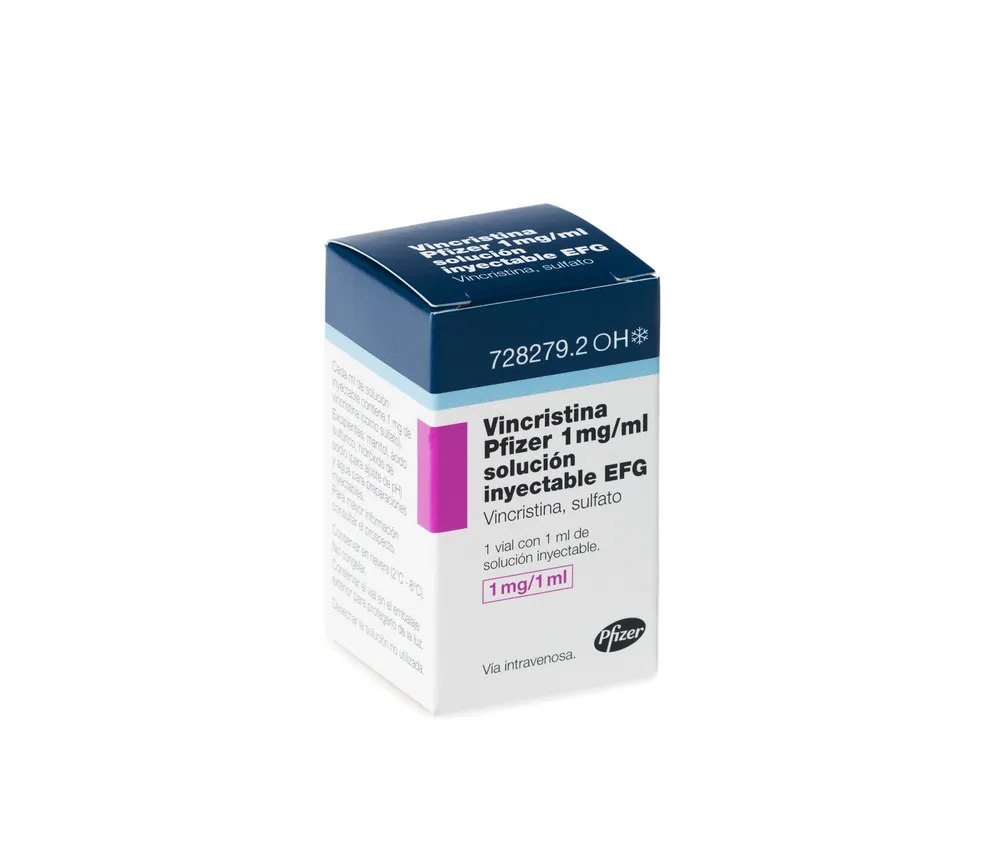
Table of Contents
- Patient Information Leaflet
- Introduction
- **Vincristine Pfizer 1 mg/ml injectable solution EFG**
- Vincristine sulfate
- 1. What Vincristine Pfizer is and what it is used for
- 2. What you need to know before using Vincristine Pfizer
- 3. How to use Vincristina Pfizer
- 4. Possible adverse effects
- 5. Storage of Vincristine Pfizer
- 6. Package contents and other information
Patient Information Leaflet
Introduction
Patient Information Leaflet
Vincristine Pfizer 1 mg/ml injectable solution EFG
Vincristine sulfate
Read the entire leaflet carefully before starting to use this medicine, as it contains important information for you.
- Keep this leaflet, as you may need to read it again.
- If you have any questions, consult your doctor or pharmacist.
- This medicine has been prescribed for you only, and you should not give it to others, even if they have the same symptoms as you, as it could harm them.
- If you experience adverse effects, consult your doctor or pharmacist, even if they are adverse effects not listed in this leaflet. See section 4.
Leaflet contents
- What Vincristine Pfizer is and what it is used for
- What you need to know before using Vincristine Pfizer
- How to use Vincristine Pfizer
- Possible adverse effects
- Storage of Vincristine Pfizer
- Package contents and additional information
1. What Vincristine Pfizer is and what it is used for
Vincristine Pfizer belongs to a group of medicines called antineoplastic agents, which are used to treat cancer.
Vincristine Pfizer is a medicine used alone or in combination with other anticancer medicines in the treatment of:
- Acute leukemia.
- Malignant lymphomas, including: Hodgkin's disease, lymphocytic, mixed cell, histiocytic, undifferentiated, nodular and diffuse non-Hodgkin lymphomas.
- Rhabdomyosarcoma.
- Neuroblastoma.
- Wilms' tumor.
- Osteogenic sarcoma.
- Mycosis fungoides.
- Ewing's sarcoma.
- Breast cancer.
- Malignant melanoma.
- Small cell lung carcinoma.
- Childhood gynecological tumors.
- True idiopathic thrombocytopenic purpura in patients who do not respond to splenectomy (removal of the spleen) and short-term treatment with adrenocortical steroids.
2. What you need to know before using Vincristine Pfizer
Do not use Vincristine Pfizer
- If you are allergic to vincristine sulfate or any of the other ingredients of this medicine (listed in section 6).
- For intrathecal use: administration by this route can be fatal.
- If you have the demyelinating form of Charcot-Marie-Tooth syndrome.
- If you are receiving radiotherapy in areas near the liver.
- If you are pregnant.
- During breastfeeding.
Warnings and precautions
Vincristine Pfizer must be administered EXCLUSIVELY through a vein, either by intravenous injection (slow IV injection) or intravenous infusion (IV).
Vincristine Pfizer must NOT be administered by intramuscular injection, subcutaneous injection, or by injection into the spinal canal (intrathecal injection).
Intrathecal administration of vincristine can be fatal.
Talk to your doctor or pharmacist before starting to use Vincristine Pfizer.
Take special care with Vincristine Pfizer:
- If you have leukemia affecting the central nervous system, as additional antitumor medicines may be required.
- If you are taking other neurotoxic medicines (medicines that damage the nervous system), have received spinal irradiation, or have a neurological disease, as the adverse effects of vincristine on the nervous system may be increased. In these cases, periodic clinical evaluation is necessary to determine whether dose adjustment is needed.
- If blood test results prior to each dose of vincristine show low white blood cell or platelet counts, as this must be considered before continuing administration of the dose.
- If you have signs of infection, as this should be taken into account before administering the next dose of vincristine.
- If you are taking other medicines that may cause urinary retention, especially if you are elderly, in which case your doctor should consider temporarily stopping such treatment during the first few days of vincristine administration.
- If you have impaired liver function, as this may increase the severity of adverse effects caused by vincristine, requiring dose adjustment.
- If you are being treated with mitomycin-C (a medicine used to treat certain types of cancer) and have lung impairment, as this increases the risk of serious respiratory problems. If such reactions occur, vincristine sulfate will not be administered again.
- If you are taking other medicines that are ototoxic (toxic to the ear).
Since this medicine may cause constipation, your doctor will recommend treatment to prevent this problem.
During the first three to four weeks of treatment, you will need regular monitoring of blood uric acid levels, as these may rise during treatment and cause kidney damage. Measures to reduce these effects include adequate fluid intake, urine alkalinization, and/or administration of a medicine called allopurinol.
Using Vincristine Pfizer with other medicines
Tell your doctor or pharmacist if you are taking, have recently taken, or might need to take any other medicines.
Certain medicines may increase the adverse effects of vincristine, such as allopurinol (used to treat gout and high uric acid levels), L-asparaginase (used to treat certain types of cancer), mitomycin-C (used to treat certain types of cancer), itraconazole and fluconazole (used to treat fungal infections), voriconazole (used to treat serious fungal infections), and other medicines affecting the so-called cytochrome P450 system, neurotoxic medicines (those damaging the nervous system), and ototoxic medicines (toxic to the ear).
Azole antifungals (a group of medicines used to treat fungal infections such as itraconazole, posaconazole, fluconazole, isavuconazole, or voriconazole).
Ketoconazole (used to treat Cushing's syndrome, a condition characterized by excessive production of the hormone cortisol).
St. John’s wort should be used with caution (also known as “Hypericum perforatum”, a herbal remedy used to treat mild depression).
Vincristine may also alter the action of other medicines, such as phenytoin (used to treat epilepsy).
If you are undergoing radiotherapy treatment, vincristine should not be administered until the treatment has ended.
Live microbial vaccines (also known as "live vaccines"). Vincristine sulfate suppresses the immune system, and if administered concomitantly with this type of vaccine, serious infections may occur. It is necessary to wait between 3 months and 1 year after stopping the medicine before the body's response to vaccination recovers.
Medicines used to treat low white blood cell counts (granulocyte colony-stimulating factors [G-CSF]). Concomitant administration with vincristine sulfate may reduce blood cell production in the bone marrow (myelosuppression).
Pregnancy, breastfeeding, and fertility
If you are pregnant or breastfeeding, think you may be pregnant, or plan to become pregnant, consult your doctor or pharmacist before using this medicine.
Pregnancy
Vincristine Pfizer is contraindicated during pregnancy.
If you become pregnant while being treated, you must consult your doctor, who will inform you about the potential risks to the fetus.
Breastfeeding
Vincristine Pfizer is contraindicated during breastfeeding.
It is unknown whether vincristine sulfate is excreted in human breast milk. Due to the potential adverse reactions in the breastfed infant, breastfeeding must be discontinued during treatment and for at least one month after the last dose.
Fertility
In patients treated with combinations of antitumor medicines including vincristine, fertility may be impaired (absence of sperm and absence of menstruation); therefore, you should consult your doctor.
If you wish to have children after treatment with vincristine, you should discuss fertility preservation options with your doctor before starting treatment.
Contraception in men and women
Women must always use an effective method of contraception (birth control) during treatment and for at least 7 months after the last dose. Male patients with female partners of childbearing potential must always use highly effective contraceptive methods to prevent pregnancy during treatment and for at least 4 months after the last dose.
Talk to your doctor about suitable contraceptive methods for you and your partner.
Driving and use of machines
It is not recommended to drive or operate machinery after administration of this medicine.
Vincristine Pfizer contains sodium
This medicine contains less than 1 mmol of sodium (23 mg) per ml; essentially "sodium-free".
3. How to use Vincristina Pfizer
This product must be administered EXCLUSIVELY intravenously, either by intravenous injection (slow IV injection) or infusion (IV), by personnel experienced in the use of chemotherapy. If administered intrathecally, it is fatal.
The dose will depend on your body weight and general condition. Your doctor will calculate your body surface area in square meters and determine the dose you should receive.
Your doctor will establish the dose, duration of treatment, and the most appropriate method of administration for you, based on your condition and response to treatment.
If you use more Vincristina Pfizer than you should
Although unlikely, if doses higher than recommended are administered, you may experience adverse effects in an exaggerated manner. Since no specific antidote for vincristine sulfate has been identified, treatment of an overdose should include supportive and symptomatic therapy.
4. Possible adverse effects
Like all medicines, this medicine may cause adverse effects, although not everyone experiences them.
In general, adverse effects are reversible and are related to the dose and cumulative dose. The most common adverse effect is hair loss (alopecia), and the most problematic ones are of neuromuscular origin.
The following adverse effects have been reported:
Very common adverse effects (may affect more than 1 in 10 patients) are:
- Reduction in the number of platelets (thrombocytopenia) and red blood cells (anemia) in blood.
- Low sodium levels (hyponatremia), decreased appetite.
- Unsteady gait and foot drop (peroneal nerve paralysis), tingling sensation (paresthesia).
- Constipation, abdominal pain, vomiting, nausea.
- Hair loss (alopecia).
- Muscle pain (myalgia), bone pain.
- Weight loss.
Common adverse effects (may affect up to 1 in 10 people) are:
- Pain in the mouth and throat.
- Paralysis of the intestine (paralytic ileus), diarrhea.
- Jaw pain.
- Urinary retention.
Uncommon adverse effects (may affect up to 1 in 100 people) are:
- Coma.
Adverse effects with unknown frequency (cannot be estimated from the available data) are:
- Reduction in the number of white blood cells in blood (granulocytopenia).
- Severe allergic-type reactions (anaphylaxis), swelling (angioedema).
- Excessive excretion of sodium in urine accompanied by low sodium levels in blood due to excess antidiuretic hormone (syndrome attributed to inappropriate antidiuretic hormone secretion).
- Dehydration, increased levels of uric acid in blood (hyperuricemia).
- Paralysis, seizures, paralysis of cranial nerves affecting particularly eye and larynx muscles, loss of sensation, loss of reflexes (areflexia), nerve pain (neuralgia), salivary gland pain, nerve damage, involuntary eye movements (nystagmus), lack of coordination of movements (ataxia), impaired balance, gait disturbances, dizziness, headache.
- Transient blindness, optic nerve atrophy.
- Deafness, vertigo.
- Myocardial infarction, disease of the arteries supplying blood to the heart.
- Low blood pressure (hypotension), high blood pressure (hypertension).
- Breathing difficulty (acute respiratory distress syndrome), bronchial spasm (bronchospasm).
- Intestinal perforation, death of intestinal tissue (gastrointestinal necrosis), mouth sores (oral ulceration).
- Liver disease due to venous obstruction, especially in children.
- Rash.
- Loss of muscle mass (muscular atrophy), limb pain, back pain.
- Kidney disease caused by excess uric acid (urate nephropathy), excessive urine production (polyuria), pain during urination (dysuria), inability to properly empty the urinary bladder (atonic urinary bladder).
- Fever, reaction at the injection site.
In clinical reports of men and women undergoing treatment with multiple antineoplastic agents including vincristine, absence of sperm (azoospermia) and absence of menstruation (amenorrhea) have been observed.
Reporting of adverse effects
If you experience any type of adverse effect, consult your doctor or pharmacist, even if they are possible adverse effects not listed in this leaflet. You may also report them directly via the Spanish Pharmacovigilance System for Human Medicines: https://www.notificaram.es/. By reporting adverse effects, you can help provide more information on the safety of this medicine.
5. Storage of Vincristine Pfizer
Keep out of the sight and reach of children.
Store in a refrigerator (between 2°C and 8°C).
Do not freeze.
Keep the vial in the outer packaging to protect it from light.
Do not use this medicine after the expiry date stated on the packaging after EXP. The expiry date refers to the last day of the month indicated.
Vincristine Pfizer does not contain any preservative. Therefore, vials are for single use only and any unused portion must be discarded.
Do not use any container that is damaged or open.
Medicines must not be disposed of via wastewater or household waste. Return unused containers and medicines to the SIGRE collection point at your pharmacy. Ask your pharmacist how to dispose of medicines and containers you no longer need. This will help protect the environment.
6. Package contents and other information
Composition of Vincristine Pfizer
- The active substance is vincristine sulfate. Each ml of injectable solution contains 1 mg of vincristine sulfate.
- The other components (excipients) are: mannitol, sulfuric acid, sodium hydroxide (to adjust the solution pH), and water for injections.
Appearance of the product and contents of the container
Vincristine Pfizer is a clear, colourless solution supplied in 2 ml clear Type I glass vials with bromobutyl stoppers, aluminium caps, and plastic "flip-off" caps.
Vincristine Pfizer is available in vials containing 1 ml or 2 ml of injectable solution.
Marketing Authorisation Holder
Pfizer, S.L.
Avda. de Europa, 20B
Parque Empresarial La Moraleja
28108 Alcobendas (Madrid)
Manufacturer
Pfizer Service Company BV
Hermeslaan 11
1932 Zaventem
Belgium
Date of the most recent revision of this leaflet: March 2025.
Detailed information on this medicine is available on the website of the Spanish Agency of Medicines and Health Products (AEMPS) http://www.aemps.gob.es/.
This information is intended exclusively for healthcare professionals:
Method of administration
The calculated dose of vincristine sulfate solution must be administered EXCLUSIVELY through a vein, either by intravenous injection (slow IV injection) or infusion (IV), according to the treatment protocol and under constant supervision to detect signs of extravasation.
Slow intravenous injection
Direct injection into the vein (slow IV injection) or via an intravenous catheter/needle can be completed within approximately one minute.
Intravenous infusion
Diluted vincristine sulfate injection may be administered by infusion using a flexible plastic container (e.g., an infusion bag) or as an intravenous continuous infusion of normal saline or glucose solution, whichever is more appropriate for the patient (see section 6.2).
It is recommended to administer the solution over 5 to 10 minutes after dilution in a 50 ml infusion bag (50 ml of sodium chloride or another compatible diluent).
After administration, the vein should be thoroughly flushed. Care must be taken to avoid extravasation, as this may cause local ulceration.
Instructions for preparation and use
Administration of Vincristine Pfizer must be performed by personnel experienced in the use of chemotherapy.
To reduce the risk of fatal medication errors due to incorrect route of administration, it is strongly recommended to dilute vincristine sulfate in a flexible plastic container rather than in a syringe. The minibag must be clearly labelled as follows: “FOR INTRAVENOUS USE ONLY – FATAL IF ADMINISTERED BY OTHER ROUTES” (see sections 4.3 and 4.4). Syringes containing vincristine sulfate should also be labelled: “FOR INTRAVENOUS USE ONLY – FATAL IF ADMINISTERED BY OTHER ROUTES”.
Extemporaneously prepared syringes containing vincristine sulfate should be packaged in a wrapper bearing the label: “Do not remove the wrapper until the time of injection. FOR INTRAVENOUS USE ONLY – FATAL IF ADMINISTERED BY OTHER ROUTES”.
Emergency treatment for accidental intrathecal administration: Treatment of patients following accidental intrathecal administration of vincristine sulfate has included immediate withdrawal of cerebrospinal fluid and lavage with lactated Ringer's solution and other solutions, but this has not prevented ascending paralysis and death. In one case, progressive paralysis in an adult was halted by the following treatment, initiated immediately after intrathecal injection:
-
As much cerebrospinal fluid as possible was withdrawn via lumbar access without endangering the patient's life.
-
The subarachnoid space was irrigated with lactated Ringer's solution administered by continuous infusion through a catheter placed in a lateral cerebral ventricle at a flow rate of 150 ml/hour. Cerebrospinal fluid was withdrawn via lumbar access.
-
As soon as fresh frozen plasma became available, 25 ml diluted in 1 litre of lactated Ringer's solution was administered through the catheter placed in the lateral cerebral ventricle at a flow rate of 75 ml/hour, with withdrawal via lumbar access. The infusion rate was adjusted to maintain a cerebrospinal fluid protein level of 150 mg/dl.
-
10 g of glutamic acid was administered intravenously over 24 hours, followed by 500 mg three times daily orally for one month or until neurological dysfunction stabilized. The role of glutamic acid in this treatment is not defined and may not be essential.
Protective measures
Vincristine sulfate is a cytotoxic drug and appropriate safety measures must be taken during handling:
- Pregnant women are advised not to handle cytotoxic drugs such as vincristine sulfate.
- As with other cytotoxic drugs, dilution of vincristine sulfate should be carried out by trained healthcare personnel. This should be performed in a designated area (preferably in a cytotoxic laminar flow cabinet). The work surface should be protected with absorbent, plastic-backed, disposable paper.
- Protective clothing must be worn when handling vincristine sulfate: protective goggles, gown, gloves, and disposable masks.
- If the solution comes into accidental contact with skin or mucous membranes, the affected area should be immediately washed with water and soap.
Avoid accidental contact with the eyes, as vincristine sulfate is highly irritating and may cause corneal ulceration. In case of accidental eye contact, flush immediately with abundant water.
Spill management procedure
Personnel involved in the preparation, transport, and administration of cytotoxic products must be fully familiar with spill management procedures. Therefore, it is imperative that a validated spill management protocol is available at all locations where cytotoxic drugs are handled. The recommended treatment should completely degrade the cytotoxic agent without subsequent release of toxic products. A 5% sodium hydroxide solution is recommended to neutralize vincristine sulfate. Equipment used to dilute vincristine sulfate or materials in contact with the drug should be placed in a double-sealed polyethylene bag and incinerated at 1,100 °C.