Vimkunya injectable suspension in pre-filled syringe
SpainTable of Contents
Package leaflet: Information for the user
Introduction
Package leaflet: information for the user
VIMKUNYA injectable suspension in a pre-filled syringe
chikungunya vaccine (recombinant, adsorbed)
This medicinal product is subject to additional monitoring, which will allow quicker identification of new safety information. You can help by reporting any side effects you may experience. How to report side effects is explained at the end of section 4.
Read all of this leaflet carefully before you start receiving this medicine, because it contains important information for you.
- Keep this leaflet. You may need to read it again.
- If you have any questions, ask your doctor, pharmacist, or nurse.
- If you experience any side effects, talk to your doctor, pharmacist, or nurse, even if they are side effects not listed in this leaflet. See section 4.
Contents of the leaflet
- What VIMKUNYA is and what it is used for
- What you need to know before receiving VIMKUNYA
- How VIMKUNYA is administered
- Possible side effects
- How to store VIMKUNYA
- Contents of the pack and other information
1. What VIMKUNYA is and what it is used for
VIMKUNYA is a vaccine used to prevent disease caused by the chikungunya virus in individuals 12 years of age and older.
VIMKUNYA is a vaccine that contains part of the "outer shell" of the chikungunya virus. This "outer shell" is non-infectious and cannot cause chikungunya, but it trains the immune system (the body's natural defenses) to protect against the virus that causes chikungunya.
Chikungunya is a disease caused by the chikungunya virus, which is transmitted through the bite of infected mosquitoes. This disease is present in countries in Asia, Africa, and the subtropical regions of America. Most people infected with the virus experience fever, rash, and severe joint pain, which usually resolve within one to two weeks, but symptoms may last for months or years.
2. What you need to know before receiving VIMKUNYA
Do not receive VIMKUNYA if you are allergic to the active substance or to any of the other components of this vaccine (listed in section 6).
Warnings and precautions
Consult your doctor, pharmacist, or nurse before receiving VIMKUNYA if:
- you have ever had a severe allergic reaction (hypersensitivity) or breathing problems after administration of any other vaccine.
- you have ever fainted after an injection.
- you have a serious illness or infection with high fever (above 38 °C). You may receive the vaccine if you have a mild fever or a mild upper respiratory tract infection such as a cold.
- you have a weakened immune system (immunodeficiency) or are taking medicines that weaken the immune system (such as high-dose corticosteroids, immunosuppressants, or cancer medicines).
- you have a bleeding or bruising disorder (such as thrombocytopenia or haemophilia) or are taking an anticoagulant (a medicine to prevent blood clots).
Children
VIMKUNYA must not be used in children under 12 years of age. There is no information available on the use of VIMKUNYA in this age group.
Other medicines and VIMKUNYA
Inform your doctor if you are taking, have recently taken, or might need to take any other medicines or vaccines.
Pregnancy, breast-feeding and fertility
If you are pregnant, breast-feeding, think you may be pregnant, or are planning to become pregnant, consult your doctor before receiving this vaccine.
Driving and using machines
Some of the possible adverse effects of VIMKUNYA mentioned in section 4 of this leaflet may temporarily affect your ability to drive or operate machinery. Wait until all vaccine effects have subsided before driving or operating machinery.
VIMKUNYA contains sodium and potassium
This vaccine contains less than 1 mmol of sodium (23 mg) per dose; essentially “sodium-free”.
This vaccine contains less than 1 mmol of potassium (39 mg) per dose; essentially “potassium-free”.
3. How VIMKUNYA is administered
VIMKUNYA is administered via a single injection into the large muscle of the upper arm. It is preferable to receive the injection in the non-dominant arm.
If you have any further questions about the use of this vaccine, ask your doctor, pharmacist, or nurse.
4. Possible adverse effects
Like all medicines, this vaccine may cause adverse effects, although not everyone experiences them.
Seek urgent medical attention if you have symptoms of a severe allergic reaction after receiving the vaccine. Symptoms may include, among others:
- feeling faint or dizzy
- changes in heart rate
- difficulty breathing
- wheezing
- swelling of the lips, face, or throat
- itchy swelling under the skin (urticaria) or skin rash
- nausea or vomiting
- stomach pain
The following adverse effects may also occur after receiving this vaccine:
Very common: may affect more than 1 in 10 people
- pain at the injection site
- tiredness (fatigue)
- headache (cephalalgia)
- muscle pain (myalgia)
Common: may affect up to 1 in 10 people
- chills
- joint pain (arthralgia)
- general malaise
- nausea
Uncommon: may affect up to 1 in 100 people
- redness, bruising, or swelling at the injection site
- fever
- dizziness
- nasal congestion
- skin rash
Rare: may affect up to 1 in 1,000 people
- tingling (paraesthesia)
- limb pain
- diarrhoea
- swelling of the lips
- swollen lymph nodes (lymphadenopathy)
- diarrhoea and vomiting (gastroenteritis)
- sore throat (oropharyngeal pain)
- runny nose (rhinorrhoea)
Reporting of adverse effects
If you experience any type of adverse effect, consult your doctor, pharmacist, or nurse, even if it is a possible adverse effect not listed in this leaflet. You can also report them directly through the national reporting system included in Appendix V. By reporting adverse effects, you can help provide more information on the safety of this medicine.
5. Storage of VIMKUNYA
Keep this vaccine out of the sight and reach of children.
Storage and proper disposal of unused medication is the responsibility of your doctor, pharmacist, or nurse. This information is intended for healthcare professionals.
Do not use this vaccine after the expiry date stated on the label after EXP.
Store in a refrigerator (between 2°C and 8°C). Do not freeze. Keep the syringe in the outer packaging to protect it from light.
Stability data during use indicate that the vaccine is stable for 4 hours when stored at temperatures between 8°C and 25°C, and for at least 24 hours when stored at temperatures between 0°C and 2°C. After this period, the vaccine must be discarded.
Vaccines must not be disposed of via wastewater or household waste. Your doctor, pharmacist, or nurse will dispose of this vaccine appropriately. This will help protect the environment.
6. Package contents and other information
Composition of VIMKUNYA
Each 0.8 ml dose contains 40 micrograms of pseudoviral particle proteins(^1,2) from chikungunya virus (CHIKV) adsorbed onto hydrated aluminium hydroxide.
(^1)Produced in human embryonic kidney cells using recombinant deoxyribonucleic acid (DNA) technology.
(^2)Derived from the CHIKV Senegal 37997 strain and composed of the capsid (C) protein and the envelope E1 and E2 proteins of CHIKV.
Content of hydrated aluminium hydroxide per 0.8 ml dose: approximately 300 micrograms of Al(^{3+}).
Hydrated aluminium hydroxide is included in the vaccine as an adsorbent. Adsorbents are substances added to certain vaccines to accelerate, enhance, or prolong the vaccine's protective effects.
The other components (excipients) are: sucrose, dipotassium phosphate, potassium dihydrogen phosphate, sodium citrate, and water for injections.
See section 2 “VIMKUNYA contains sodium and potassium”.
Appearance of the product and contents of the pack
1 dose of VIMKUNYA injectable suspension contains 0.8 ml.
Pack size: 1 pre-filled single-dose syringe.
Before shaking, the vaccine is a clear liquid with a white precipitate.
Marketing Authorisation Holder
Bavarian Nordic A/S
Philip Heymans Alle 3
DK-2900 Hellerup
Denmark
Manufacturer
Bavarian Nordic A/S
Hejreskovvej 10 A
DK-3490 Kvistgaard
Denmark
Date of the most recent revision of this leaflet:
Other sources of information
Detailed information on this medicinal product is available on the European Medicines Agency website: https://www.ema.europa.eu.
You may also scan the QR code with a mobile device to access the leaflet in different languages or visit the URL
QR code to be included
This information is intended for healthcare professionals only:
Administer VIMKUNYA by intramuscular route only, preferably into the deltoid muscle of the upper arm. Do not administer by intravenous, intradermal, or subcutaneous route.
Dosage
A single intramuscular dose of 0.8 ml should be administered.
Instructions for handling and administration
Do not use this vaccine after the expiry date stated on the label after EXP. The expiry date refers to the last day of the month indicated.
The vaccine must be handled by a healthcare professional using aseptic technique to ensure sterility of each dose.
Do not mix VIMKUNYA with any other vaccine in the same syringe or vial.
Storage conditions:
- Store in a refrigerator (between 2 °C and 8 °C).
- Do not freeze.
- Keep the syringe in the outer packaging to protect it from light.
Preparation for use:
- Remove the vaccine carton from the refrigerator (between 2 °C and 8 °C).
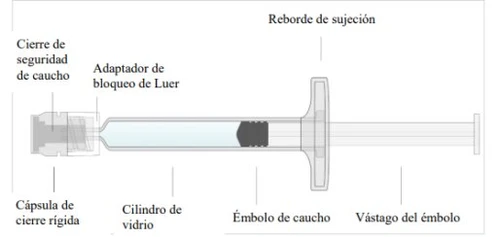
Inspection of the pre-filled syringe
- Remove the pre-filled syringe tray from the carton.
- Remove the pre-filled syringe from the tray by holding the syringe barrel.
- Inspect the pre-filled syringe for any abnormalities or leakage. If any defects are observed, do not use the syringe.
- VIMKUNYA is a clear liquid with a white precipitate before shaking.
- Shake the pre-filled syringe vigorously immediately before use to obtain a homogeneous suspension. After shaking, the suspension should be a cloudy white liquid without visible foreign particles. Inspect the suspension for any discoloration or presence of particles. Do not administer the vaccine if any of these signs are observed.
Administration of the vaccine
- Hold the pre-filled syringe with the nozzle pointing upwards and gently unscrew the Luer lock closure cap from the pre-filled syringe. Do not attempt to break or remove the tip, as this may damage the syringe.
- This container does not contain a needle. Use a sterile needle of appropriate size to ensure intramuscular injection based on the patient's size and weight.
- Attach the sterile needle to the pre-filled syringe and ensure the needle is securely fitted to the syringe.
- After shaking, VIMKUNYA is a homogeneous cloudy white suspension without visible foreign particles. If the vaccine is not a homogeneous suspension, shake the syringe vigorously to resuspend the solution before administration.
- Administer the full dose as an intramuscular (IM) injection into the deltoid muscle of the upper arm by gently pushing the plunger rod and maintaining pressure on the plunger until all the contents of the syringe are expelled to complete the injection.
- VIMKUNYA is for intramuscular (IM) use only. Do not administer by intravenous, intradermal, or subcutaneous route.
- The injection should be administered within 4 hours after removing the pre-filled syringe from refrigeration (between 2 °C and 8 °C).
- In-use stability data indicate that the vaccine is stable for 4 hours when stored at temperatures between 8 °C and 25 °C and for at least 24 hours when stored between 0 °C and 2 °C. At the end of this period, the vaccine must be discarded.
Disposal
- Dispose of the syringe after use.
- Discard this vaccine if not used within 4 hours after removal of the pre-filled syringe from storage at 2 °C to 8 °C.
Waste elimination
- Disposal of unused medicine and all materials that have come into contact with it must be carried out in accordance with local regulations.