Viaflo Plasmalyte 148 (pH 7.4), solution for infusion
Spain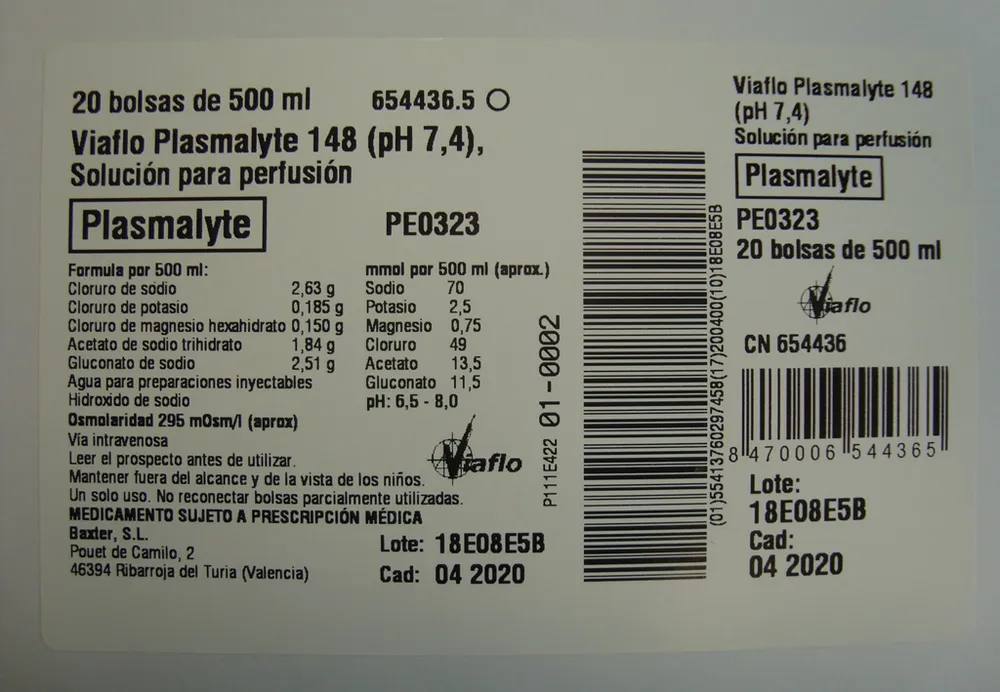
Table of Contents
- Patient Information Leaflet
- Introduction
- 1. What Viaflo Plasmalyte 148 (pH 7.4) is and what it is used for
- 2. What you need to know before Viaflo Plasmalyte 148 (pH 7.4) is administered to you
- 3. How Viaflo Plasmalyte 148 (pH 7.4) will be administered to you
- 4. Possible adverse effects
- 5. Storage of Viaflo Plasmalyte 148 (pH 7.4)
- 6. Contents of the pack and other information
- **Composition of Viaflo Plasmalyte 148 (pH 7.4)**
Patient Information Leaflet
Introduction
Patient Information Leaflet
Viaflo Plasmalyte 148 (pH 7.4) infusion solution
Active substances: sodium chloride, potassium chloride, magnesium chloride hexahydrate, sodium acetate trihydrate and sodium gluconate
Read the entire leaflet carefully before you start using this medicine, because it contains important information for you.
- Keep this leaflet, as you may need to read it again.
- If you have any questions, ask your doctor or nurse.
- If you experience any side effects, consult your doctor or nurse, even if they are side effects not listed in this leaflet. See section 4.
This medicine is called "Viaflo Plasmalyte 148 (pH 7.4) infusion solution", but throughout this text it will be referred to as "Viaflo Plasmalyte 148 (pH 7.4)".
Leaflet Contents
1 What Viaflo Plasmalyte 148 (pH 7.4) is and what it is used for
2 What you need to know before being administered Viaflo Plasmalyte 148 (pH 7.4)
3 How Viaflo Plasmalyte 148 (pH 7.4) will be administered to you
4 Possible side effects
5 How to store Viaflo Plasmalyte 148 (pH 7.4)
6 Contents of the pack and other information
1. What Viaflo Plasmalyte 148 (pH 7.4) is and what it is used for
Pharmacotherapeutic group: "Electrolytes" - ATC code: "B05BB01"
Viaflo Plasmalyte 148 (pH 7.4) is a solution containing the following substances in water:
- sodium chloride
- potassium chloride
- magnesium chloride hexahydrate
- sodium acetate trihydrate
- sodium gluconate
Sodium, potassium, magnesium, chloride, acetate, and gluconate are chemical substances present in the blood.
Viaflo Plasmalyte 148 (pH 7.4) is used:
- to provide fluids, for example, in cases of:
- burns
- head trauma
- fractures
- infections
- peritoneal irritation (inflammation in the abdominal cavity)
- to provide fluids during surgical procedures
- for the treatment of shock caused by blood loss and for other conditions requiring rapid replacement of blood, fluids, or both
- in non-life-threatening metabolic acidosis (when the blood becomes too acidic)
- in lactic acidosis (a type of metabolic acidosis caused by accumulation of lactic acid in the body). Lactic acid is produced mainly in the muscles and eliminated by the liver.
Viaflo Plasmalyte 148 (pH 7.4) may be used in:
- adults, elderly, and adolescents
- infants and young children from 28 days to 23 months of age, and children from 2 to 11 years of age.
2. What you need to know before Viaflo Plasmalyte 148 (pH 7.4) is administered to you
Do NOT receive Viaflo Plasmalyte 148 (pH 7.4) if you have any of the following clinical conditions:
- High levels of potassium in your blood above normal (hyperkalemia).
- Kidney failure.
- Heart block (very slow heartbeats).
- Any disorder in which the blood becomes too alkaline (metabolic or respiratory alkalosis).
- Deficiency in stomach acid secretion (hypochloridia).
- Hypersensitivity to the active substances or to any of the other components of this medicine (listed in section 6).
Warnings and precautions
Inform your doctor if you currently have or have previously had any of the following medical conditions:
- Heart failure.
- Respiratory failure (lung disease).
- Kidney failure.
(In the above cases, special monitoring may be required.)
- High blood pressure (hypertension).
- Fluid accumulation under the skin, particularly in the ankles (peripheral edema).
- Fluid accumulation in the lungs (pulmonary edema).
- High blood pressure during pregnancy (pre-eclampsia or eclampsia).
- Aldosteronism (a condition causing increased levels of a hormone called aldosterone).
- Any other condition associated with sodium retention (when the body retains too much sodium), such as treatment with steroids (see also “Other medicines and Viaflo Plasmalyte 148 (pH 7.4)”).
- A condition that could lead to elevated levels of vasopressin, a hormone that regulates fluid in your body. You may have too much vasopressin due to, for example:
- A sudden and severe illness,
- Pain,
- Surgery,
- Infections, burns, or brain injury,
- Heart, liver, kidney, or central nervous system diseases,
- Taking certain medications (see below: “Other medicines and Viaflo Plasmalyte 148 (pH 7.4)”).
This may increase the risk of low sodium levels in the blood and may cause headache, nausea, seizures, lethargy, coma, brain swelling, and death. Brain swelling increases the risk of death and brain damage. People at higher risk of brain swelling include:
-
Children,
-
Women (particularly those of childbearing age),
-
Individuals with conditions affecting brain fluid levels, such as meningitis, bleeding in the skull, or brain injury.
-
High levels of chloride in your blood above normal (hyperchloremia).
-
High levels of sodium in your blood above normal (hypernatremia).
-
Low levels of calcium in your blood below normal (hypocalcemia).
-
Any condition indicating you may be prone to high blood potassium levels (hyperkalemia), for example:
- Kidney failure,
- Adrenocortical insufficiency (a disease of the adrenal glands affecting hormones that regulate chemical concentrations in the body),
- Acute dehydration (loss of body water, e.g., due to vomiting or diarrhea),
- Significant tissue injuries (such as those caused by severe burns).
(In these cases, close monitoring of blood potassium levels is necessary.)
- Myasthenia gravis (a disease causing progressive muscle weakness).
- Recovery following surgery.
While you are receiving this solution, your doctor may take blood and urine samples to monitor:
- The amount of fluid in your body.
- The levels of chemicals such as sodium and chloride in your blood and urine (your plasma and urinary electrolytes).
- Your acid-base balance (the acidity of blood and urine).
Although Viaflo Plasmalyte 148 (pH 7.4) contains potassium, the amount is not sufficient to treat severe potassium deficiency (very low blood potassium concentration).
Viaflo Plasmalyte 148 (pH 7.4) contains substances that may cause metabolic alkalosis (blood becoming too alkaline).
If treatment needs to be repeated, your doctor will also administer other types of infusions to meet your needs for other chemicals and nutrients (food).
If your blood is tested for the presence of a fungus called Aspergillus, the test may detect Aspergillus even if it is not actually present.
Other medicines and Viaflo Plasmalyte 148 (pH 7.4)
Inform your doctor or pharmacist if you are taking, have recently taken, or might need to take any other medicines.
The following medicines must NOT be used while you are receiving an infusion of Viaflo Plasmalyte 148 (pH 7.4):
- Potassium-sparing diuretics (a type of diuretic such as amiloride, spironolactone, triamterene, potassium canrenoate).
- Angiotensin-converting enzyme inhibitors (ACE inhibitors) (used to treat high blood pressure).
- Angiotensin II receptor antagonists (used to treat high blood pressure).
- Tacrolimus (used to prevent transplant rejection and to treat certain skin conditions).
- Cyclosporine (used to prevent transplant rejection).
These medicines may increase potassium levels in the blood, which could be life-threatening. The risk of increased blood potassium levels is higher if you have kidney disease.
Some medicines affect the hormone vasopressin. These may include:
-
Antidiabetic medications (chlorpropamide).
-
Cholesterol-lowering drugs (clofibrate).
-
Some cancer treatments (vincristine, ifosfamide, cyclophosphamide).
-
Selective serotonin reuptake inhibitors (used to treat depression).
-
Antipsychotics.
-
Opioid pain relievers for severe pain.
-
Pain and/or anti-inflammatory medicines (also known as NSAIDs).
-
Medicines that mimic or enhance the effects of vasopressin, such as desmopressin (used to treat excessive thirst and urination), terlipressin (used to treat esophageal bleeding), and oxytocin (used to induce labor).
-
Antiepileptic drugs (carbamazepine and oxcarbazepine).
-
Diuretics.
Other medicines that may affect Viaflo Plasmalyte 148 (pH 7.4) or be affected by it:
- Corticosteroids (anti-inflammatory agents).
- Carbenoxolone (an anti-inflammatory used to treat stomach ulcers).
- Neuromuscular blockers (e.g., tubocurarine, suxamethonium, vecuronium). These medicines are used during surgery and are monitored by the anesthetist.
- Acetylcholine.
- Aminoglycosides (a type of antibiotic).
- Nifedipine (used to treat high blood pressure and chest pain).
- Acidic medicines, for example:
- Salicylates used to treat inflammation (aspirin).
- Sleeping tablets (barbiturates).
- Lithium (used to treat psychiatric conditions).
- Alkaline (basic) medicines, for example:
- Sympathomimetics (stimulants such as ephedrine and pseudoephedrine, used in cough and cold preparations).
- Other stimulants (e.g., dexamphetamine, fenfluramine).
Use of Viaflo Plasmalyte 148 (pH 7.4) with food and drink
Ask your doctor about what you may eat or drink.
Pregnancy, breastfeeding, and fertility
If you are pregnant or breastfeeding, think you may be pregnant, or plan to become pregnant, consult your doctor before using this medicine.
You may receive Viaflo Plasmalyte 148 (pH 7.4) during pregnancy or breastfeeding. Your doctor will monitor blood chemical levels and fluid balance.
However, if another medicine is added to the infusion solution during pregnancy or breastfeeding, you must:
- Consult your doctor.
- Read the package leaflet of the added medicine.
Driving and using machines
Seek advice from your doctor or pharmacist before driving or operating machinery.
3. How Viaflo Plasmalyte 148 (pH 7.4) will be administered to you
Viaflo Plasmalyte 148 (pH 7.4) will be administered to you by a doctor or nurse. Your doctor will decide how much you need and when it should be given. This will depend on your age, body weight, physical condition, and the reason for treatment. The amount you receive may also be influenced by other treatments you are receiving.
DO NOT receive Viaflo Plasmalyte 148 (pH 7.4) if there are particles floating in the solution or if the container is damaged in any way.
Usually, Viaflo Plasmalyte 148 (pH 7.4) is administered through a plastic tube inserted via a needle into a vein, most commonly in your arm. However, your doctor may use another method to administer the medicine.
Before and during the infusion, your doctor will monitor:
- the amount of fluid in your body
- the acidity of your blood and urine
- the level of electrolytes in your body (particularly sodium, in patients with high levels of vasopressin or who are taking other medications that enhance the effect of vasopressin).
Any unused portion of the solution must be discarded. You MUST NOT receive Viaflo Plasmalyte 148 (pH 7.4) from a bag that has already been partially used.
If you receive more Viaflo Plasmalyte 148 (pH 7.4) than you should
If you receive too much Viaflo Plasmalyte 148 (pH 7.4) or if it is administered too quickly, you may experience the following symptoms:
-
water or sodium (salt) overload and fluid accumulation in tissues (edema), causing swelling.
-
tingling in arms and legs (paresthesia).
-
muscle weakness.
-
inability to move (paralysis).
-
irregular heartbeats (cardiac arrhythmias).
-
heart block (very slow heartbeats).
-
cardiac arrest (heart stops beating, life-threatening).
-
confusion.
-
loss of tendon reflexes.
-
reduced breathing (respiratory depression).
-
nausea.
-
vomiting.
-
skin redness.
-
thirst.
-
low blood pressure (hypotension).
-
drowsiness.
-
slow heart rate (bradycardia).
-
coma (loss of consciousness).
-
blood acidification (acidosis), causing fatigue, confusion, lethargy, and increased breathing rate.
-
hypokalemia (abnormally low potassium levels in blood) and metabolic alkalosis (blood becomes too alkaline), especially in patients with renal insufficiency.
-
mood changes.
-
fatigue.
-
difficulty breathing.
-
muscle stiffness.
-
muscle twitching.
-
muscle contractions.
If you experience any of these symptoms, you must inform your doctor immediately. Your infusion will be stopped and you will be treated according to your symptoms.
If you are not in the hospital, go to the nearest hospital or contact the Toxicology Information Service at telephone number: 91 562 04 20, stating the name of the medication and the amount used. It is recommended to bring the medication container and package leaflet to the healthcare professional.
If another medicine has been added to Viaflo Plasmalyte 148 (pH 7.4) before the overdose occurred, that medicine may also be causing symptoms. You should read the package leaflet of the added medicine to see the list of possible symptoms.
If you stop treatment with Viaflo Plasmalyte 148 (pH 7.4)
Your doctor will decide when to stop the infusion.
If you have any further questions about the use of this medicine, ask your doctor or nurse.
4. Possible adverse effects
Like all medicines, this medicine can cause adverse effects, although not everyone will experience them.
Inform your doctor or nurse immediately if you experience any of the following symptoms, as they may be signs of a very severe or even life-threatening allergic reaction (hypersensitivity):
- swelling of the skin of the face, lips, and throat
- difficulty breathing
- skin rash
- redness of the skin (erythema)
You will be given appropriate treatment depending on the symptoms.
Other adverse effects are listed below by frequency.
Rare (seen in less than 1 in 1,000 patients but in more than 1 in 10,000)
- Reactions due to the administration technique:
- fever (febrile reaction),
- infection at the injection site,
- burning sensation,
- local pain or reaction (redness or swelling) at the site of administration,
- irritation and inflammation of the vein into which the solution is infused (phlebitis). This may cause redness, pain or burning, and swelling along the vein where the solution was infused,
- formation of blood clots (venous thrombosis) at the infusion site causing pain, swelling, or redness in the area of the clot,
- leakage of the solution into surrounding tissues (extravasation). This may damage tissues and cause scarring,
- excess fluid in the blood vessels (hypervolemia),
- seizures,
- hives (urticaria),
- severe allergic reaction causing difficulty breathing or dizziness (anaphylactic reaction),
- rapid heartbeat (tachycardia),
- palpitations,
- chest pain,
- chest discomfort,
- difficulty breathing (dyspnea),
- increased respiratory rate,
- redness,
- hyperemia,
- feeling of weakness (asthenia),
- abnormal sensation,
- piloerection,
- peripheral edema,
- fever (pyrexia).
- low levels of sodium in the blood that may occur during hospitalization (nosocomial hyponatremia) and related neurological disorder (acute hyponatremic encephalopathy). Hyponatremia can cause irreversible brain damage and death due to brain swelling (cerebral edema/inflammation) (see also “Warnings and precautions”).
If another medicine has been added to the infusion solution, that medicine may also cause adverse effects. These will depend on the medicine added. You should read the package leaflet of the added medicine to see the list of possible symptoms.
Other adverse effects reported with similar products:
- other manifestations of hypersensitivity or infusion-related reactions: drop in blood pressure (hypotension), wheezing, cold sweat, chills,
- hyperkalemia.
Reporting of adverse effects
If you experience any adverse effect, talk to your doctor, pharmacist, or nurse, even if it is a possible adverse effect not listed in this leaflet. You may also report them directly via the Spanish Pharmacovigilance System for Human Medicinal Products: www.notificaRAM.es.
By reporting adverse effects, you can help provide more information on the safety of this medicine.
5. Storage of Viaflo Plasmalyte 148 (pH 7.4)
Keep this medicine out of the sight and reach of children.
This medicine does not require any special storage conditions.
DO NOT use this medicine after the expiry date stated on the bag after EXP. The expiry date refers to the last day of the month indicated.
Do not use this medicine if you see particles floating in the solution or if the container is damaged in any way.
6. Contents of the pack and other information
Composition of Viaflo Plasmalyte 148 (pH 7.4)
The active substances are:
- Sodium chloride: 5.26 g per litre
- Potassium chloride: 0.37 g per litre
- Magnesium chloride hexahydrate: 0.30 g per litre
- Sodium acetate trihydrate: 3.68 g per litre
- Sodium gluconate: 5.02 g per litre
The other components are:
- Water for injections
- Sodium hydroxide
Appearance of the product and contents of the container
Viaflo Plasmalyte 148 (pH 7.4) is a clear solution, free from visible particles. It is supplied in plastic bags made of polyolefin/polyamide (Viaflo). Each bag is enclosed in a sealed protective overpouch made of plastic.
Available bag sizes:
- 500 ml
- 1,000 ml
The bags are supplied in cartons, each containing the following quantities:
- 1 bag of 500 ml
- 20 bags of 500 ml
- 1 bag of 1,000 ml
- 10 bags of 1,000 ml
- 12 bags of 1,000 ml
Only certain pack sizes may be marketed.
Marketing Authorisation Holder and Manufacturers
Marketing Authorisation Holder:
Baxter S.L.
Pouet de Camilo 2, 46394 Ribarroja del Turia (Valencia), Spain
Manufacturers:
Baxter S.A.
Boulevard René Branquart, 80, 7860 Lessines, Belgium
Bieffe Medital S.A.
Ctra. Biescas-Senegüé, 22666 Sabiñánigo (Huesca), Spain
This medicinal product is authorised in the European Economic Area Member States and in the United Kingdom (Northern Ireland) under the following names:
Austria: Plasmalyt – Infusionslösung
Belgium, Luxembourg: Plasmalyte A Viaflo, solution for infusion
Croatia: Plasma-Lyte 148 (pH 7,4) Viaflo, otopina za infuziju
Czech Republic: Plasmalyte roztok
Cyprus: Plasma-Lyte 148 (pH 7,4) διάλυμα για έγχυση
Spain: Viaflo Plasmalyte 148 (pH 7,4), solución para perfusión
Denmark: Plasmalyte, infusionsvæske, opløsning
Finland: Plasmalyte infuusioneste, liuos
France: Plasmalyte Viaflo, solution pour perfusion
Greece: Plasma-Lyte 148 (pH 7,4) διάλυμα για έγχυση
Iceland: Plasmalyte innrennslislyf, lausn
Ireland: Plasma-Lyte 148 (pH 7.4) Solution for infusion
Italy: CrystalSol Solution for infusion
Lithuania: Plasmalyte infuzinis tirpalas
Malta: Plasma-Lyte 148 (pH 7.4) Solution for infusion
Netherlands: Plasma-Lyte 148, oplossing voor infusie
Norway: Plasmalyte infusjonsvæske, oppløsning
Poland: Plasmalyte roztwór do infuzji
Portugal: Plasma-lyte (pH 7,4) 148 Viaflo
Slovenia: Plaslyte raztopina za infundiranje
Slovakia: Plasmalyte infúzny roztok
Sweden: Plasmalyte infusionsvätska, lösning
United Kingdom (Northern Ireland): Plasma-Lyte 148 (pH 7.4) Solution for Infusion
The most recent revision of this leaflet was in October 2023
Detailed and up-to-date information on this medicinal product is available on the website of the Spanish Agency of Medicines and Health Products (AEMPS) http://www.aemps.gob.es/
This information is intended for healthcare professionals only:
Handling and preparation
When permitted by the solution and container, visually inspect the solution for visible particles and discoloration prior to administration. Do not administer unless the solution is clear and the container is intact.
Do not remove the bag from its protective overpouch until ready for use. The inner bag maintains the sterility of the product. Administer immediately after connecting the infusion set.
Do not connect plastic containers in series. This practice may result in gas embolism due to residual air being entrained from the primary container before completion of administration from the secondary container. Pressurizing intravenous solutions in flexible plastic containers to increase flow rates may cause gas embolism if residual air in the container is not completely evacuated before administration.
Using an intravenous administration set with a vent filter in the open position may lead to gas embolism. Such intravenous administration sets with the vent filter open must not be used with flexible plastic containers.
The solution must be administered intravenously using a sterile set and aseptic technique. The administration set should be primed with the solution to prevent air from entering the system.
Medications may be added before or during infusion via the injection site.
The addition of other medications or incorrect administration techniques may cause febrile reactions due to possible introduction of pyrogens. In case of an adverse reaction, infusion must be stopped immediately.
Discard after single use.
Discard partially used containers.
Do not reconnect partially used bags.
1-Opening
-
Remove the Viaflo bag from the protective overpouch immediately before use.
-
Check for small leaks by firmly squeezing the inner bag. If leaks are detected, discard the solution, as it may no longer be sterile.
-
Check the clarity of the solution and absence of foreign particles. Discard the solution if it is not clear or contains foreign particles.
2-Preparation for administration
Use sterile materials for preparation and administration.
-
Hang the container by the eyelet.
-
Remove the plastic protector from the outlet port at the bottom of the container.
- Hold the small fin on the neck of the outlet tube with one hand.
- Hold the large fin on the closure cap with the other hand and twist.
- The cap will detach.
-
Use aseptic technique when preparing the infusion.
-
Connect the administration set. Refer to the instructions accompanying the administration set for connection, priming, and administration of the solution.
3-Techniques for injection of added medication
Warning: Added medications may be incompatible. Before adding any medication, verify its compatibility with both the bag and the solution. After adding medications, verify isotonicity before parenteral administration. A complete and careful aseptic mixing of any added medication is required. Solutions containing added medications should be used immediately and not stored. (See section 5 “Incompatibilities of added medications”).
To add medication before administration
-
Disinfect the injection site.
-
Using a syringe with a needle gauge 19 (1.10 mm) to 22 (0.70 mm), puncture the resealable injection site and inject.
-
Carefully mix the medication and solution. For high-density medications such as potassium chloride, gently move the tubes while in vertical position to ensure mixing.
Caution: Do not store bags with added medication.
To add medication during administration
-
Close the clamp on the administration set.
-
Disinfect the injection site.
-
Using a syringe with a needle gauge 19 (1.10 mm) to 22 (0.70 mm), puncture the resealable injection site and inject.
-
Remove the container from the intravenous support and/or rotate to place it in vertical position.
-
Empty both tubes by gently tapping them while the container is in vertical position.
-
Carefully mix the solution and medication.
-
Return the container to the upright position, reopen the clamp, and continue administration.
4-Expiry after first opening:
The product must be used immediately after opening.
In-use expiry after reconstitution with added medications
Before use, the physical and chemical stability of any added medication at the pH of Viaflo Plasmalyte 148 (pH 7.4) solution in the Viaflo container must be established.
From a microbiological standpoint, the diluted product should be used immediately. If not used immediately, storage duration and conditions prior to use are the responsibility of the user and should normally not exceed 24 hours between 2 and 8 °C, unless reconstitution has taken place under controlled and validated aseptic conditions.
5-Incompatibilities of added medications
When adding medications to Viaflo Plasmalyte 148 (pH 7.4), an aseptic technique must be used. After addition, mix the solution thoroughly. Do not store bags containing added medications.
As with all parenteral solutions, incompatibility of added medications with the solution in the Viaflo bag must be verified before addition.
The summary of product characteristics (SmPC) of the medication to be added should be consulted.
Before adding a medication, verify that it is soluble and/or stable in water and that the pH range of Viaflo Plasmalyte 148 (pH 7.4) solution (pH 6.5 – 8.0) is appropriate. After addition, observe for possible changes in colour and/or formation of precipitates, insoluble complexes, or crystals.
Medications known to be incompatible must not be used.