Verrucutan 5 mg/g + 100 mg/g cutaneous solution
Spain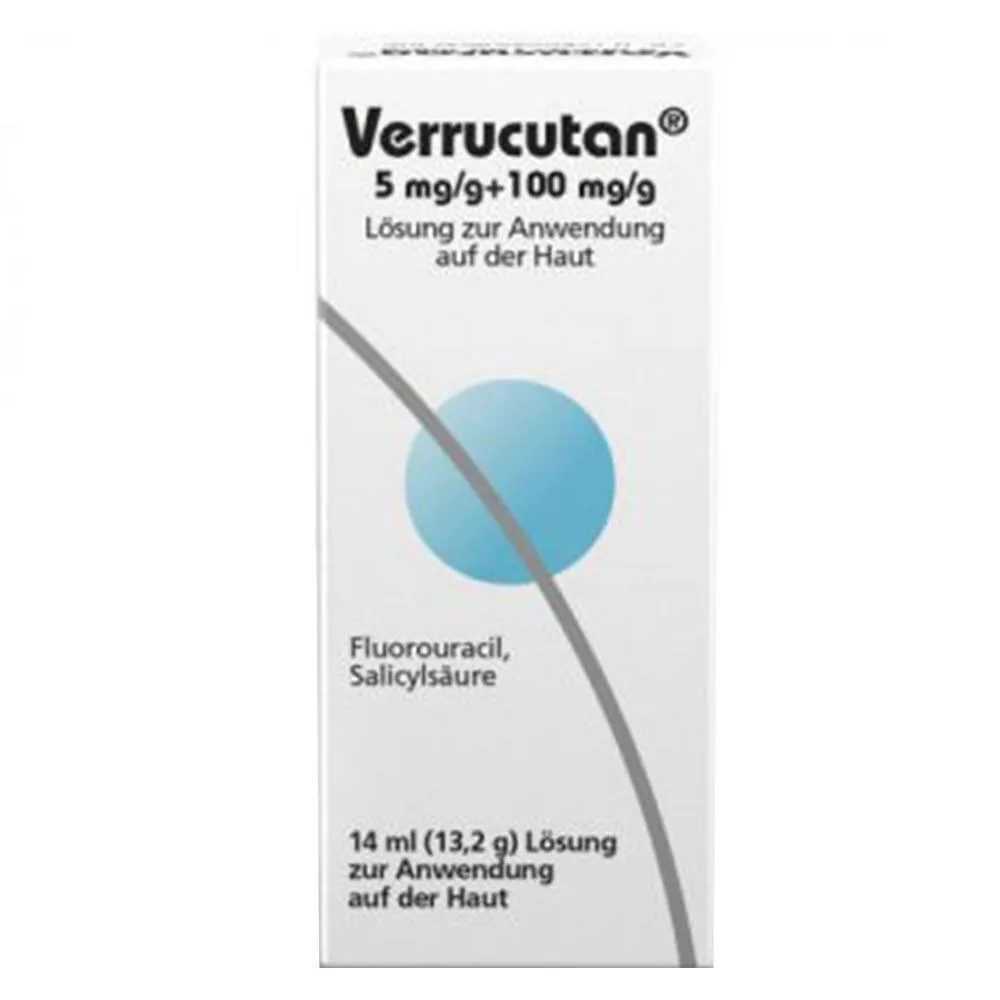
Table of Contents
Package leaflet: Information for the user
Introduction
Package leaflet: information for the user
Verrucutan 5 mg/g + 100 mg/g cutaneous solution
Fluorouracil / Salicylic acid
Read the entire leaflet carefully before you start using this medicine, because it contains important information for you.
- Keep this leaflet, as you may need to read it again.
- If you have any questions, ask your doctor or pharmacist.
- This medicine has been prescribed for you only, and you should not give it to other people, even if they have the same symptoms as you, because it may harm them.
- If you experience any adverse effects, consult your doctor or pharmacist, even if they are adverse effects not listed in this leaflet. See section 4.
Leaflet contents
- What Verrucutan is and what it is used for
- What you need to know before using Verrucutan
- How to use Verrucutan
- Possible side effects
- How to store Verrucutan
- Contents of the pack and other information
1. What Verrucutan is and what it is used for
Verrucutan is a therapeutic agent for warts.
Verrucutan is used for common warts, warts on the soles of the feet (plantar warts), and flat warts (plane warts, juvenile warts) on the arms and legs.
2. What you need to know before using Verrucutan
Do not use Verrucutan
- if you are allergic to fluorouracil, salicylic acid, or any of the other ingredients of this medicine (listed in section 6).
- if you are breastfeeding.
- if you are pregnant or cannot definitely rule out the possibility of pregnancy.
- in infants under 1 year of age.
- if you know you have impaired kidney function.
- if you are taking certain antiviral medicines to treat chickenpox or shingles (herpes zoster therapy).
You must not use Verrucutan if you are currently being treated with brivudine, sorivudine, and/or similar substances as part of herpes zoster treatment, or if you have received such treatment within the last 4 weeks. The active ingredient fluorouracil, in combination with brivudine, sorivudine, and their derivatives, may significantly increase the side effects of Verrucutan. You should not start treatment with fluorouracil for at least 4 weeks after completing herpes zoster treatment with brivudine or sorivudine. If you are or have recently been treated for a herpes zoster infection, inform your doctor about the medicines you are taking.
Verrucutan is not intended for use on large areas of skin (more than 25 cm²) and must not come into contact with the eyes or mucous membranes.
Warnings and precautions
Talk to your doctor or pharmacist before using Verrucutan if you know you lack the enzyme dihydropyrimidine dehydrogenase (DPD) (complete DPD deficiency).
Use Verrucutan with caution if you are taking phenytoin for epileptic seizures. If you are taking phenytoin, concomitant use of Verrucutan may lead to increased blood levels of phenytoin. Therefore, you should be monitored periodically for increased blood levels of phenytoin.
If warts affect areas of skin with a thin upper layer, apply Verrucutan less frequently and have the treated area examined medically more often, as this may lead to scarring.
Keep in mind that regular medical check-ups are required if your ability to feel touch, pain, or temperature is limited (sensory disorders, for example due to diabetes).
Verrucutan must not come into contact with textiles or acrylic materials (e.g. acrylic bathtubs) during use. The solution may cause irreversible stains.
Note that Verrucutan is flammable before the lacquer film has formed.
Keep away from fire and flames.
Verrucutan must not be used on bleeding lesions.
Children
Verrucutan must not be used in infants under 1 year of age. Since the risk of overdose is higher in children than in adults, the recommended treatment area and frequency must not be exceeded, especially in young children.
Other medicines and Verrucutan
Tell your doctor or pharmacist if you are taking/using, have recently taken/used, or might need to take/use any other medicines.
This is particularly important because, when several medicines are taken at the same time, the effect of individual medicines may become stronger or weaker.
You must not use Verrucutan if you are taking or have taken certain medicines to treat viral diseases such as chickenpox or shingles (brivudine, sorivudine, or their derivatives) within the last 4 weeks.
You should take special care if you are taking medicines for seizures (phenytoin). Systemic use of fluorouracil in cancer therapy has shown that co-administration with phenytoin may lead to increased phenytoin levels.
Due to the possible absorption of salicylic acid, interactions with methotrexate (a medicine used to treat certain rheumatic diseases, cancer, or severe psoriasis) and sulfonylureas (contained in some hypoglycemic/antidiabetic medicines) are possible.
Pregnancy and breastfeeding
If you are pregnant or breastfeeding, think you may be pregnant, or plan to become pregnant, consult your doctor or pharmacist before using this medicine.
Verrucutan must not be used during breastfeeding, pregnancy, or if pregnancy cannot be definitely ruled out.
Driving and use of machines
No special precautions are required.
Verrucutan contains dimethyl sulfoxide and alcohol (ethanol)
This medicine may cause skin irritation because it contains dimethyl sulfoxide.
This medicine contains 171.5 mg/g of alcohol (ethanol).
It may cause a burning sensation on damaged skin.
3. How to use Verrucutan
Follow exactly the administration instructions for this medicine as given by your doctor or pharmacist. If in doubt, consult your doctor or pharmacist again.
Dosage
Unless otherwise prescribed, Verrucutan should be applied two or three times a day to each wart.
Method of administration
For cutaneous use only.
Verrucutan should only come into contact with the wart and not with the surrounding healthy skin; when appropriate, the surrounding skin should be protected with a paste or ointment. If necessary, your doctor or pharmacist may recommend a suitable product. It is advisable to pass the spatula over the neck of the bottle before application. For very small warts, a toothpick or similar object should be used instead of the spatula for more precise application. Before each new application of Verrucutan, remove the existing film coating by peeling it off.
For warts around or under the nail, ensure that the nail is intact and that Verrucutan cannot penetrate into the nail bed.
Verrucutan is not indicated for use on large areas of skin. The total combined treated area should not exceed 25 cm².
It is recommended that you consult your doctor regularly during treatment. Experience shows that, in many cases (e.g., warts or warts that protrude significantly), it is beneficial for your doctor to remove dead tissue during treatment with Verrucutan.
Duration of treatment
The average duration of treatment is 6 weeks. After successful treatment, continue treatment for approximately one additional week.
Inform your doctor or pharmacist if you feel that the effect of Verrucutan is too strong or too weak.
If you use more Verrucutan than you should
In case of overdose or accidental ingestion, consult your doctor, pharmacist, or call the Toxicology Information Service immediately at: 91 562 04 20, indicating the medicine and the amount ingested. It is recommended to bring the medicine packaging and leaflet to the healthcare professional.
If you forget to use Verrucutan
Do not use a double dose to make up for missed doses. Continue applying as prescribed by your doctor or as described in this leaflet.
If you stop using Verrucutan
In this case, contact your doctor.
If you have any further questions about the use of this medicine, ask your doctor or pharmacist.
4. Possible adverse effects
Like all medicines, this medicine can cause adverse effects, although not everyone will experience them.
- Very common (may affect more than 1 in 10 people): skin redness, swelling, irritation, burning, pain, and itching at the application site may occur.
- Common (may affect up to 1 in 10 people): bleeding, crust formation, and oozing from the skin at the application site may occur. The skin may peel, and erosive skin reactions (loss of the upper layer of skin tissue) may develop.
- Headache may occur.
- Uncommon (may affect up to 1 in 100 people): skin inflammation, edema, and ulcers may occur at the application site.
- In the eyes, increased tear production, itching, and dry eyes may occur.
- Rare (may affect up to 1 in 1,000 people): intense burning sensation may occur, in which case treatment should be discontinued.
- Verrucutan contains salicylic acid. This component may cause mild signs of irritation, such as skin inflammation (dermatitis) and hypersensitivity reactions (contact allergic reactions). These signs of irritation may also appear as itching, redness, and blistering beyond the site of application.
- In the area surrounding the wart, whitish discoloration and skin peeling may occur.
Reporting of adverse effects
If you experience any adverse effect, consult your doctor or pharmacist, even if it is a possible adverse effect not listed in this leaflet. You may also report them directly via the Spanish Pharmacovigilance System for Human Medicines: https://www.notificaram.es. By reporting adverse effects, you can help provide more information on the safety of this medicine.
5. Storage of Verrucutan
Keep this medicine out of the sight and reach of children.
Do not use this medicine after the expiry date stated on the label of the bottle and on the carton, following “EXP”. The expiry date refers to the last day of the month indicated.
Do not store above 30°C.
Do not refrigerate or freeze.
After first opening, the product is stable for 6 months.
The bottle must be tightly closed after use. Otherwise, the product will dry out quickly and can no longer be used properly. Do not use Verrucutan if it has dried out. Do not use Verrucutan if crystals have formed.
Medicines must not be disposed of via wastewater or household waste. Dispose of unused containers and medicines at the SIGRE collection point at your pharmacy. Ask your pharmacist how to dispose of containers and medicines you no longer need. This will help protect the environment.
Caution: Flammable; keep away from fire and flames.
6. Contents of the pack and other information
Composition of Verrucutan
The active substances are: fluorouracil and salicylic acid.
1 g of solution contains 5 mg of fluorouracil and 100 mg of salicylic acid.
The other components are: dimethyl sulfoxide, anhydrous ethanol, ethyl acetate, pyroxilin, poly(butyl methacrylate-co-methyl methacrylate) (80:20).
Appearance of the product and contents of the container
Verrucutan is a cutaneous solution; transparent, colourless to slightly yellowish. It is available in brown glass bottles with screw caps and child-resistant polyethylene spatula applicators, containing 13 ml (12.3 g) and 14 ml (13.2 g).
Not all pack sizes may be marketed.
Marketing Authorization Holder and Manufacturer
Marketing Authorization Holder:
Mibe Pharma España S.L.U.
C/Amaltea 9, 4th floor, letter B,
28045, Madrid
Spain
Manufacturer:
Mibe GmbH Arzneimittel
Münchener Strasse 15
06796 – Brehna
Germany
Or
Sun-Farm Sp. z o.o.
Ul. Dolna 21, Lomianki
Mazowieckie 05-092
Poland
Date of the most recent revision of this leaflet: May 2022
Detailed information on this medicine is available on the website of the Spanish Agency of Medicines and Health Products (AEMPS) (http://www.aemps.gob.es/).