Verdye 25 mg powder for injection solution
Spain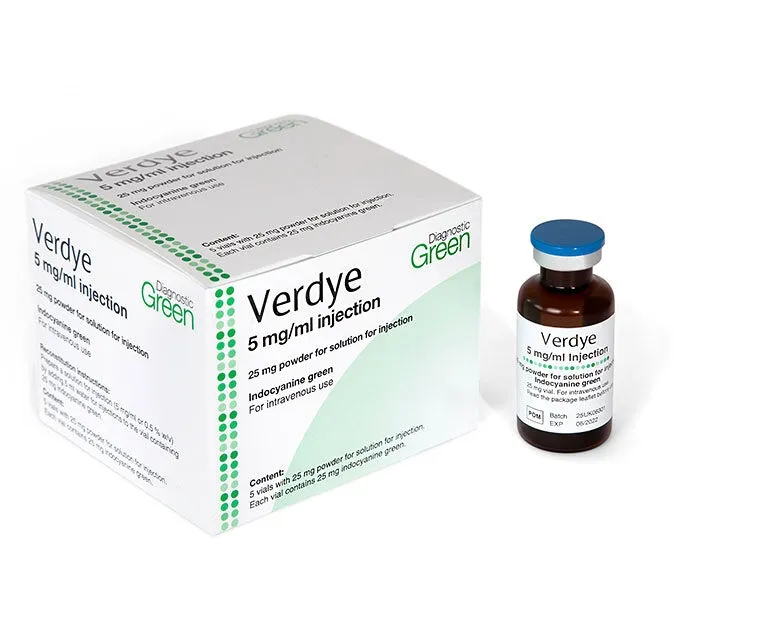
Table of Contents
Package leaflet: Information for the user
Introduction
Package leaflet: information for the user
Verdye 25 mg powder for injectable solution
Indocyanine green
Read the entire leaflet carefully before you start using this medicine, because it contains important information for you.
- Keep this leaflet, as you may need to read it again.
- If you have any questions, ask your doctor, pharmacist or nurse.
- This medicine has been prescribed for you only, and you should not give it to other people, even if they have the same symptoms as you, because it could harm them.
- If you experience any adverse effects, consult your doctor, pharmacist or nurse, even if they are adverse effects not listed in this leaflet. See section 4.
Leaflet contents
- What Verdye is and what it is used for
- What you need to know before using Verdye
- How to use Verdye
- Possible side effects
- How to store Verdye
- Contents of the pack and other information
1. What Verdye is and what it is used for
Verdye is a dark green powder that is mixed with water for injectable preparations. The active substance of the solution is called indocyanine green, a dye. This dye is then injected into one of your veins, where it mixes with the blood. The doctor can observe:
- the distance the dye travels from the injection site
- how much dye is present in various parts of your body.
When Verdye is injected into the skin or subcutaneous fatty tissue of patients with breast cancer, it accumulates in the lymph nodes, making the lymphatic vessels visible.
This medicine is for diagnostic use only, to help determine what medical conditions you may have, for example:
-
how blood circulation functions in a particular part of your body, such as:
- the heart
- the brain
- the liver
- a layer in the inner part of the eye called the choroid.
-
the amount of blood in certain areas of your body.
-
how well your liver is functioning.
Verdye is also used to visualize and identify sentinel lymph nodes and lymphatic pathways during surgery in adult patients with breast cancer. For this purpose, the medicine is injected into the skin, into the fatty tissue beneath the skin, or into the area of the tumor, rather than into the veins.
The lymph nodes closest to the tumor are called sentinel lymph nodes. These lymph nodes and their associated lymphatic vessels are most likely to be the first sites to which cancer cells spread. Once Verdye reaches the sentinel lymph nodes, they can be examined for the presence of cancer cells. Verdye accumulates in the sentinel lymph nodes and can be detected using a special camera.
2. What you need to know before using Verdye
Do not use Verdye:
- if you are allergic to indocyanine green or to any of the other components of this medicine (listed in section 6).
- if you have hyperactive thyroid or benign tumors of the thyroid gland.
- if you have ever experienced any side effect after receiving these injections.
Warnings and precautions
Talk to your doctor, pharmacist, or nurse before using Verdye.
Take special care with Verdye if:
- you have renal impairment.
Consult your doctor to determine whether this medicine is suitable for you.
- you need to undergo a test called “radioactive iodine uptake,” which evaluates thyroid gland function.
This test should be delayed for at least one week after receiving Verdye, because the injection could affect the results of the thyroid test.
The skin may become more sensitive to sunlight and UV radiation in patients receiving Verdye injected into the skin or into subcutaneous fatty tissue. Therefore, affected patients should avoid direct exposure to sunlight or artificial UV radiation (e.g., tanning booths) for at least 1 week after administration of Verdye, until any greenish discoloration at the injection site has disappeared.
The identification of sentinel lymph nodes and visualization of lymphatic pathways may be impaired if they are located in deeper tissue layers or covered by fatty tissue. Similarly, in patients with marked obesity (BMI >40), sentinel lymph node mapping and visualization of lymphatic pathways may be impaired. Indocyanine green may be used in combination with radiopharmaceuticals when indicated for sentinel lymph node detection.
Patient preparation
It may be helpful to administer an antiemetic medication to prevent nausea and vomiting in sensitive patients, and to perform the injection slowly.
Patients with renal impairment and patients with hepatic impairment
Since adverse reactions have occurred with administration of indocyanine green in patients with advanced renal impairment, special attention should be paid to the indication for use of Verdye in these patients.
Reduced hepatic perfusion and/or impaired liver function will lead to a reduced plasma clearance rate of indocyanine green.
Patients with cardiac failure
Cardiac failure may influence the extraction rate of indocyanine green due to reduced hepatic/splanchnic perfusion.
Children and adolescents
The use of Verdye is contraindicated in premature infants and newborns for whom an exchange transfusion is indicated due to hyperbilirubinemia.
Use of Verdye with other medicines
Inform your doctor or pharmacist if you are taking, have recently taken, or might need to take any other medicines.
Tell your doctor if:
- you are taking any medication that affects liver function, as the elimination process of indocyanine green from the body after injection may be affected.
- you are taking, or think you may be taking, any of the following medicines, because some of these medicines could alter the uptake of indocyanine green, the active substance in Verdye, and could make the diagnosis inaccurate:
- anticonvulsants (medicines used to treat epilepsy)
- cyclopropane (anesthetic)
- enalapril maleate (medicine used to treat hypertension)
- haloperidol (medicine used to treat psychiatric disorders and anxiety)
- meperidine (strong analgesic)
- metamizole (analgesic)
- methadone (opioid substitution treatment)
- morphine and other opioids (strong analgesics and/or antidiarrheals)
- nifedipine (medicine used to treat hypertension)
- nitrofurantoin (antibiotic)
- phenobarbital (medicine used to treat epilepsy and as an anesthetic)
- phenylbutazone (analgesic)
- progestin (contraceptive)
- propranolol (medicine used to treat hypertension and heart conditions)
- rifampicin (antibiotic)
- any injection containing sodium bisulfite (preservative).
Pregnancy and breastfeeding
If you are pregnant or breastfeeding, think you may be pregnant, or plan to become pregnant, consult your doctor or pharmacist before using this medicine.
Driving and use of machines
No studies have been conducted on the effects on the ability to drive and use machines.
Consult your doctor before driving or operating machinery immediately after an injection.
3. How to use Verdye
Follow exactly the instructions for administration of this medicine as given by your doctor. If in doubt, consult your doctor again.
The injection is administered only under the supervision of a physician.
- Indocyanine green is dissolved only with water for injectable preparations.
- The solution for injection must be inspected before administration. If it is cloudy, it must not be used.
- Your doctor or nurse will inject the medicine directly into a vein using a needle, a catheter, or a cardiac catheter.
- The vein selected for injection depends on the type of study being performed.
- If this medicine is injected into a vein in the arm, your doctor or nurse may apply a temporary tourniquet. This facilitates insertion of the needle into the vein.
- The dose you receive will depend on the type of test being performed and on your body weight.
- Your doctor may add a product called heparin to the blood samples obtained. (This prevents the blood samples from clotting.)
- If this medicine is injected into the skin, subcutaneous fatty tissue, or into the tumor area, a needle specifically designed for this purpose will be used.
Adults
Single measured dose
Cardiac, circulatory, and microcirculatory diagnosis:
0.1 to 0.3 mg/kg body weight as a bolus injection
Liver function diagnosis:
0.25 to 0.5 mg/kg body weight as a bolus injection
Ophthalmic angiography:
0.1 to 0.3 mg/kg body weight as a bolus injection
Imaging of sentinel lymph nodes and visualization of lymphatic pathways, regardless of body weight:
1 to 10 mg per injection. The injection volume must not exceed 2 mL, and the concentration of indocyanine green must not exceed 5 mg/mL. Larger injection volumes may be administered if dilutions below 5 mg/mL are used. A lower dose (1 to 5 mg per injection) may be advantageous if administration is into the skin or subcutaneous fatty tissue. A higher dose (5 to 10 mg) may be advantageous for deeper tissue areas.
Daily total dose:
The total daily dose of Verdye must be less than 5 mg/kg body weight.
For detection of sentinel lymph nodes and visualization of lymphatic pathways, the total daily dose must not exceed 10 mg.
Elderly patients
Single measured dose
Cardiac, circulatory, and microcirculatory diagnosis:
0.1 to 0.3 mg/kg body weight as a bolus injection
Liver function diagnosis:
0.25 to 0.5 mg/kg body weight as a bolus injection
Ophthalmic angiography:
0.1 to 0.3 mg/kg body weight as a bolus injection
Imaging of sentinel lymph nodes and visualization of lymphatic pathways, regardless of body weight:
1 to 10 mg per injection. The injection volume must not exceed 2 mL, and the concentration of indocyanine green must not exceed 5 mg/mL. Larger injection volumes may be administered if dilutions below 5 mg/mL are used. A lower dose (1 to 5 mg per injection) may be advantageous if administration is into the skin or subcutaneous fatty tissue. A higher dose (5 to 10 mg) may be advantageous for deeper tissue areas.
Daily total dose:
The total daily dose of Verdye must be less than 5 mg/kg body weight.
For detection of sentinel lymph nodes and visualization of lymphatic pathways, the total daily dose must not exceed 10 mg.
Patients with renal impairment
In patients with end-stage renal failure, the incidence of anaphylactic reactions appears to be increased.
Patients with hepatic impairment
In patients with impaired liver function, plasma clearance rates are low.
Patients with cardiac failure
The extraction rate of ICG may be influenced in patients with cardiac failure due to reduced hepatic/splanchnic perfusion.
Use in children and adolescents
Single measured dose
Cardiac, circulatory, and microcirculatory diagnosis:
0.1 to 0.3 mg/kg body weight as a bolus injection
Liver function diagnosis:
Not recommended due to lack of data
Ophthalmic angiography:
0.1 to 0.3 mg/kg body weight as a bolus injection
Imaging of sentinel lymph nodes and visualization of lymphatic pathways:
Not recommended due to lack of data.
Daily total dose:
Children aged 0 to 2 years:
The total daily dose of Verdye must be less than 1.25 mg/kg body weight.
Children aged 2 to 11 years:
The total daily dose of Verdye must be less than 2.5 mg/kg body weight.
Children aged 11 to 18 years:
The total daily dose of Verdye must be less than 5 mg/kg body weight.
If you use more Verdye than you should
Inform your doctor if you think you have been given too much of this medicine.
If you have any further questions about the use of this medicine, ask your doctor or pharmacist.
4. Possible adverse effects
Like all medicines, this medicine may cause adverse effects, although not everyone experiences them.
Severe allergic reactions: Very rare (affect fewer than 1 in 10,000 patients).
Symptoms include:
- throat tightness
- itching
- blotchy skin
- hives
- coronary artery spasm
- facial swelling (facial edema)
- breathing difficulties
- chest tightness or pain
- rapid heartbeat
- drop in blood pressure and shortness of breath
- heart failure (cardiac arrest)
- restlessness
- nausea
- feeling of warmth
- hot flushes
The likelihood of an allergic reaction is higher in patients with extremely severe renal impairment. In addition, reversible greenish skin discoloration at the injection site has been reported following administration of indocyanine green into the skin or subcutaneous fatty tissue.
If symptoms of a severe allergic reaction occur, you may require emergency treatment, such as:
- injections of adrenaline, hydrocortisone, and antihistamines
- artificial blood or electrolyte solutions (by infusion)
- oxygen, to assist breathing
Reporting of adverse effects
If you experience any type of adverse effect, consult your doctor, pharmacist, or nurse, even if it is a possible adverse effect not listed in this leaflet. You may also report them directly through the Spanish System of Pharmacovigilance of Human Medicines: www.notificaRAM.es. By reporting adverse effects, you can help provide more information on the safety of this medicine.
5. Storage of Verdye
Keep this medicine out of sight and reach of children.
Do not store above 30 °C.
The glass vials should be kept in their outer packaging to protect the medicine from light.
Once the injectable solution has been prepared, it must be protected from light and used immediately. Only use solutions that are free from visible particles.
Do not use Verdye after the expiry date stated on the packaging and on the label of the vial. The expiry date refers to the last day of the month indicated.
Medicines should not be disposed of via wastewater or household waste. Ask your pharmacist how to dispose of medicines and packaging that you no longer need. This will help protect the environment.
6. Contents of the pack and other information
Composition of Verdye
The active substance is indocyanine green.
Each amber glass vial contains:
25 mg of indocyanine green powder (to be reconstituted with 5 ml of water for injectable preparations).
Appearance of the medicinal product and contents of the container
Verdye powder for injectable solution is available in the following presentation: 5 vials containing 25 mg of the active substance, indocyanine green.
The container is hermetically sealed with a grey rubber stopper and secured with an aluminium cap covered by a polypylene flip-off seal.
Marketing Authorisation Holder:
Diagnostic Green Limited,
Athlone Business and Technology Park,
Garrycastle, Athlone, Westmeath
N37 F786, Ireland
www.diagnosticgreen.com
T: +353 90 646 5499
Manufacturer: | |
Renew Pharmaceuticals Ltd. Athlone Business and Technology Park Garrycastle, Athlone Co. Westmeath, N37 F680 Ireland | |
Date of the most recent review of this leaflet: March 2026.
<---------------------------------------------------------------------------------------------------------------------
This information is intended for healthcare professionals only:
The complete Summary of Product Characteristics for Verdye 25 mg powder for injectable solution is included as a separate document in the product packaging, providing additional scientific and practical information for healthcare professionals on the administration and use of this medicinal product.
Please consult the Summary of Product Characteristics.