Vepesid 100 mg soft capsules
Spain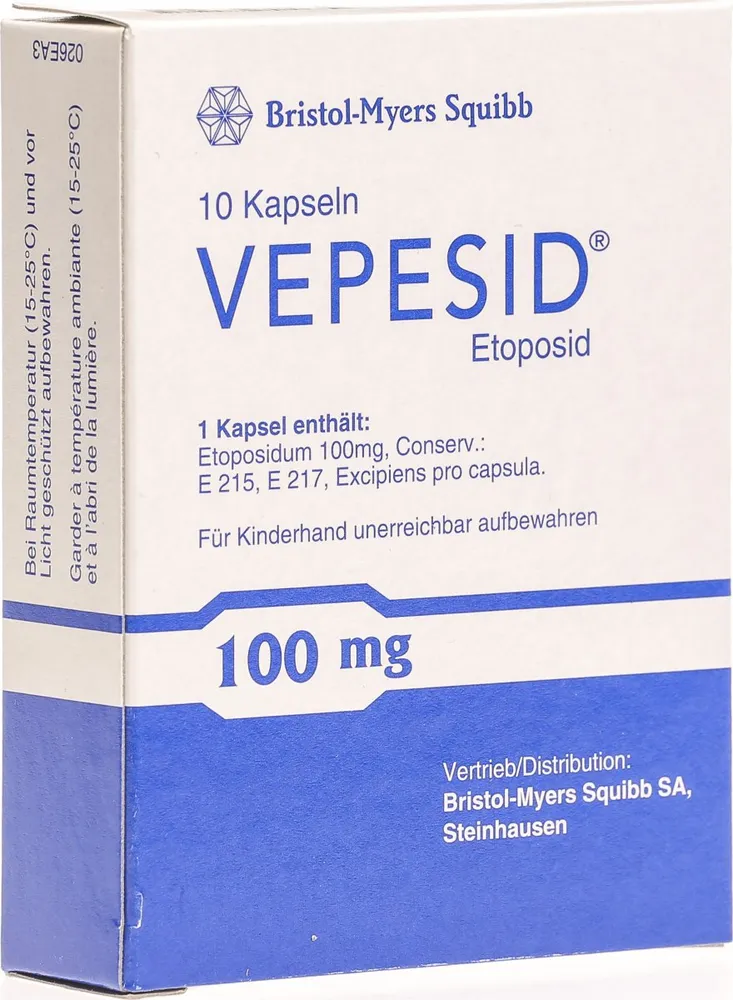
Table of Contents
Patient Information Leaflet
Introduction
Package leaflet: Information for the patient
Vepesid 100 mg soft capsules
Etoposide
Read the entire leaflet carefully before you start taking this medicine because it contains important information for you.
- Keep this leaflet, as you may need to read it again.
- If you have any questions, ask your doctor or pharmacist.
- This medicine has been prescribed for you only and must not be given to other people, even if they have the same symptoms as you, because it could harm them.
- If you experience any side effects, consult your doctor or pharmacist, even if the side effects are not listed in this leaflet (see section 4).
Leaflet contents
- What Vepesid is and what it is used for
- What you need to know before taking Vepesid
- How to take Vepesid
- Possible side effects
- How to store Vepesid
- Contents of the pack and other information
1. What Vepesid is and what it is used for
The name of this medicine is Vepesid. Each capsule contains 100 mg of etoposide as the active substance.
Etoposide belongs to a group of medicines called cytostatics, which are used in the treatment of cancer.
Vepesid is used in the treatment of certain types of cancer in adults:
- testicular cancer
- small cell lung cancer
- blood cancer (acute myeloid leukemia)
- tumor of the lymphatic system (Hodgkin's lymphoma, non-Hodgkin's lymphoma)
- ovarian cancer
You should discuss with your doctor the exact reason why Vepesid capsules have been prescribed for you.
2. What you need to know before starting to take Vepesid
Do not take Vepesid
-
- if you are allergic to the active substance, sodium ethyl parahydroxybenzoate (E-215), sodium propyl parahydroxybenzoate (E-217), or to any of the other ingredients of this medicine (listed in section 6).
-
- if you have recently received a vaccine containing live viruses, including the yellow fever vaccine.
-
- if you are breastfeeding or planning to breastfeed.
If any of the above applies to you, or if you are unsure whether it does, consult your doctor, who can advise you.
Warnings and precautions
Talk to your doctor or pharmacist before starting to take Vepesid
- if you have any infection.
- if you have recently received radiotherapy or chemotherapy.
- if you have low levels of a protein called albumin in your blood.
- if you have liver or kidney problems.
Effective anticancer treatment can rapidly destroy large numbers of cancer cells. Very rarely, this may lead to the release of harmful amounts of these cancer cells into the bloodstream. In such cases, this may cause problems in the liver, kidneys, heart, or blood, which could be fatal if not treated.
To prevent this, your doctor must carry out regular blood tests to monitor the levels of these substances during treatment with this medicine.
This medicine may reduce the number of certain blood cells, which could make you more susceptible to infections or impair your blood's ability to clot properly if you are cut. To ensure this does not happen, you will have blood tests at the beginning of treatment and before each dose.
If you have reduced liver or kidney function, your doctor may also want you to have regular blood tests to monitor these levels.
Children and adolescents
The safety and efficacy of this medicine in pediatric patients have not been established.
Other medicines and Vepesid
Inform your doctor if you are taking, have recently taken, or might take any other medicines.
This is especially important
- if you are taking a medicine called cyclosporine (used to reduce the activity of the immune system).
- if you are receiving treatment with cisplatin (a medicine used to treat cancer).
- if you are taking phenytoin or any other medicine used for epilepsy.
- if you are taking warfarin (a medicine used to prevent blood clots).
- if you have recently received any vaccine containing live viruses.
- if you are taking phenylbutazone, sodium salicylate, or acetylsalicylic acid.
- if you are taking any anthracycline (a group of medicines used to treat cancer).
- if you are taking any medicine with a mechanism of action similar to Vepesid.
Pregnancy, breastfeeding and fertility
If you are pregnant, breastfeeding, think you may be pregnant, or plan to become pregnant, consult your doctor or pharmacist before using this medicine.
You must not use Vepesid during pregnancy unless clearly indicated by your doctor.
You must not breastfeed while taking Vepesid.
Male and female patients of reproductive age must use an effective contraceptive method (e.g., barrier method or condom) during treatment and for at least 6 months after completion of treatment with Vepesid.
Male patients treated with Vepesid are advised not to father a child during treatment and for 6 months after treatment ends. In addition, men are advised to seek counseling regarding sperm preservation before starting treatment.
Patients of both sexes who are considering having a child after treatment with Vepesid should discuss this with their doctor or nurse.
Driving and using machines:
No studies have been performed on the effects on the ability to drive and use machines. However, if you feel tired, nauseous, dizzy, or drowsy, you should not drive or operate machinery until you have discussed this with your doctor.
Vepesid contains
Vepesid may cause allergic reactions (possibly delayed) because it contains sodium ethyl parahydroxybenzoate (E-215) and sodium propyl parahydroxybenzoate (E-217).
This medicine contains less than 1 mmol of sodium (23 mg) per soft capsule; i.e., it is essentially "sodium-free".
3. How to take Vepesid
Follow exactly the instructions for administration of this medicine given by your doctor or pharmacist. If you are unsure, consult your doctor or pharmacist again.
The dose you will receive will be specific to you and will be calculated by your doctor. The usual dose is between 100 and 200 mg/m² of body surface area, daily for 5 consecutive days, or 200 mg/m² of body surface area on days 1, 3, and 5. The daily dose may sometimes be divided and taken in the morning and at night. This treatment cycle may be repeated later depending on blood test results, but not sooner than 21 days after the first treatment cycle.
An alternative regimen sometimes used is 50 mg/m² of body surface area daily for 2 or 3 weeks. This treatment cycle may then be repeated depending on blood test results, but not sooner than 7 days after the first treatment cycle.
On some occasions, your doctor may prescribe a different dose, especially if you have kidney problems.
The capsules must be taken with a glass of water and on an empty stomach.
If you take more Vepesid than you should
If you take too many capsules, go immediately to the nearest hospital emergency department or contact your doctor immediately. Take the empty packaging and any remaining capsules with you.
In case of overdose or accidental ingestion, contact the Toxicology Information Service. Telephone 91 562 04 20.
If you forget to take Vepesid
If you miss or forget a dose of this medicine, DO NOT WORRY; take the next dose at the scheduled time. DO NOT take a double dose to make up for the missed dose.
If you have any further questions about the use of this medicine, ask your doctor or pharmacist.
4. Possible adverse effects
Like all medicines, this medicine can cause adverse effects, although not everyone will experience them.
Stop taking the medicine and inform your doctor immediately if you experience any of the following symptoms: swelling of the tongue or throat, difficulty breathing, rapid heartbeat, skin flushing, or rash. These could be signs of a severe allergic reaction.
Occasionally, serious damage to the liver, kidneys, or heart has been observed due to a disorder called tumor lysis syndrome, which is caused by harmful amounts of substances from cancer cells entering the bloodstream when Vepesid is taken together with other drugs used to treat cancer.
Other adverse effects experienced with Vepesid
Very common adverse effects (affecting more than 1 in 10 people)
|
|
|
|
|
|
|
|
Frequent adverse effects (affecting between 1 in 10 and 1 in 100 people)
|
|
|
|
|
|
Uncommon adverse effects (affecting between 1 in 100 and 1 in 1,000 people)
- tingling or numbness in the hands and feet
Rare adverse effects (affecting between 1 in 1,000 and 1 in 10,000 people)
|
|
|
|
|
|
Frequency not known (cannot be estimated from the available data)
|
|
|
|
|
|
|
|
Reporting of adverse reactions
If you experience adverse reactions, consult your doctor or pharmacist, even if they are possible adverse reactions not listed in this leaflet. You can also report them directly through the Spanish Pharmacovigilance System for Human Medicines: https://www.notificaram.es. By reporting adverse reactions, you can help provide more information on the safety of this medicine.
5. Storage of Vepesid
Keep this medicine out of the sight and reach of children.
Do not use this medicine after the expiry date stated on the carton and blister after EXP. The expiry date refers to the last day of the month indicated.
Do not store above 25 °C. Keep in the original packaging.
Do not use any blister or bottle showing signs of leakage from the capsule contents.
As with all medicines used to treat cancer, caution must be exercised when handling Vepesid capsules and associated trade names. Avoid direct contact with the capsules by wearing gloves, and wash your hands thoroughly with soap and water after handling the medicine.
Medicines must not be disposed of via wastewater or household waste. Return unused containers and medicines to your pharmacy’s SIGRE collection point. If in doubt, ask your pharmacist how to dispose of containers and medicines you no longer need. This will help protect the environment.
6. Contents of the pack and other information
Composition of Vepesid
- The active substance is etoposide. Each capsule contains 100 mg of etoposide.
- The other components are: anhydrous citric acid (E330), glycerol (85 percent) (E422), macrogol 400 (E1521) and water. The capsule shell contains gelatin (E441), glycerol (85 percent) (E422), iron oxide red (E172), sodium ethyl parahydroxybenzoate (E215), sodium propyl parahydroxybenzoate (E217) and titanium dioxide (E171).
Appearance of Vepesid and contents of the pack
Opaque pink, soft gelatin capsules.
The 100 mg capsules are available in PVC/aluminum blisters, packs of 10 soft gelatin capsules.
Marketing Authorization Holder and Manufacturer
Marketing Authorization Holder
CHEPLAPHARM Arzneimittel GmbH
Ziegelhof 24
17489 Greifswald
Germany
Manufacturer
Latina Pharma S.p.A.
Via del Murillo No. 7
04013 Sermoneta
Latina, Italy
Or
CHEPLAPHARM Arzneimittel GmbH
Ziegelhof 23-24
17489 Greifswald
Germany
Local Representative
Laboratorios Rubió, S.A.
C/ Industria, 29 - Pol. Ind. Comte de Sert
08755 Castellbisbal (Barcelona)
Spain
This medicinal product is authorized in the Member States of the European Economic Area and in the United Kingdom (Northern Ireland) under the following names:
Germany: Vepesid K
Austria, Belgium, Estonia, Ireland, Italy, Netherlands, Luxembourg, Romania, Spain: Vepesid
United Kingdom (Northern Ireland): Etoposide
Date of the most recent revision of this leaflet: January 2024.
"Detailed and up-to-date information on this medicinal product is available on the website of the Spanish Agency for Medicines and Health Products (AEMPS) http://www.aemps.gob.es/"